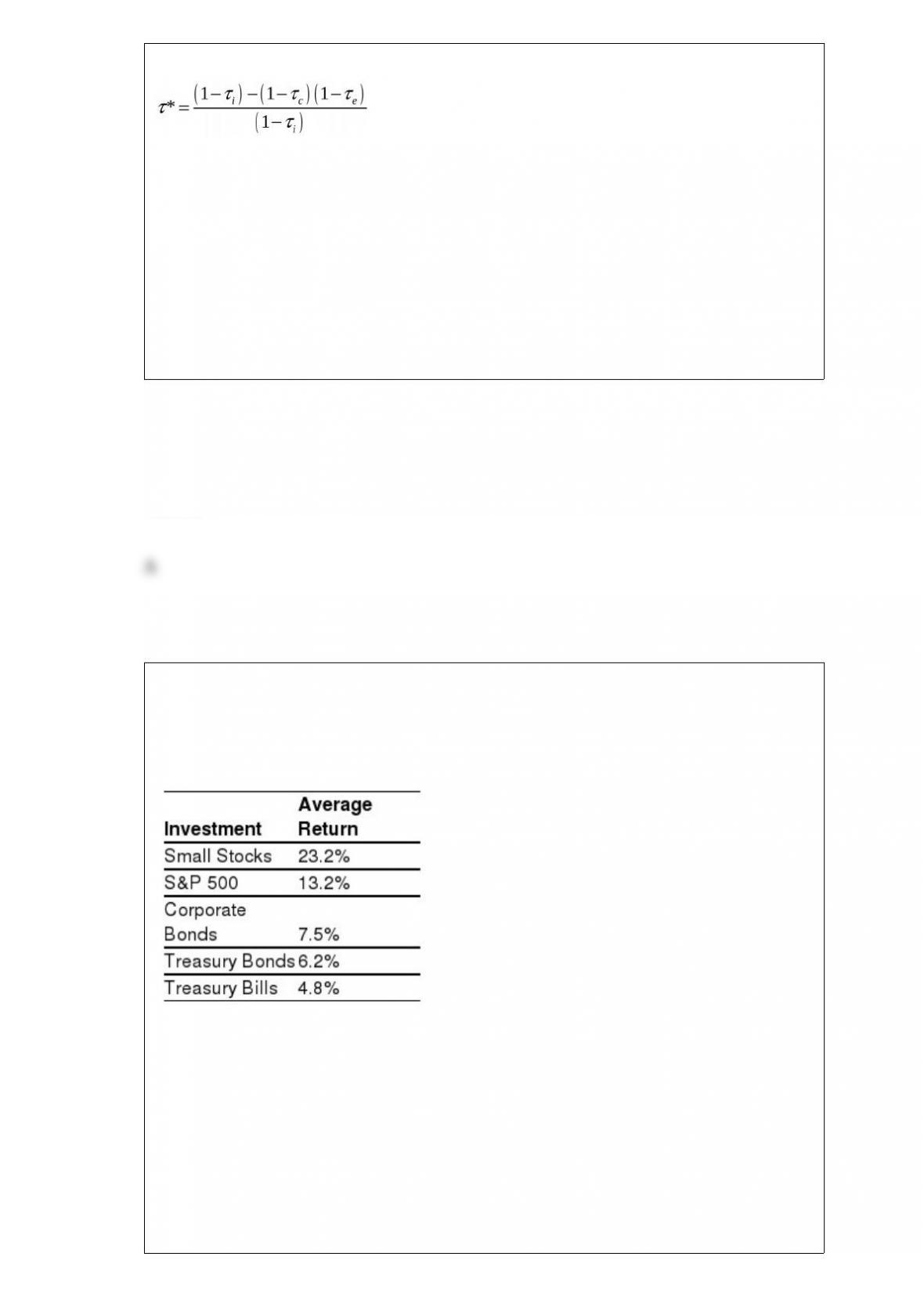
Consider the following formula:
The term τ* is
A) the effective tax advantage of debt.
B) the effective personal tax rate on interest income.
C) the effective personal tax rate on equity.
D) the effective corporate tax rate on income.
Answer:
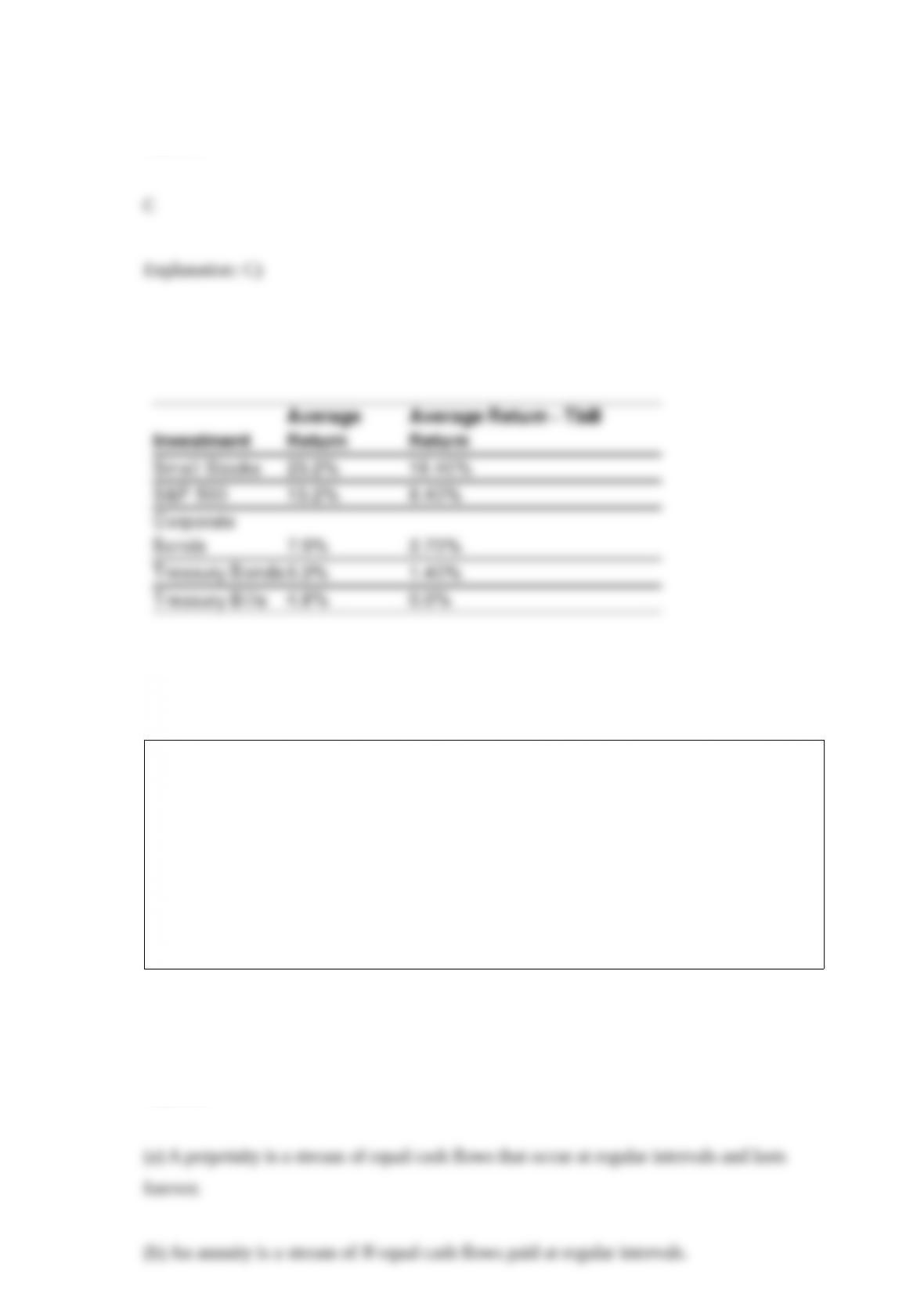
Use the table for the question(s) below.
Consider the following average annual returns:
What is the excess return for the portfolio of small stocks?
A) 10.0%
B) 15.7%
C) 18.4%
D) 17.0%
Answer:
Define the following terms:
(a) perpetuity
(b) annuity
(c) growing perpetuity
(d) growing annuity
Answer:

Which of the following is true of asset betas?
A) Asset betas are expected to vary greatly within firms in the same industry.
B) Businesses that are less sensitive to market and economic conditions tend to have
higher asset betas than more cyclical industries.
C) Businesses that are less sensitive to market and economic conditions tend to have
lower asset betas than more cyclical industries.
D) A and B are correct.
Answer:
Which of the following statements is false?
A) Investors can alter the leverage choice of the firm to suit their personal tastes either
by borrowing and reducing leverage or by holding bonds and adding more leverage.
B) On the market value balance sheet the total value of all securities issued by the firm
must equal the total value of the firm’s assets.
C) The market value balance sheet captures the idea that value is created by a firm’s
choice of assets and investments.
D) One application of MM Proposition I is the useful device known as the market value
balance sheet of the firm.

Answer:
Use the information for the question(s) below.
Your firm faces an 8% chance of a potential loss of $50 million next year. If your firm
implements new safety policies, it can reduce the chance of this loss to 3%, but the new
safety policies have an upfront cost of $250,000. Suppose that the beta of the loss is 0
and the risk-free rate of interest is 5%.
If your firm is uninsured, the NPV of implementing the new safety policies is closest to:
A) $2.25 million
B) -$.25 million
C) $2.5 million
D) $2.15 million
Answer:

Use the information for the question(s) below.
You are in the process of purchasing a new automobile that will cost you $27,500. The
dealership is offering you either a $2,500 rebate (applied toward the purchase price) or
1.9% financing for 48 months (with payments made at the end of the month). You have
been pre-approved for an auto loan through your local credit union at an interest rate of
6.5% for 48 months.
If you take the $2,500 rebate and finance your new car through your credit union your
monthly payments will be closest to:
A) $520
B) $573
C) $593
D) $799
Answer:

Use the information for the question(s) below.
Von Bora Corporation is expected pay a dividend of $1.40 per share at the end of this
year and a $1.50 per share at the end of the second year. You expect Von Bora’s stock
price to be $25.00 at the end of two years. Von Bora’s equity cost of capital is 10%
Suppose you plan to hold Von Bora stock for only one year. Your capital gain from
holding Von Bora stock for the first year is closest to:
A) $0.95
B) $1.40
C) $1.85
D) $1.25
Answer:
Which of the following statements is false?
A) The WACC can be used throughout the firm as the company wide cost of capital for
new investments that are of comparable risk to the rest of the firm and that will not alter
the firm’s debt-equity ratio.
B) A disadvantage of the WACC method is that you need to know how the firm’s

leverage policy is implemented to make the capital budgeting decision.
C) The intuition for the WACC method is that the firm’s weighted average cost of
capital represents the average return the firm must pay to its investors (both debt and
equity holders) on an after-tax basis.
D) To be profitable, a project should generate an expected return of at least the firm’s
weighted average cost of capital.
Answer:
Use the information for the question(s) below.
Big Cure and Little Cure are both pharmaceutical companies. Big Cure presently has a
potential “blockbuster” drug before the Food and Drug Administration (FDA) waiting
for approval. If approved, Big Cure’s blockbuster drug will produce $1 billion in net
income for Big Cure. Little Cure has 10 separate less important drugs before the FDA
waiting for approval. If approved, each of Little Cure’s drugs would produce $100
million in net income for Little Cure. The probability of the FDA approving a drug is
50%.
What is the expected payoff for Big Cure’s Blockbuster drug?
A) $100 million
B) $0
C) $1 billion
D) $500 million
Answer:
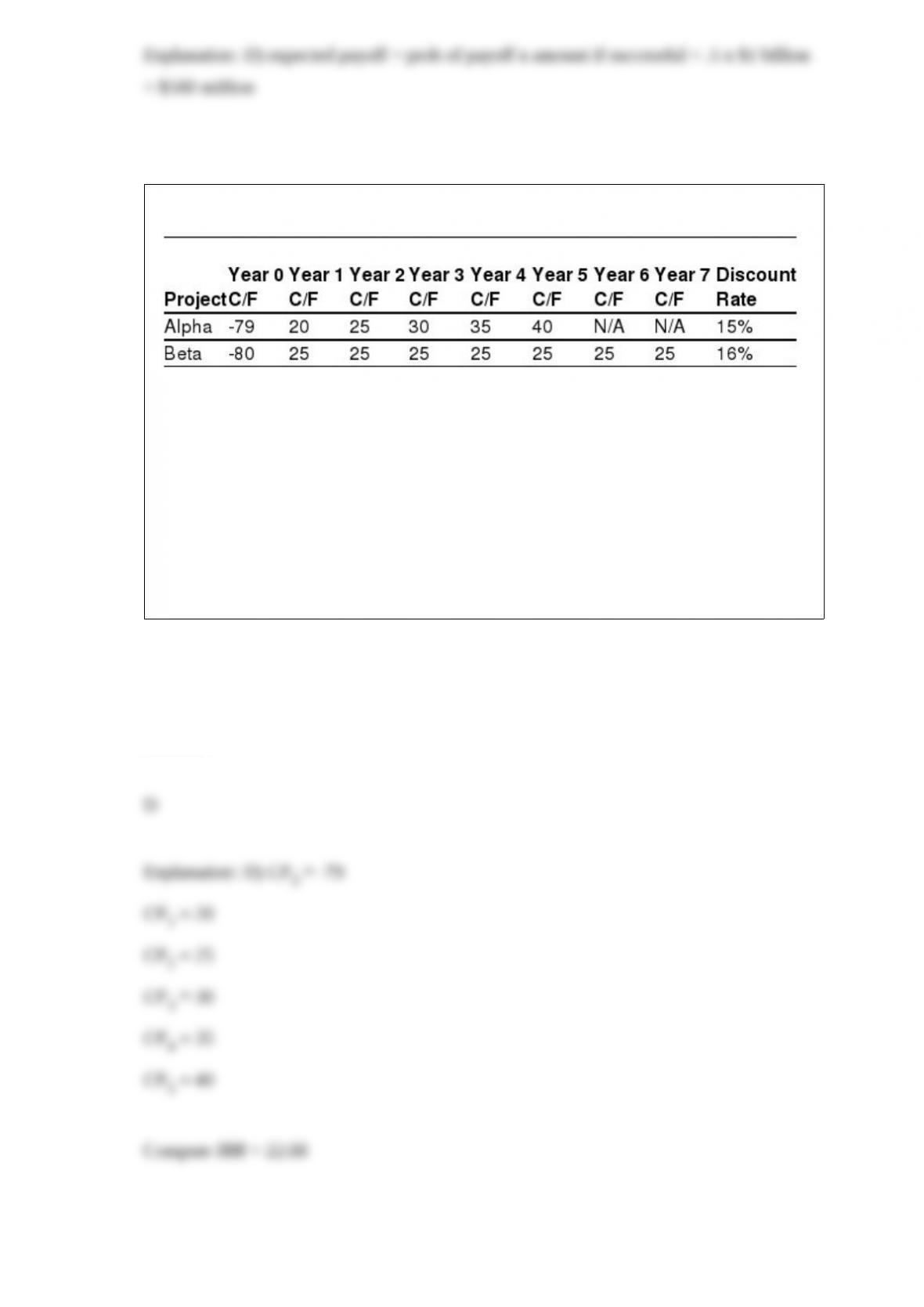
Consider the following two projects:
The internal rate of return (IRR) for project Alpha is closest to:
A) 25.0%
B) 22.2%
C) 24.5%
D) 22.7%
Answer:

What is the no-arbitrage price for security C?
A) $800
B) $1600
C) $3200
D) $4000
Answer:
Which of the following statements is false?
A) One study found that firms with fewer restrictions on shareholder power performed
worse than firms with more restrictions during the 1990s.
B) Some large public pension funds, such as CalPERS (the California Public
Employees Retirement System), take an activist role in corporate governance.
C) In 2004 with the Walt Disney Company, major shareholders were dissatisfied with
the recent performance of Disney under long-time CEO and Chairman, Michael Eisner.
They began an organized campaign to convince the majority of Disney shareholders to
withhold their approval of the reelection of Eisner as director and chairman of the
board.

D) Given the importance of shareholder action in corporate governance, researchers and
large investors alike have become increasingly interested in measuring the balance of
power between shareholders and managers in a firm.
Answer:
Use the information for the question(s) below.
Von Bora Corporation is expected pay a dividend of $1.40 per share at the end of this
year and a $1.50 per share at the end of the second year. You expect Von Bora’s stock
price to be $25.00 at the end of two years. Von Bora’s equity cost of capital is 10%
Suppose you plan to hold Von Bora stock for one year. The price one would expect to
be able to sell a share of Von Bora stock for in one year is closest to:
A) $26.50
B) $22.70
C) $23.15
D) $24.10
Answer:
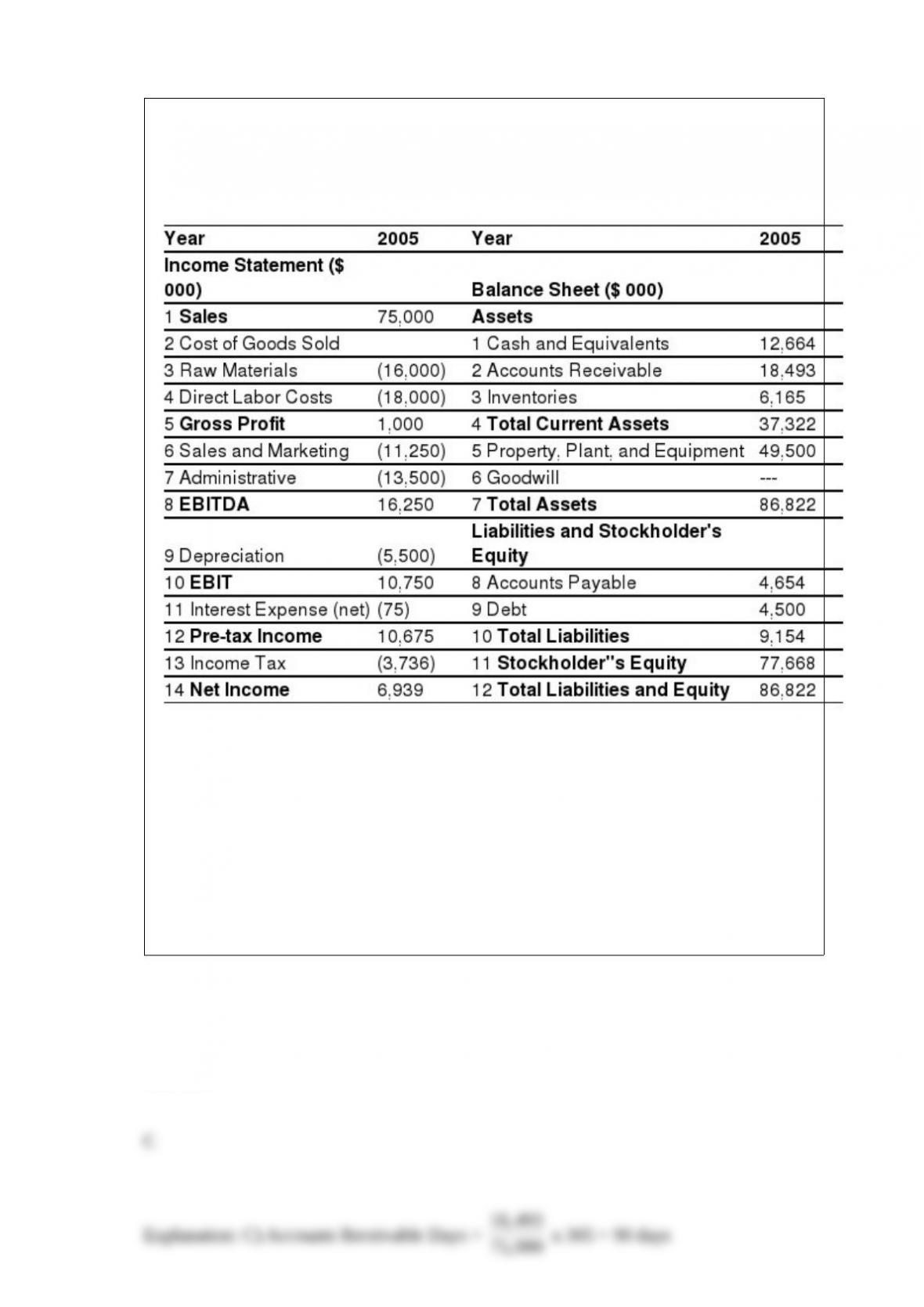
Use the tables for the question(s) below.
Estimated 2005 Income Statement and Balance Sheet Data for Ideko Corporation
Ideko’s Accounts Receivable Days is closest to:
A) 84 days
B) 95 days
C) 90 days
D) 75 days
Answer:

If a project has a higher proportion of fixed to variable costs, holding the risk of its
revenues constant
A) its beta will be lower, hence its cost of capital will be lower.
B) its beta will be higher, hence its cost of capital will be higher.
C) its beta will be unaffected, since beta does not measure the sensitivity of the project’s
cash flows to market risk.
D) its financial leverage will be higher.
Answer:
Which of the following statements is false?
A) Not all insurable risks have a beta of zero. Some risks, such as hurricanes and
earthquakes, create losses of tens of billions of dollars and may be difficult to diversify
completely.
B) When a firm buys insurance, it transfers the risk of the loss to an insurance company.
The insurance company charges an upfront premium to take on that risk.
C) By its very nature, insurance for non-diversifiable hazards is generally a positive
beta asset; the insurance payment to the firm tends to be largerwhen total losses are low
and the market portfolio is high.
D) Because insurance provides cash to the firm to offset losses, it can reduce the firm’s
need for external capital and thus reduce issuance costs.
Answer:

Which of the following statements regarding futures contracts is false?
A) Both the buyer and the seller can get out of the contract at any time by selling it to a
third party at the current market price.
B) Futures prices are not prices that are paid today. Rather, they are prices agreed
totoday, to be paid in the future.
C) Futures contracts are traded anonymously on an exchange at a publicly observed
market price and are generally very illiquid.
D) Traders are required to post collateral, called margin, when buying or selling
commodities using futures contracts.
Answer:
Which of the following statements is false?
A) The long-run growth rate gFCF is typically based on the expected long-run growth
rate of the firm’s revenues.
B) Because the firm’s free cash flow is equal to the sum of the free cash flows from the
firm’s current and future investments, we can interpret the firm’s enterprise value as the
total NPV that the firm will earn from continuing its existing projects and initiating new
ones.
C) If the firm has no debt then rwacc= the risk-free rate of return.
D) When using the discounted free cash flow model, we forecast the firm’s free cash

flow up to some horizon, together with some terminal (continuation) value of the
enterprise.
Answer:
What kind of corporate debt must be secured by real property?
A) Mortgage bonds
B) Notes
C) Asset-backed bonds
D) Debentures
Answer:
Use the table for the question(s) below.
Consider the following returns:
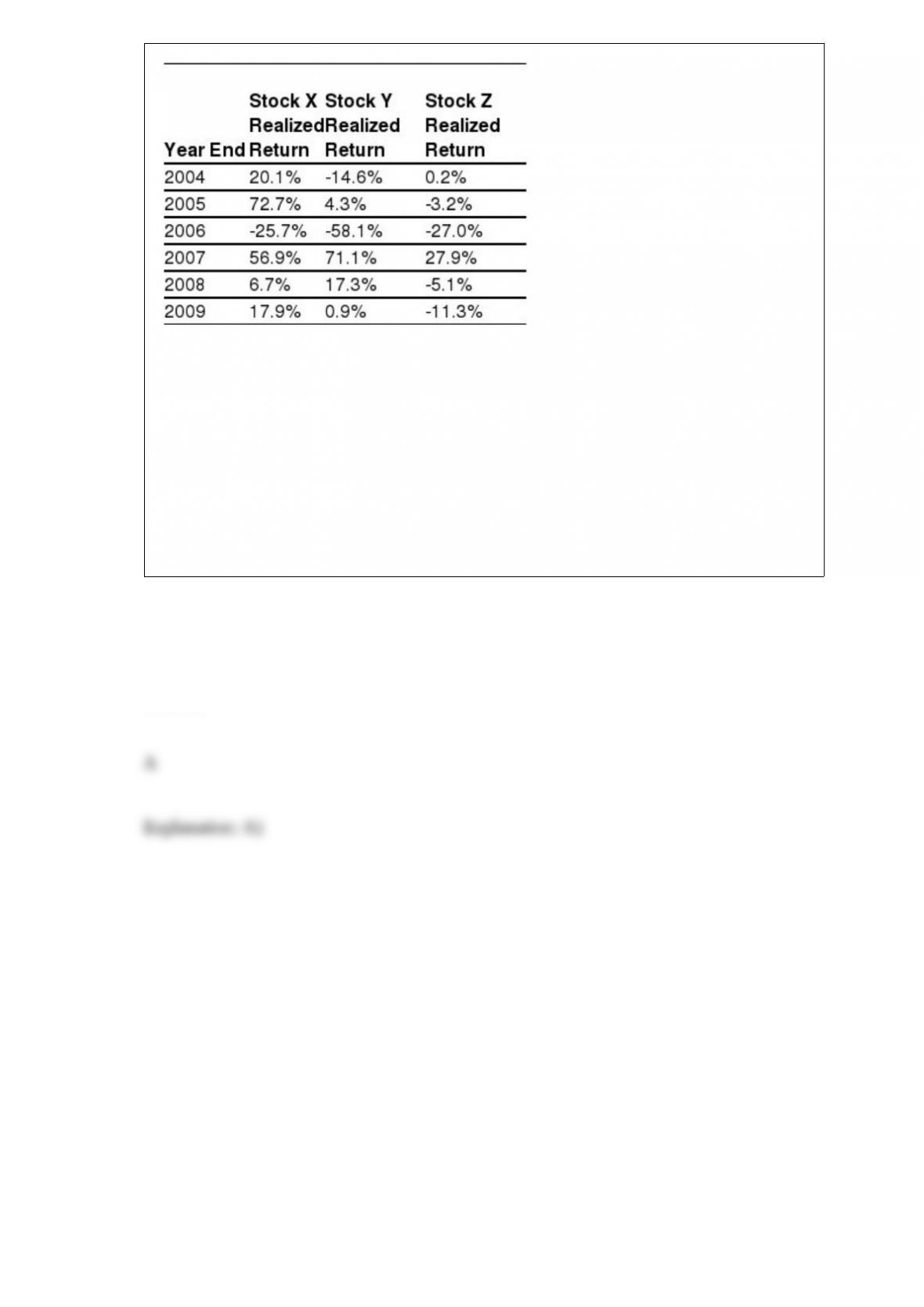
The Volatility on Stock X’s returns is closest to:
A) 35%
B) 10%
C) 13%
D) 42%
Answer:
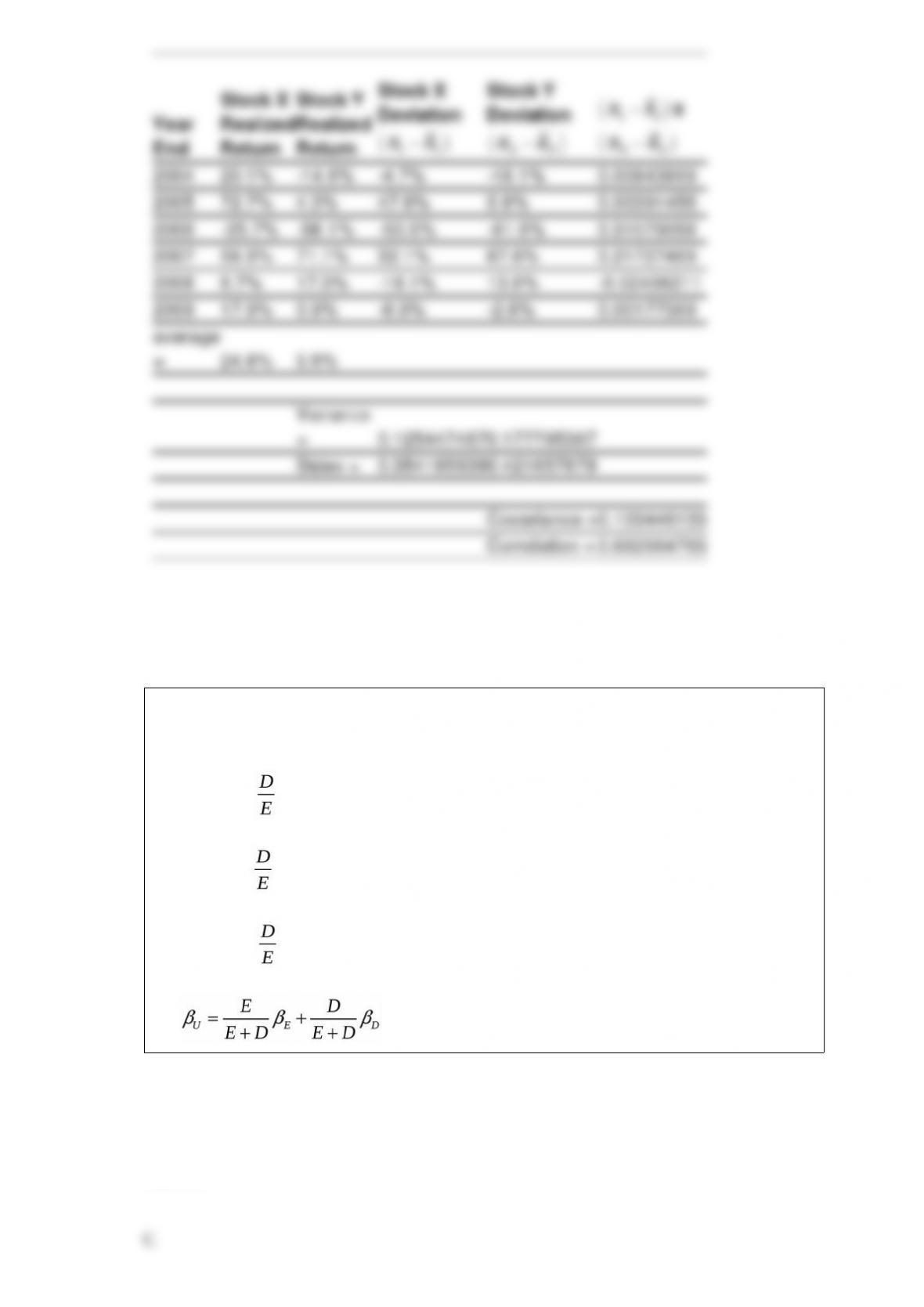
Which of the following equations would not be appropriate to use in a firm with risky
debt?
A) βE = βU+ (βU – βD)
B) βU = βE+ (βU – βD)
C) βE = βU + βU
D)
Answer:

Which of the following statements is false?
A) The United States is somewhat of an exception, in that it focuses solely on
maximizing shareholder welfare.
B) A controlling family has many opportunities to expropriate minority shareholders in
a pyramid structure.
C) One way for families to gain control over firms even when they do not own more
than half the shares is to issue dual class sharesa scenario in which companies have
more than one class of shares and one class has superior voting rights over the other
class.
D) Researchers have claimed that the degree of investor protection was largely
determined by the legal origin of the countryspecifically, whether its legal system was
based on British common law (less protection) or French, German, and Scandinavian
civil law (more protection).
Answer:
Use the following information to answer the question(s) below.
Suppose that the market portfolio is equally likely to increase by 24% or decrease by
8%. Security “X” goes up on average by 29% when the market goes up and goes down
by 11% when the market goes down. Security “Y” goes down on average by 16% when
the market goes up and goes up by 16% when the market goes down. Security “Z” goes
up on average by 4% when the market goes up and goes up by 4% when the market
goes down.
The expected return on security with a beta of 0 is closest to:

A) -4.0%
B) 0.0%
C) 3.2%
D) 4.0%
Answer:
Bonds issued by a local entity, denominated in the local currency, traded in a local
market, but purchased by foreigners are called
A) Domestic bonds.
B) Yankee bonds.
C) Eurobonds.
D) Foreign bonds.
Answer:
Risk neutral probabilities are also known as all of the following except
A) contingent probabilities.
B) state-contingent prices.
C) martingale prices.
D) state prices.
Answer:
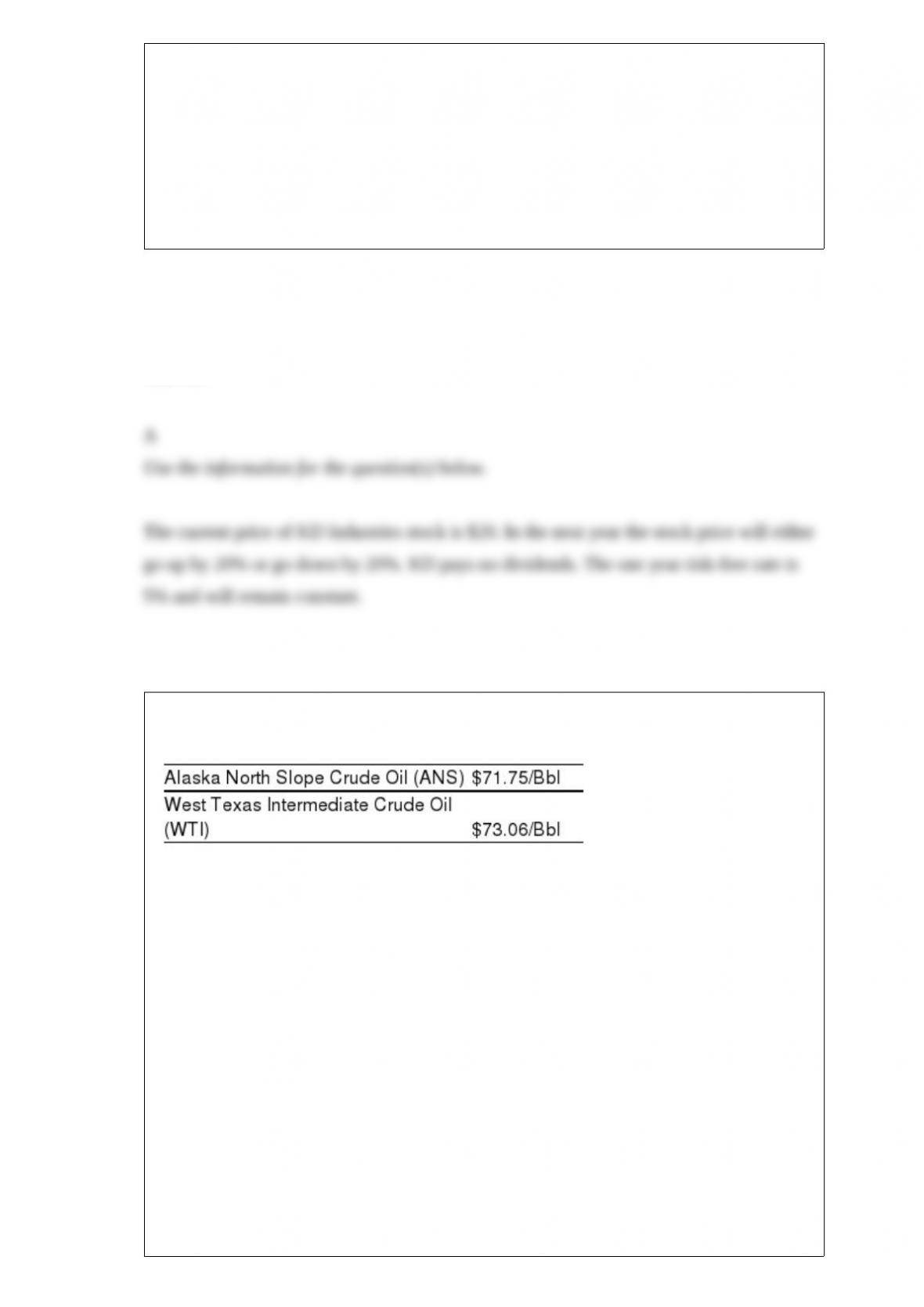
Use the information for the question(s) below.
As an oil refiner, you are able to produce $76 worth of unleaded gasoline from one
barrel of Alaska North Slope (ANS) crude oil. Because of its lower sulfur content, you
can produce $77 worth of unleaded gasoline from one barrel of West Texas
Intermediate (WTI) crude.
Another oil refiner is offering to trade you 10,150 Bbls of Alaska North Slope (ANS)
crude oil for 10,000 Bbls of West Texas Intermediate (WTI) crude oil. Assuming you
currently have 10,000 Bbls of WTI crude, the added benefit (cost) to you if you take the
trade is closest to:
A) ($1,400)
B) $1,400
C) ($3,908)

D) $3,908
Answer:
Which of the following statements is false?
A) We can estimate the value of a firm’s shares by multiplying its current earnings per
share by the average P/E ratio of comparable firms.
B) For valuation purposes, the trailing P/E ratio is generally preferred, since it is based
on actual not expected earnings.
C) Forward earnings are the expected earnings over the coming 12 months.
D) Trailing earnings are the earnings over the previous 12 months.

Answer:
Which of the following statements is false?
A) The process of moving a value or cash flow backward in time is known as
discounting.
B) FV =
C) The process of moving a value or cash flow forward in time is known as
compounding.
D) The value of a cash flow that is moved forward in time is known as its future value.
Answer:
Use the information for the question(s) below.
KT Enterprises, a U.S. import-export trading, is considering its international tax
situation. Currently KT is U.S. tax rate is 35%. KT has significant operations in both
Japan and Ireland. In Japan the current exchange rate is 118.4/$ and earnings in Japan
are taxed at 41%. In Ireland the current exchange rate is $1.27/€ and earnings in Ireland

are taxed at 12.5%. KT’s profits, which are fully and immediately repatriated, and
foreign taxes paid for the current year are shown here (in millions):
After the Japanese taxes are paid, the amount of the earnings before interest and after
taxes in dollars from the Japanese operations is closest to:
A) $20.5 million
B) $29.5 million
C) $5.1 million
D) $50.0 million
Answer:
Use the following information to answer the question(s) below.
Luther Industries has 25 million shares outstanding trading at $18 per share. In addition,
Luther has $150 million in outstanding debt. Suppose Luther’s equity cost of capital is
13%, its debt cost of capital is 7%, and the corporate tax rate is 40%.
Luther’s weighted average cost of capital is closest to:
A) 9.8%
B) 10.8%
C) 11.5%

D) 13.0%
Answer:
Which of the following statements is false?
A) In general, the difference between the cost of capital and the IRR is the maximum
amount of estimation error in the cost of capital estimate that can exist without altering
the original decision.
B) The IRR can provide information on how sensitive your analysis is to errors in the
estimate of your cost of capital.
C) If you are unsure of your cost of capital estimate, it is important to determine how
sensitive your analysis is to errors in this estimate.
D) If the cost of capital estimate is more than the IRR, the NPV will be positive.
Answer: