
Consider the following two projects:
The payback period for project Alpha is closest to:
A) 3.2 years
B) 2.9 years
C) 3.1 years
D) 2.6 years
Answer:
Use the following information to answer the question(s) below.
Suppose that you have received two job offers. Rearden Metal offers you a contract for
$75,000 per year for the next two years while Wyatt Oil offers you a contract for
$90,000 per year for the next two years. Both jobs are equivalent. Suppose that Rearden
Metal’s contract is certain, but Wyatt Oil has a 60% chance of going bankrupt at the end
of the year. In the event that Wyatt Oil files for bankruptcy, it will cancel your contract
and pay you the lowest amount possible for you to not quit. If you do quit, you expect
you could find an new job paying $75,000 per year, but you would be unemployed for
four months while searching for this new job.

Assuming your cost of capital is 6 percent, based on the present value of your expected
wage you should
A) accept Rearden’s offer since the PV of your expected wage would be approximately
$6,000 higher.
B) accept Rearden’s offer since the PV of your expected wage would be approximately
$8,000 lower.
C) accept Rearden’s offer since the PV of your expected wage would be approximately
$8,000 higher.
D) accept Wyatt’s offer since the PV of your expected wage would be approximately
$6,000 higher.
Answer:
Rearden Metals is considering opening a strip mining operation to provide some of the
raw materials needed in producing Rearden metal. The initial purchase of the land and
the associated costs of opening up mining operations will cost $100 million today. The
mine is expected to generate $16 million worth of ore per year for the next 12 years. At
the end of the 12th year Rearden will need to spend $20 million to restore the land to its
original pristine nature appearance.
One of the IRR for Rearden’s mining operation is closest to:

A) 0%
B) 10.6%
C) 12.4%
D) 72.0%
Answer:
Use the information for the question(s) below.
Suppose that the risk-free rate is 5% and the market portfolio has an expected return of
13% with a volatility of 18%. Monsters Inc. has a 24% volatility and a correlation with
the market of .60, while California Gold Mining has a 32% volatility and a correlation
with the market of -.7. Assume the CAPM assumptions hold.
California Gold Mining’s beta with the market is closest to:
A) 0.9
B) 1.25
C) -0.9
D) -1.25
Answer:

Which of the following statements is false?
A) The Law of One Price implies that leverage will affect the total value of the firm
under perfect capital market conditions.
B) In the absence of taxes or other transaction costs, the total cash flow paid out to all
of a firm’s security holders is equal to the total cash flow generated by the firm’s assets.
C) With perfect capital markets, leverage merely changes the allocation of cash flows
between debt and equity, without altering the total cash flows of the firm.
D) In a perfect capital market, the total value of a firm is equal to the market value of
the total cash flows generated by its assets and is not affected by its choice of capital
structure.
Answer:
Use the information for the question(s) below.
Flagstaff Enterprises expected to have free cash flow in the coming year of $8 million,
and this free cash flow is expected to grow at a rate of 3% per year thereafter. Flagstaff
has an equity cost of capital of 13%, a debt cost of capital of 7%, and it is in the 35%
corporate tax bracket.
If Flagstaff currently maintains a .5 debt to equity ratio, then Flagstaff’s after-tax WACC

is closest to:
A) 10.00%
B) 10.25%
C) 9.50%
D) 8.75%
Answer:
Which of the following statements is false?
A) For a lease to be attractive to both the lessee and the lessor, the gains must come
from some underlying economic benefits that the leasing arrangement provides.
B) With a true tax lease, the lessor replaces depreciation and interest tax deductions
with a deduction for the lease payments.
C) Generally speaking, if the asset’s tax depreciation deductions are more rapid than its
lease payments, a true tax lease is advantageous if the lessor is in a higher tax bracket
than the lessee.
D) A tax gain occurs if the lease shifts the more valuable deductions to the party with
the higher tax rate.
Answer:

Use the information for the question(s) below.
Monsters Incorporated (MI) in ready to launch a new product. Depending upon the
success of this product, MI will have a value of either $100 million, $150 million, or
$191 million, with each outcome being equally likely. The cash flows are unrelated to
the state of the economy (i.e. risk from the project is diversifiable) so that the project
has a beta of 0 and a cost of capital equal to the risk-free rate, which is currently 5%.
Assume that the capital markets are perfect.
Suppose that MI has zero-coupon debt with a $125 million face value due next year.
The total value of MI with leverage is closest to:
A) $133 million
B) $140 million
C) $147 million
D) $125 million
Answer:

Which of the following statements is false?
A) Individuals in the highest tax brackets have a preference for stocks that pay high
dividends, whereas tax-free investors and corporations have a preference for stocks
with no or low dividends.
B) To compare investor preferences, we must quantify the combined effects of dividend
and capital gains taxes to determine an effective dividend tax rate for an investor.
C) The dividend-capture theory states that absent transaction costs, investors can trade
shares at the time of the dividend so that non-taxed investors receive the dividend.
D) Differences in tax preferences create clientele effects, in which the dividend policy
of a firm is optimized for the tax preference of its investor clientele.
Answer:
Which of the following statements is false?
A) Investors may have different information regarding expected returns, correlations,
and volatilities, but they correctly interpret that information and the information
contained in market prices and they adjust their estimates of expected returns in a
rational way.
B) Investors may learn different information through their own research and
observations, but as long as they understand the differences in information and learn
from other investors by observing prices, the CAPM conclusions still stand.
C) Every investor, regardless of how much information he has access to, can guarantee
himself an alpha of zero by holding the market portfolio.
D) The CAPM requires making the strong assumption of homogeneous expectations.
Answer:
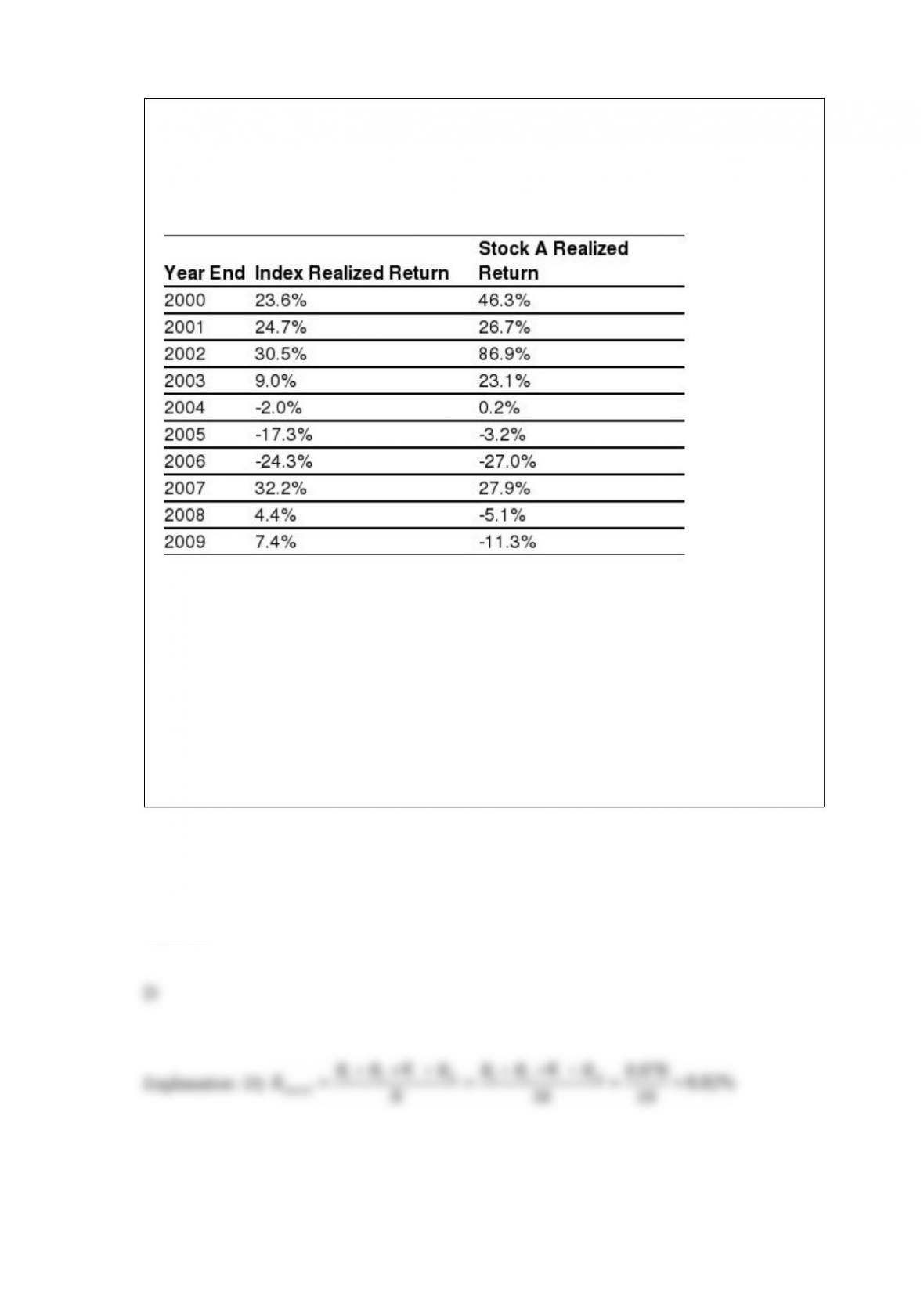
Use the table for the question(s) below.
Consider the following realized annual returns:
The average annual return on the Index from 2000 to 2009 is closest to:
A) 7.10%
B) 4.00%
C) 9.75%
D) 8.75%
Answer:

You own a bond with a face value of $1,000 and a conversion ratio of 45. The
conversion price is closest to:
A) $18
B) $22
C) $45
D) $1,000
Answer:
The largest sector of the asset-backed security market is the ________ market.
A) collateralized debt obligation
B) mortgage-backed security
C) real property-backed security
D) double-barreled security
Answer:
Consider the following two projects:

The NPV of project A is closest to:
A) 12.0
B) 12.6
C) 15.0
D) 42.9
Answer:
Use the information for the question(s) below.
You own your own firm and you need to raise $50 million to fund an expansion.
Following the expansion, your firm will be worth $75 million in its unlevered form.
You want to go ahead with the expansion, but you are concerned that you may not be
able to maintain ownership of over 50% of your firm’s equity. In other words, you are
concerned that if you use equity to finance the expansion, you may loose control of
your firm.
Assume that capital markets are perfect, you issue $30 million in new debt, and you
issue $20 million in new equity. You ownership stake in the firm following these new
issues of debt and equity is closest to:
A) 58%

B) 50%
C) 33%
D) 55%
Answer:
Use the information for the question(s) below.
Consider a project with free cash flows in one year of $90,000 in a weak economy or
$117,000 in a strong economy, with each outcome being equally likely. The initial
investment required for the project is $80,000, and the project’s cost of capital is 15%.
The risk-free interest rate is 5%.
Suppose that to raise the funds for the initial investment the firm borrows $40,000 at the
risk free rate and issues new equity to cover the remainder. In this situation, the cash
flow that equity holders will receive in one year in a weak economy is closest to:
A) $90,000
B) $0
C) $50,000
D) $48,000

Answer:
Which of the following statements is false?
A) The more cash the firm uses to repurchase shares, the less it has available to pay
dividends.
B) Free cash flow measures the cash generated by the firm after payments to debt or
equity holders are considered.
C) We estimate a firm’s current enterprise value by computing the present value of the
firm’s free cash flow.
D) We can interpret the enterprise value as the net cost of acquiring the firm’s equity,
taking its cash and paying off all debts.
Answer:
Suppose a five- year bond with a 7% coupon rate and semiannual compounding is
trading for a price of $951.58. Expressed as an APR with semiannual compounding,
this bonds yield to maturity (YTM) is closest to:
A) 7.0%
B) 7.5%
C) 7.8%
D) 8.2%
Answer:
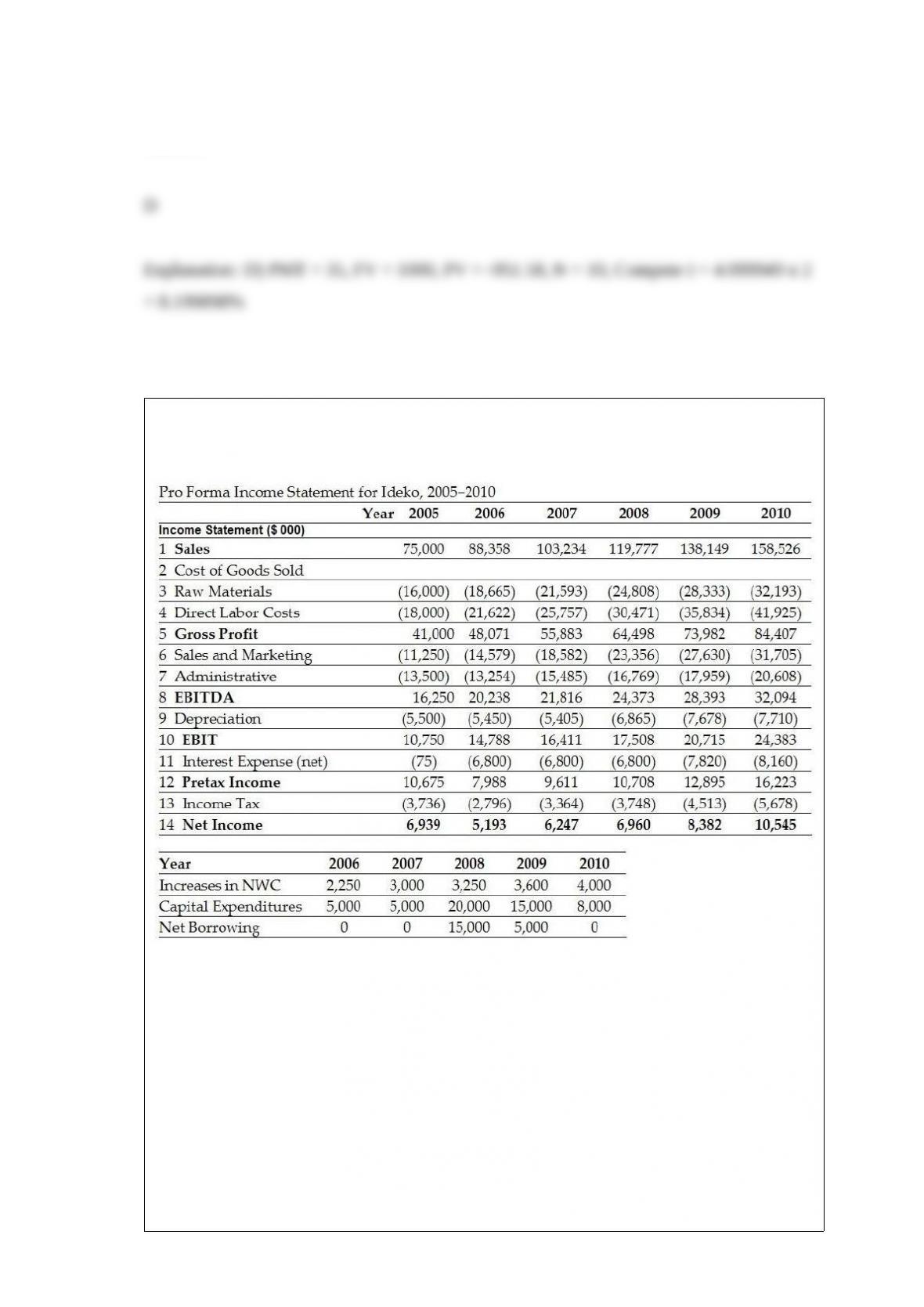
Use the following information to answer the question(s) below:
The free cash flow to the firm in 2008 is closest to:
A) -5,005
B) -1,755
C) 5,575
D) 14,995
E) 18,245

Answer:
The merger of two companies in the same industry that make products required at
different stages of the production cycle is called
A) economies of scope.
B) vertical integration.
C) economies of scale.
D) horizontal integration.
Answer:
Which of the following statements is false?
A) To determine the project’s debt capacity for the interest tax shield calculation, we

need to know the value of the project.
B) To compute the present value of the interest tax shield, we need to determine the
appropriate cost of capital.
C) Because we don”t value the tax shield separately, with the APV method we need to
include the benefit of the tax shield in the discount rate as we do in the WACC method.
D) A target leverage ratiomeans that the firm adjusts its debt proportionally to the
project’s value or its cash flows.
Answer:
Which of the following statements is false?
A) The prime rateis the rate banks charge other banks.
B) With a variable interest rate, the terms of the loan may indicate that the rate will vary
with some spread relative to a benchmark rate, such as the yield on one-year Treasury
securities or the prime rate.
C) With a discount loan, the borrower is required to pay the interest at the beginning of
the loan period.
D) A common benchmark rate is the London Inter-Bank Offered Rate, or LIBOR,
which is the rate of interest at which banks borrow funds from each other in the London
inter bank market.
Answer:

Which of the following statements is false?
A) The total payout model allows us to ignore the firm’s choice between dividends and
share repurchases.
B) By repurchasing shares, the firm increases its share count, which decreases its
earning and dividends on a per-share basis.
C) The total payout model discounts the total payouts that the firm makes to
shareholders, which is the total amount spent on both dividends and share repurchases.
D) In the dividend discount model we implicitly assume that any cash paid out to the
shareholders takes the form of a dividend.
Answer:
Your son is about to start kindergarten in a private school. Currently, the tuition is
$12,000 per year, payable at the start of the school year. You expect annual tuition
increases to average 6% per year over the next 13 years. Assuming that you son remains
in this private school through high school and that your current interest rate is 6%, then
the present value of your son’s private school education is closest to:
A) $106,230
B) $156,000
C) $137,900
D) This problem cannot be solved
Answer:

Rearden Metal can invest in a risk-free technology that requires an up-front investment
of $1 million. Rearden’s managers are hesitant to invest because of uncertainty over
future interest rates. Suppose that all interest rates will be either 8% or 4% in one year
and remain there forever. The risk-neutral probability that interest rates will drop to 4%
is 40%. The one-year risk-free interest rate is 5% and today’s rate on a risk-free
perpetual bond is 6%. The rate on an equivalent perpetual bond that is repayable at any
time (the callable annuity rate) is 7.65%.
Assuming that this project will provide Rearden with perpetual annual cash flows of
$65,000, the NPV of investing in using the hurdle rate is closest to:
A) -281,000
B) -150,000
C) -83,000
D) +83,000
E) +281,000
Answer:

Use the following information to answer the question(s) below.
Galt Industries is expected to generate free cash flows of $24 million per year. Galt has
permanent debt of $80 million, a corporate tax rate of 40%, and an unlevered cost of
capital of 12% and its cost of debt capital is 6%.
The value of Galt’s equity using the WACC method is closest to:
A) $150 million
B) $180 million
C) $230 million
D) $240 million
Answer:

Suppose an investment is equally likely to have a 35% return or a – 20% return. The
expected return for this investment is closest to:
A) 7.5%
B) 15%
C) 5%
D) 10%
Answer:
A firm can repurchase shares through a(n) ________ in which it offers to buy shares at
a prespecified price during a short time periodgenerally within 20 days.
A) tender offer
B) open market share repurchases
C) targeted repurchase
D) Dutch auction share repurchase
Answer: