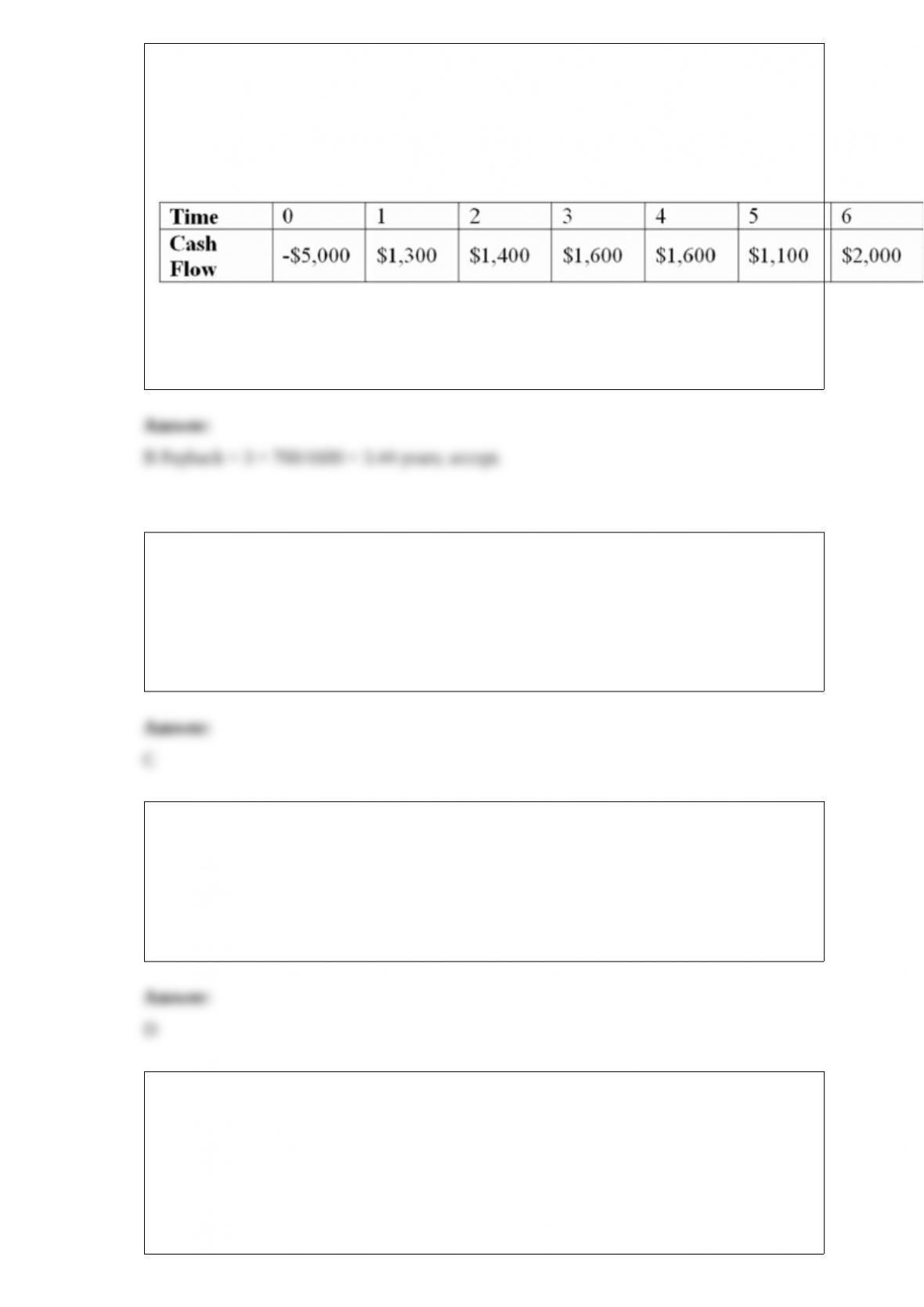
1) Suppose your firm is considering investing in a project with the cash flows shown
below, that the required rate of return on projects of this risk class is 8 percent, and that
the maximum allowable payback and discounted payback statistics for the project are
3.5 and 4.5 years, respectively. Use the payback decision to evaluate this project; should
it be accepted or rejected?
A.Payback = 4.44 years; reject
B.Payback = 3.44 years; accept
C.Payback = 3.54 years; reject
D.Payback = 3.24 years; reject
2) Regarding a bond’s characteristics, which of the following is the principal loan
amount that the borrower must repay?
A.call premium
B.maturity date
C.par or face value
D.time to maturity value
3) Which of these statements is false?
A.Bonds are more important capital sources than stocks for companies and
governments
B.Some bonds offer high potential for rewards and, consequently, higher risk
C.The bond market is larger than the stock market
D.Bonds are always less risky than stocks
4) You are trying to pick the least-expensive machine for your company. You have two
choices: machine A, which will cost $100,000 to purchase and which will have OCF of
-$7,000 annually throughout the machine’s expected life of three years; and machine B,
which will cost $125,000 to purchase and which will have OCF of -$2,600 annually
throughout that machine’s four-year life. Both machines will be worthless at the end of
their life. If you intend to replace whichever type of machine you choose with the same
thing when its life runs out, again and again out into the foreseeable future, and if your
business has a cost of capital of 15 percent, which one should you choose?
A.Machine A
B.Machine B
C.Both Machine A and B
D.Neither Machine A nor B
5) Convert each of the following indirect quotes to dollar direct quotes:
$1 = 805 Vietnam Dong
$1 = 2,349.6 Venezuelan Bolivar
$1 = 7.0523 South African Rand
$1 equals:
A.0.0012 Dong; 0.0004 Bolivar; 0.1418 Rand
B.0.0072 Dong; 0.004 Bolivar; 0.1418 Rand
C.0.0012 Dong; 0.004 Bolivar; 0.1478 Rand
D.0.0022 Dong; 0.0004 Bolivar; 0.1418 Rand
6) Asset Management and Profitability Ratios You have the following information on
Zip’s Diner, Inc.: sales to working capital = 8 times, profit margin = 5%, net income
available to common stockholders = $20 million, and current liabilities = $4 million.
What is the firm’s balance of current assets?
A.$4.125 m
B.$6.5 m
C.$46 m
D.$54 m
7) Goldilochs Inc. reported sales of $8 million and net income of $1.5 million. The firm
has $10.5 million in total assets and $1 million in current liabilities. The firm currently
pays out 75% of its net income to shareholders. Assume that all assets and current
liabilities are expected to grow with sales. If Goldilochs does not want to rely on any
external sources of funds, what is the most sales can grow (in dollars)?
A.$187,900
B.$299,900
C.$328,800
D.$364,100
8) Assume that you borrow $2000 from your sister and that you will pay her back in
one lump sum. She charges you 9% interest in year 1 and increases the rate by 1% per
year until the loan is paid off. How much will you owe if you wait until year 3 to pay
off the loan?
A.$2,467.91
B.$2,661.78
C.$2,775.23
D.$2,809.53
9) The reason that we do not use an after-tax cost of preferred stock is __________.
A.because preferred dividends are paid out of before-tax income
B.because most of the investors in preferred stock do not pay tax on the dividends
C.because we can only estimate the marginal tax rate of the preferred stockholders
D.None of these answers is correct

10) What is the present value of a $600 payment in one year when the discount rate is
8%?
A.$498.61
B.$525.87
C.$555.56
D.$575.09
11) You are evaluating two different cookie-baking ovens. The Pillsbury 707 costs
$25,000, has a six-year life, and has an annual OCF (after tax) of -$5,000 per year. The
Keebler CookieMunster costs $40,000, has a seven-year life, and has an annual OCF
(after tax) of -$500 per year. If your discount rate is 10 percent, what is each machine’s
EAC?
A.Pillsbury: -$11,594.94; Keebler: $8,716.22
B.Pillsbury: -$11,594.94; Keebler: -$9,145.62
C.Pillsbury: -$10,740.18; Keebler: -$9,145.62
D.Pillsbury: -$10,740.18; Keebler: -$8,716.22
12) If a firm starts selling its accounts receivable to a factor, how will the firm’s cash
cycle change?
A.The firm will increase its cash cycle since it will now have to wait longer for
payment
B.The firm will decrease its cash cycle since accounts receivable is reduced
C.Depending on conditions, the cash cycle could either increase or decrease
D.There will be no change
13) Suppose your firm is considering two independent projects with the cash flows
shown below. The required rate of return on projects of both of their risk class is 12
percent, and the maximum allowable payback and discounted payback statistic for the
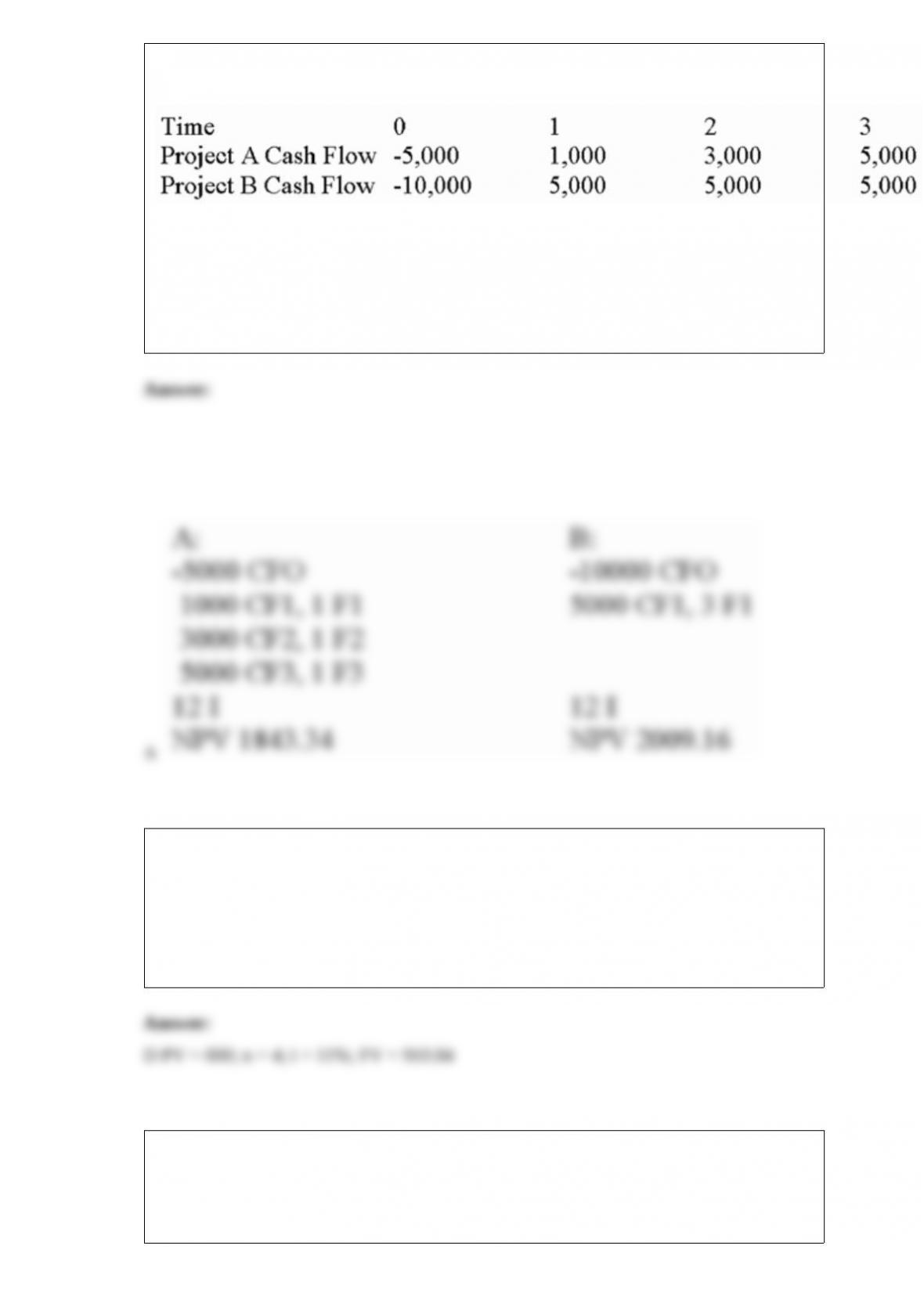
projects are 2.5 and 3 years, respectively.
Use the NPV decision rule to evaluate these projects; which one(s) should be accepted
or rejected?
A.accept both A and B
B.accept neither A nor B
C.accept A, reject B
D.reject A, accept B
14) What is the future value of $600 deposited for 4 years earning an 11% interest rate
annually?
A.$792.90
B.$803.61
C.$899.23
D.$910.84
15) Credit Risk and Yield Rank the following bonds in order from lowest credit risk to
highest risk all with the same time to maturity, by their yield to maturity: JM Corporate
bond with yield of 12.25 percent, IB Corporate bond with yield of 4.49 percent, TC
Corporate bond with yield of 8.76 percent, and B&O Corporate bond with a yield of
5.99 percent.
A.JM bond, TC bond, B&O bond, IB bond
B.IB bond, B&O bond, TC bond, JM bond
C.TC bond, B&O bond, IB bond, JM bond
D.JM bond, IB bond, B&O bond, TC bond
16) Which ratio measures the number of dollars of operating cash available to meet
each dollar of interest and other fixed charges that the firm owes?
A.Times interest earned
B.Fixed-charge coverage ratio
C.Cash coverage ratio
D.Operating coverage ratio
17) These individuals examine a firm’s financial strength for its debt holders.
A.Auditors
B.Investment analysts
C.Investment bankers
D.Credit analysts
18) Portfolio Beta You have a portfolio with a beta of 0.9. What will be the new
portfolio beta if you keep 40 percent of your money in the old portfolio and 60 percent
in a stock with a beta of 1.5?
A.1.00
B.1.20
C.1.26
D.2.40
19) Stock Index Performance On November 27, 2007, The Dow Jones Industrial

Average closed at 12,958.44, which was up 215.04 that day. What was the return (in
percent) of the stock market that day?
A.-.017%
B.+.017%
C.-1.69%
D.+1.69
20) P/E Model and Cash Flow Valuation Suppose that a firm’s recent earnings per share
and dividends per share are $2.50 and $1.00, respectively. Both are expected to grow at
10 percent. However, the firm’s current P/E ratio of 22 seems high for this growth rate.
The P/E ratio is expected to fall to 18 within five years. Compute a value for this stock
by first estimating the dividends over the next five years and the stock price in five
years. Then discount these cash flows using a 14 percent required rate.
A.$37.51
B.$37.64
C.$42.14
D.$72.47
21) If a firm has retained earnings of $20 million, a common shares account of $25
million, and additional paid-in-capital of $15 million, how much would be transferred
in (or out) of these accounts in response to a 15 percent stock dividend, respectively?
A.-15%, 0%, +15%
B.-15%, +15%, 0%
C.-30%, +15%, +15%
D.-30%, +30%, +30%

22) If Walt Disney and American Airlines merged together, it would be an example of a
___________.
A.Consolidation merger
B.Conglomerate merger
C.Vertical merger
D.Horizontal merger
23) All of the following are necessary conditions for an efficient market except
_________.
A.Low trading or transaction costs
B.Many buyers and sellers
C.Free and readily available information to market participants
D.Low stock prices
24) Which of these is the trade agreement between South American countries to create
their own free trade zone?
A.South American Union
B.South American Free Trade Agreement (SAFTA)
C.South American Monetary Fund (SAMF)
D.Mercosur
25) These ratios measure how efficiently a firm uses its assets, as well as how
efficiently the firm manages its accounts payable.
A.asset management
B.cash
C.internal-growth
D.quick or acid test
26) Solving for Rates What annual rate of return is earned on a $10,000 investment

when it grows to $15,000 in ten years?
A.1.50%
B.3.97%
C.4.14%
D.5.00%
27) Under which conditions will an investor demand a larger return (yield) on a bond?
A.The bond issue is upgraded from A to AA
B.The bond issue is downgraded from A to BBB
C.Interest rates decrease due to decline in inflation
D.None of these conditions will cause an increase in the bond’s yield
28) Value of Future Cash Flows A firm recently paid a $0.30 annual dividend. The
dividend is expected to increase by 8 percent in each of the next four years. In the
fourth year, the stock price is expected to be $60. If the required rate for this stock is 10
percent, what is its current value?
A.$15.00
B.$20.41
C.$42.13
D.$45.30
29) The ___________ approach to computing a divisional weighted average cost of
capital (WACC) uses the average beta of projects in each division to calculate the
WACC.
A.subjective
B.objective
C.firmwide
D.implicit
30) A fast growing firm recently paid a dividend of $0.80 per share. The dividend is
expected to increase at a rate of 30% rate for the next 4 years. Afterwards, a more stable
7% growth rate can be assumed. If a 10% discount rate is appropriate for this stock,
what is its value?
A.$60.48
B.$60.18
C.$61.34
D.$73.86
31) An all-equity firm is considering the projects shown below. The T-bill rate is 3%
and the market risk premium is 6%. If the firm uses its current WACC of 12% to
evaluate these projects, which project(s), if any, will be incorrectly rejected?
A.Only Project A would be incorrectly rejected
B.Both Projects A and C would be incorrectly rejected
C.Projects A, B and C would be incorrectly rejected
D.None of the projects would be incorrectly rejected
32) All of the following are the different types of float the firm may experience in its
collections except _____________.
A.Mail float
B.Availability float
C.Check kiting float
D.Processing float
33) DuPont Analysis Last year, DJ’s Soda Fountains, Inc. reported an ROE = 27%. The
firm’s debt ratio was 50%, sales were $9 million, and the capital intensity ratio was 1.5
times. What is the net income for DJ’s last year?
A.$1.22m
B.$1.82m
C.$2.43m
D.$2.84m
34) Calculate the rate at which the follow projects’ NPV profiles cross and explain
when IRR will give the correct answer when choosing between these two mutually
exclusive projects.
35) How do taxes influence how corporate managers’ and investors’ structure
transactions and capitalize their companies?
36) Compound Frequency Say that you own a small business, which you plan to
expand. Your expansion plans include borrowing $100,000 from the bank with a
five-year, amortized loan. The bank has given you three loan choices:
Annual payments at 8.85 percent APR
Quarterly payments at 8.75 percent APR
Monthly payments at 8.65 percent APR
37) How is the capital intensity ratio calculated? How is it used in the AFN formula?
38) Say you double your money in five years. Explain why the rate of return is NOT 20
percent per year.
39) Bond Ratings and Prices A corporate bond with a 5.75 percent coupon has 10
years left to maturity. It has had a credit rating of BBB and a yield to maturity of 6.25
percent. The firm has recently gotten into some trouble and the rating agency is
downgrading the bonds to BB. The new appropriate discount rate will be 6.75 percent.
What will be the change in the bond’s price in dollars and percentage terms? (Assume
interest payments are paid semi-annually and a par value of $1,000.)
40) Under what conditions would the constant-growth-rate model not be appropriate?
41) For computing a project WAAC, why do we take some component costs from the
firm, but compute others that are specific for the project being considered?
42) What is a credit-scoring model?
43) How would you compute the equity flotation cost if a firm were going to use a
mixture of retained earnings and new equity to finance a project? Give an example.