
1) Additional investment in working capital, even if it may be recovered at the end of a
project, must be included in capital budgeting analysis because of the time value of
money.
2) If external financing needed cannot be obtained due to poor market conditions, a firm
could reduce the amount needed by increasing its retention ratio.
3) Economic value added is calculated by taking (net income less the cost of all capital)
times total assets.
4) A bond that matures in 5 years has less interest rate risk than a bond that matures in
25 years because regardless of changes in interest rates, the bond can be redeemed for
face value 20 years earlier.
5) Accounts receivable is an asset representing sales made on credit.
6) The Eurodollar market is larger than any financial market in the United States.
7) Cash flows and profits are synonymous; in other words, higher cash flows equal
higher profits.

8) For a growing firm, external financing needed will most likely be greater than
discretionary financing needed due to increases in accounts payable and accruals.
9) The purpose of work-in-process inventory is to ensure that machine failures and
work stoppages in one operation do not affect other operations.
10) The annual cash budget not only shows the amount of financing needed for the
year, but also when the funds will be needed.
11) One of the disadvantages of the payback method is that it ignores time value of
money.
12) Free cash flows represent the benefits generated from accepting a capital-budgeting
proposal.
13) Depreciation is a non-cash deduction so it may be ignored in the calculation of a
project’s incremental after-tax cash flows.
14) If John owns 5% of XYZ corporation before its 2 for 1 stock split, John will own
5% of XYZ corporation after the stock split as well.

15) A company with negative net income will also have negative operating cash flow.
16) DAS, Inc has a line of credit with FBT Bank that allows DAS to borrow up to
$400,000 at an annual interest rate of 11 percent. However, DAS must keep a
compensating balance of 25 percent of any amount borrowed on deposit at the bank.
DAS does not normally have a cash balance account with the bank. What is the
effective annual cost of credit?
A) 11.45%
B) 12.59%
C) 14.67%
D) 16.00%
17) Spontaneous sources of financing include
A) marketable securities
B) wages payable
C) accounts receivable
D) common stock
18) What is the expected rate of return on a bond that matures in 5 years, has a par
value of $1,000, a coupon rate of 11.5%, and is currently selling for $982? Assume
annual coupon payments.
A) 12.5%
B) 12.0%
C) 12.7%
D) 13.4%
19) AFB Corp. needs to replace an old lathe with a new, more efficient model. The old
lathe was purchased for $50,000 nine years ago and has a current book value of $5,000.
(The old machine is being depreciated on a straight-line basis over a ten-year useful
life.) The new lathe costs $100,000. It will cost the company $10,000 to get the new
lathe to the factory and get it installed. The old machine will be sold as scrap metal for
$2,000. The new machine is also being depreciated on a straight-line basis over ten
years. Sales are expected to increase by $8,000 per year while operating expenses are

expected to decrease by $12,000 per year. AFB’s marginal tax rate is 40%. Additional
working capital of $3,000 is required to maintain the new machine and higher sales
level. The new lathe is expected to be sold for $5,000 at the end of the project’s ten-year
life. What is the project’s terminal cash flow?
A) $3,000
B) $5,000
C) $6,000
D) $8,000
20) A company with a bond rating of BBB is more likely to have which of the following
qualities compared to a company with a bond rating of B?
A) greater reliance on equity financing
B) high variability in past earnings
C) little use of subordinated debt
D) small firm size
21) In terms of the costs to organize each, which of the following sequences is correct,
moving from highest to lowest cost?
A) general partnership, sole proprietorship, limited partnership, corporation
B) sole proprietorship, general partnership, limited partnership, corporation
C) corporation, limited partnership, general partnership, sole proprietorship
D) sole proprietorship, general partnership, corporation, limited partnership
22) Given the following annual net cash flows, determine the internal rate of return to
the nearest whole percent of a project with an initial outlay of $750,000.
YearNet Cash Flow
1$500,000
2$150,000
3$250,000
A) 9%
B) 11%
C) 13%
D) 15%

23) For the net present value (NPV) criteria, a project is acceptable if NPV is
________, while for the profitability index a project is acceptable if PI is ________.
A) greater than zero; greater than the required return
B) greater than or equal to zero; greater than zero
C) greater than one; greater than or equal to one
D) greater than or equal to zero; greater than or equal to one
24) Which of the following will cause the value of a bond to increase, other things held
the same?
A) investors’ required rate of return increases
B) the company’s debt rating drops from AAA to BBB
C) interest rates decrease
D) the bond is callable
25) Matterhorn, Inc. had the following sales for the past six months. Matterhorn collects
its credit sales 30% in the month of sale, 60% one month after the sale, and 10% two
months after the sale.
Cash SalesCredit Sales
January$50,000$50,000
February$70,000$110,000
March$55,000$95,000
April$78,000$130,000
May$80,000$105,000
June$75,000$148,000
What are Matterhorn’s total cash receipts for the month of April?
A) $208,000
B) $176,000
C) $168,000
D) $98,000
26) A project requires an initial investment of $389,600. The project generates free cash
flow of $540,000 at the end of year 4. What is the internal rate of return for the project?
A) 138.6%
B) 38.6%
C) 8.5%
D) 6.9%

27) Use the “percent of sales method” of preparing pro forma financial statements to
determine the projection for next year’s accounts receivable. Make the following
assumptions: current year’s sales are $45,450,000; current year’s cost of goods sold is
$26,950,000; sales are expected to rise by 20%. The firm’s investment in accounts
receivable in the current year is $8,600,000. The firm’s marginal tax rate is 35%. What
is the projection for next year’s accounts receivable?
A) $11,345,000
B) $10,320,000
C) $9,575,000
D) $8,772,000
28) Which of the following statements concerning stock repurchases is MOST correct?
A) Increasingly companies are using stock repurchases to distribute cash to their
shareholders, but dividends remain the primary means to distribute cash
B) Companies currently spend more money on stock buybacks than on dividend
payments
C) Repurchasing stock is strictly a financing decision made by the corporation
D) A tender offer is the only way to complete a stock repurchase due to SEC rules
29) One component of a firm’s financial structure which is NOT a component of its
capital structure is
A) common stock
B) accounts payable
C) long-term debt
D) preferred stock
30) The calculation of incremental free cash flows over a project’s life should include
A) labor and material saving
B) additional revenue
C) interest to bondholders
D) A and B

31) DYI Construction Co. is considering a new inventory system that will cost
$750,000. The system is expected to generate positive cash flows over the next four
years in the amounts of $350,000 in year one, $325,000 in year two, $150,000 in year
three, and $180,000 in year four. DYI’s required rate of return is 8%. What is the
payback period of this project?
A) 4.00 years
B) 3.09 years
C) 2.91 years
D) 2.50 years
32) Which of the following is generally under the control of the financial manager?
A) the percentage of credit sales to total sales
B) the actual level of sales
C) the credit policies
D) A and B
33) A bottle of German wine costs $21 euros in Berlin. According to the purchasing
power parity theory, what would the bottle sell for in New York if it costs the New York
company $1.25 per bottle to transport the wine to the United States? Assume the
exchange rate is $1.32 per euro.
A) $40.54
B) $28.97
C) $27.22
D) $39.50
34) Table 4-3
Emery Corporation
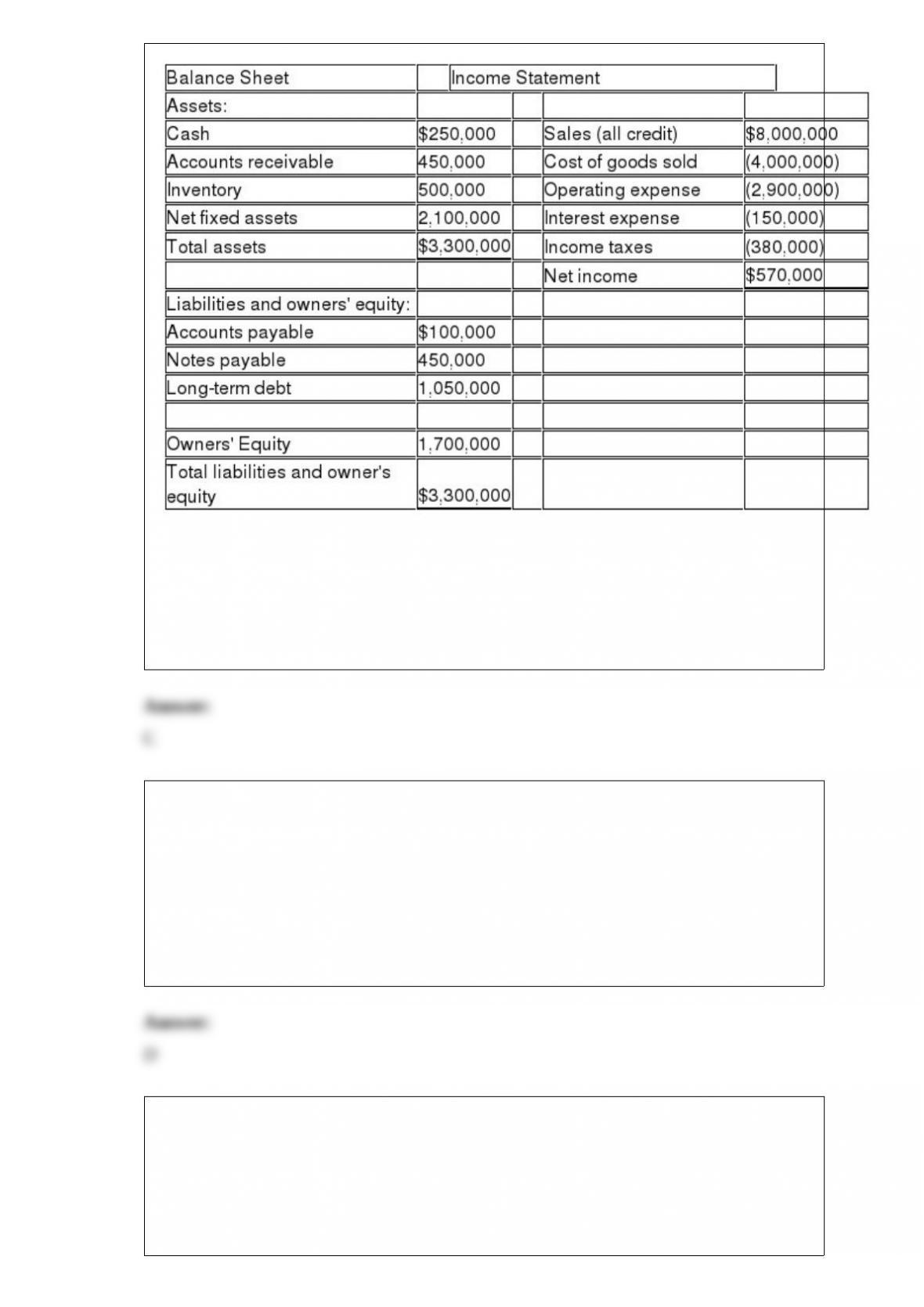
Based on the information in Table 4-3, the average collection period is
A) 38.01 days
B) 27.36 days
C) 20.53 days
D) 17.49 days
35) Stock dividends
A) decrease stock prices because no cash goes to shareholders but companies pay
transactions costs
B) may increase stock prices if the dividend is used to maintain on optimal trading
range for the common stock
C) may increase stock prices if investors perceive the dividend as containing favorable
information about the firm’s future prospects
D) Both B and C are true
36) Which of the following statements is MOST correct concerning a corporation’s
optimal capital structure?
A) The optimal capital structure maximizes the present value of the interest tax shield
B) The optimal capital structure occurs at the point where the market value of the
levered firm is maximized
C) The optimal capital structure minimizes the present value of financial distress costs

and agency costs
D) The optimal capital structure occurs where the present value of the interest tax shield
equals the present value of the firm’s bankruptcy costs
37) Portfolio risk is typically measured by ________ while the risk of a single
investment is measured by ________.
A) standard deviation; beta
B) security market line; standard deviation
C) beta; standard deviation
D) beta; slope of the characteristic line
38) Which of the following is an advantage of organized stock exchanges?
A) increased stock price volatility
B) screening companies to ensure only low risk stocks are sold
C) providing a continuous market
D) only profitable companies may issue new securities on an organized exchange
39) Table 4-2
Drummond Company
Balance Sheet
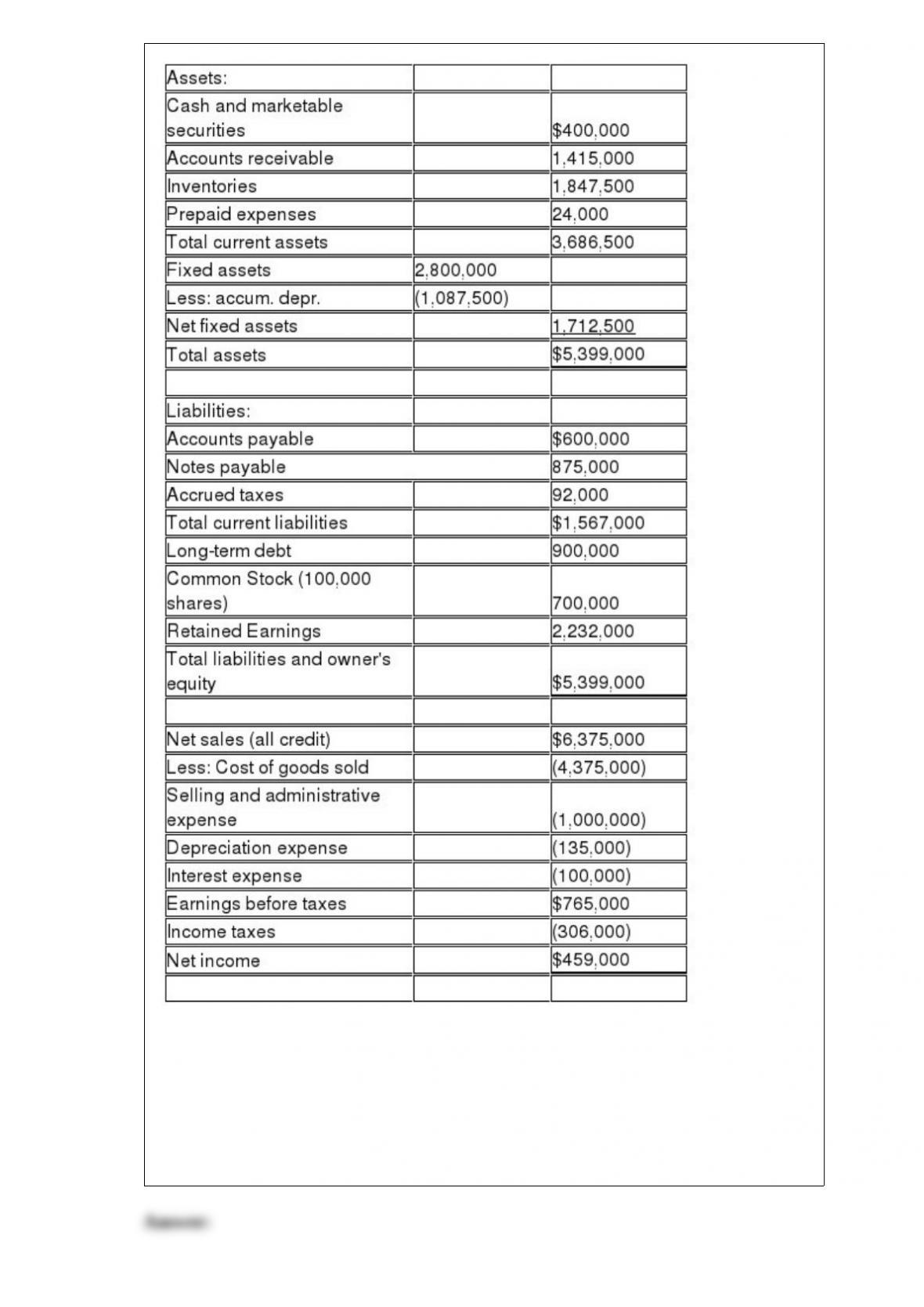
Based on the information in Table 4-2, and assuming the company’s stock price is $50
per share, the P/E ratio is
A) 10.89
B) 14.33
C) 24.44
D) 27.50

40) Castle, Inc. paid a dividend yesterday of $2 per share. Castle management expects
the dividend to increase next year to $3 annually. If the dividend is expected to stay at
$3 per year for the foreseeable future, what is the value of the stock to an investor with
a required rate of return of 10%?
A) $7.50
B) $30.00
C) $32.00
D) $50.00
41) Glenna Gayle common stock sells for $55, and dividends paid last year were $1.35.
Flotation costs on issuing stock will be 8% of the market price. The dividends are
predicted to have a 10% growth rate. What is the cost of internal equity, and new equity,
respectively for Glenna Gayle?
42) The date today is January 1, 2010. A one-year security maturing on 1/1/11 yields
3%. A two-year security maturing on 1/1/12 yields 6%. A three-year security maturing
on 1/1/13 yields 11%. Calculate the expected annual return on a two-year security
beginning 1/1/11 and maturing on 1/1/13.
43) Your friend, John, believes that since capital markets are efficient, he doesn’t need
to read the financial press or be involved in stock research before purchasing stocks for
his portfolio. He simply throws darts at the stock pages and buys the stocks the darts
hit. Is stock research and analysis important when buying and selling stocks in an
efficient market?
44) A retirement home in Florida costs $200,000 today. Housing prices in Florida are
increasing at a rate of 4% per year. Joe wants to buy the home in 8 years when he
retires. Joe has $25,000 right now in a savings account paying 8% interest per year. Joe
wants to make eight equal annual deposits into the savings account starting today. How
much must each deposit be so Joe will have enough money in his savings account to
buy the retirement home when he retires?
45) The Smith Corporation is a maker of fine stereo components and presently has
finished goods inventories of $800,000. They need a short-term bank loan of $400,000
for three months. The bank has proposed two different financing arrangements. The
first is a floating lien arrangement at a rate of 22 percent. The second proposal is for a
terminal warehouse arrangement at 11 percent. Under the latter proposal, Smith will
pay $1,000 a month plus round trip shipping expense of $6,000. Which source of credit
should be selected by the Smith Corporation? Explain.
46) Describe the types of dividend policies that corporations frequently use. Which is
most common? Why?

47) An investment promises to pay you the following amounts at the end of each of the
next 10 years: (1) $1,000, (2) $2,000, (3) $3,000, (4) $4,000, (5) – (10) $5,000 per year.
If you want to earn a return of 8% per year, how much will you be willing to pay for the
investment today?