
1) Your firm needs a computerized machine tool lathe which costs $50,000 and another
$12,000 in maintenance for each year of its 3-year life. After 3 years, this machine will
be replaced. The machine falls into the MACRS 3-year class life category. Assume a tax
rate of 30% and a discount rate of 12%. If the lathe can be sold for $6,000 at the end of
year 3, what is the after-tax salvage value?
A.$3,470.50
B.$4,344.50
C.$5,499.50
D.$5,311.50
2) Which of these completes this statement to make it true? The constant growth model
is
A.always going to have assumptions that will hold true
B.able to be adjusted for stocks that don’t expect constant growth without sizeable
errors
C.only going to be appropriate for the limited number of stocks that just happen to
expect constant growth
D.only going to be appropriate for the limited number of stocks that just happen to
expect nonconstant growth
3) Calculating Costs of Issuing Stock Video Games, Inc., with the help of its investment
bank recently issued 10 million shares of new stock. The offer price on the stock was
$47.50 per share and Video’s received a total of $446,500,000 through this stock
offering. Calculate the net proceeds and the underwriter’s spread on the stock offering.
What percentage of the gross price is the investment bank charging Video’s for
underwriting the stock issue?
A.3%
B.30%
C.6%
D.9%
4) You are evaluating the balance sheet for Goodman’s Bees Corporation. From the
balance sheet you find the following balances: Cash and marketable securities =
$200,000, Accounts receivable = $1,100,000, Inventory = $2,000,000, Accrued wages
and taxes = $500,000, Accounts payable = $600,000, and Notes payable = $100,000.
Calculate Goodman’s Bees’ net working capital.
A.$2,000,000
B.$2,100,000
C.$1,400,000
D.$1,900,000
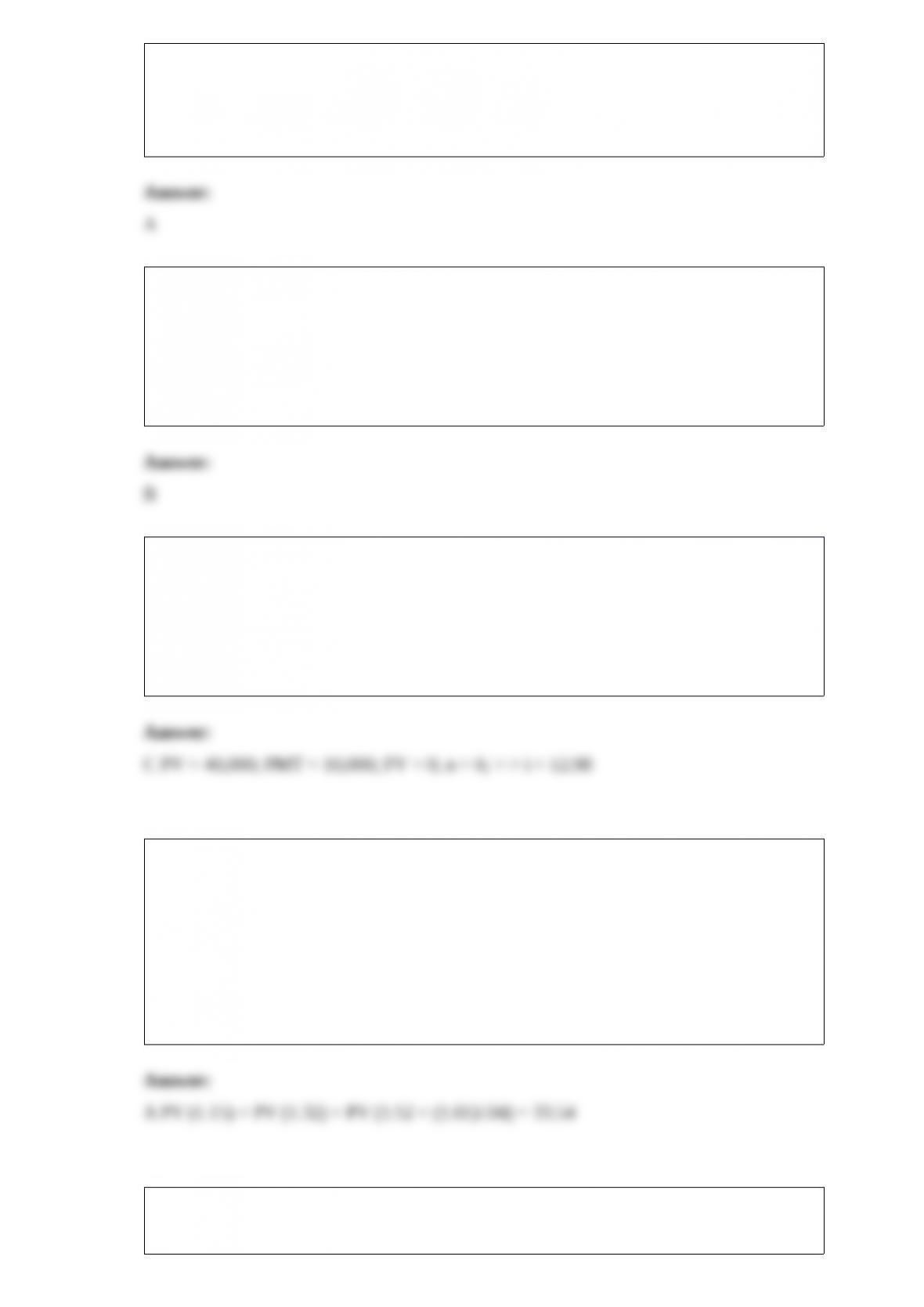
5) Suppose your firm is considering investing in a project with the cash flows shown
below, that the required rate of return on projects of this risk class is 10 percent, and
that the maximum allowable payback and discounted payback statistics for the project
are 3.5 and 4.5 years, respectively. Use the discounted payback decision to evaluate this
project; should it be accepted or rejected?
A.Discounted payback = 4.29 years; accept the project
B.Discounted payback = 3.97 years; accept the project
C.Discounted payback > 4.5 years; reject the project
D.Discounted payback = 4.4 years; accept the project
6) Which of the following will increase the present value of an annuity?
A.The number of periods decreases
B.The interest rate decreases
C.The amortization schedule decreases
D.The effective rate is calculated over fewer years
7) A firm wants to reduce its cash conversion cycle. Which of the following actions will
reduce its cash conversion cycle?
A.The firm reduces its DSO
B.The firm increases its inventory
C.The firm reduces its accounts payable
D.All of these
8) To compensate the bondholders for getting the bond called, the issuer pays which of
the following?
A.call feature
B.call premium
C.coupon rate
D.original issue premium
9) What is the interest rate of a 6-year, annual $10,000 annuity with a present value of
$40,000?
A.11.94%
B.12.24%
C.12.98%
D.13.12%
10) A fast growing firm recently paid a dividend of $1.00 per share. The dividend is
expected to increase at a rate of 15% rate for the next 3 years. Afterwards, a more stable
6% growth rate can be assumed. If a 10% discount rate is appropriate for this stock,
what is its value?
A.$33.54
B.$37.99
C.$39.37
D.$42.03
11) Which of the following is the type of financial distress in which a firm’s operating
cash flows are not sufficient to pay its liabilities as they come due?
A.business failure
B.economic failure
C.technical insolvency
D.business extension
12) The longer money can earn interest,
A.the greater the interest earned on the original deposit exceeds the interest-on-interest
B.the greater the compounding effect
C.the greater the present value must be to reach a financial goal
D.the greater the risk to the investor of not reaching a financial goal
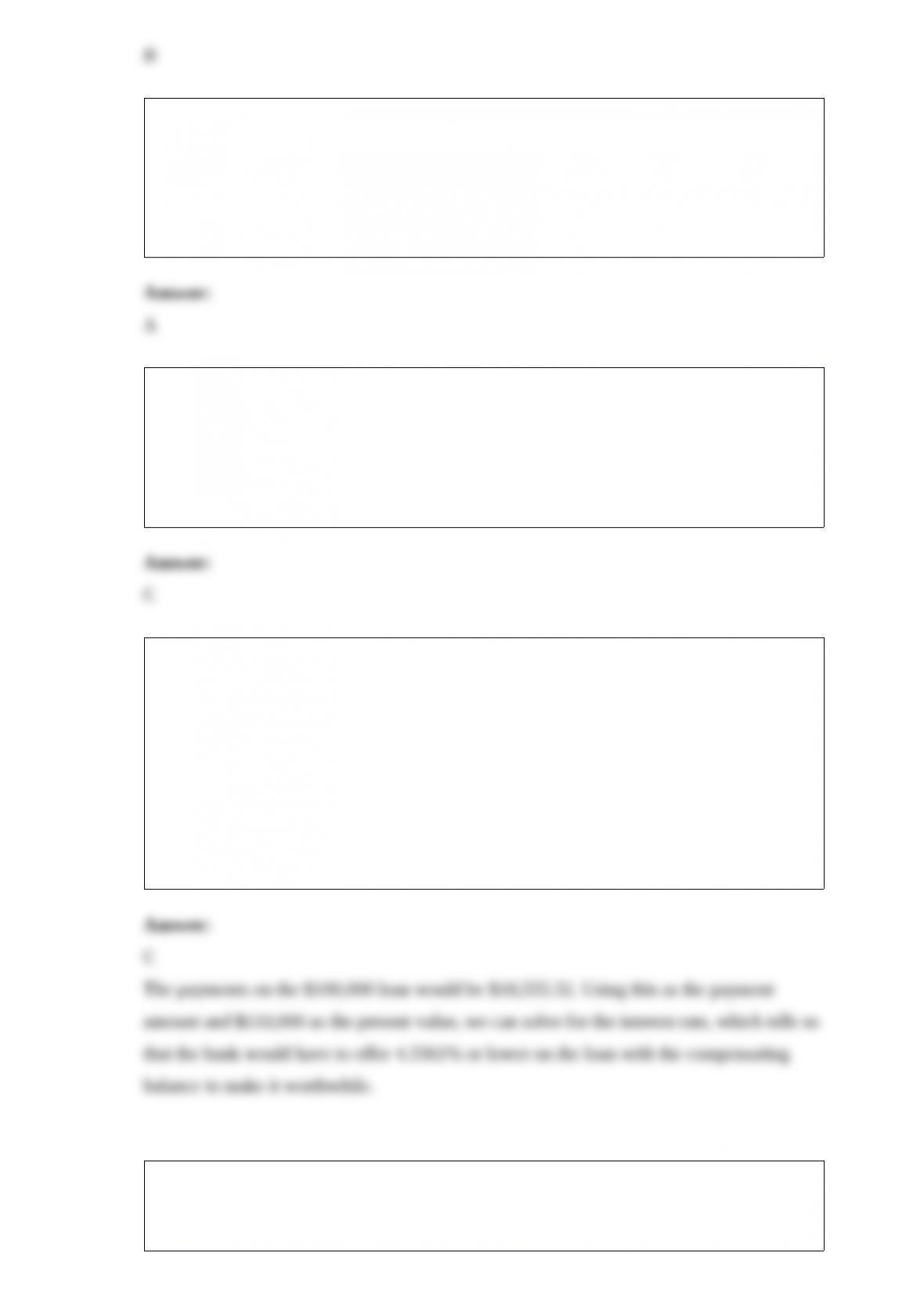
13) Suppose your firm is considering two mutually exclusive, required projects with the
cash flows shown below. The required rate of return on projects of both of their risk
class is 8 percent, and the maximum allowable payback and discounted payback
statistic for the projects are 2 and 3 years, respectively.
Use the payback decision rule to evaluate these projects; which one(s) should be
accepted or rejected?
A.accept both A and B
B.accept neither A nor B
C.accept A, reject B
D.reject A, accept B

14) All of the following are users of financial ratios except ___________.
A.Managers
B.Investors
C.Analysts
D.Auditors
15) Shares of stock issued to employees that have limitations on when they can be sold.
A.executive stock options
B.privately held information
C.restricted stock
D.stock market bubble
16) Which statement is incorrect regarding hybrid organizations?
A.They offer single taxation
B.They offer limited risk to the owners
C.They offer the same type of control as a sole proprietorship
D.All of these answers are correct statements
17) A firm has 4,000,000 shares of common stock outstanding, each with a market price
of $12.00 per share. It has 25,000 bonds outstanding, each selling for $980. The bonds
mature in 20 years, have a coupon rate of 9%, and pay coupons semi-annually. The
firm’s equity has a beta of 1.5, and the expected market return is 15%. The tax rate is
30% and the WACC is 15%. What is the risk-free rate?
A.6.28%
B.8.00%
C.9.22%
D.19.36%

18) You are trying to pick the least-expensive car for your new delivery service. You
have two choices: the Scion xA, which will cost $13,000 to purchase and which will
have OCF of -$1,200 annually throughout the vehicle’s expected life of three years as a
delivery vehicle; and the Toyota Prius, which will cost $23,000 to purchase and which
will have OCF of -$550 annually throughout that vehicles expected five-year life. Both
cars will be worthless at the end of their life. If you intend to replace whichever type of
car you choose with the same thing when its life runs out, again and again out into the
foreseeable future, and if your business has a cost of capital of 16 percent, what is the
difference in the EAC of the two cars?
A.$381.36
B.$428.04
C.$586.07
D.$601.51
19) Suppose a firm pays total dividends of $125,000 out of net income of $500,000.
What would the firm’s retention ratio be?
A.22.00%
B.69.00%
C.25.00%
D.75.00%
20) A manufacturing firm is planning on expanding its existing operations. The
expansion project is significant and will require the firm to house the expansion in a
different location. The firm is considering building on a lot they own across town. The
lot is currently vacant and it was paid for nearly 20 years ago. Given this information,
which of the following statements is correct?
A.The lot is not an incremental cash flow because it is not being utilized at this time
B.The lot is an incremental cash flow because it represents an opportunity cost
C.The lot is an incremental cash flow because it represents a sunk cost
D.The lot is not an incremental cash flow because it has already been paid for
21) This ratio measures a firm’s ability to pay short-term obligations with its available
cash and market securities.
A.cash
B.current
C.internal-growth
D.quick or acid test
22) This is the maximum growth rate that can be achieved by financing asset growth
with new debt and retained earnings.
A.internal growth rate
B.retained earnings growth rate
C.sustainable growth rate
D.weighted growth rate
23) Suppose your firm is seeking a 7-year, amortizing $100,000 loan with annual
payments and your bank is offering you the choice between a $110,000 loan with a
$10,000 compensating balance and a $100,000 loan without a compensating balance. If
the interest rate on the $100,000 loan is 7 percent, how low would the interest rate on
the loan with the compensating balance have to be in order for you to choose it?
A.7%
B.10%
C.4.34%
D.not enough information is given to know
24) Chase purchased a $23,000 car three years ago using a 14%, 6-year car loan. He has
decided that he would sell the car now if he could get a price that would pay off the
balance of his loan. What is the minimum price Chase would need to receive for his
car? (Assume monthly payments.)
A.$12,592.41
B.$13,866.82
C.$14,136.72
D.$14,809.48
25) An 8% coupon municipal bond has 15 years left to maturity and has a price quote of
98.5. The bond can be called in 6 years. The call premium is one year of coupon
payments. Compute the bond’s yield to call and determine if the bond will be called.
Assume interest payments are paid semi-annually and a par value of $5,000.
A.4.68%; yes, the bond will be called
B.9.36%; yes, the bond will be called
C.9.36%; no, the bond will not be called
D.10.71%; no, the bond will not be called
26) One way to account for flotation costs of raising capital is to
A.adjust all the project’s cash flows so that each year it will reflect the flotation costs
B.adjust the project’s initial cash flow so that it will reflect the flotation costs
C.adjust only the project’s operating cash flows to account for paying back the
shareholders
D.adjust the project’s tax burden to account for the tax implications of raising capital
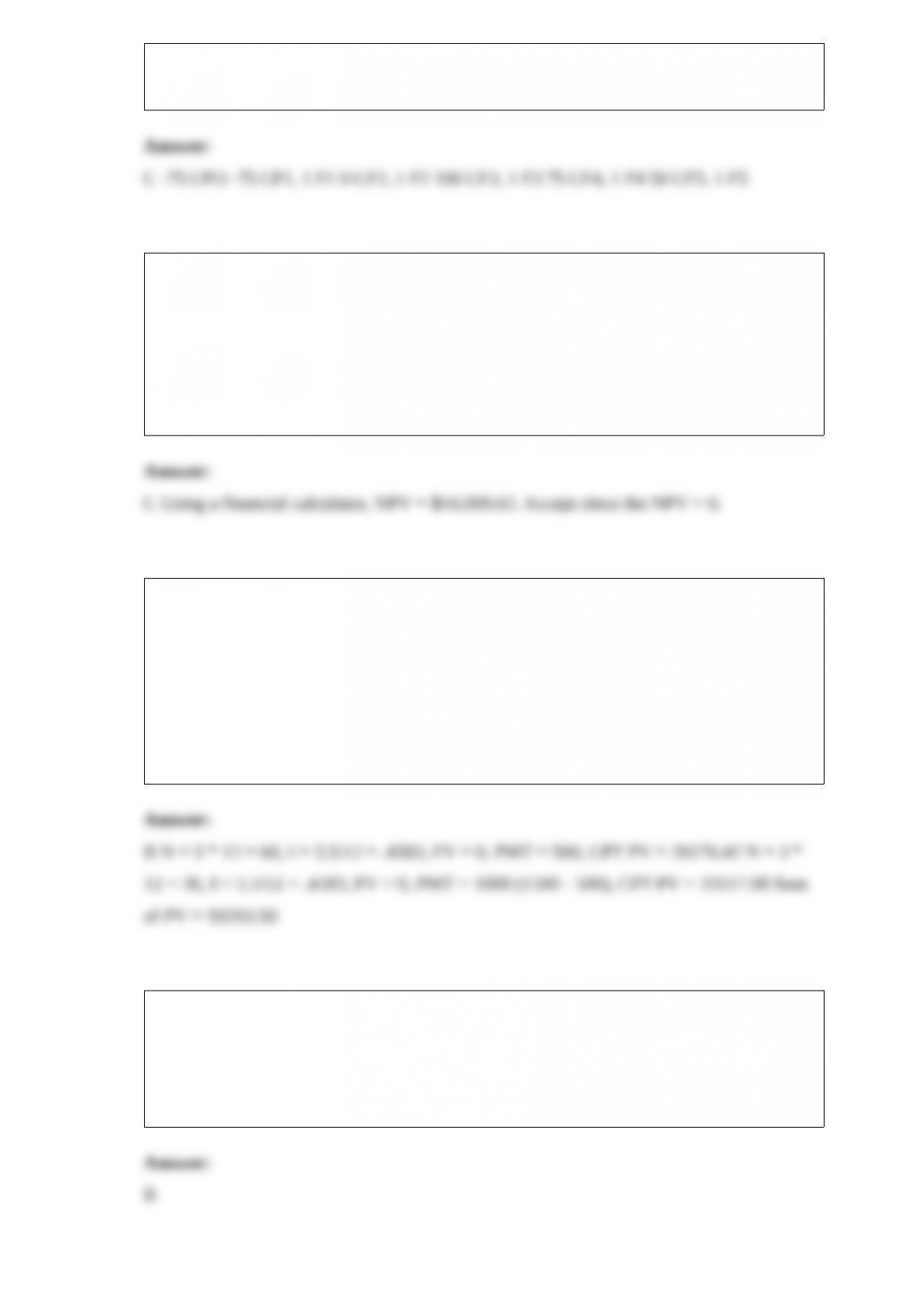
27) Compute the IRR statistic for Project X and note whether the firm should accept or
reject the project with the cash flows shown below if the appropriate cost of capital is
10 percent.
A.10%, accept
B.10%, reject
C.13.26%, accept
D.13.26%, reject
28) A project costs $91,000 today and is expected to generate cash flows of $11,000 per
year for the next 20 years. The firm has a cost of capital of 8%. Should this project be
accepted, and why?
A.Yes, the project should be accepted since it has a NPV = $15,391.23
B.Yes, the project should be accepted since it has a NPV = $13,610.89
C.Yes, the project should be accepted since it has a NPV = $16,999.62
D.None of these answers is correct
29) Present Value of Multiple Annuities A small business owner visits his bank to ask
for a loan. The owner states that he can repay a loan at $1,500 per month for the next
three years and then $500 per month for the two years after that. If the bank is charging
customers 5.5 percent APR, how much would it be willing to lend the business owner?
A.$4,046.90
B.$59,293.50
C.$24.261.00
D.$66,000.00
30) This is the continual increase in the price level of a basket of goods and services.
A.deflation
B.inflation
C.recession
D.stagflation
31) Which of the following is NOT included when calculating the depreciable basis for
real property?
A.freight charges for item
B.sales tax paid for item
C.financing fees
D.installation and testing fees
32) What shape does the term structure usually take? Why?
33) How do Financial Intermediaries (FIs) act as asset transformers?
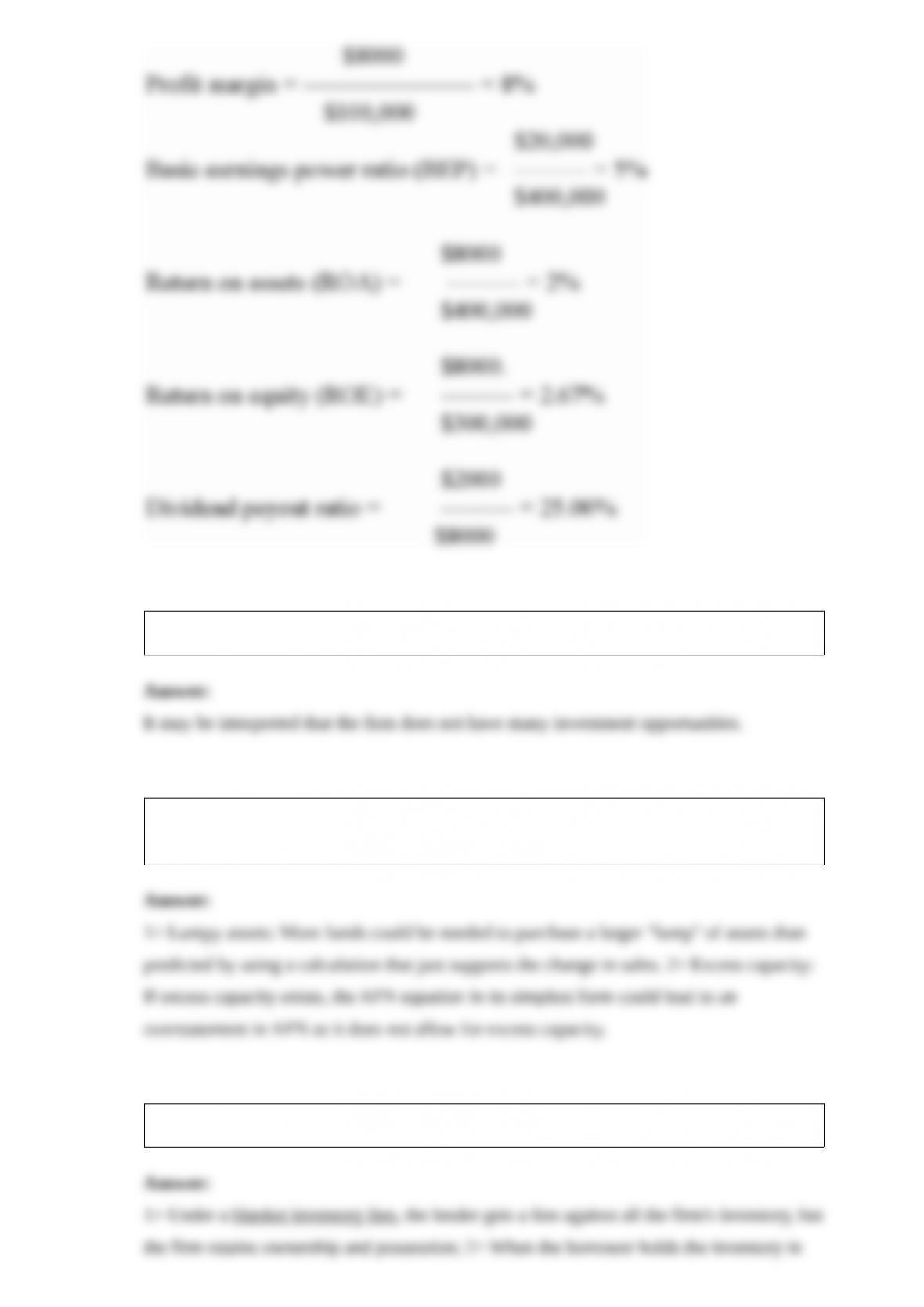
34) Profitability Ratios Sue’s Crops, Inc.’s 2011 income statement listed net sales =
$100,000, EBIT = $20,000, net income available to common stockholders = $8,000,
and common stock dividends = $2,000. The 2011 year-end balance sheet listed total
assets = $400,000, and common stockholders equity = $300,000 with 3,000 shares
outstanding. Calculate the profit margin, basic earnings power ratio, ROA, ROE, and
dividend payout ratio.
35) When might raising a firm’s dividend payout ratio be viewed as a negative signal?
36) What are two issues that are not addressed regarding fixed assets if one simply uses
the AFN formula in its simplest form? How would they impact the AFN calculation?
37) Detail the major differences between the three inventory loan types.
38) Will operating cash flow typically be larger or smaller than net income? Why?
39) Explain how the difference in the bid and ask prices might be considered a hidden
cost to the investor.