A firm has a return on equity of 17.8 percent, a return on assets of 11.3 percent, and a
65 percent dividend payout ratio. What is the sustainable growth rate?
A. 5.72 percent
B. 6.84 percent
C. 7.12 percent
D. 11.38 percent
E. 6.64 percent
City Rentals has 44,000 shares of common stock outstanding at a market price of $32 a
share. The common stock just paid a $1.50 annual dividend and has a dividend growth
rate of 2.5 percent. There are 7,500 shares of $9 preferred stock outstanding at a market
price of $72 a share. The outstanding bonds mature in 11 years, have a total face value
of $825,000, a face value per bond of $1,000, and a market price of $989 each, and a
pretax yield to maturity of 8.3 percent. The tax rate is 35 percent. What is the firm’s
weighted average cost of capital?
A. 7.76 percent
B. 8.68 percent
C. 9.29 percent
D. 9.97 percent
E. 10.30 percent
Over the period of 1926-2014:
A. long-term government bonds underperformed long-term corporate bonds.
B. small-company stocks underperformed large-company stocks.
C. inflation exceeded the rate of return on U.S. Treasury bills.
D. U.S. Treasury bills outperformed long-term government bonds.
E. large-company stocks outperformed all other investment categories.
Plenti-Good Foods has ending net fixed assets of $98,700 and beginning net fixed
assets of $84,900. During the year, the firm sold assets with a total book value of
$13,200 and also recorded $9,800 in depreciation expense. How much did the company
spend to buy new fixed assets?
A. -$23,900
B. $9,200
C. $36,800
D. $40,700
E. $37,400
The Food Network needs to raise $16.8 million to expand its operations nationally. The
company will sell new shares of common stock using a general cash offering. The
underwriters spread will be 7.85 percent, the administrative costs will be $515,000, and
the offer price will be $21 per share. How many shares of stock must be sold for the
company to receive the expansion funds it needs?
A. 894,763 shares
B. 938,311 shares
C. 947,222 shares
D. 814,141 shares
E. 892,674 shares
You want to have $35,000 in cash to buy a car 3 years from today. You expect to earn
3.6 percent, compounded annually, on your savings. How much do you need to deposit
today if this is the only money you save for this purpose?
A. $32,618.92
B. $34,511.68
C. $33,726.04
D. $31,476.67
E. $30,156.19
The Steel Factory is considering a project that will produce annual cash flows of
$43,800, $40,200, $46,200, and $41,800 over the next four years, respectively. What is
the internal rate of return if the initial cost of the project is $127,900?
A. 13.00 percent
B. 10.19 percent
C. 11.28 percent
D. 12.24 percent
E. 12.83 percent
Your grandfather started his own business 52 years ago. He opened an investment
account at the end of his third month of business and contributed $x. Every three
months since then, he faithfully saved another $x. His savings account has earned an
average rate of 5.73 percent annually. Today, his account is valued at $289,209.11. How
much did your grandfather save every three months assuming he saved the same
amount each time?
A. $284.02
B. $328.67
C. $331.09
D. $226.78
E. $262.25
You purchase a bond with a coupon rate of 6.15 percent, semiannual coupons, and a

clean price of $998.40. If the next coupon payment is due in two months, what is the
invoice price?
A. $1,018.90
B. $1,019.36
C. $1,001.60
D. $1,027.67
E. $1,004.33
Rock Haven has a proposed project that will generate sales of 1,840 units annually at a
selling price of $31 each. The fixed costs are $13,400 and the variable costs per unit are
$7.47. The project requires $32,000 of fixed assets that will be depreciated on a
straight-line basis to a zero book value over the four-year life of the project. The
salvage value of the fixed assets is $8,500 and the tax rate is 35 percent. What is the
operating cash flow for Year 4?
A. $22,231.88
B. $22,416.67
C. $17,258.4
D. $16,347.78
E. $16,970.16
You are analyzing a company that has cash of $8,800, accounts receivable of $15,800,
fixed assets of $87,600, accounts payable of $40,300, and inventory of $46,900. What
is the quick ratio?
A. 1.20
B. .67
C. .83
D. .61
E. 1.64
You are considering an investment for which you require a rate of return of 8.5 percent.
The investment costs $67,400 and will produce cash inflows of $25,720 for three years.
Should you accept this project based on its internal rate of return? Why or why not?
A. Yes; because the IRR is 9.51 percent
B. Yes; because the IRR is 7.08 percent
C. Yes; because the IRR is 6.67 percent
D. No; because the IRR is 7.08 percent
E. No’; because the IRR is 9.51 percent
UXZ has sales of $683,200, cost of goods sold of $512,900, and inventory of $74,315.
What is the inventory turnover rate?
A. 7.33 times
B. 6.90 times
C. 5.70 times
D. 7.14 times
E. 8.47 times
Which activity is most apt to reduce the inventory period for a grocery store?
A. Replacing slow-moving items with faster-selling products
B. Replacing fresh foods with canned goods
C. Decreasing the amount of discounts offered to customers
D. Increasing the amount of inventory on hand
E. Decreasing the number of times the inventory turns over per year
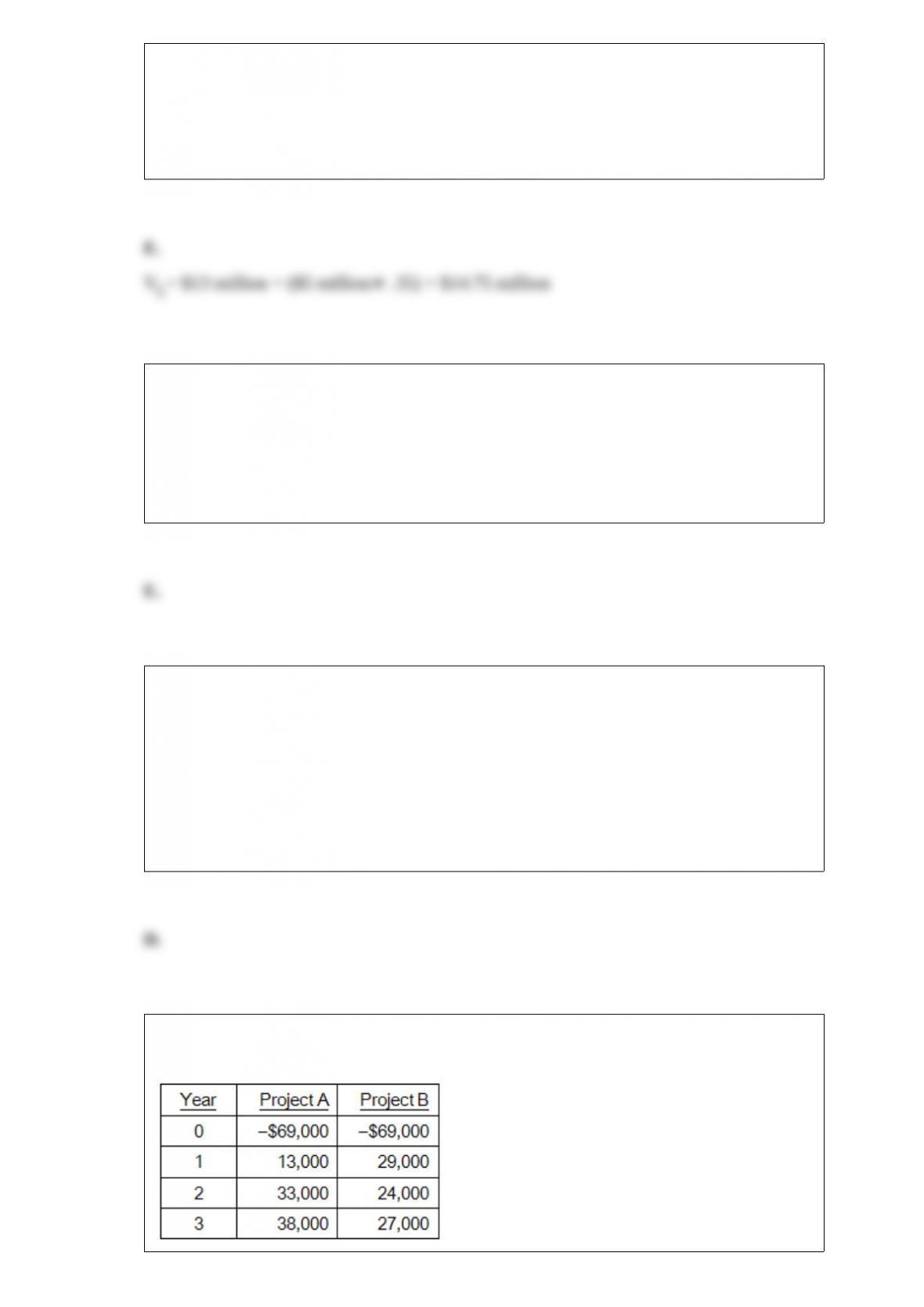
Marcos & Sons has no debt. Its current total value is $13 million. What will the
company’s value be if it sells $5 million in debt and has a tax rate of 35 percent?
Assume all debt proceeds are used to repurchase equity.
A. $16.25 million
B. $18.00 million
C. $11.25 million
D. $13.00 million
E. $14.75 million
Which statement is correct?
A. Tax rates are the key determinant to a company’s dividend policy.
B. Firms are equally likely to increase or decrease their normal dividends per share.
C. Dividends tend to be more erratic than earnings.
D. Mature firms are less apt to pay dividends than young firms.
E. Dividend growth tends to lag earnings growth.
A stock is expected to return 13 percent in an economic boom, 10 percent in a normal
economy, and 3 percent in a recessionary economy. Which one of the following will
lower the overall expected rate of return on this stock?
A. An increase in the rate of return in a recessionary economy
B. An increase in the probability of an economic boom
C. A decrease in the probability of a recession occurring
D. A decrease in the probability of an economic boom
E. An increase in the rate of return for a normal economy
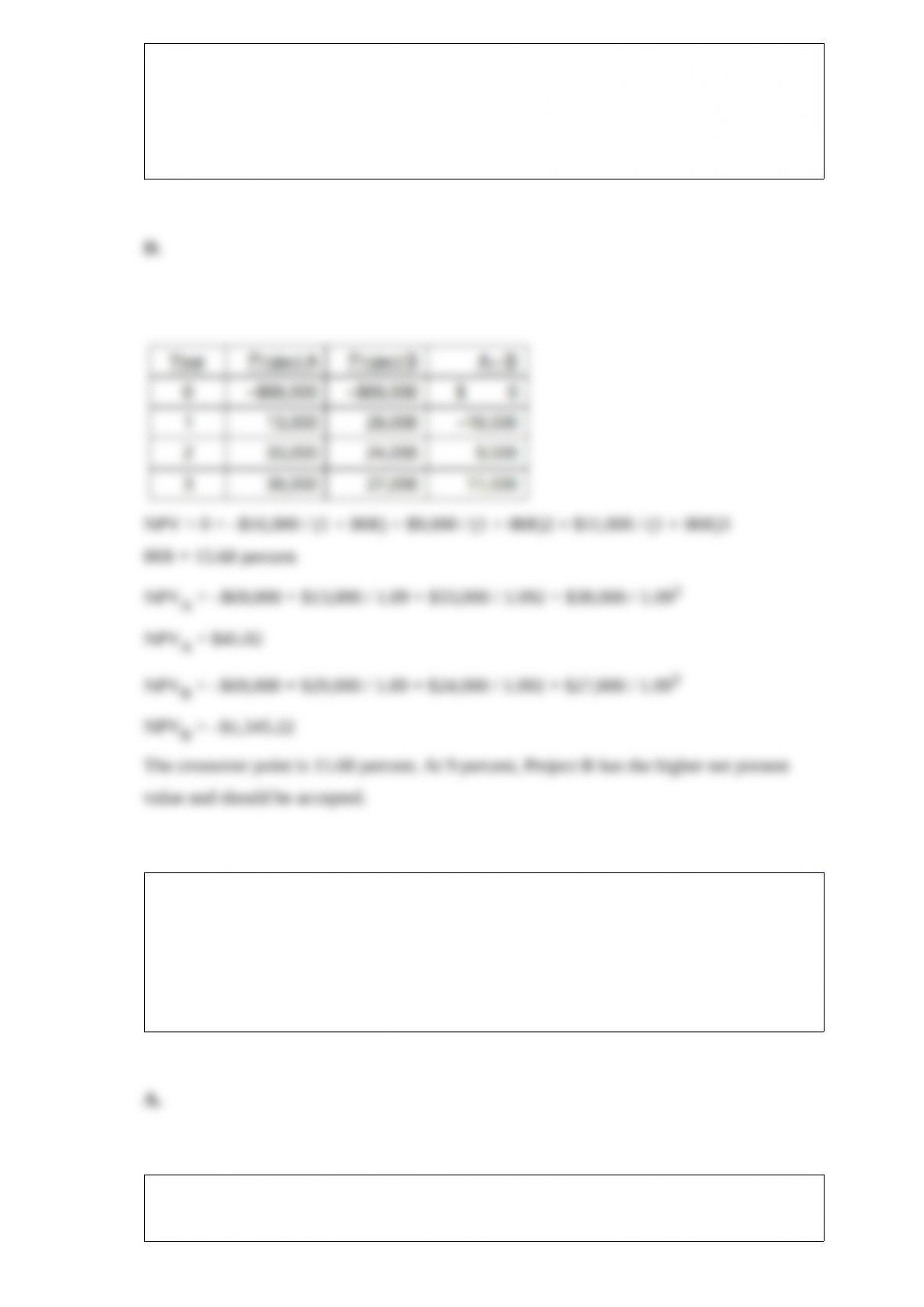
You are considering the following two mutually exclusive projects. The crossover point
is _____ percent and Project _____ should be accepted at a discount rate of 9 percent.
A. 15.68 percent; B
B. 11.38 percent; A
C. 11.38 percent; B
D. 15.68 percent; A
E. 14.02 percent; B
Which of these will tend to decrease the credit period?
A. Perishable product
B. Long production and sales cycle
C. Well-established customer
D. Heavy reliance on sales to that particular customer
E. Specialized new product
If the market price of existing publicly traded shares declines due to the announcement
of a seasoned issue of stock, the decline is referred to as which one of the following?

A. Spread
B. Direct underwriting cost
C. Underpricing
D. Direct issue cost
E. Abnormal return
A firm has multiple divisions of similar nature, yet varying degrees of risk. Which one
of the following would be the most appropriate, yet relatively easy, means of assigning
discount rates to each of its numerous proposed investments?
A. Assign every project a rate equal to the firm’s cost of equity
B. Assign every investment a random rate that varies between the firm’s cost of debt
and its cost of equity
C. Assign every project a rate equal to the firm’s WACC plus or minus a subjective
adjustment
D. Determine the best pure play rate for each project
E. Assign every project a rate equal to the market rate of return at the time of the
proposal
When a bond’s yield to maturity is less than the bond’s coupon rate, the bond:
A. had to be recently issued.
B. is selling at a premium.
C. has reached its maturity date.
D. is priced at par.
E. is selling at a discount.
You are given the following information concerning Around Town Tours:
Debt:7,500, 6.8 percent coupon bonds outstanding, with 11 years to maturity and a
quoted price of 97.9. These bonds pay interest semiannually.
Common stock:284,000 shares of common stock selling for $68 per share. The stock
has a beta of 1.04 and will pay a dividend of $2.62 next year. The dividend is expected
to grow by 2.5 percent per year indefinitely.
Preferred stock:9,000 shares of $8 preferred stock selling at $88 per share.
Market:14.6 percent expected return, 4.1 percent risk-free rate
Company:34 percent tax rate.
Calculate the WACC for this firm.
A. 9.0 percent
B. 8.7 percent
C. 9.4 percent
D. 9.6 percent
E. 10.0 percent
A portfolio is:
A. a single risky security.
B. any security that is equally as risky as the overall market.
C. any new issue of stock.
D. a group of assets held by an investor.
E. an investment in a risk-free security.
Currently, you can exchange $1 for SF1.14. Assume the average inflation rate in the
U.S. over the next two years will be 2.5 percent annually as compared to 3 percent in
Switzerland. Based on this information and relative purchasing power parity, which of
the following assumptions can you make regarding the next two years?
A. The Swiss franc will appreciate against all currencies.
B. The Swiss franc will appreciate against the U.S. dollar.

C. The U.S. dollar will appreciate against all currencies.
D. The U.S. dollar will appreciate against the Swiss franc.
E. Both the U.S. dollar and the Swiss franc will appreciate against all other currencies.
Eurobonds are best defined as international bonds issued in _____ and denominated in
____.
A. a single country; multiple currencies
B. a single country; a single currency
C. multiple countries; multiple currencies
D. multiple countries; a single currency
E. Euroland; euros
A balance sheet shows beginning values of $56,300 for current liabilities and$289,200
for long-term debt. The ending values are $61,900 and $318,400, respectively. The
income statement shows interest paid of $29,700 and dividends of $19,000. What is the
amount of the net new borrowing?
A. $29,200
B. $40,450
C. $34,800
D. $70,150
E. $58,900
You are buying a bond at a clean price of $1,140. The bond has a face value of $1,000,
a coupon rate of 3.8 percent, and pays interest semiannually. The next coupon payment
is one month from now. What is the dirty price of this bond?
A. $1,000.00
B. $1,146.67
C. $1,155.83
D. $1,176.67
E. $1,180.00

Which one of the following methods of analysis ignores cash flows?
A. Profitability index
B. Payback
C. Average accounting return
D. Modified internal rate of return
E. Internal rate of return
Which of the following tend to rise when a firm switches to a flexible financial policy
from a restrictive financial policy?
I. Restocking costs
II. Price reductions to offset limited selection
III. Storage costs
IV. Current asset opportunity costs
A. I and II only
B. III and IV only
C. I, III, and IV only
D. I, II, and III only
E. II, III, and IV only
You bought a share of 7.5 percent preferred stock for $91.60 last year. The market price
for your stock is now $89.10. What is your total return to date on this investment?
A. 5.51 percent
B. 4.73 percent
C. 5.86 percent
D. 6.10 percent
E. 5.46 percent
Whitt’s BBQ has sales of $1,318,000, a profit margin of 7.4 percent, and a capital
intensity ratio of .78. What is the total asset turnover rate?
A. 1.04
B. 1.08
C. 1.13
D. 1.43
E. 1.28
The process of determining the probability that potential customers will not pay is
called:
A. credit analysis.
B. collection policy.
C. account aging.
D. credit terms.
E. customer invoicing.
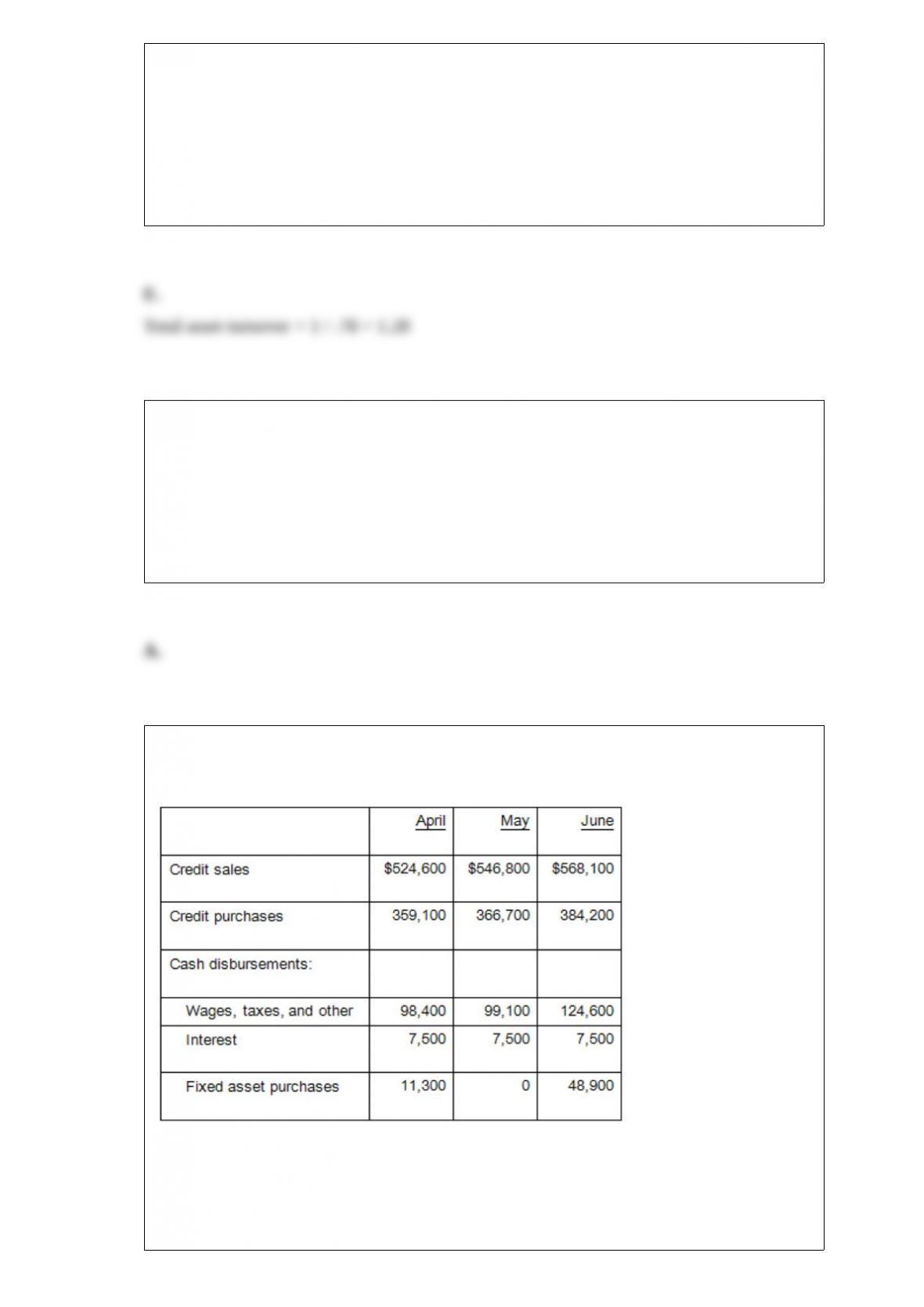
Here are some important figures from the budget of Global Enterprises for the second
quarter:
The company predicts that 2 percent of its credit sales will never be collected, 45
percent of its sales will be collected in the month of sale, and the remaining 53 percent
will be collected in the following month. Credit purchases will be paid in the month
following the purchase. March credit sales were $487,900 and credit purchases were
$349,500. What is the ending cash balance for April if the beginning cash balance was

$39,500?
A. $67,410
B. $67,457
C. $68,800
D. $64,440
E. $69,230
The Inside Door has total debt of $208,600, total equity of $343,560, and a return on
equity of 13.27 percent. What is the return on assets?
A. 9.14 percent
B. 8.26 percent
C. 11.45 percent
D. 9.61 percent
E. 9.48 percent