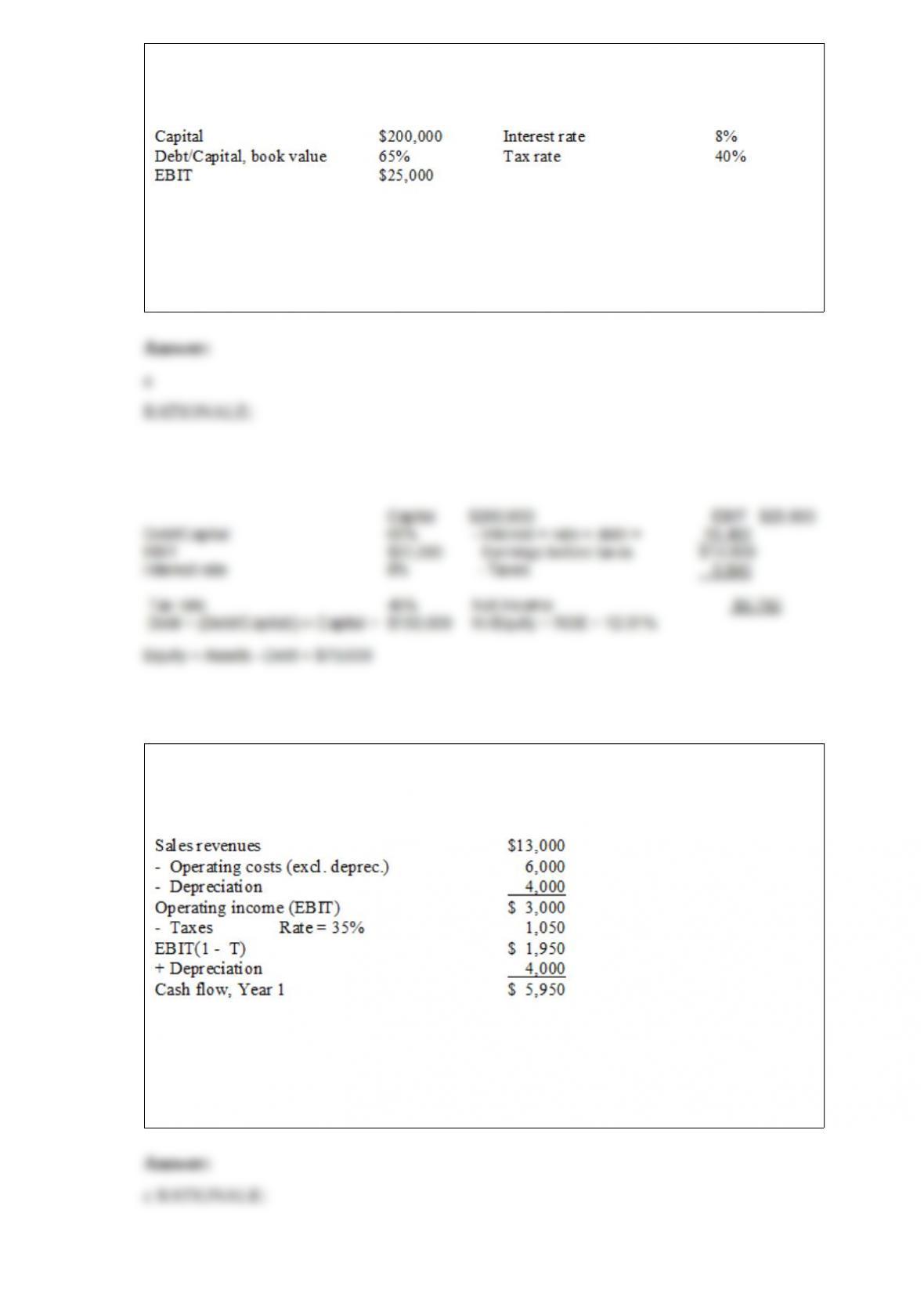
Confu Inc. expects to have the following data during the coming year. What is the firm’s
expected ROE?
a.12.51%
b.13.14%
c.13.80%
d.14.49%
e.15.21%
Your company, RMU Inc., is considering a new project whose data are shown below.
What is the project’s Year 1 cash flow?
a.$ 8,903
b.$ 9,179
c.$ 9,463
d.$ 9,746
e.$10,039
The text gives a number of valid, acceptable reasons for companies to merge. Which of
the following is NOT acceptable?
a.Synergistic benefits arising from mergers.
b.Reduction in competition resulting from mergers.
c.Acquisition of assets at below replacement value.
d.Attempts to minimize taxes by acquiring a firm with large accumulated losses that can
be used immediately.
e.Using surplus cash to acquire another firm and prevent unfavorable tax consequences
for shareholders.
Which of the following statements is CORRECT?
a.Net working capital is defined as current assets minus the difference between current
liabilities and notes payable, and any increase in the current ratio automatically
indicates that net working capital has increased.
b.Although short-term interest rates have historically averaged less than long-term
rates, the heavy use of short-term debt is considered to be an aggressive strategy
because of the inherent risks associated with using short-term financing.
c.If a company follows a policy of “matching maturities,” this means that it matches its
use of common stock with its use of long-term debt as opposed to short-term debt.
d.Net working capital is defined as current assets minus the difference between current
liabilities and notes payable, and any decrease in the current ratio automatically
indicates that net working capital has decreased.
e.If a company follows a policy of “matching maturities,” this means that it matches its
use of short-term debt with its use of long-term debt.
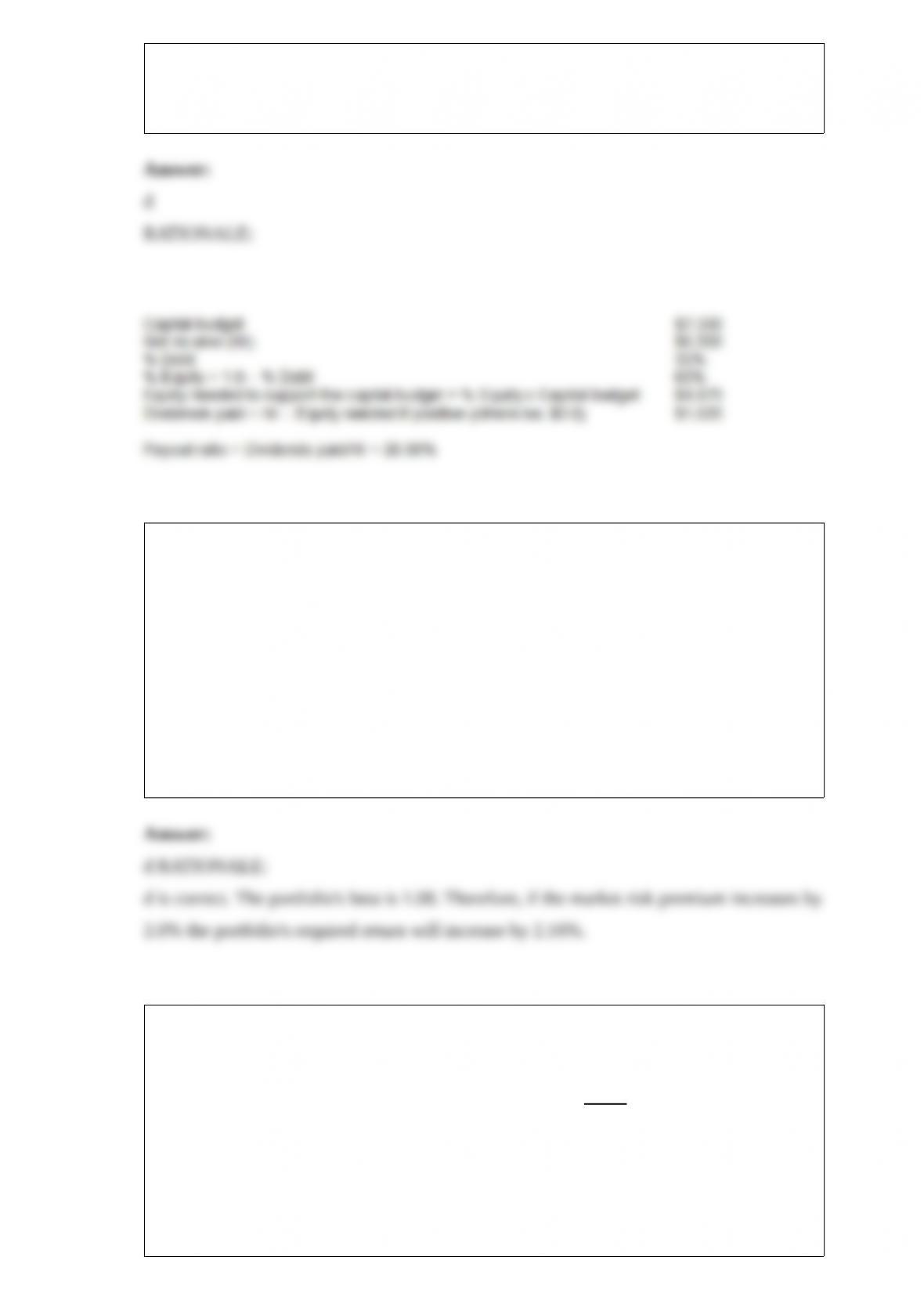
New Orleans Builders Inc. has the following data. If it follows the residual dividend
model, what is its forecasted dividend payout ratio?
a.18.23%
b.20.25%
c.22.50%
d.25.00%
e.27.50%
The risk-free rate is 6% and the market risk premium is 5%. Your $1 million portfolio
consists of $700,000 invested in a stock that has a beta of 1.2 and $300,000 invested in
a stock that has a beta of 0.8. Which of the following statements is CORRECT?
a.If the stock market is efficient, your portfolio’s expected return should equal the
expected return on the market, which is 11%.
b.The required return on the market is 10%.
c.The portfolio’s required return is less than 11%.
d.If the risk-free rate remains unchanged but the market risk premium increases by 2%,
your portfolio’s required return will increase by more than 2%.
e.If the market risk premium remains unchanged but expected inflation increases by
2%, your portfolio’s required return will increase by more than 2%.
Which of the following statements is CORRECT?
a.One disadvantage of operating as a corporation rather than as a partnership is that
corporate shareholders are exposed to more personal liability than are partners.
b.Relative to proprietorships, corporations generally face fewer regulations, and they
also find it easier to raise capital.
c.There is no good reason to expect a firm’s stockholders and bondholders to react
differently to the types of assets in which it invests.
d.Stockholders should generally be happier than bondholders to have managers invest
in risky projects with high potential returns as opposed to safe projects with lower
expected returns.
e.Stockholders in general would be better off if managers never disclosed favorable
events and therefore caused the price of the firm’s stock to sell at a price below its
intrinsic value.
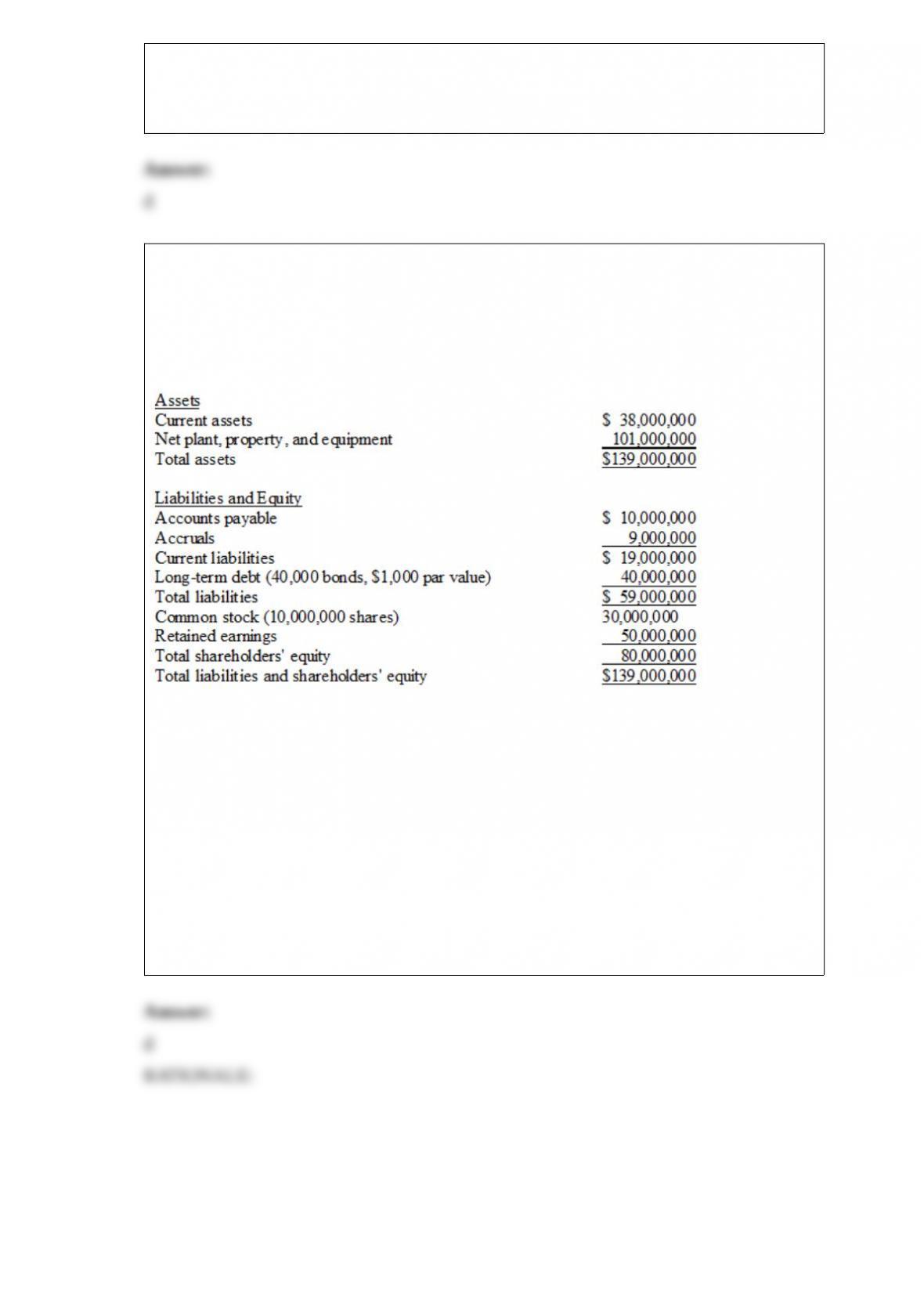
Exhibit 10.1
Assume that you have been hired as a consultant by CGT, a major producer of
chemicals and plastics, including plastic grocery bags, styrofoam cups, and fertilizers,
to estimate the firm’s weighted average cost of capital. The balance sheet and some
other information are provided below.
The stock is currently selling for $15.25 per share, and its noncallable $1,000 par value,
20-year, 7.25% bonds with semiannual payments are selling for $875.00. The beta is
1.25, the yield on a 6-month Treasury bill is 3.50%, and the yield on a 20-year Treasury
bond is 5.50%. The required return on the stock market is 11.50%, but the market has
had an average annual return of 14.50% during the past 5 years. The firm’s tax rate is
40%.
Refer to Exhibit 10.1. Based on the CAPM, what is the firm’s cost of equity?
a.11.15%
b.11.73%
c.12.35%
d.13.00%
e.13.65%

Your firm is currently 100% equity financed. The CFO is considering a recapitalization
plan under which the firm would issue long-term debt with an after-tax yield of 9% and
use the proceeds to repurchase some of its common stock. The recapitalization would
not change the company’s total investor-supplied capital, the size of the firm (i.e., total
assets), and it would not affect the firm’s return on investors’ capital (ROIC), which is
15%. The CFO believes that this recapitalization would reduce the firm’s WACC and
increase its stock price. Which of the following would be likely to occur if the company
goes ahead with the recapitalization plan?
a.The company’s net income would increase.
b.The company’s earnings per share would decline.
c.The company’s cost of equity would increase.
d.The company’s ROA would increase.
e.The company’s ROE would decline.
Which of the following statements is CORRECT?
a.If you add enough randomly selected stocks to a portfolio, you can completely
eliminate all of the market risk from the portfolio.
b.If you were restricted to investing in publicly traded common stocks, yet you wanted
to minimize the riskiness of your portfolio as measured by its beta, then according to
the CAPM theory you should invest an equal amount of money in each stock in the
market. That is, if there were 10,000 traded stocks in the world, the least risky possible
portfolio would include some shares of each one.
c.If you formed a portfolio that consisted of all stocks with betas less than 1.0, which is
about half of all stocks, the portfolio would itself have a beta coefficient that is equal to
the weighted average beta of the stocks in the portfolio, and that portfolio would have
less risk than a portfolio that consisted of all stocks in the market.
d.Market risk can be eliminated by forming a large portfolio, and if some Treasury
bonds are held in the portfolio, the portfolio can be made to be completely riskless.
e.A portfolio that consists of all stocks in the market would have a required return that
is equal to the riskless rate.
Assume that the State of Florida sold tax-exempt, zero coupon bonds with a $1,000
maturity value 5 years ago. The bonds had a 25-year maturity when they were issued,
and the interest rate built into the issue was a nominal 8%, compounded semiannually.
The bonds are now callable at a premium of 4% over the accrued value. What effective
annual rate of return would an investor who bought the bonds when they were issued
and who still owns them earn if they were called today?
a.7.73%
b.8.13%
c.8.56%
d.9.01%
e.9.46%

You sold a car and accepted a note with the following cash flow stream as your
payment. What was the effective price you received for the car assuming an interest rate
of 6.0%?
a.$5,987
b.$6,286
c.$6,600
d.$6,930
e.$7,277
Which of the following statement completions is CORRECT? If the yield curve is
upward sloping, then the marketable securities held in a firm’s portfolio, assumed to be
held for emergencies, should
a.consist mainly of long-term securities because they pay higher rates.
b.consist mainly of short-term securities because they pay higher rates.
c.consist mainly of U.S. Treasury securities to minimize interest rate risk.
d.consist mainly of short-term securities to minimize interest rate risk.
e.be balanced between long- and short-term securities to minimize the adverse effects
of either an upward or a downward trend in interest rates.
If you receive $15,000 today and can invest it at a 5% annual rate compounded
continuously, what will be your ending value after 20 years?
a.$38,735.52
b.$40,774.23
c.$42,812.94
d.$44,953.59
e.$47,201.27
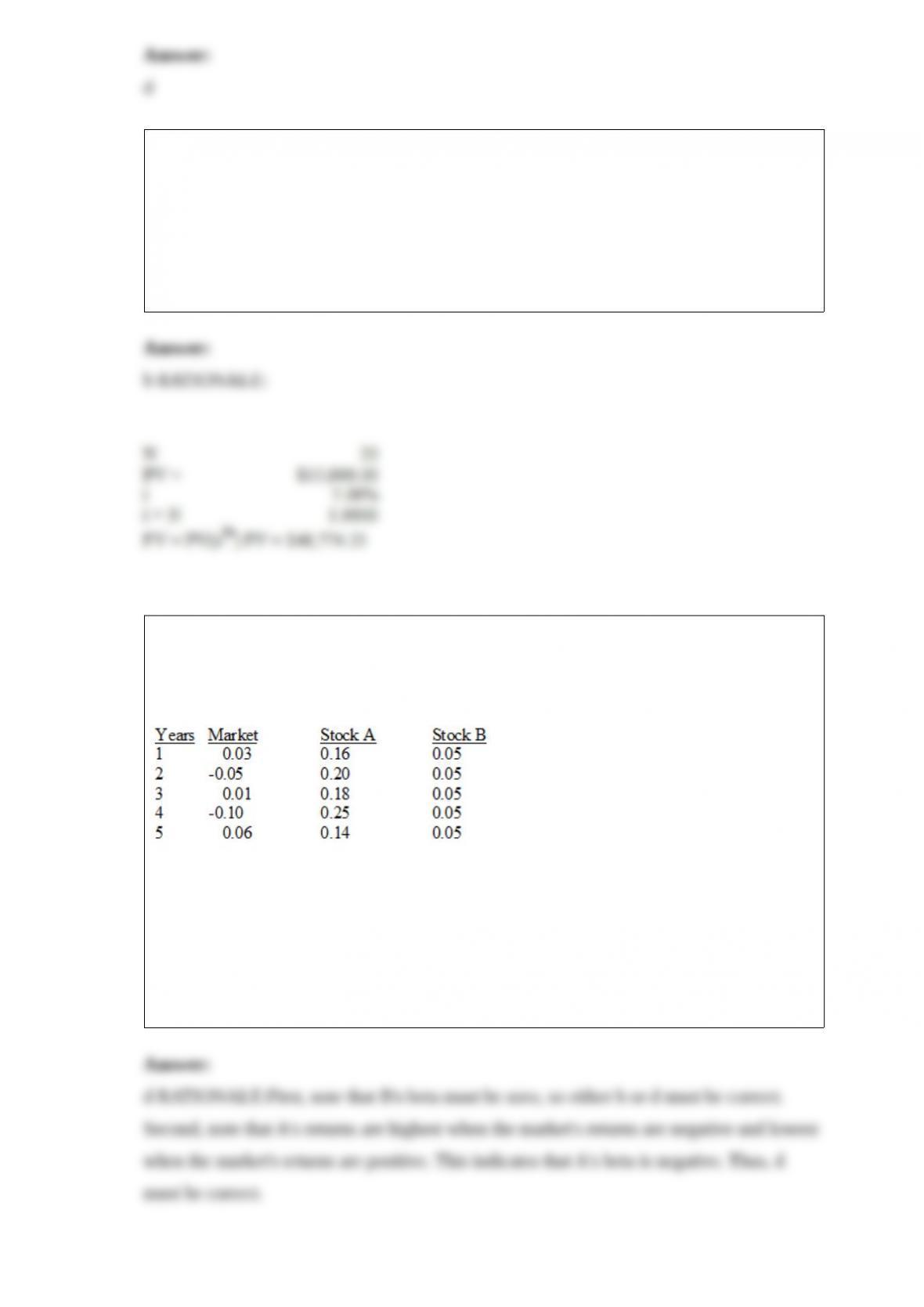
You have the following data on (1) the average annual returns of the market for the past
5 years and (2) similar information on Stocks A and B. Which of the possible answers
best describes the historical betas for A and B?
€
a.bA > 0; bB = 1.
b.bA > +1; bB = 0.
c.bA = 0; bB = -1.
d.bA < 0; bB = 0.
e.bA < -1; bB = 1.