
1) The most common approach to developing proforma financial statements is called
the:
A.cash budget method.
B.financial planning method
C.seasonality approach
D.percent-of-sales method
E.market-oriented approach
F.None of the above
2) Which of the following should be included in the analysis of a new product?
I. Money already spent for research and development of the new product
II. Reduction in sales for a current product once the new product is introduced
III. Increase in working capital needed to finance sales of the new product
IV. Interest expense on the loan used to finance the new product launch
A.II and III only
B.II and IV only
C.I, II, and III only
D.II, III, and IV only
E.I, II, III, and IV
F.None of the above
3) Law Dog, Inc. is a provider of temporary and permanent personnel in legal services.
The following are selected financial data for the company for the period 2000 – 2004.
Use Law Dog’s selected information to answer the following questions:
a. Calculate Law Dog’s sustainable growth rate in each year.
b. Comparing the company’s sustainable growth rate with its actual growth rate in sales,
what growth problems did the company face over this period?
c. Considering economic conditions over the period, what appears a likely cause of
these problems?

4) The financial statements for Limited Brands, Inc. follow (fiscal years ending
January):
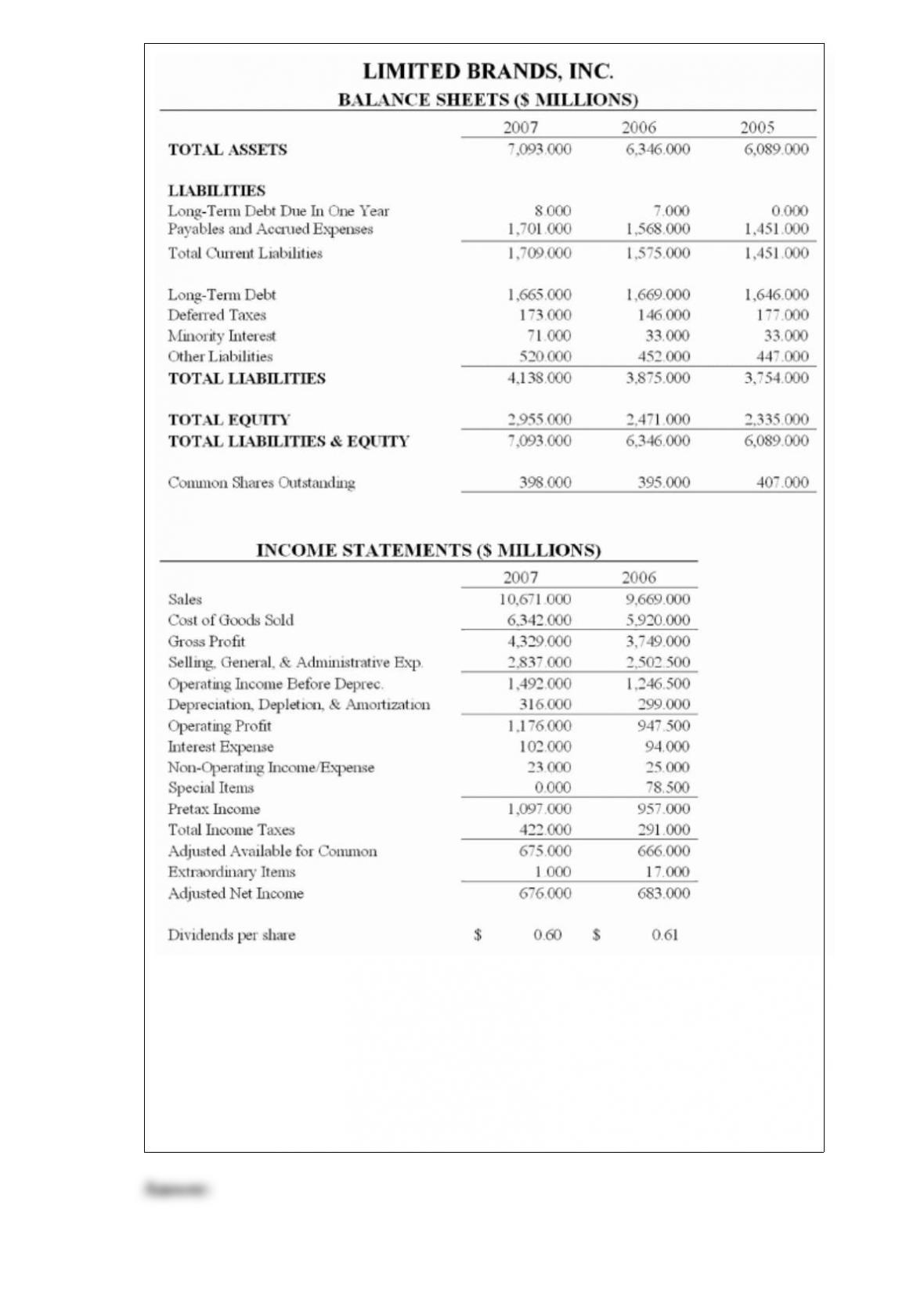
Use Limited Brands, Inc.’s financial statements, above, to answer the following
question. Use the company’s operating profit as an approximation of its EBIT, and
assume a 40% tax rate for your calculations. What percentage decline in earnings before
interest and taxes could Limited Brands have sustained in fiscal years 2006 and 2007
before failing to cover:
a) Interest and principal repayment requirements;
b) Interest, principal and common dividend payments?

5) To estimate Missed Places, Inc.’s (MP) external financing needs, the CFO needs to
figure out how much equity her firm will have at the end of next year. At the end of the
most recent fiscal year, MP’s retained earnings were $158,000. The Controller has
estimated that over the next year, gross profits will be $360,700, earnings after tax will
total $23,400, and MP will pay $12,400 in dividends. What are the estimated retained
earnings at the end of next year?
A.$169,000
B.$170,400
C.$181,400
D.$506,300
E.$518,700
F.None of the above
6) You are estimating your company’s external financing needs for the next year. At the
end of the year you expect that owners’ equity will be $80 million, total assets will
amount to $170 million, and total liabilities will be $70 million. How much will your
firm need to borrow, or otherwise acquire, from outside sources during the year?
A.$20 million
B.$70 million
C.$150 million
D.$160 million
E.$180 million
F.None of the above
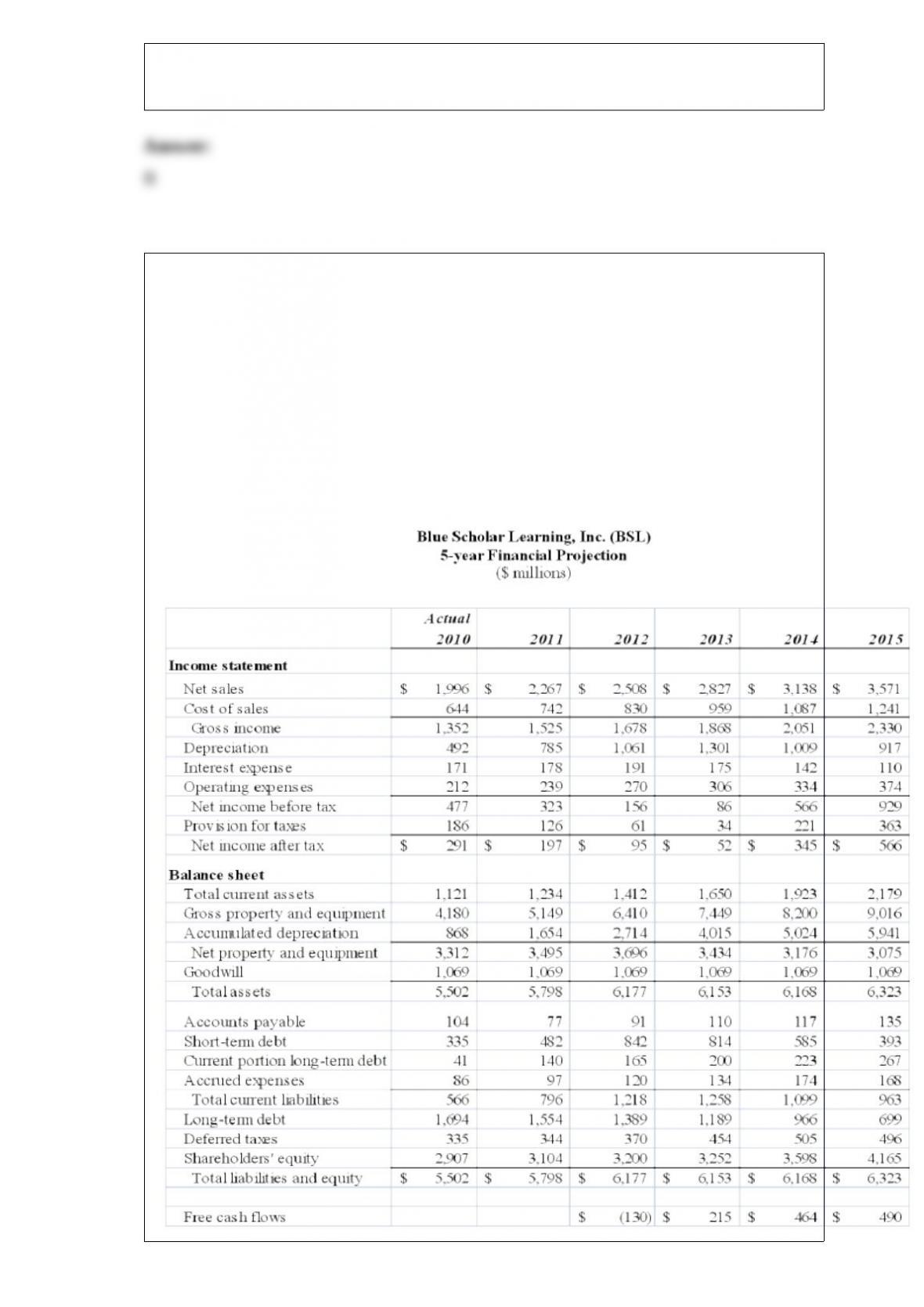
7) Figure 9.1
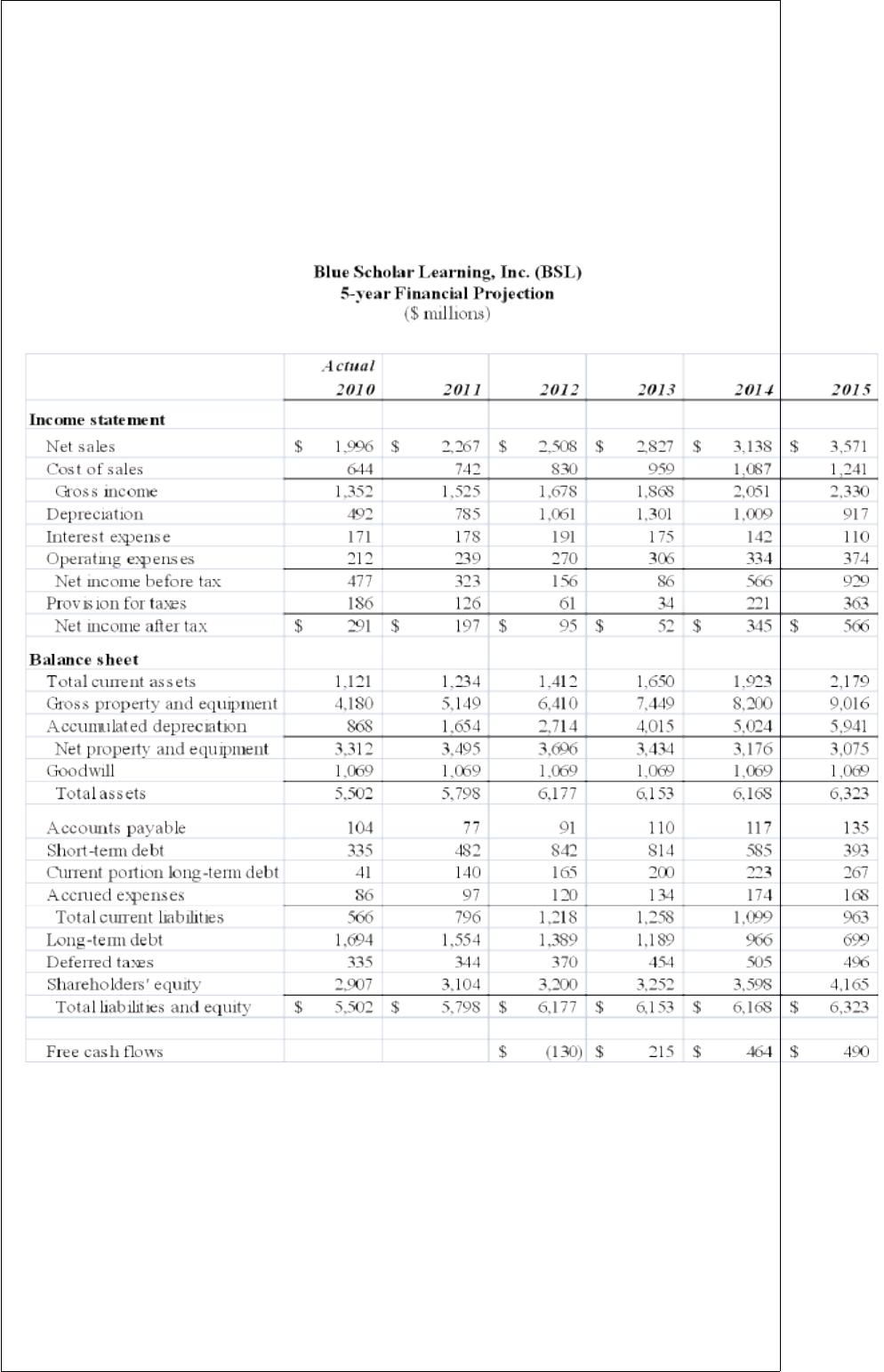
In March of 2011, Macklemore Corp. considered an acquisition of Blue Scholar
Learning, Inc. (BSL), a privately-held educational software firm. As a first step in
deciding what price to bid for BSL, Macklemore’s CFO, Ryan Lewis, has prepared a
five-year financial projection for the company assuming the acquisition takes place.
Use this projection and BSL’s 2010 actual financial figures to answer the questions
below.
Estimate BSL’s value (in $ millions) at the end of 2010 assuming it is worth the book
value of its assets at the end of 2015. Macklemore’s WACC is 8.0 percent. BSL’s
WACC is 11.5 percent, and the average of the two companies’ WACCs, weighted by
sales, is 8.2 percent.
A.$628.24
B.$3,669.01
C.$4,297.25
D.$4,412.94
E.$4,984.28
F.$6,951.24
G.None of the above

8) Financial leverage:
I. increases expected ROE but does not affect its variability.
II. increases breakeven, like operating leverage, but increases the rate of earnings per
share growth once breakeven is achieved.
III. is a fundamental financial variable affecting sustainable growth.
IV. increases expected return and risk to owners.
A.I and II only
B.I and III only
C.II and IV only
D.II, III, and IV only
E.I, II, III, and IV
F.None of the above
9) Figure 9.1
In March of 2011, Macklemore Corp. considered an acquisition of Blue Scholar
Learning, Inc. (BSL), a privately-held educational software firm. As a first step in
deciding what price to bid for BSL, Macklemore’s CFO, Ryan Lewis, has prepared a
five-year financial projection for the company assuming the acquisition takes place.
Use this projection and BSL’s 2010 actual financial figures to answer the questions
below.
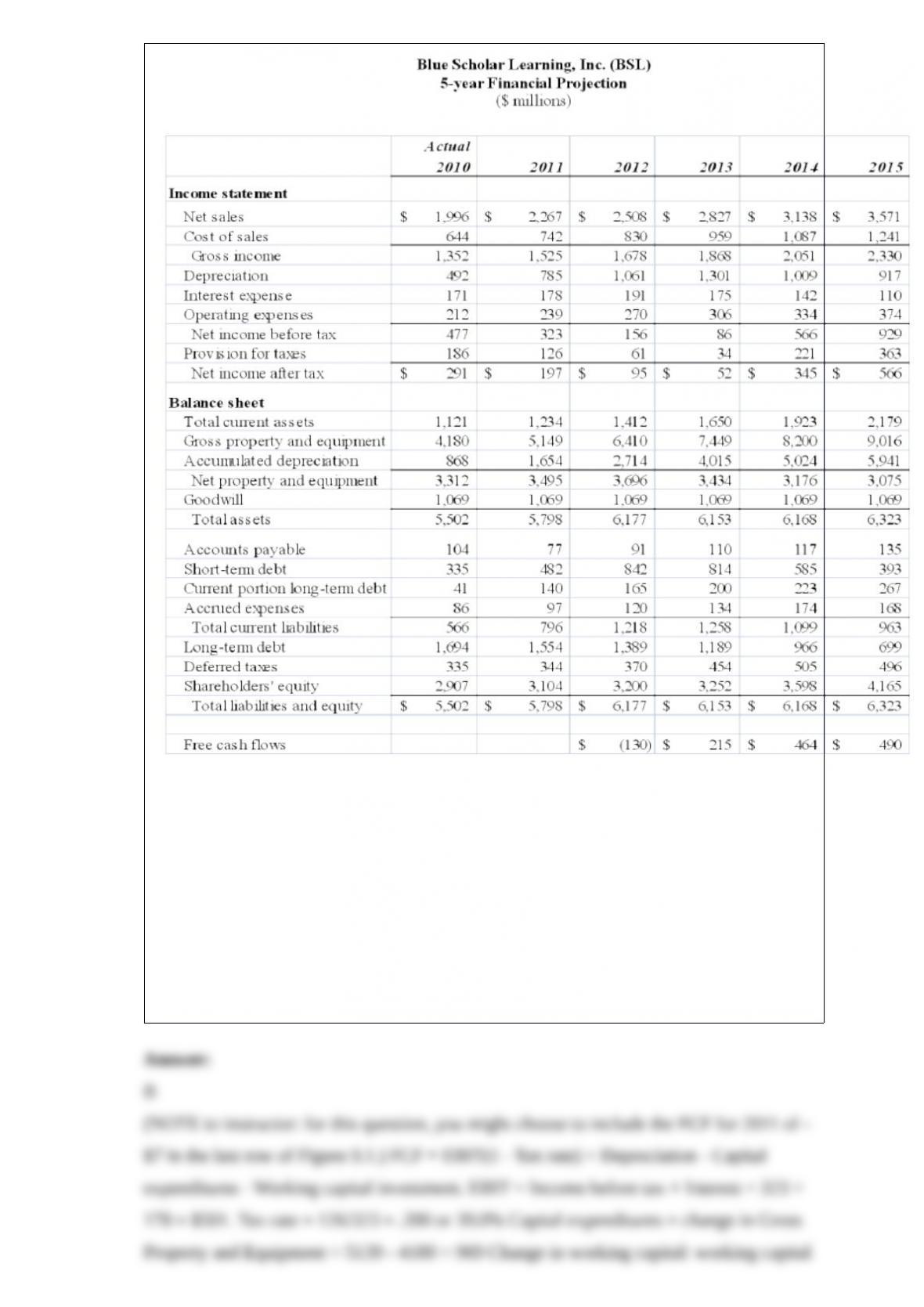
Assume that at year-end 2015 the company’s equity is worth 15 times earnings after tax
and its debt is worth book value. Macklemore’s WACC is 8.0 percent. BSL’s WACC is
11.5 percent, and the average of the two companies’ WACCs, weighted by sales, is 8.2
percent. What is the maximum acquisition price (in $ millions) Macklemore should pay
to acquire BSL’s equity at the end of 2010?
A.$3,484.68
B.$4,723.26
C.$4,938.06
D.$5,554.68
E.$6,343.26
F.None of the above

10) At the end of fiscal year 2011, Crane Industries, Inc.’s stock price was $30.75. A
year later it was $34.88. Per share dividends over the year were $0.55, while earnings
per share were $1.33. What rate of return did the common stock owners earn in fiscal
year 2012?
A.1.79%
B.4.33%
C.43%
D.15.22%
E.17.76%
F.None of the above
11) Which of the following is NOT a likely financing policy for a rapidly growing
business?
A.Adopt a modest dividend payout policy that enables the company to finance most of
its growth externally
B.Borrow funds rather than limit growth, thereby limiting growth only as a last resort
C.Maintain a conservative leverage ratio to ensure continuous access to financial
markets
D.If external financing is necessary, use debt to the point it does not affect financial
flexibility
E.None of the above
12)
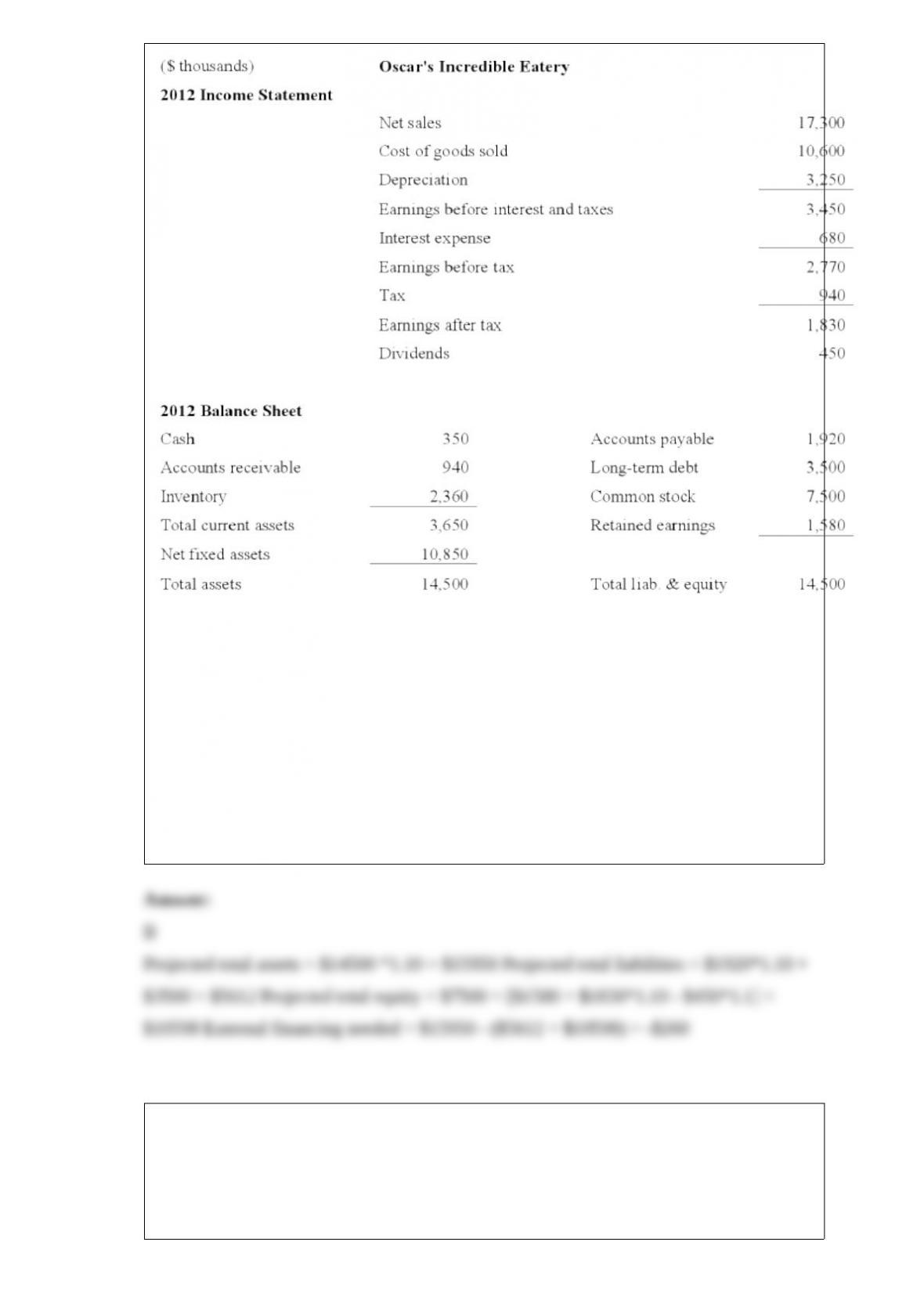
Please refer to Oscar’s financial statements. Assume a constant net profit margin and
dividend payout ratio, and further assume all of Oscar’s assets and current liabilities
vary directly with sales. Assume long-term debt and common stock remain unchanged.
Sales are projected to increase by 10 percent. What is the external financing need for
next year?
A.-$410
B.-$260
C.$235
D.$1,320
E.$7,240
F.None of the above
13) Which one of the following correctly defines the retention ratio?
A.one plus the dividend payout ratio
B.additions to retained earnings divided by net income
C.additions to retained earnings divided by dividends paid
D.net income minus additions to retained earnings
E.net income minus cash dividends
F.None of the above
14) Figure 9.1
In March of 2011, Macklemore Corp. considered an acquisition of Blue Scholar
Learning, Inc. (BSL), a privately-held educational software firm. As a first step in
deciding what price to bid for BSL, Macklemore’s CFO, Ryan Lewis, has prepared a
five-year financial projection for the company assuming the acquisition takes place.
Use this projection and BSL’s 2010 actual financial figures to answer the questions
below.
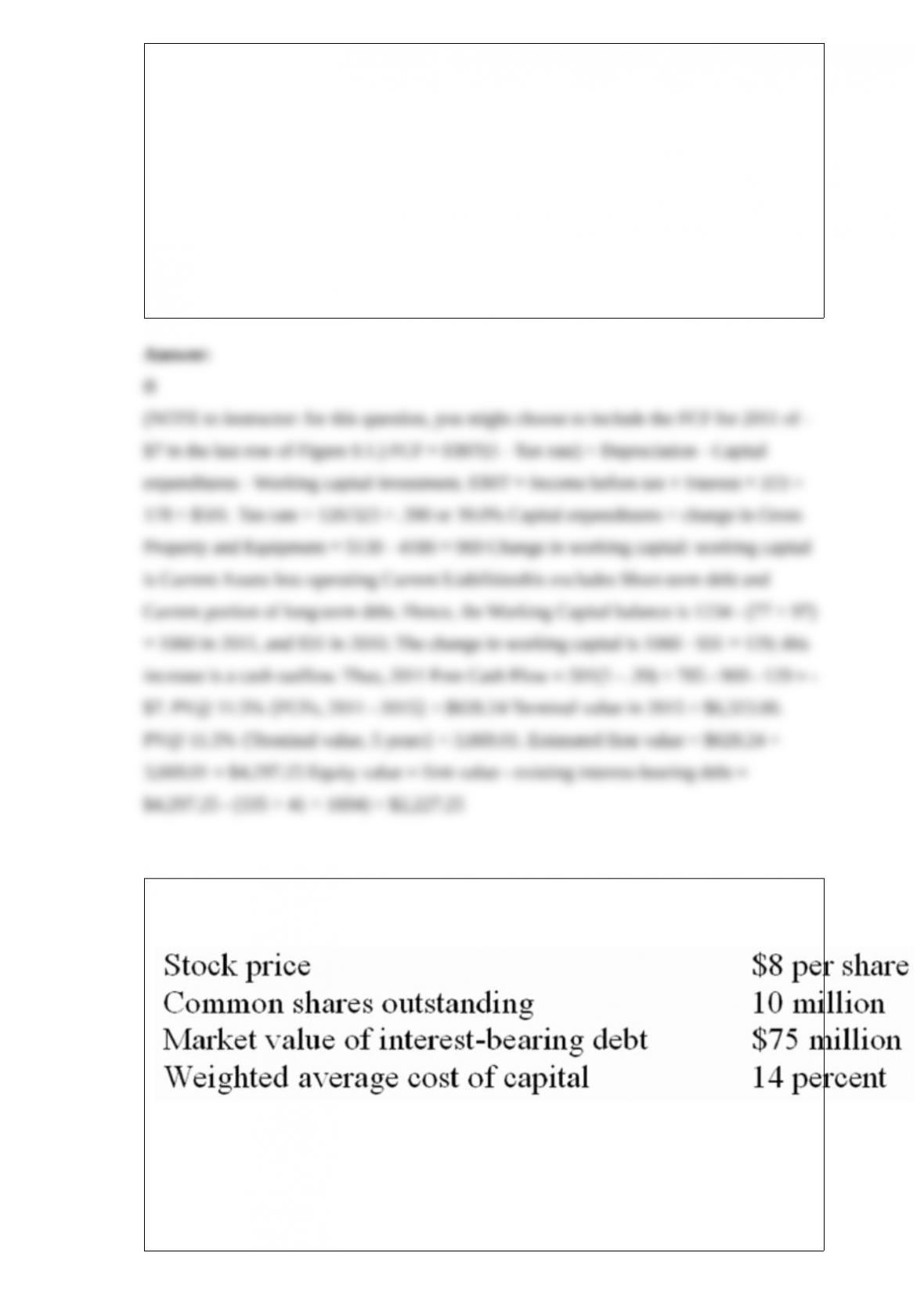
Assume BSL is worth the book value of its assets at the end of 2015. Macklemore’s
WACC is 8.0 percent. BSL’s WACC is 11.5 percent, and the average of the two
companies’ WACCs, weighted by sales, is 8.2 percent. What is the maximum
acquisition price (in $ millions) Macklemore should pay to acquire BSL’s equity?
A.$1,702.25
B.$2,227.25
C.$2,342.94
D.$2,383.94
E.$2,603.25
F.$4,297.25
G.None of the above
15) The following information is available about Chiantivino Corp. (CC):
An activist investor is confident that by terminating CC’s money-losing fortified wine
division, she can increase free cash flow by $4 million annually for the next decade. In
addition, she estimates that an immediate, special dividend of $10 million can be
financed by the sale of the division.
a. Assuming these actions do not affect CC’s cost of capital, what is the maximum price

per share the investor would be justified in bidding for control of CC? What percentage
premium does this represent?
b. Show your answer if you conduct a sensitivity analysis by assuming the cost of
capital is 15 percent and the increased cash flow is only $3.5 million per year.
16) The following table presents forecasted financial and other information for Scott’s
Miracle-Gro Co.:
What is an appropriate estimate of Scott’s terminal value as of the end of 2014, using a
warranted multiple of free cash flow as your estimate?
A.$155 million
B.$2,895 million
C.$3,007.0 million
D.$4,365.0 million
E.$7,042.2 million
F.None of the above
17) Which of these ratios are the determinants of a firm’s sustainable growth rate?
I. Assets-to-equity ratio
II. Profit margin
III. Retention ratio
IV. Asset turnover ratio
A.I and III only
B.II and III only
C.II, III, and IV only
D.I, II, and III only
E.I, II, III, and IV
F.None of the above
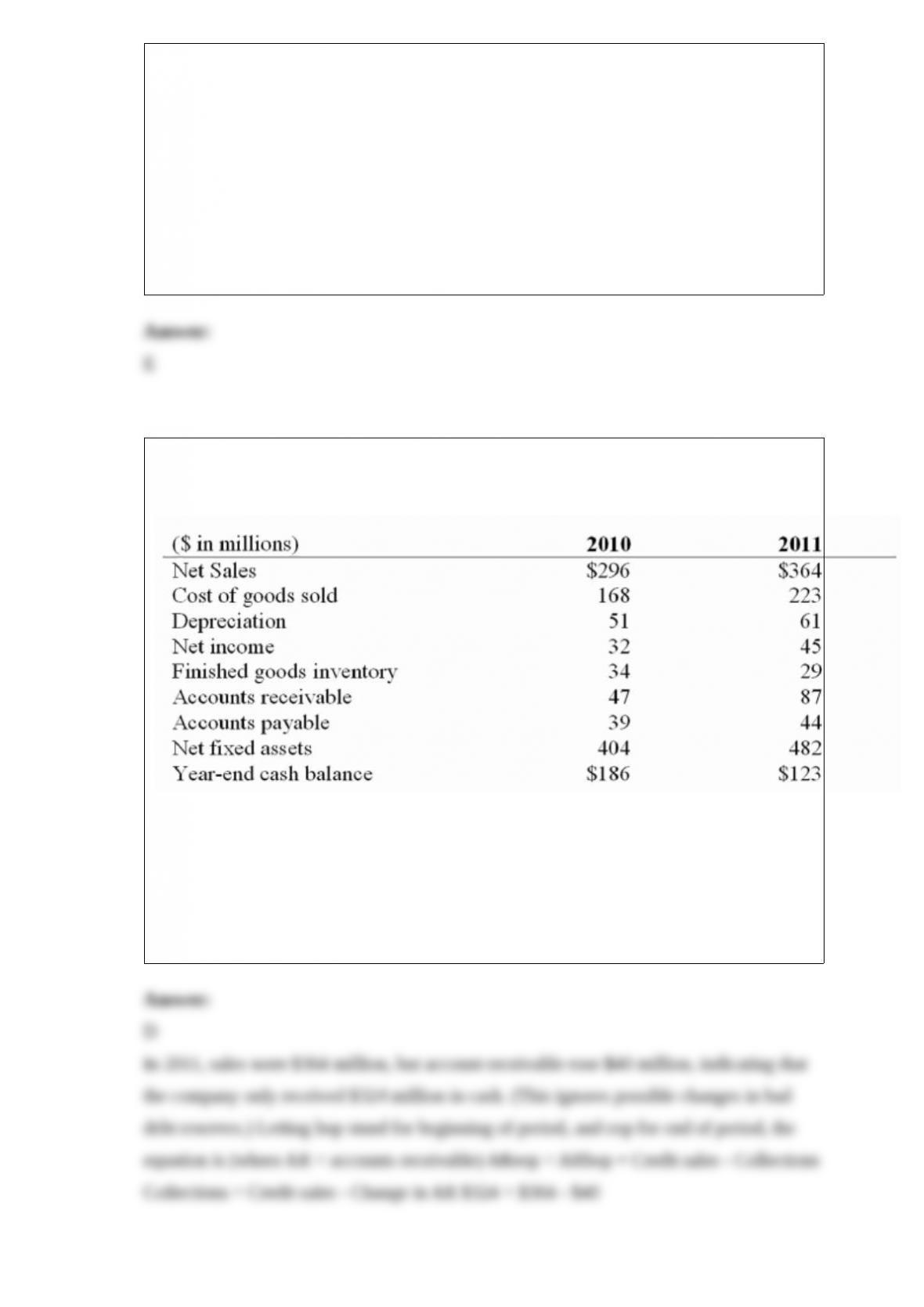
18) Selected information about South, Inc., a restaurant chain, follows.
During 2011, how much cash (in $ millions) did South collect from sales?
A.364
B.277
C.404
D.324
E.451
F.None of the above

19) Assume you are a banker who has loaned money to a firm, but that firm is now
facing increased competition and reduced cash flows. Which one of the following ratios
would you most closely monitor to evaluate the firm’s ability to repay its loan?
A.current ratio
B.debt-to-equity ratio
C.times interest earned ratio
D.times burden covered ratio
E.None of the above.
20) The excess return earned by a risky asset, for example with a beta of 1.4, over that
earned by a risk-free asset is referred to as a:
A.market risk premium
B.risk premium
C.systematic return
D.total return
E.real rate of return
F.None of the above
21) Consider the following premerger information about a bidding firm (Buyitall Inc.)
and a target firm (Tarjay Corp.). Assume that neither firm has any debt outstanding.
Buyitall has estimated that the present value of any enhancements that Buyitall expects
from acquiring Tarjay is $2,600. What is the NPV of the merger assuming that Tarjay is
willing to be acquired for $28 per share in cash?
A.$400
B.$600
C.$1,800
D.$2,200

E.$2,600
F.None of the above
22) Which one of the following statements does NOT describe a problem with using
ROE as a performance measure?
A.ROE measures return on accounting book value, and this problem is not solved by
using market value
B.ROE is a forward-looking, one-period measure, while business decisions span the
past and present
C.ROE measures only return, while financial decisions involve balancing risk against
return.
D.None of these describe problems with ROE
E.All of these describe problems with ROE
23) Which of the following factors favor the issuance of debt in the financing decision?
I. Market signaling
II. Distress costs
III. Management incentives
IV. Financial flexibility
A.I and II only
B.I and III only
C.II and IV only
D.I, II, and III only
E.I, II, and IV only
F.None of the above
24) You are the beneficiary of a life insurance policy. The insurance company informs
you that you have two options for receiving the insurance proceeds. You can receive a
lump sum of $200,000 today or receive payments of $1,400 a month for 20 years. You

can earn a 6 percent annual rate on your money, compounded monthly. Which option
should you take and why?
A.You should accept the monthly payments because they are worth $209,414 to you
B.You should accept the $200,000 lump sum because the monthly payments are only
worth $16,057 to you today
C.You should accept the monthly payments because they are worth $336,000 to you
D.You should accept the $200,000 lump sum because the monthly payments are only
worth $189,311 to you today
E.You should accept the $200,000 lump sum because the monthly payments are only
worth $195,413 to you today
F.None of the above
25) A project will produce after-tax operating cash inflows of $3,200 a year for 5 years.
The after-tax salvage value of the project is expected to be $2,500 in year 5. The
project’s initial cost is $9,500. What is the net present value of this project if the
required rate of return is 16 percent?
A.-$302
B.$2,168.02
C.$4,650.11
D.$9,188.98
E.$21,168.02
F.None of the above
26) At $1,000 par value, 10 percent coupon bond matures in 20 years. If the price of the
bond is $1,196.80, what is the yield to maturity on the bond? Assume interest is paid
annually.