1) The contribution-margin ratio is calculated as unit contribution margin divided by the
selling price per unit.
2) Finished goods inventory is ordinarily held for sale by a manufacturing company.
3) Middle-level managers would likely be considered internal users of accounting
information rather than external users.
4) That employees make little effort to achieve budgetary goals is an outcome
sometimes associated with participative budgeting.
5) A firm that decides to emphasize those goods with the highest contribution margin
per unit may have made an incorrect decision when the company has capacity
constraints in the form of limited resources.
6) Absorption costing is required for tax purposes.
7) Melborne Corporation manufactures a single product that has a cost of $350. The
company uses a 70% markup on cost to arrive at a selling price of $595, which results
in a price that virtually always exceeds that of the market leaders. If Mohawk changes
to the approach known as target costing, the company will first undertake a thorough
study of competitors’ prices.

8) Fixed manufacturing overhead is not inventoried under absorption costing.
9) The least-squares regression method of cost estimation relies on only two data points.
10) The concept of a relevant cost can be defined as a past cost that differs among
alternatives.
11) A controller is normally involved with preparing financial statements.
12) The comprehensive set of budgets that serves as a company’s overall financial plan
is commonly known as the financial budget.
13) When units sold exceed units produced, absorption-costing income will be lower
than variable-costing income.
14) A company that uses activity-based costing would likely allocate costs from
activity-cost pools to products and services.
15) For external-reporting purposes, generally accepted accounting principles require
that net income be based on variable costing.
16) The budgeting technique that helps managers assess the company’s future and know
if they are reaching their performance goals is called life-cycle budgeting.
17) A controller is normally involved with preparing financial statements.
18) Which of the following is (are) a key feature of target costing?
A.The use of cross-functional teams
B.A focus on the customer
C.A focus on product design
D.A focus on process design
E.All of the other answers are correct
19) Assuming no change in sales volume, an increase in company’s per-unit
contribution margin would:
A.increase income
B.decrease income
C.have no effect on income
D.increase fixed costs
E.decrease fixed costs
20) Marcellus Corporation, which uses the weighted-average method of process
costing, reported the following as of February 1:
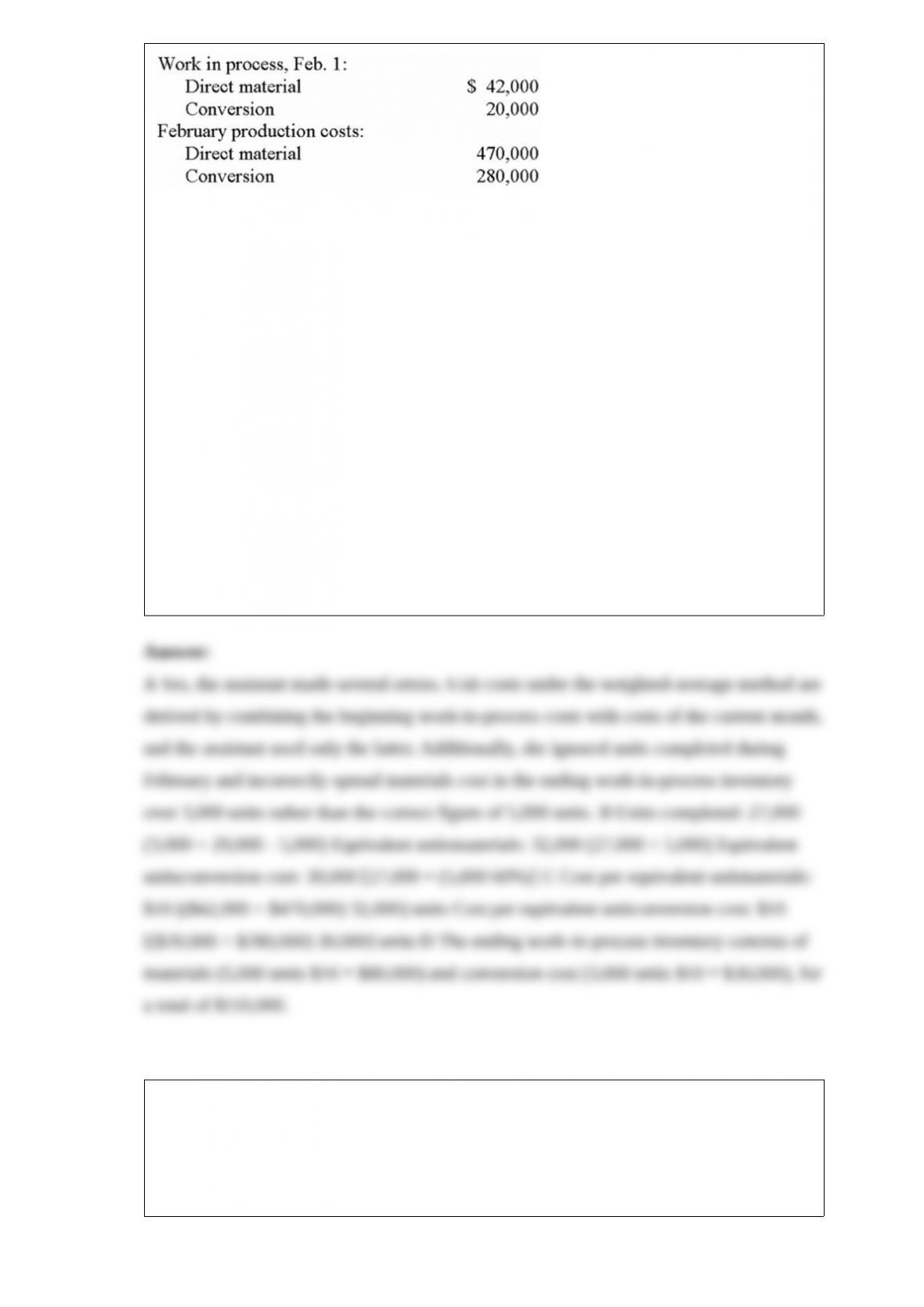
Conversations with the production supervisor revealed that materials are introduced at
the start of the process and conversion cost is incurred evenly throughout
manufacturing. The company started 29,000 units during the month. Goods in process
at the beginning and end of February totaled 3,000 units and 5,000 units, respectively,
the latter batch being 60% complete.
Just prior to leaving on vacation, a trusted staff assistant was asked to compute the cost
of February’s ending work-in-process inventory. Her calculations showed a huge rise in
unit cost when compared with the February 1 figures, soaring to $250 [($470,000 +
$280,000) 3,000 units (5,000 units 60%)].
Required:
A. Did the staff assistant make any errors in her calculations? Explain.
B. Analyze the company’s production volume and determine the proper equivalent-unit
figures for February.
C. Calculate the proper unit costs for February.
D. Calculate the cost of the February 28 work-in-process inventory.
21) Riverside Florists uses an activity-based costing system to compute the cost of
making floral bouquets and delivering the bouquets to its commercial customers.
Company personnel who earn $180,000 typically perform both tasks; other firm-wide
overhead is expected to total $70,000. These costs are allocated as follows:
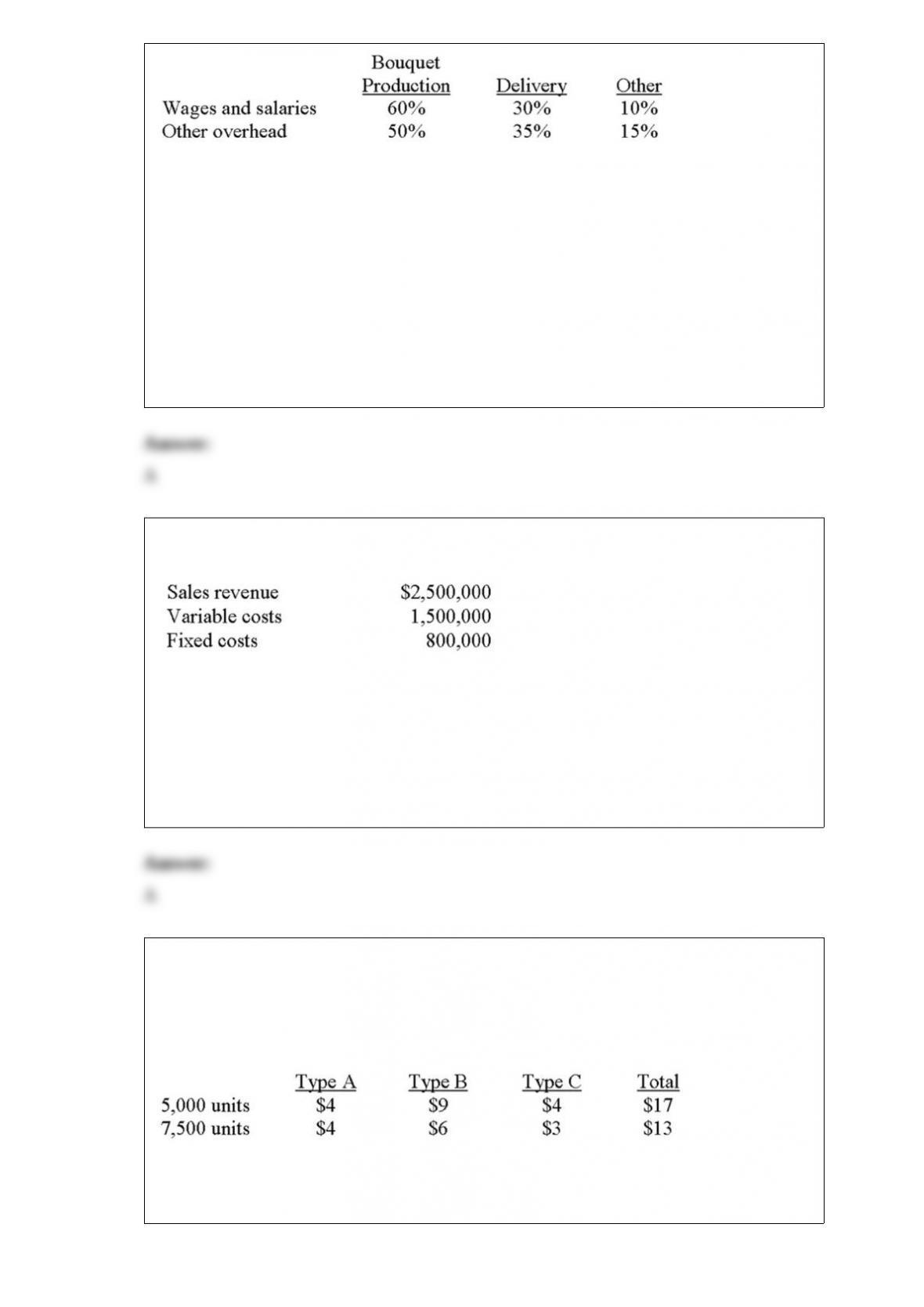
Riverside anticipates making 20,000 bouquets and 4,000 deliveries in the upcoming
year.
The cost of wages and salaries and other overhead that would be charged to each
bouquet made is:
A.$7.15
B.$8.75
C.$12.50
D.$13.75
E.None of the other answers is correct
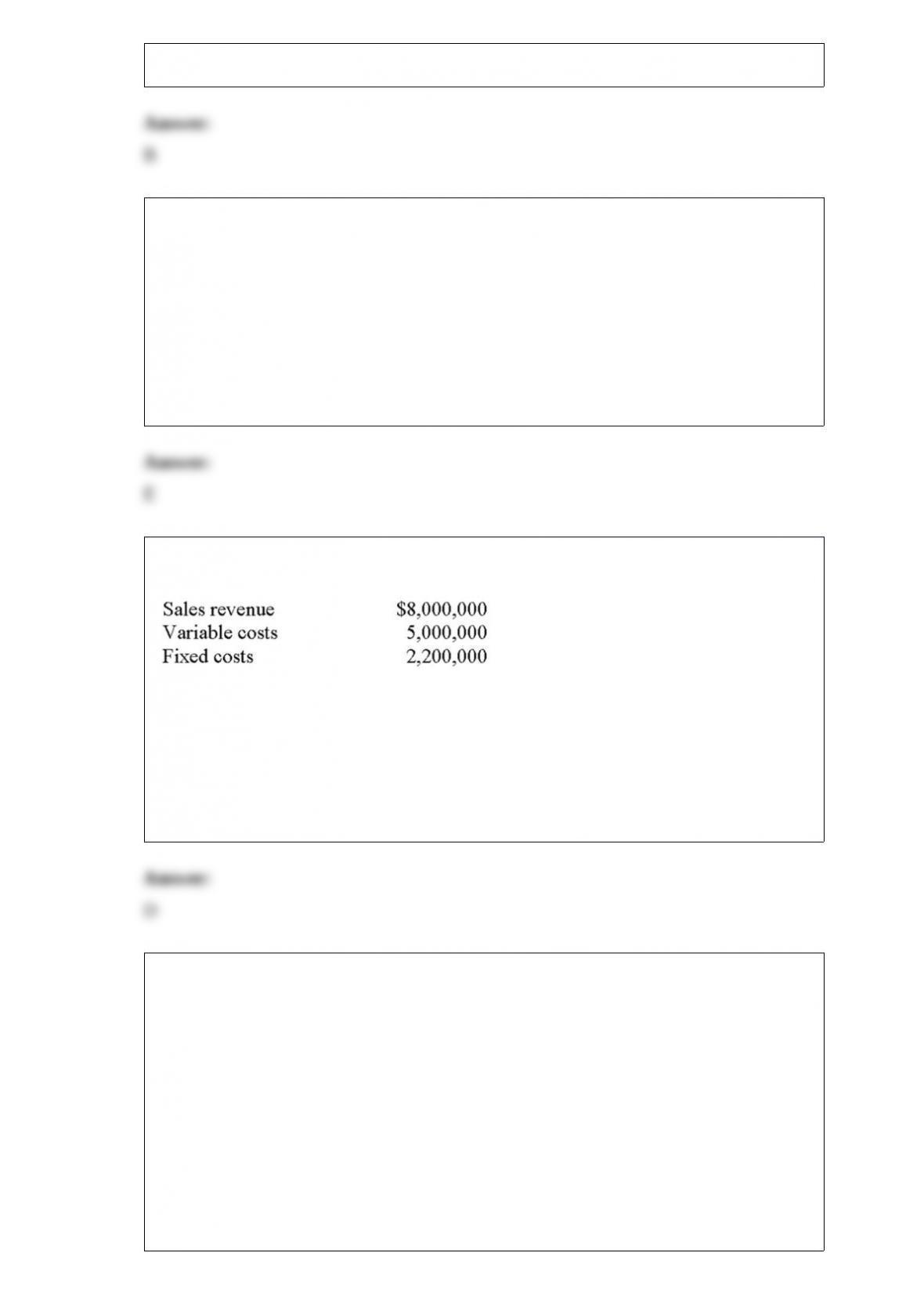
22) A recent income statement of Yang Corporation reported the following data:
If these data are based on the sale of 5,000 units, the break-even sales would be:
A.$2,000,000
B.$2,206,000
C.$2,500,000
D.$10,000,000
E.None of the other answers is correct
23) Yang Manufacturing, which uses the high-low method, makes a product called Yin.
The company incurs three different cost types (A, B, and C) and has a relevant range of
operation between 2,500 units and 10,000 units per month. Per-unit costs at two
different activity levels for each cost type are presented below.
The cost types shown above are identified by behavior as:
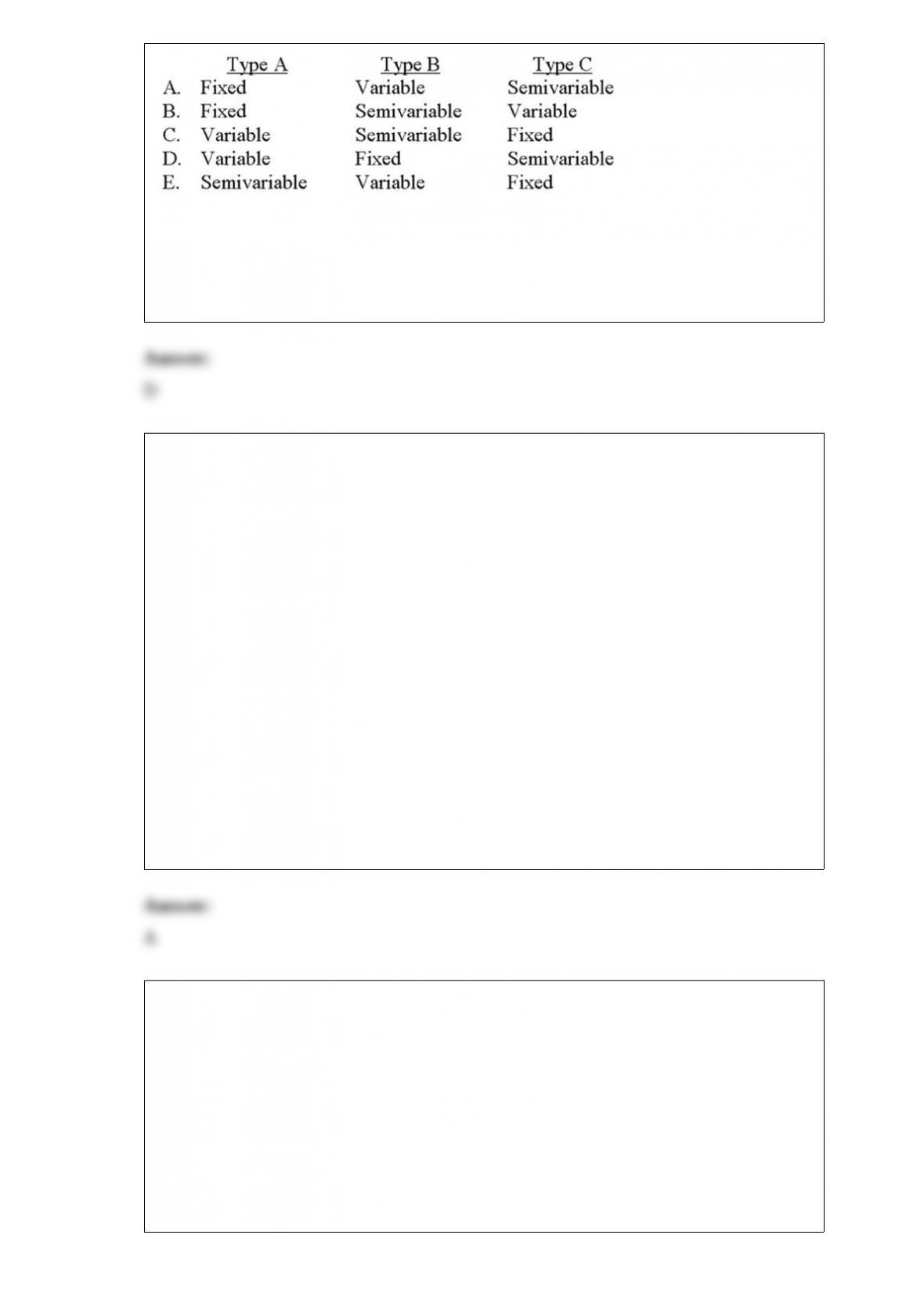
A.Choice A
B.Choice B
C.Choice C
D.Choice D
E.Choice E
24) Taylor Enterprises purchased 56,000 pounds (cost = $420,000) of direct material to
be used in the manufacture of the company’s sole product. According the production
specifications, each completed unit requires five pounds of direct material at a standard
cost of $7.80 per pound. Direct materials consumed by the end of the period totaled
53,500 pounds in the manufacture of 10,900 finished units.
An examination of Taylor’s payroll records revealed that the company worked 22,000
labor hours (cost = $319,000) during the period, and specifications called for each
completed unit requiring two hours of labor at a standard cost of $14.80 per hour.
Assume that the company computes variances at the earliest point in time.
Taylor’s direct-material quantity variance was:
A.$7,800F
B.$16,800F
C.$7,800U
D.$16,800U
E.none of the other answers are correct
25) To achieve the objectives of sections 302 and 404 of the Sarbanes-Oxley Act,
management and independent auditors should:
A.Disclose the minutia of the internal control structure
B.Conduct a cost-benefit analysis prior to deciding whether or not to adopt these
sections
C.Emphasize those areas where the greatest risk of fraud or material misstatement is
likely to occur
D.Analyze all financial transactions that are included in the reported financial
statements
E.Work together to design the most effective internal control system
26) Which of the following would not be considered if a company desires to establish a
series of practical manufacturing standards?
A.Production time lost during unusual machinery breakdowns
B.Normal worker fatigue
C.Freight charges on incoming raw materials
D.Production time lost during setup procedures for new manufacturing runs
E.The historical 2% defect rate associated with raw material inputs
27) Newbill Enterprises recently used 24,000 labor hours to produce 8,600 completed
units. According to manufacturing specifications, each unit is anticipated to take 2.75
hours to complete. The company’s actual payroll cost amounted to $456,000. If the
standard labor cost per hour is $19.20, Newhart’s labor rate variance is:
A.$1,920U
B.$1,920F
C.$4,800U
D.$4,800F
E.none of the other answers are correct
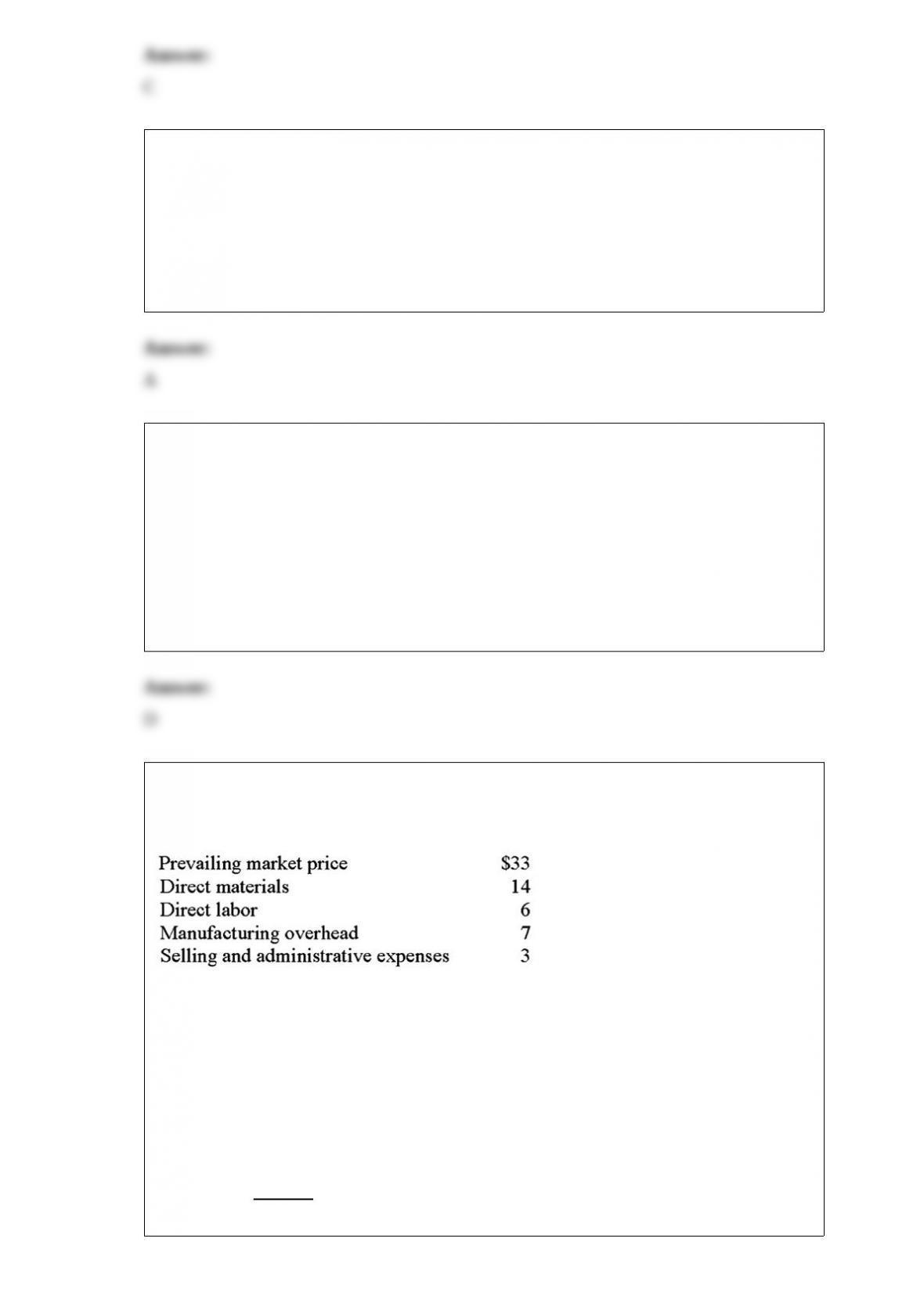
28) Morrow Corporation manufactures part no. 67, which is used in the production of
mountain bikes. Per-unit information about part no. 67 follows.
Morrow has traditionally used a 20% markup on total cost to arrive at a reasonable
selling price. The company, though, has noticed a sizable drop in sales volume during
the last few quarters, which it attributes to new entrants in the marketplace.
Required:
A. Compute the current selling price of part no. 67 .
B. If management desired to meet the prevailing market price and maintain the current
rate of profit on sales, what must happen to the company’s total manufacturing costs?
By how much?
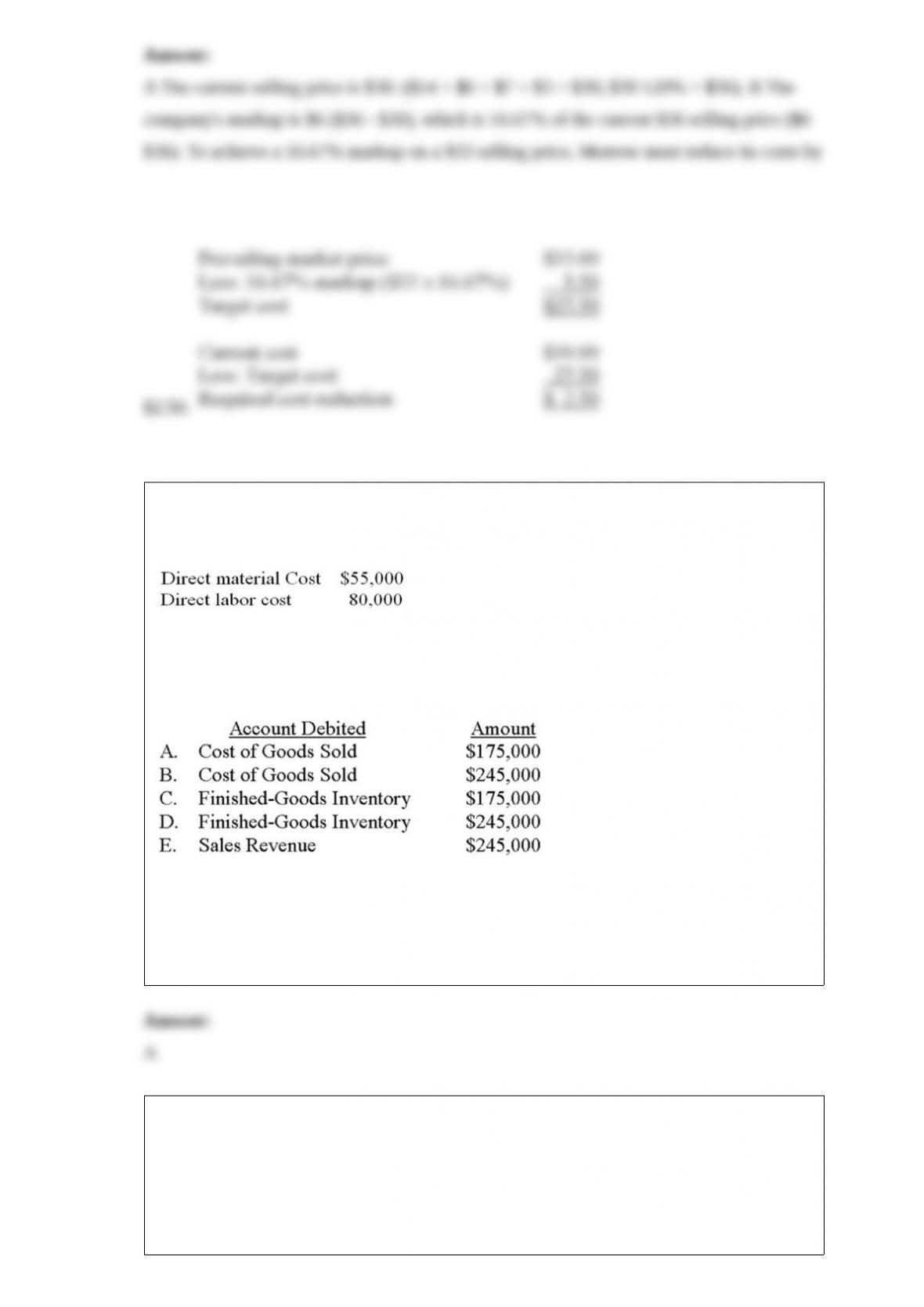
29) Blarney Company applies manufacturing overhead by using a predetermined rate of
50% of direct labor cost. The data that follow pertain to job no. 764:
If Blarney adds a 40% markup on total cost to generate a profit, which of the following
choices depicts a portion of the accounting needed to record the sale of job no. 764?
A.Choice A
B.Choice B
C.Choice C
D.Choice D
E.Choice E
30) The following information relates to October:
Production supervisor’s salary: $3,500
Factory maintenance wages: 250 hours at $10 per hour
The journal entry to record the preceding information is:
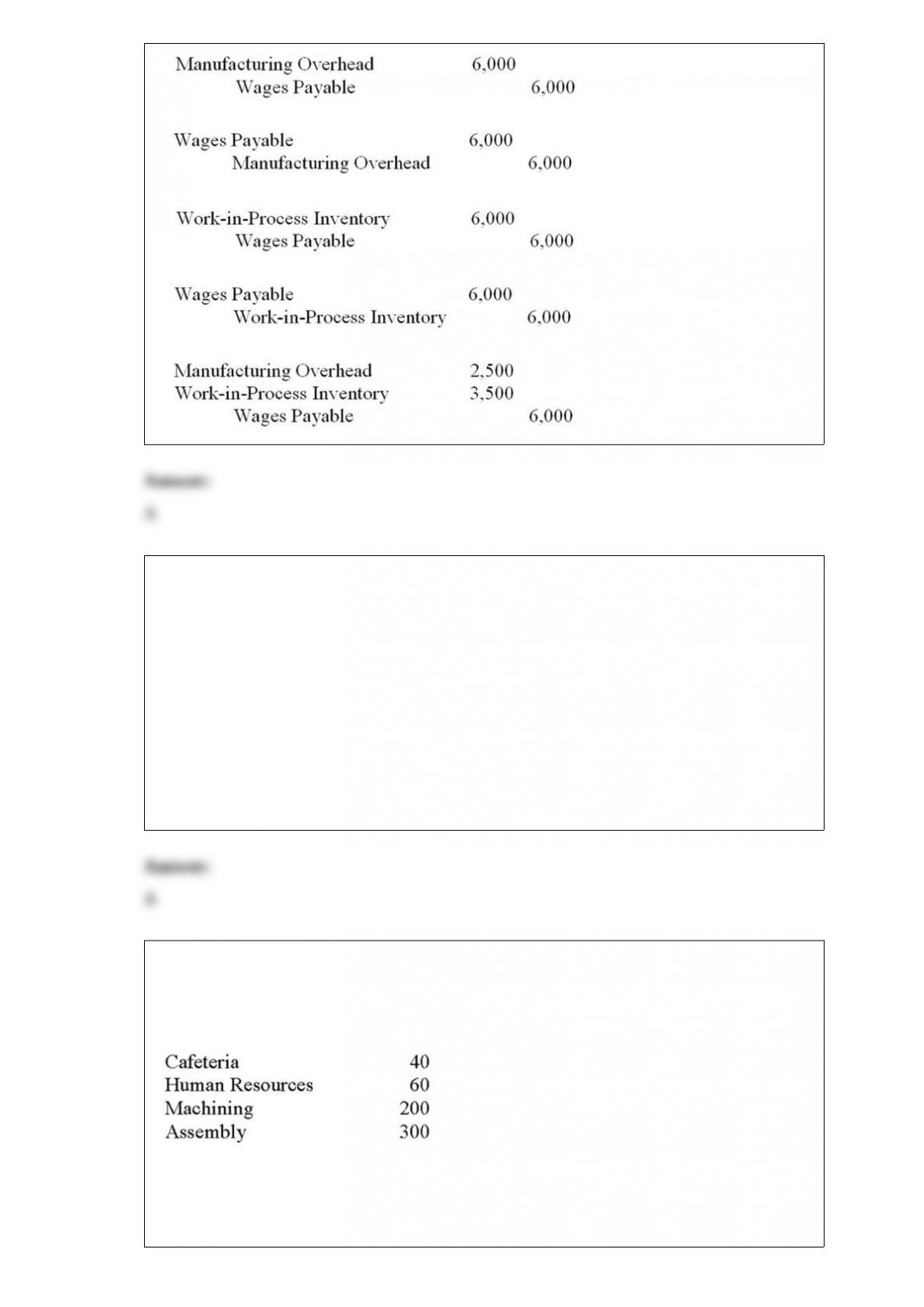
A.
B.
C.
D.
E.
31) Swanson and Associates presently leases a copy machine under an agreement that
calls for a fixed fee each month and a charge for each copy made. Swanson made 7,000
copies and paid a total of $360 in March; in May, the firm paid $280 for 5,000 copies.
The company uses the high-low method to analyze costs.
Swanson’s monthly fixed fee is:
A.$80
B.$102
C.$106
D.$112
E.None of the other answers is correct
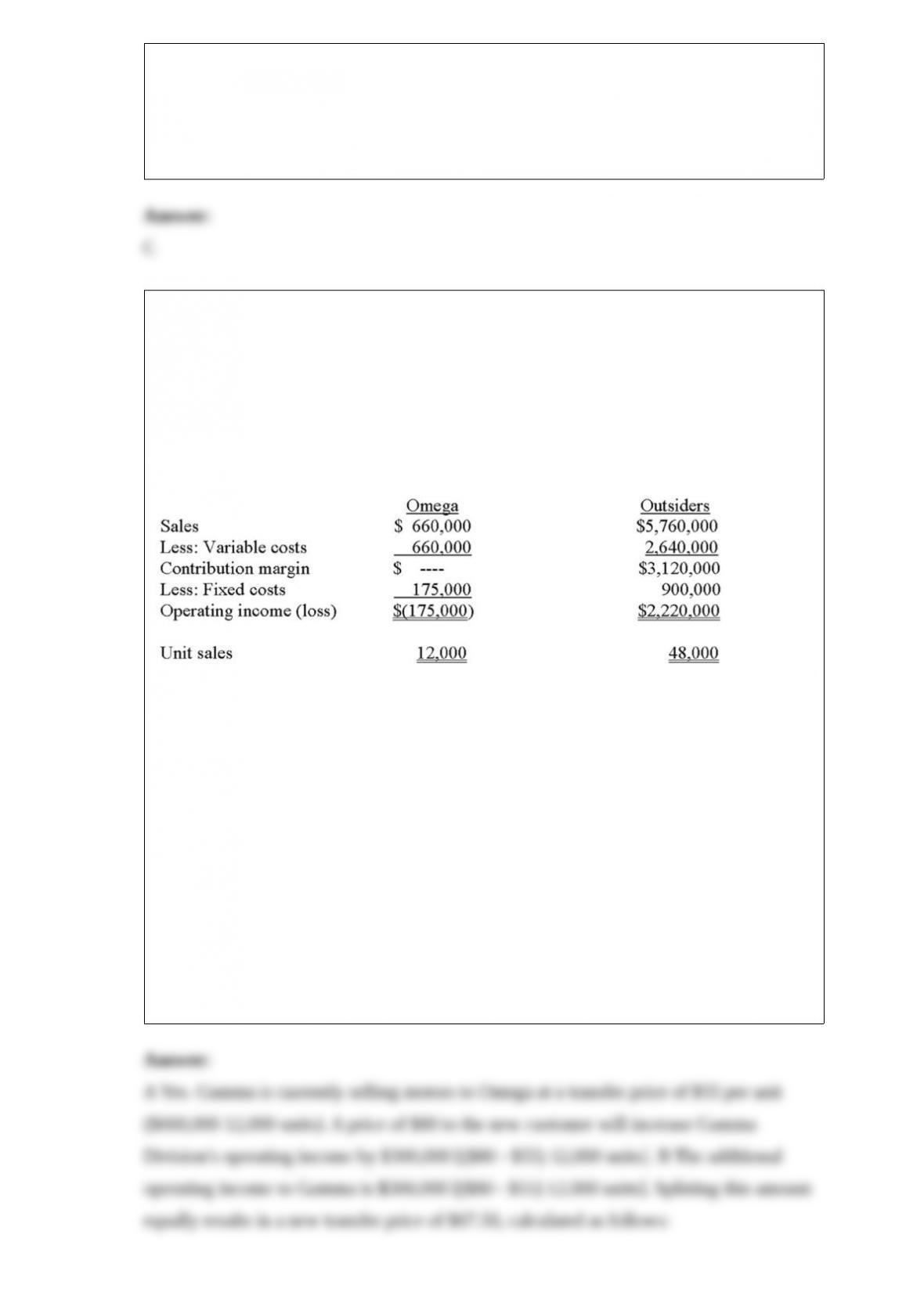
32) Pederson Company has two service departments (Cafeteria and Human Resources)
and two production departments (Machining and Assembly). The number of employees
in each department follows.
Pederson uses the direct method of cost allocation and allocates cost on the basis of
employees. If Human Resources cost amounts to $1,800,000, how much of the
department’s cost would be allocated to Assembly?
A.$900,000
B.$720,000
C.$1,080,000
D.$1,200,000
E.None of the other answers are correct
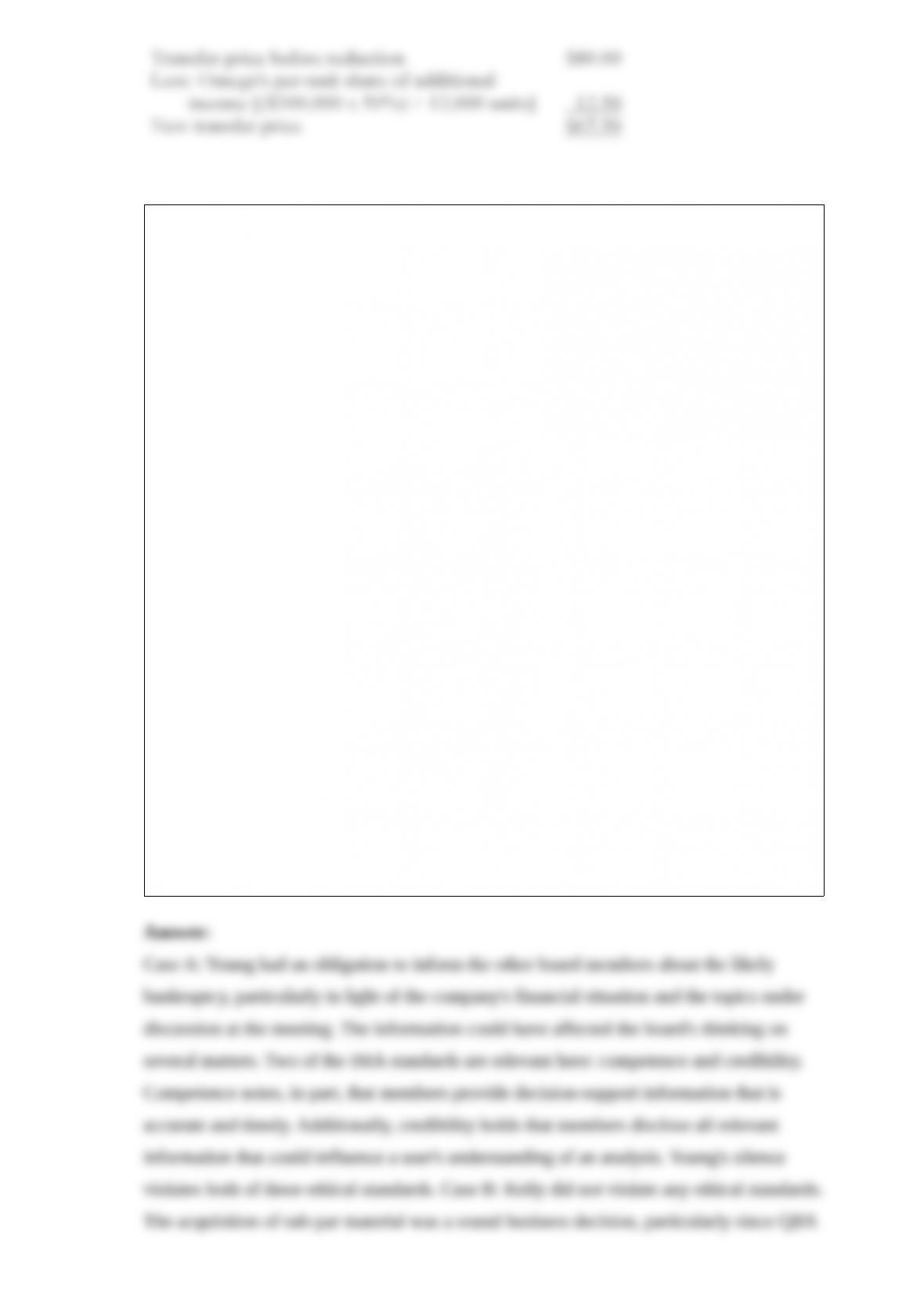
33) Gamma Division of Vaughn Corporation produces electric motors, 20% of which
are sold to Vaughan’s Omega Division and 80% to outside customers. Vaughn treats its
divisions as profit centers and allows division managers to choose whether to sell to or
buy from internal divisions. Corporate policy requires that all interdivisional sales and
purchases be transferred at variable cost. Gamma Division’s estimated sales and
standard cost data for the year ended December 31, based on a capacity of 60,000 units,
are as follows:
Gamma has an opportunity to sell the 12,000 units shown above to an outside customer
at $80 per unit. Omega can purchase the units it needs from an outside supplier for $92
each.
Required:
A. Assuming that Gamma desires to maximize operating income, should it take on the
new customer and discontinue sales to Omega? Why? (Note: Answer this question from
Gamma’s perspective.)
B. Assume that Vaughn allows division managers to negotiate transfer prices. The
managers agreed on a tentative price of $80 per unit, to be reduced by an equal sharing
of the additional Gamma income that results from the sale to Omega of 12,000 motors
at $80 per unit. On the basis of this information, compute the company’s new transfer
price.
34) Many professions have adopted a series of ethical standards to provide guidance for
their memberships. The Institute of Management Accountants (IMA), for example, has
published standards that focus on competence, confidentiality, integrity, and credibility.
In light of these standards, consider the three cases that follow.
Case ALeston Corporation has experienced serious financial difficulties in recent years.
John Young, the company’s chief financial officer, has just learned that a major
competitor was likely to file for bankruptcy; however, he failed to disclose this
information at a board meeting held later that day when a plant closure decision was
being discussed. The board evaluated several proposals during the session that focused
on improving Leston’s financial position.
Case BQBX Company manufactures fertilizer from various raw materials, including a
raw material know as Felstar. Paul Kelly, the firm’s purchasing manager, purposely
acquired a lower grade of Felstar than normal because of a very attractive price. The
lower-grade product resulted in increased usage during the manufacturing process but
had no effect on the fertilizer’s overall quality. An end-of-period report showed that
QBX profited from Kelly’s actions, with the overall savings in purchase price more than
offsetting the cost of added consumption.
Case CCentral Distributing has a participative budgeting process, allowing employees
to have a say in projected sales targets for the upcoming period. These targets are
reflected in a series of performance reports that compare actual sales achieved against
targeted amounts. Hillary Baxter submitted very low sales targets because, as she
confided in a colleague, “I always want to look good in terms of meeting targets, even if
anticipated sales and closures don’t materialize.”
Required:
Evaluate the three cases and determine the ethical issues, if any, that are involved. Cite
the IMA’s standards if appropriate.
35) If a particular job takes 20 hours of labor and $800 of materials, the price charged
for the job is:
A.$1,380
B.$1,444
C.$1,530
D.$1,594
E.none of the other answers are correct
36) When using a graphical solution to a linear programming problem, the optimal
solution will lie in an area commonly known as the:
A.region of maximization
B.feasible region
C.objective region
D.constraint region
E.curvilinear region
37)
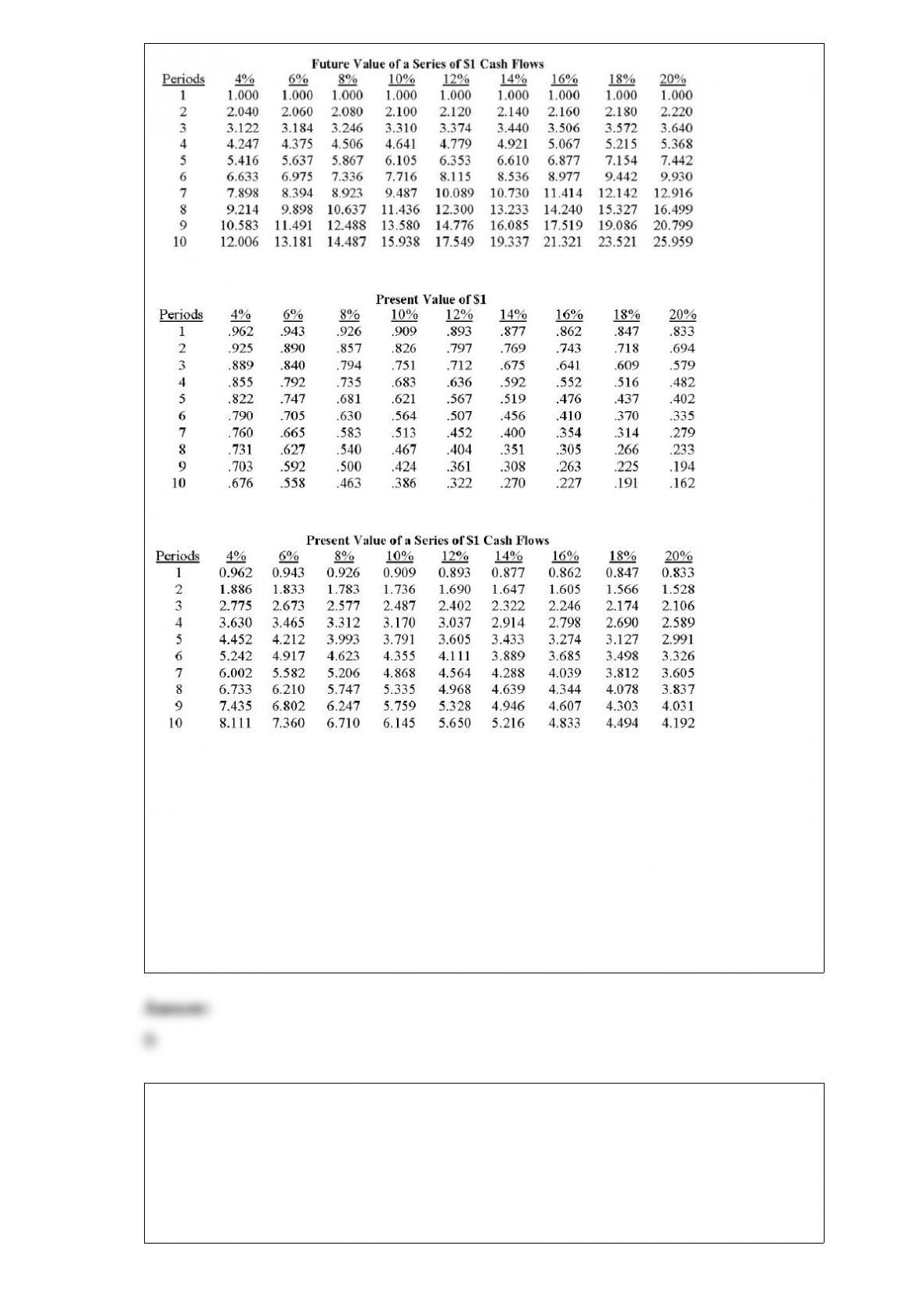
St. Augustine can acquire a $700,000 machine now that will benefit the firm over the
next 5 years. A newly hired staff assistant correctly computed the net present value to be
$134,020 by using a 10% hurdle rate. On the basis of this information, the machine was
expected to produce annual cash operating savings of approximately:
A.$166,804
B.$220,000
C.$268,605
D.$834,020
E.None of the other answers are correct
38) The extent to which an organization uses fixed costs in its cost structure is measured
by:
A.financial leverage
B.operating leverage
C.fixed cost leverage
D.contribution leverage
E.efficiency leverage
39) An employee accidentally overstated the year’s advertising expense by $50,000.
Which of the following correctly depicts the effect of this error?
A.Cost of goods manufactured will be overstated by $50,000
B.Cost of goods sold will be overstated by $50,000
C.Both cost of goods manufactured and cost of goods sold will be overstated by
$50,000
D.Cost of goods sold will be overstated by $50,000, and cost of goods manufactured
will be understated by $50,000
E.None of the other answers are correct
40) A recent income statement of Black Corporation reported the following data:
If these data are based on the sale of 20,000 units, the break-even point would be:
A.9,565 units (rounded)
B.11,000 units (rounded)
C.7,586 units (rounded)
D.14,667 units (rounded)
E.None of the other answers is correct
41) Sussex Company uses a standard cost system and prepared the following budget for
May when 24,000 machine hours of activity were anticipated: variable overhead,
$48,000; fixed overhead: $240,000. Actual data for May were:
Standard machine hours allowed for output attained: 25,000
Actual machine hours worked: 24,000
Variable overhead incurred: $50,000
Fixed overhead incurred: $250,000
The standard variable overhead rate for May is:
A.$2.00
B.$2.08
C.$3.00
D.$5.00
E.$5.21
42) The following data relate to product no. 89 of Des Moines Corporation:
Direct material standard: 3 square feet at $2.50 per square foot
Direct material purchased: 30,000 square feet at $2.60 per square foot
Direct material consumed: 29,200 square feet
Manufacturing activity: 9,600 units completed
Assume that the company computes variances at the earliest point in time.
The direct-material quantity variance is:
A.$1,000F
B.$1,000U
C.$1,040F
D.$1,040U
E.$2,000F
43) Capacity restrictions often change the way that managers make decisions. For
example, consider a retailer that has limited square footage in its store. What guideline
should be used in deciding which new products to carry? How would this differ, say,
from a concert promoter that desires to bring a rock group to an arena-type facility?
44) The time value of money and present value are important business concepts.
Required:
Briefly explain these concepts to someone with a limited business background.
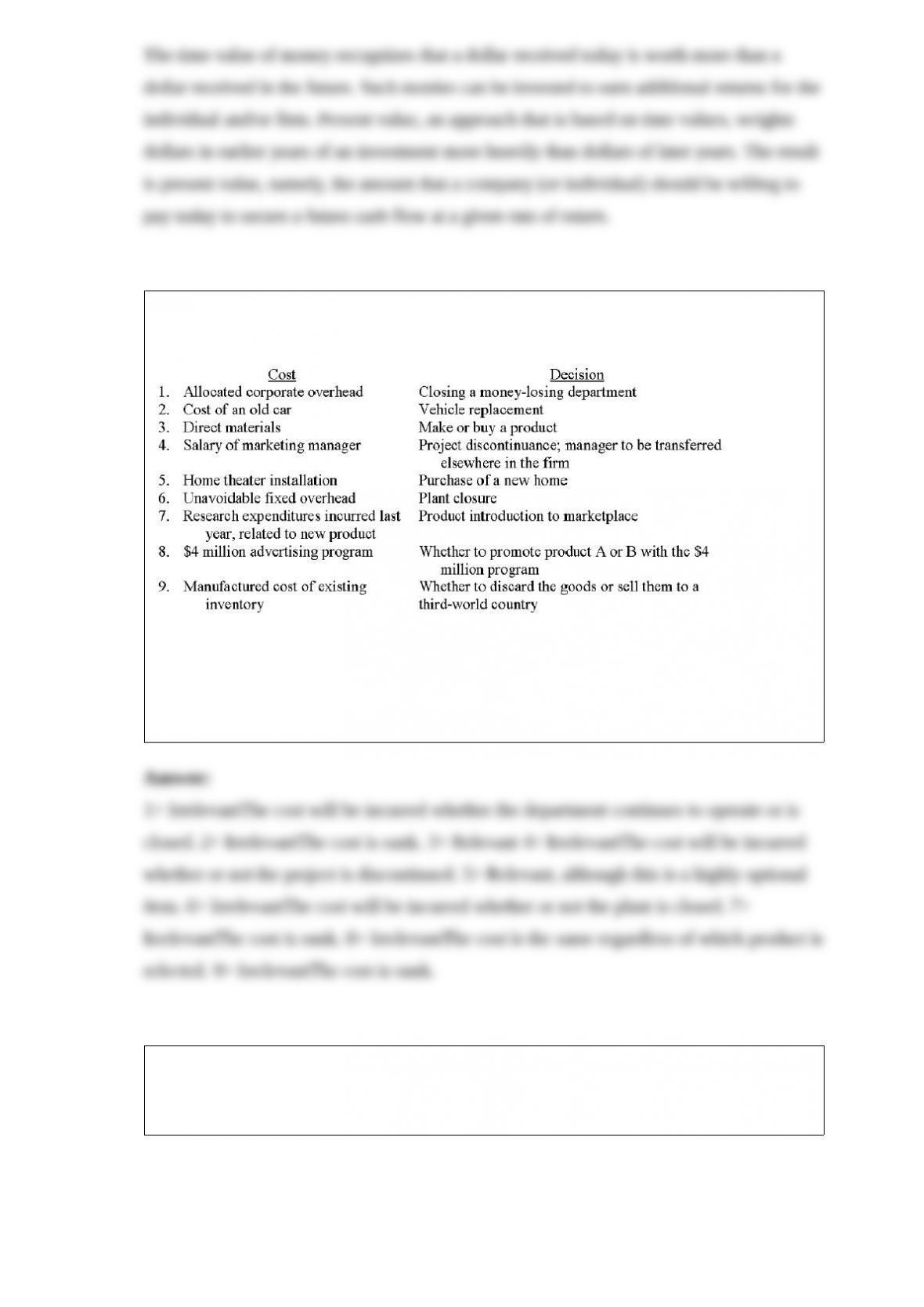
45) The following costs relate to a variety of decision settings:
Required:
Consider each of the nine costs listed and determine whether it is relevant or irrelevant
to the decision cited. If the cost is irrelevant, briefly explain why.
46) Aurora Muffler, Inc. operates an automobile service facility. The table below shows
the cost incurred during a month when 500 mufflers were replaced.
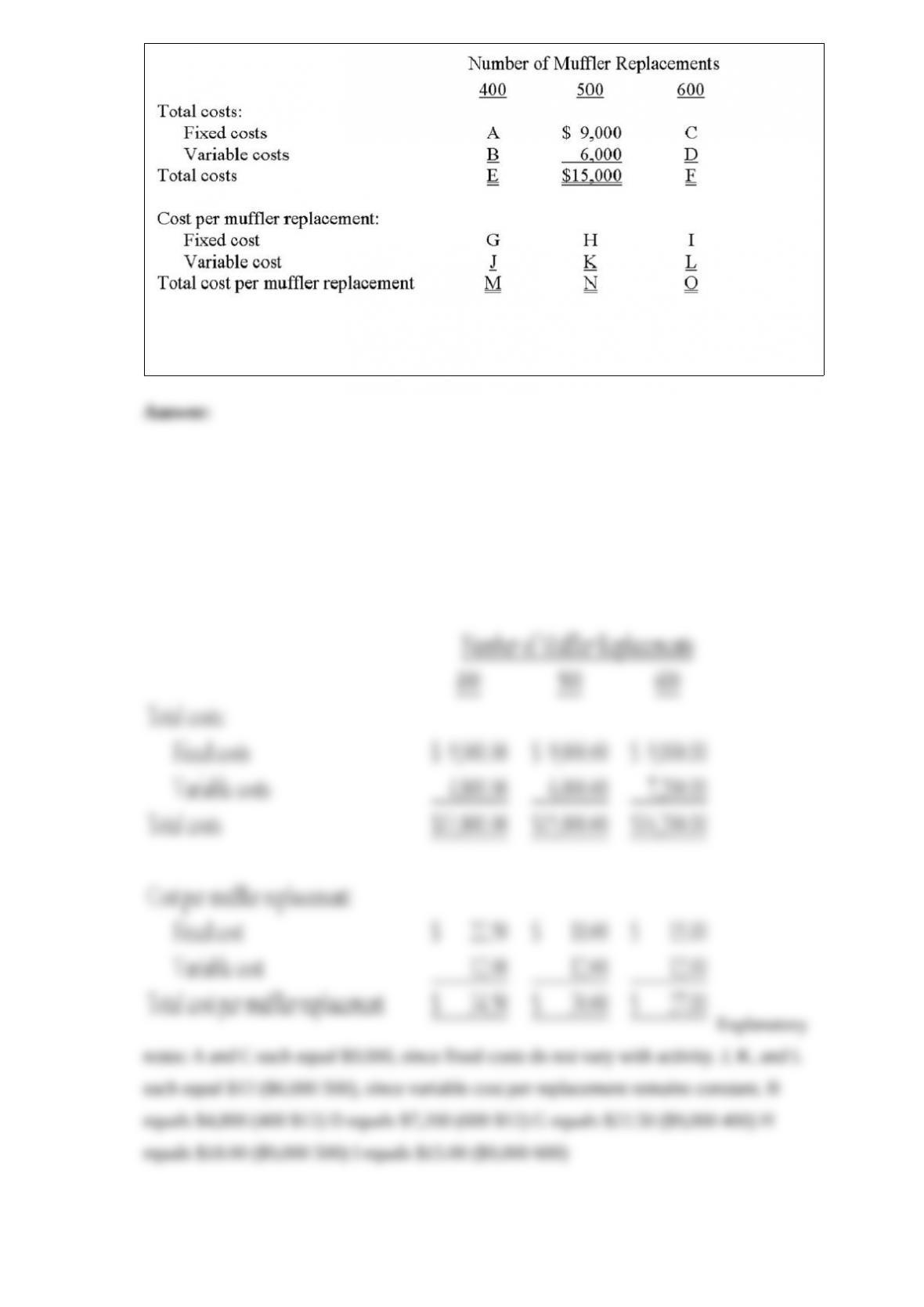
Required:
Fill in the missing amounts, labeled A through O, in the table above.
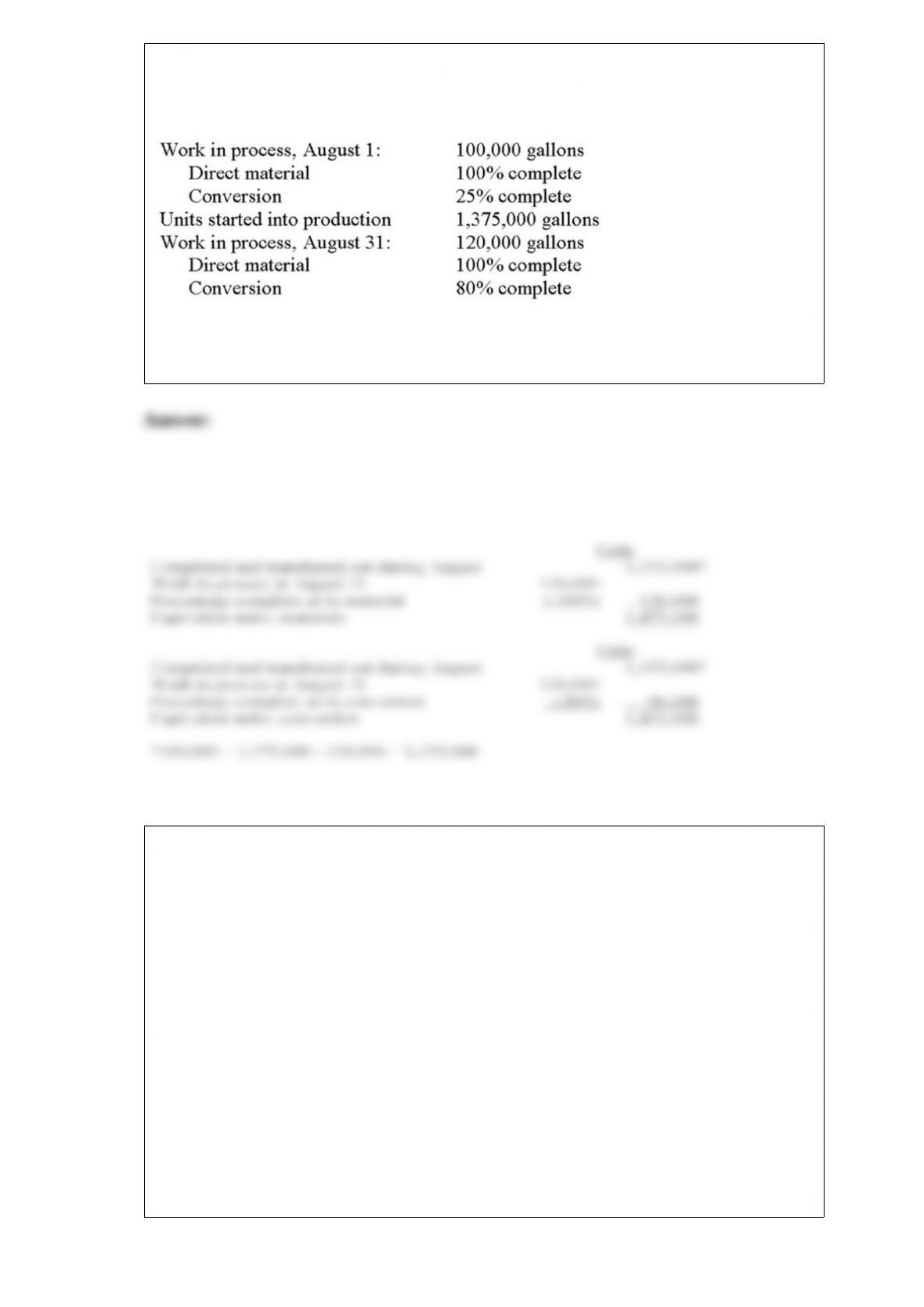
47) EnviroSmart Chemical Company refines a variety of petrochemical products. The
following data pertain to the firm’s Baton Rouge plant:
Required:
Compute the equivalent units of direct materials and conversion for August.
48) The following selected information was extracted from the accounting records of
Austin, Inc.:
Planned manufacturing activity: 40,000 machine hours
Standard variable-overhead rate per machine hour: $16
Budgeted fixed overhead: $100,000
Variable-overhead spending variance: $92,000U
Variable-overhead efficiency variance: $102,000F
Fixed-overhead budget variance: $25,000U
Total actual overhead: $675,000
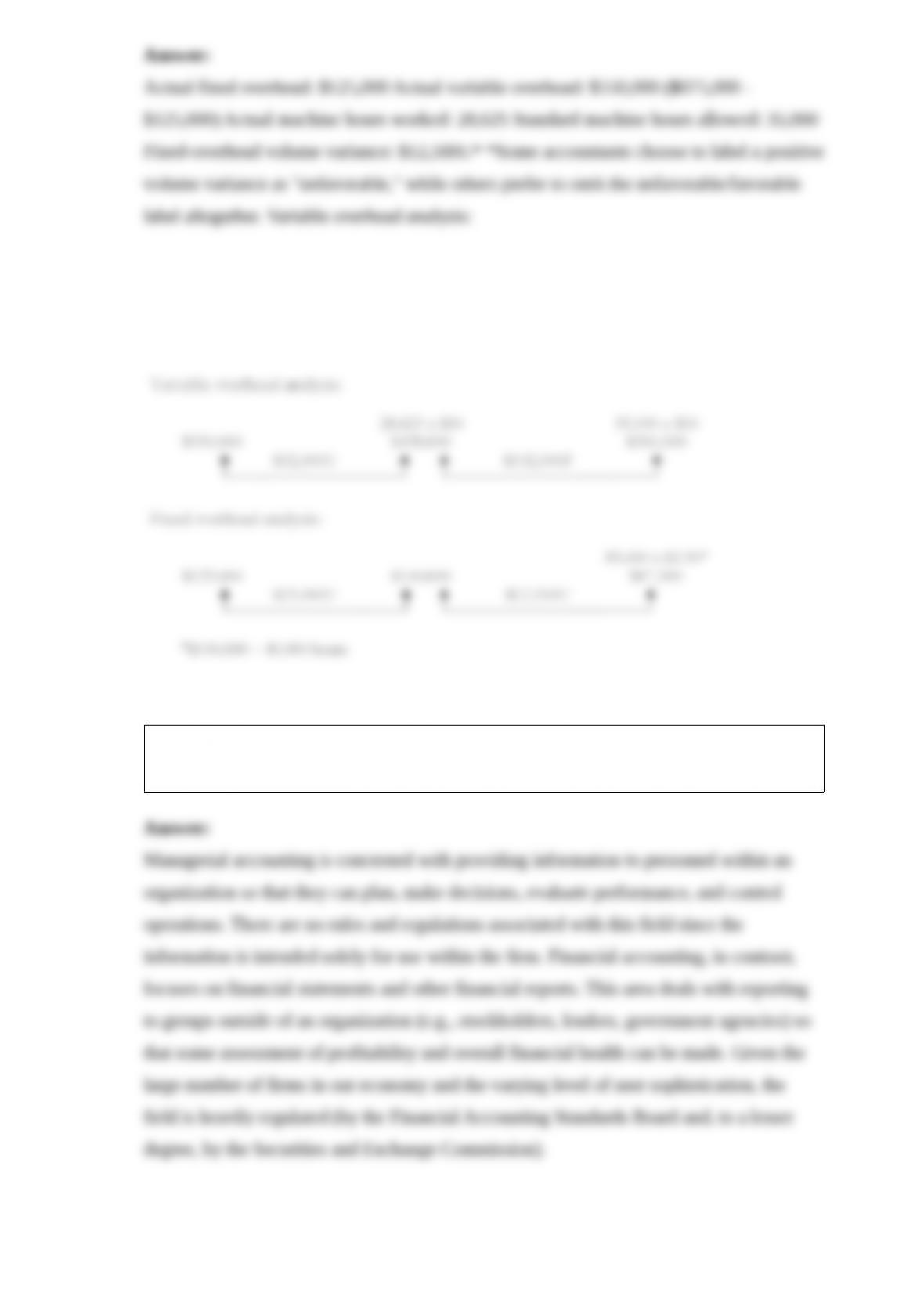
Required:
Determine the following: actual fixed overhead, actual variable overhead, actual
machine hours worked, standard machine hours allowed for actual production, and the
fixed-overhead volume variance.
49) Briefly distinguish between managerial accounting and financial accounting. Be
sure to comment on the general focus, users, and regulation related to the two fields.
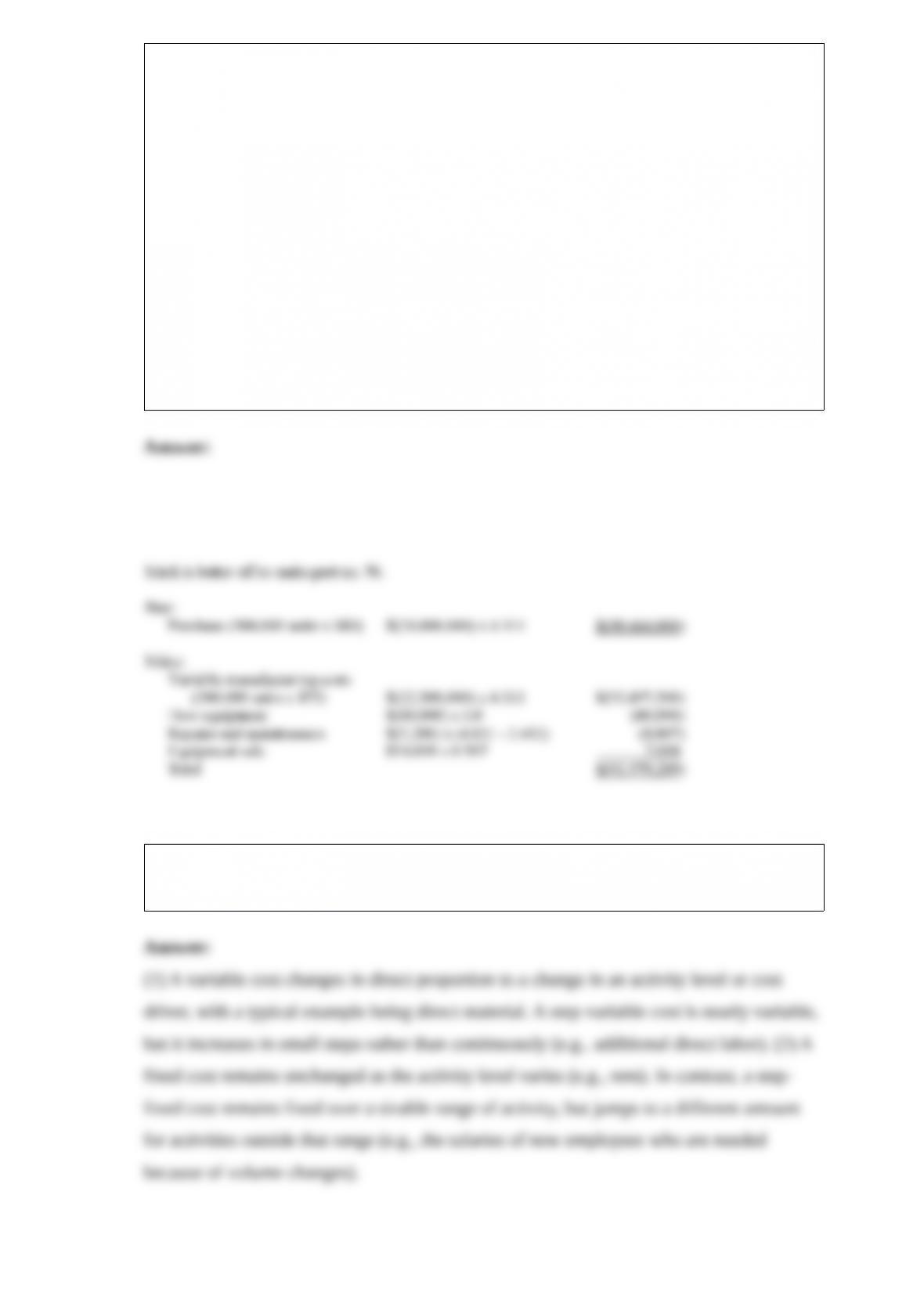
50) Mark Industries is currently purchasing part no. 76 from an outside supplier for $80
per unit. Because of supplier reliability problems, the company is considering
producing the part internally in an idle manufacturing plant. Annual volume over the
next six years is expected to total 300,000 units at variable manufacturing costs of $75
per unit.
Mark must acquire $80,000 of new equipment if it reopens the plant. The equipment
has a six-year service life, a $14,000 salvage value, and will be depreciated by the
straight-line method. Repairs and maintenance are expected to average $5,200 per year
in years 4-6, and the equipment will be sold at the end of its life.
Required:
Rounding to the nearest dollar, use the net-present-value method (total-cost approach)
and a 12% hurdle rate to determine whether Mark should make or buy part no. 76 .
Ignore income taxes.
51) Compare and contrast the following types of costs: (1) variable and step-variable
and (2) fixed and step-fixed.