
Which one of the following decreases net income but does not affect the operating cash
flow of a firm that owes no taxes for the current year?
A. Indirect cost
B. Direct cost
C. Noncash item
D. Period cost
E. Variable cost
Answer:
Which one of the following terms is used to describe international bonds issued in a
single country and generally denominated in that country’s currency?
A. Eurobonds
B. American Depositary Receipts
C. Foreign bonds
D. Swaps
E. Gilts
Answer:
Which one of the following is probably the most effective means of increasing
investors’ interest in an IPO?
A. Extending the lockup period
B. Issuing the IPO through a rights offering
C. Underpricing the IPO
D. Eliminating the quiet period
E. Eliminating the Green Shoe option
Answer:
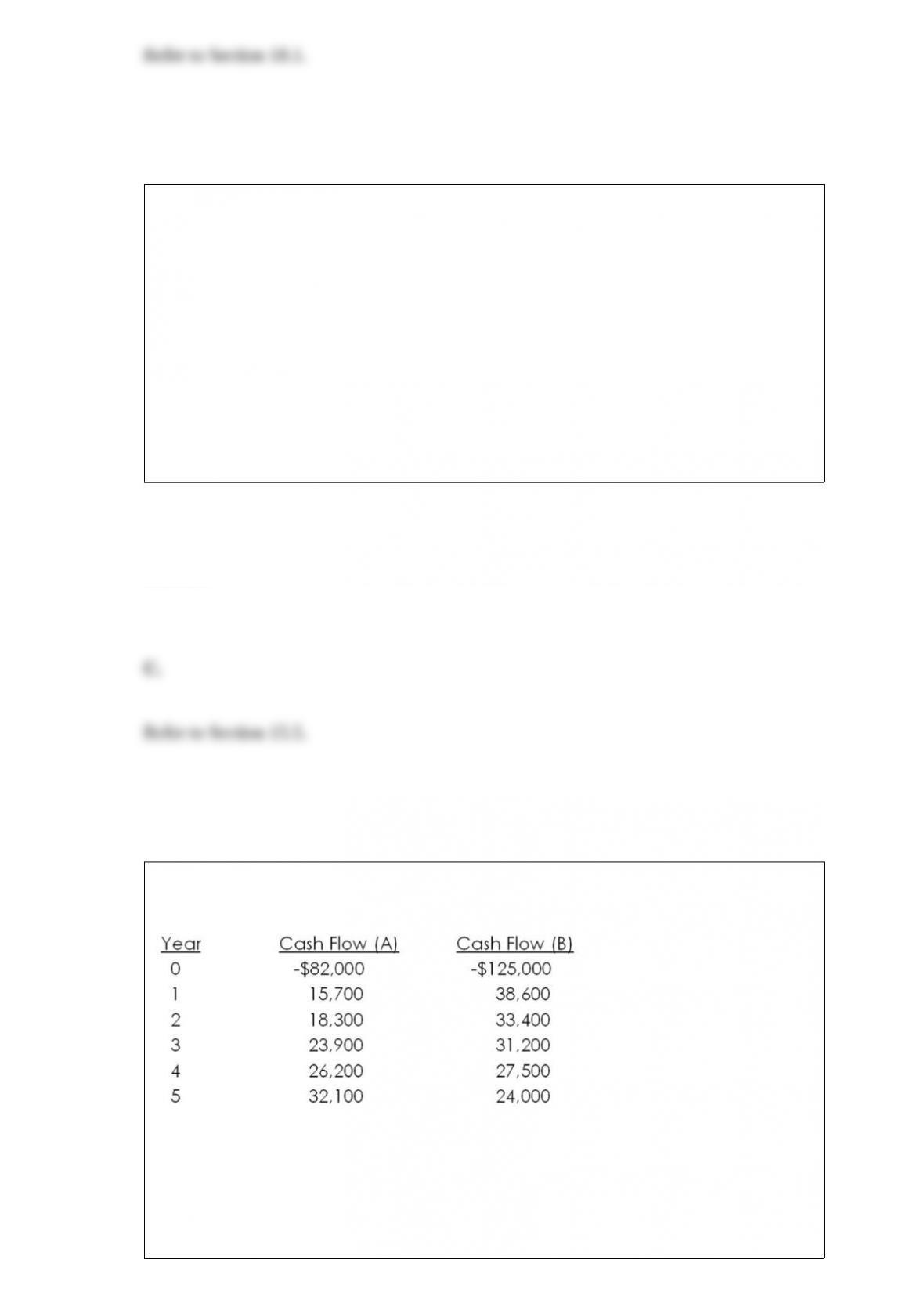
Quattro, Inc. has the following mutually exclusive projects available. The company has
historically used a four-year cutoff for projects. The required return is 11 percent.
The payback for Project A is ____ while the payback for Project B is ____. The NPV
for Project A is _____ while the NPV for Project B is ____. Which project, if any,
should the company accept?
A. 3.92 years; 3.64 years; $780.85; $1,211.48; accept both Project A and B

B. 3.92 years; 3.79 years; -$211.60; $1,211.48; accept Project B only
C. 3.92 years; 3.79 years; $780.85; -$7,945.93; accept Project A only
D. 4.06 years; 3.64 years; $780.85; $1,211.48; accept both Project A and B
E. 4.06 years; 3.79 years; -$211.60; -$7,945.93; reject both projects
Answer:
The net present value of an investment represents the difference between the
investment’s:
A. cash inflows and outflows.
B. cost and its net profit.
C. cost and its market value.
D. cash flows and its profits.
E. assets and liabilities.
Answer:

A loan that compounds interest monthly has an EAR of 14.40 percent. What is the
APR?
A. 13.53 percent
B. 13.59 percent
C. 13.96 percent
D. 14.07 percent
E. 14.10 percent
Answer:
Chandler Tire Co. is trying to decide which one of two projects it should accept. Both
projects have the same start-up costs. Project 1 will produce annual cash flows of
$52,000 a year for six years. Project 2 will produce cash flows of $48,000 a year for
eight years. The company requires a 15 percent rate of return. Which project should the
company select and why?
A. Project 1, because the annual cash flows are greater than those of Project 2
B. Project 1, because the present value of its cash inflows exceeds those of Project 2 by
$14,211.62

C. Project 2, because the total cash inflows are $70,000 greater than those of Project 1
D. Project 2, because the present value of the cash inflows exceeds those of Project 1 by
$18,598.33
E. It does not matter as both projects have almost identical present values.
Answer:
A firm has net income of $31,300, depreciation of $5,100, taxes of $14,600, and interest
paid of $3,100. What is the cash coverage ratio?
A. 8.78
B. 10.10
C. 14.14
D. 16.32
E. 17.45
Answer:

McClary Tires just decided to save money each year for the next four years to help fund
a new building. If it earns 6.5 percent on its savings, how much will the firm have saved
at the end of year 4?
A. $107,525.40
B. $108,392.69
C. $111,860.57
D. $113,200.39
E. $119,426.41
Answer:
Molly is considering a project with cash inflows of $918, $867, $528, and $310 over
the next four years, respectively. The relevant discount rate is 10 percent. What is the
net present value of this project if it the start-up cost is $2,100?
A. $59.50
B. $131.83
C. $148.08
D. $210.45
E. $229.50

Answer:
Katz is an all-equity development company that has 36,000 shares of stock outstanding
at a market price of $25 a share. The firm’s earnings before interest and taxes are
$29,000. Katz has decided to issue $200,000 of debt at a rate of 6 percent and use the
proceeds to repurchase shares. What should Leslie do if she owns 600 shares of Katz
stock and wants to use homemade leverage to offset the leverage being assumed by the
firm?
A. Borrow money and buy an additional 22 shares
B. Borrow money and buy an additional 133 shares
C. Sell 22 shares and loan out the proceeds
D. Sell 56 shares and loan out the proceeds
E. Sell 133 shares and loan out the proceeds
Answer:

Abbott & Costello has the following estimated sales.
Purchases are equal to 75 percent of the following quarter’s sales. What is the estimated
amount of purchases for quarter 2?
A. $5,209
B. $5,508
C. $5,848
D. $7,125
E. $7,720
Answer:
Electronics and More offers credit terms of 1/5, net 20. What is the effective annual rate
on a $12,000 purchase if you forgo the discount?
A. 0 percent
B. 8.59 percent
C. 14.99 percent

D. 27.71 percent
E. 32.58 percent
Answer:
Which one of the following is an advantage of being a limited partner?
A. Nontaxable share of any profits
B. Control over the daily operations of the firm
C. Losses limited to capital invested
D. Unlimited profits without risk of incurring a loss
E. Active market for ownership interest
Answer:
The term structure of interest rates represents the relationship between which of the
following?
A. Nominal rates on risk-free and risky bonds
B. Real rates on risk-free and risky bonds
C. Nominal and real rates on default-free, pure discount bonds
D. Market and coupon rates on default-free, pure discount bonds
E. Nominal rates on default-free, pure discount bonds and time to maturity
Answer:
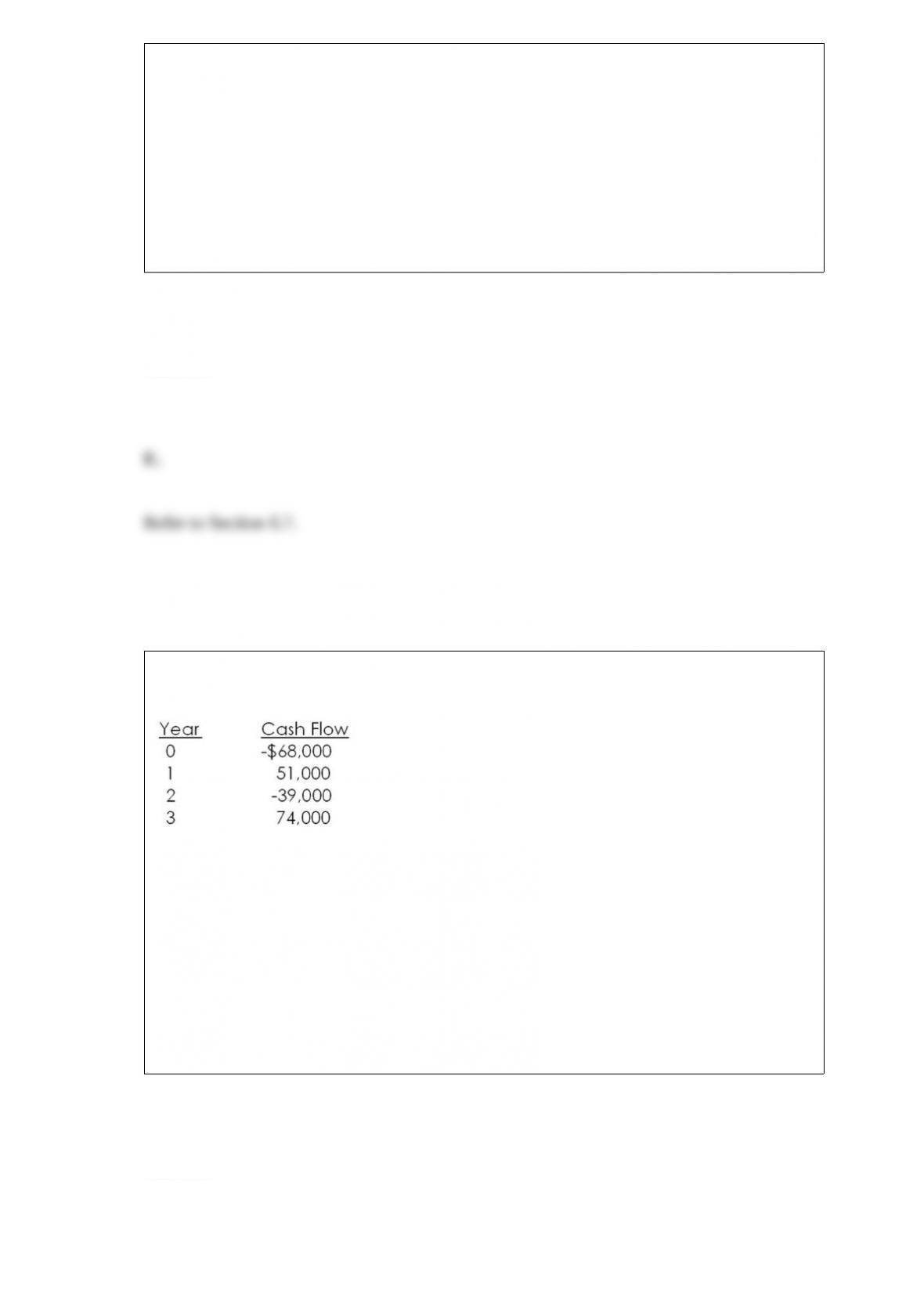
What is the net present value of the following cash flows if the relevant discount rate is
8.0 percent?
A. $1,482.15
B. $4,529.59
C. $23,507.19
D. $54,211.40
E. $71,402.02
Answer:

Cox Footwear pays a constant annual dividend. Last year, the dividend yield was 2.5
percent when the stock was selling for $26 a share. What is the current price of the
stock if the current dividend yield is 3.1 percent?
A. $18.92
B. $20.97
C. $25.20
D. $26.87
E. $27.40
Answer:
Skyline Industries will need $1.8 million 5 years from now to replace some equipment.
Currently, the firm has some extra cash and would like to establish a savings account
for this purpose. The account pays 5.25 percent interest, compounded annually. How
much money must the company deposit today to fully fund the equipment purchase?
A. $1,279,947.20
B. $1,298,407.21
C. $1,350,868.47

D. $1,393,676.52
E. $1,412,308.18
Answer:
A project has sales of $462,000, costs of $274,000, depreciation of $26,000, interest
expense of $3,400, and a tax rate of 35 percent. What is the value of the depreciation
tax shield?
A. $9,100
B. $9,564
C. $10,650
D. $10,800
E. $11,350
Answer:

Which one of the following is an example of long-run exposure to exchange rate risk?
Ignore all fees and transaction costs.
A. A U.S. firm owns land in Mexico valued at three million pesos. That value has
remained constant in Mexican pesos for the past year. However, the firm’s financial
statement reflects a 3 percent decrease in the value of that land for last year.
B. A U.S. firm sells $250,000 worth of goods to Peru. However, when the payment for
those goods arrives and the U.S. firm exchanges the foreign currency, it receives only
$248,700.
C. A U.S. firm purchases $120,000 worth of goods from Canada. However, by the time
the goods arrive and the invoice is payable, the cost of those goods has increased to
$120,400.
D. A few years ago, a U.S. firm built a factory in Asia to take advantage of the lower
labor costs. Today, the Asian labor costs have increased such that the Asian factory no
longer provides a cost advantage over a U.S. factory.
E. A U.S. traveler withdrew an extra $2,000 in cash from her savings account to take
with her as emergency funds when she traveled to Mexico. Before leaving on her trip,
she exchanged this money into Mexican pesos. She never used any of this money
during her vacation, so exchanged all of it back into U.S. dollars on her return and
received $1,960.
Answer:
Research conducted on firms’ dividend policies over time support which one of the
following conclusions?
A. Aggregate dividends and stock repurchases have steadily declined in real terms.
B. Dividends are currently paid by the vast majority of firms.
C. Managers tend to smooth dividends.
D. Stock prices tend to increase whenever anticipated changes in dividends occur.

E. Firms commence paying dividends prior to doing any stock repurchases.
Answer:
Lawler’s BBQ has sales of $311,800, a profit margin of 3.9 percent, and dividends of
$4,500. What is the plowback ratio?
A. 46.32 percent
B. 49.78 percent
C. 50.23 percent
D. 58.09 percent
E. 62.99 percent
Answer:
An agent who buys and sells securities from inventory is called a:
A. floor trader.

B. dealer.
C. commission broker.
D. broker.
E. floor broker.
Answer: