
1) The market price of a firm’s common stock equals the sum of all equity accounts as
reported in its balance sheet (common stock + paid-in capital + retained earnings)
divided by the number of shares outstanding.
2) Business risk refers to the relative dispersion (variability) of a company’s net income.
3) If a project’s profitability index is less than one then the project should be rejected.
4) Because risk is measured by variability of returns, how long we hold our investments
does not matter very much when it comes to reducing risk.
5) In the EOQ model the optimal ordering quantity is the quantity for which the sum of
the costs of ordering and carrying inventory is minimized.
6) Cash flows is the most relevant variable to measure the returns on debt instruments,
while GAAP net income is the most relevant variable to measure the returns on
common stock.
7) Exchange rate risk exists in International Trade Contracts, Foreign Portfolio
Investments, and in Direct Foreign Investments.

8) Money market mutual funds are diversified portfolios of short-term, high-grade debt
instruments.
9) If two companies have the same revenues and operating expenses, their net incomes
will still be different if one company finances its assets with more debt and the other
company with more equity.
10) The risk-adjusted discount rate for a replacement decision will be less than the rate
used by the same firm when considering a new product line.
11) If Cindy deposits $12,000 into a bank account that pays 6% interest compounded
semiannually, what will the account balance be in seven years?
A) 18,151
B) 14,356
C) 16,987
D) 15,555
12) Suppose interest rates have been at historically low levels the past two years. A
reasonable strategy for bond investors during this time period would be to
A) invest in long-term bonds to reduce interest rate risk
B) invest in short-term bonds to reduce interest rate risk
C) buy only junk bonds which have higher interest rates
D) invest in long-term bonds to lock in a bond position for when interest rates increase
in the future

13) Symco Corp. needs $500,000 for 90 days to get through a period of unexpectedly
high oil prices. Symco’s line of credit with the bank allows the company to borrow at
6% per year with a compensating balance of 10% of the amount borrowed. Currently,
Symco has no money on deposit with the bank.
a.Calculate the amount Symco must borrow to meets its needs plus the compensating
balance.
b.What is the annual percentage rate for this financing?
c.If the bank requires discount interest, what is the annual percentage rate for this
financing?
14) An important (additional) consideration for a direct foreign investment is
A) political risk
B) maximizing the firm’s profits
C) attaining a high international P/E ratio
D) maintaining the domestic cost of capital
15) A life insurance company purchases $1 billion of corporate bonds from premiums
collected on its life insurance policies. Therefore
A) the corporate bonds are indirect securities and the life insurance policies are direct
securities
B) the corporate bonds are indirect securities and the life insurance policies are indirect
securities
C) the corporate bonds are direct securities and the life insurance policies are indirect
securities
D) the corporate bonds are direct securities and the life insurance policies are direct
securities
16) Working capital management is concerned with
A) how a firm can best manage its cash flows as they arise in its day-to-day operations
B) how a firm should raise money to fund its investments
C) what long-term investments a firm should undertake
D) managing a firms capital stock

17) A bond issued by Liberty, Inc. 10 years ago has a coupon rate of 8% and a face
value of $1,000. The bond will mature in 15 years. What is the value to an investor with
a required return of 12.5%?
A) $800
B) $750.86
C) $658.94
D) $701.52
18) Assume that you have $330,000 invested in a stock that is returning 11.50%,
$170,000 invested in a stock that is returning 22.75%, and $470,000 invested in a stock
that is returning 10.25%. What is the expected return of your portfolio?
A) 15.6%
B) 12.9%
C) 18.3%
D) 14.8%
19) Kingston Corp. is considering a new machine that requires an initial investment of
$480,000 installed, and has a useful life of 8 years. The expected annual after-tax cash
flows for the machine are $89,000 for each of the 8 years and nothing thereafter.
a.Calculate the net present value of the machine if the required rate of return is 11
percent.
b.Calculate the IRR of this project.
c.Should Kingston accept the project (assume that it is independent and not subject to
any capital rationing constraint)? Explain your answer.
20) Credit and collection policies affect all of the following EXCEPT
A) level of sales

B) length of time before credit sales are collected
C) terms of sales
D) pricing policies
21) If you put $2,000 in a savings account that yields 8% compounded semiannually,
how much money will you have in the account in 20 years (round to nearest $10)?
A) $6,789
B) $8,342
C) $9,602
D) $9,972
22) The Net Present Value (or NPV) criteria for capital budgeting decisions assumes
that expected future cash flows are reinvested at ________, and the Internal Rate of
Return (or IRR) criteria assumes that expected future cash flows are reinvested at
________.
A) the firm’s discount rate; the internal rate of return
B) the internal rate of return; the internal rate of return
C) the internal rate of return; the firm’s discount rate
D) Neither criteria assumes reinvestment of future cash flows
23) Optimal capital structure is
A) the mix of permanent sources of funds used by the firm in a manner that will
maximize the company’s common stock price
B) the mix of all items that appear on the right-hand side of the company’s balance
sheet
C) the mix of funds that will minimize the firm’s cost of equity capital
D) the mix of funds that will maximize the firm’s interest tax shield
24) Siskiyou Corp. has cash of $75,000; short-term notes payable of $100,000; accounts
receivables of $275,000; accounts payable of $135,000: inventories of $350,000; and
accrued expenses of $75,000. What is the firm’s net working capital?
A) $390,000
B) $175,000

C) $700,000
D) $210,000
25) Investment firms, such as Goldman Sachs, assist the transfer of capital by
A) facilitating indirect transfers from savers (investing public) to borrowers
(corporations needing capital)
B) selling indirect securities to savers and using the funds to buy common stock for
corporations needing funds
C) selling direct securities
D) selling common stock for corporate clients in the secondary market
26) Sunk costs are
A) recoverable
B) incremental
C) not relevant in capital budgeting
D) not deductible for tax purposes
27) Assume that an investment is forecasted to produce the following returns: a 30%
probability of a 12% return; a 50% probability of a 16% return; and a 20% probability
of a 19% return. What is the expected percentage return this investment will produce?
A) 33.3%
B) 16.1%
C) 9.5%
D) 15.4%
28) The CFO of Twine Enterprises expects sales to increase from $8,000,000 in 2010 to
$12,000,000 in 2011 . Current assets in 2010 are equal to $5,000,000. Using the percent
of sales method, projected current assets for 2011 are equal to
A) $5,500,000
B) $7,083,333
C) $9,000,000
D) $7,500,000
29) Welker Products sells small kitchen gadgets for $15 each. The gadgets have a
variable cost of $4 per unit, and Welker Products’ fixed operating costs are $220,000 per
year. Welker Products’ capital structure includes 55% debt and 45% equity. Annual
interest expense is $25,000, and the corporate tax rate is 35%.
a.Calculate the break-even point in units.
b.If Welker Products sells 25,000 units, calculate the firm’s EBIT and net income.
c.If sales increase ten percent from 25,000 units to 30,000 units, estimate the firm’s
expected EBIT and net income.
d.Does Kelly Products use operating leverage and/or financial leverage? Explain.
30) Today is your 21st birthday and your bank account balance is $25,000. Your
account is earning 6.5% interest compounded monthly. How much will be in the
account on your 50th birthday?
A) $159,795
B) $162,183
C) $163,823
D) $164,631

31) Which of the following will most likely result in an increase in discretionary
funding needed?
A) The company’s profit margin increases
B) The company’s dividend payout ratio increases
C) The company’s assets are only operating at 50% of capacity
D) The company pays its accounts payable in 50 days, up from 45 days
32) CraftCo, Inc.’ projected sales for the first six months of 2012 are given below:
Jan.$500,000April$490,000
Feb.$740,000May$740,000
Mar.$380,000June$610,000
40% of sales are collected in cash at time of sale, 50% are collected in the month
following the sale, and the remaining 10% are collected in the second month following
the sale. Cost of goods sold is 60% of sales. Purchases are made in the month prior to
the sales, and payments for purchases are made in the month of the sale. Total other
cash expenses are $40,000/month. The company’s cash balance as of February 28, 2012
will be $25,000. Excess cash will be used to retire short-term borrowing (if any).
CraftCo, Inc. has no short term borrowing as of February 28, 2012 . Assume that the
interest rate on short-term borrowing is 1% per month. The company must have a
minimum cash balance of $15,000 at the beginning of each month. What is CraftCo,
Inc.’ total cash receipts for April 2010?
A) $460,000
B) $490,000
C) $524,000
D) $560,000
33) How is preferred stock similar to bonds?
A) Dividend payments to preferred shareholders (much like bond interest payments to
bondholders) are tax deductible
B) Investors can sue the firm if preferred dividend payments are not paid (much like
bondholders can sue for non-payment of interest payments)
C) Preferred stockholders receive a dividend payment (much like interest payments to
bondholders) that is usually fixed
D) Preferred stock is not like bonds in any way

34) Waterfront Solutions, Inc. paid a dividend of $5.00 per share on its common stock
yesterday. Dividends are expected to grow at a constant rate of 4% for the next two
years, at which point the stock is expected to sell for $56.00. If investors require a rate
of return on Waterfront’s common stock of 18%, what should the stock sell for today?
A) $50.22
B) $48.51
C) $44.76
D) $40.22
35) Which of the following would NOT be a part of a firm’s capital structure?
A) short-term notes payable
B) long-term bonds
C) preferred stock
D) common stock
36) A firm’s cost of capital is influenced by
A) the current ratio
B) par value of common stock
C) capital structure
D) net income
37) A limited partnership provides limited liability to
A) all general partners
B) only limited partners responsible for day to day management of the firm
C) only to limited partners who do not participate in the management of the business
D) all partners
38) Which of the following is always a non-cash expense?
A) income taxes
B) salaries
C) depreciation
D) none of the above

39) Maynard Inc. preferred stock pays an annual dividend of $7 per share. Which of the
following statements is TRUE for an investor with a required return of 9%?
A) The value of the preferred stock is $7 because the dividend is fixed at $7 each year
B) The value of the preferred stock is $63.00 per share
C) The value of the preferred stock is $77.78 per share
D) The value of the preferred stock is $6.30 per share because of the 9% required return
40) To measure value, the concept of time value of money is used
A) to determine the interest rate paid on corporate debt
B) to bring the future benefits and costs of a project, measured by its expected profits,
back to the present
C) to bring the future benefits and costs of a project, measured by its cash flows, back
to the present
D) to ensure that expected future profits exceed current profits today
41) Which of the following accounts does NOT belong in the liability section of a
balance sheet?
A) accruals
B) short-term debt
C) additional paid-in capital
D) long-term debt
42) Financial leverage has to do with
A) the usage of fixed cost financial securities to finance a portion of a firm’s assets
B) using common stock to finance a portion of a firm’s assets
C) the incurrence of fixed operating costs in the firm’s income stream
D) a high gross profit margin
43) TC Corp paid a dividend today of $5 per share. The dividend is expected to grow at
a constant rate of 6.5% per year. If TC Corp stock is selling for $50.00 per share, the
stockholders’ expected rate of return is
A) 11.50%
B) 13.56%
C) 15.49%
D) 16.50%
44) The current ratio of a firm would be decreased by which of the following?
A) Land held for investment is sold for cash
B) Equipment is purchased, financed by a long-term debt issue
C) Inventories are sold for cash
D) Inventories are sold on a long-term credit basis
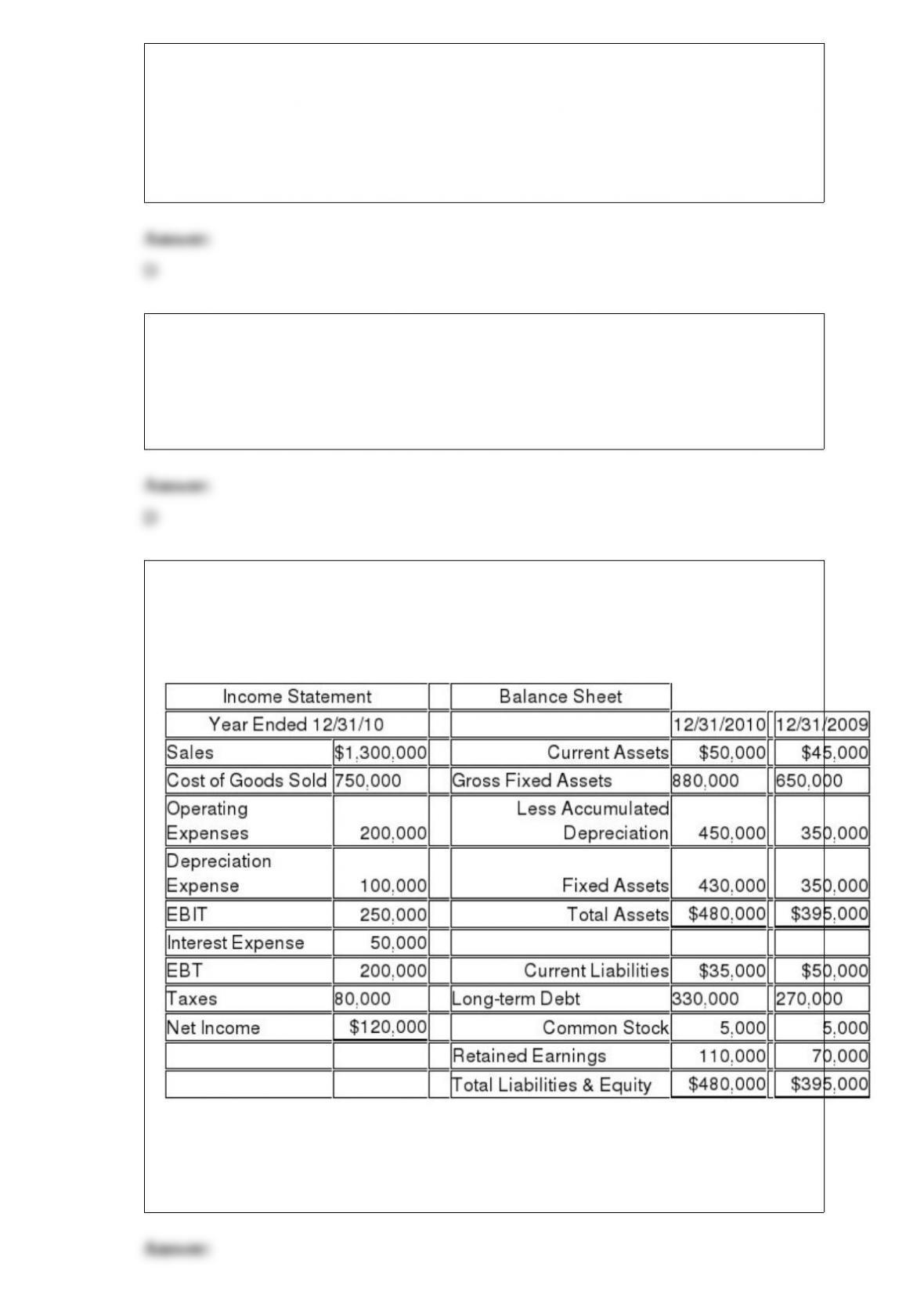
45) Given the following financial statements for ARGON Corporation, and assuming
that ARGON paid a common dividend of $80,000 in 2010, what is the company’s
financing cash flow for 2010?
A) -$10,000
B) -$15,000
C) -$65,000
D) -$70,000