
1) Intra-entity receivables and payables for an 80%-owned subsidiary are eliminated to
the extent of ownership (i.e., 80% of balance is eliminated).
2) GAAP does not require the cost flow assumption to conform to the actual physical
flow of the goods.
3) The Summary of Significant Accounting Policies would contain an explanation of
the company’s revenue recognition policies.
4) Generally, the recorded cost of a nonmonetary asset acquired in exchange for some
other nonmonetary asset is the fair value of the asset that was given up.
5) Under GAAP, current cost accounting may or may not be used at the discretion of
management.
6) By definition, discontinued operations will not generate future cash flows thus
transactions related to operations the firm intends to discontinue, or has already
discontinued, must be reported separately from other income items on the income
statement.
7) Lenders form opinions about a company’s credit risk by comparing current and future
debt-service requirements to estimates of the company’s current and expected future
cash flows.
8) The goal of the FASB’s proposed changes in financial statement presentation is the
same as that of present financial reporting, namely to assist statement users in
predicting the amount, timing and uncertainty of future cash flows.
9) A company has stock options outstanding which allow the holders of the options to
buy 12,000 shares of common stock; therefore 12,000 shares will be added to the
denominator when calculating diluted earnings per share.
10) Banks and other financial institutions are required by federal and state regulatory
agencies to meet minimum capital requirements.
11) GAAP’s flexibility in its reporting standards allows companies to
A.smooth reported earnings over several reporting periods
B.change accounting estimates to meet target sales or earnings
C.change accounting principles to improve reported earnings
D.avoid adopting specific accounting techniques and reporting procedures
12) When a lessee has a capital lease for its primary premises it would initially record a
leased asset on the balance sheet equal to
A.zero
B.the present value of future lease payments
C.the sum of future lease payments
D.the lesser of the fair value of the asset or the present value of the future lease
payments

13) The Canton Corporation’s December 31, 2011 balance sheet reports prepaid pension
cost of $397,500. On December 31, 2011, the projected benefit obligation was
$6,479,000, the fair value of the plan assets was $6,747,000, and the accumulated
benefit obligation was $3,482,500. The December 31, 2011 balance sheet should report
A.prepaid pension cost of $397,500
B.prepaid pension cost of $268,000
C.an accrued liability of $3,482,500
D.an accrued liability of $3,264,500
14) If the parent company owns more than 50% of the subsidiary’s voting stock, and
effectively has control of the subsidiary, consolidated financial statements are
A.optional
B.required
C.not possible
D.required only by the SEC
15) LIFO’s tax advantage is that
A.it provides a higher net income than FIFO during periods of rising prices and
nondecreasing inventory quantities
B.it provides a lower net income than FIFO during periods of rising prices and
nondecreasing inventory quantities
C.it provides a lower net income than FIFO during periods of falling prices and
nondecreasing inventory quantities
D.it provides a lower net income than FIFO during periods of rising prices and
decreasing inventory quantities
16) Which one of the following is part of other comprehensive income (OCI)?
A.Unrealized gains resulting from translating foreign currency financial statements of
majority-owned subsidiaries to U.S. dollar amounts
B.Gains on sales of treasury stock
C.Receipt of land donated by a governmental unit
D.Sale of common stock above par

17) Short-term notes sold directly to investors by large, highly rated companies are
called
A.commercial paper
B.secured notes
C.bonds
D.debentures
18) Analysts can use the deferred tax portion of the income tax note to the financial
statements to undo differences in financial reporting choices across firms and thereby
A.denigrate interfirm comparisons
B.improve interfirm comparisons
C.make interfirm comparisons impossible
D.make intracompany comparisons meaningful
19) A derivative instrument that gives the holder the right but not the obligation to do
something is a/an
A.future contract
B.swap contract
C.performance contract
D.options contract
20) To preclude firms from generating artificial gains on exchange transactions booked
at fair value, GAAP requires that the transaction
A.must possess commercial substance
B.have future cash flows that remain substantially the same
C.be reviewed and approved by the SEC
D.All of the above criteria must be met to book an exchange transaction at the fair value
of the exchanged assets
21) Cash flows that arise from transactions of a firm related to the production and
delivery of goods and services to customers are cash flows from
A.investing activities
B.operating activities
C.financing activities
D.research activities
22) Some managers of acquiring companies believe that large income statement charges
arising from acquisitions are treated as transitory events by analysts because their
impact on firm valuation is presumed to be
A.totally ignored
B.significant
C.minimal
D.positive
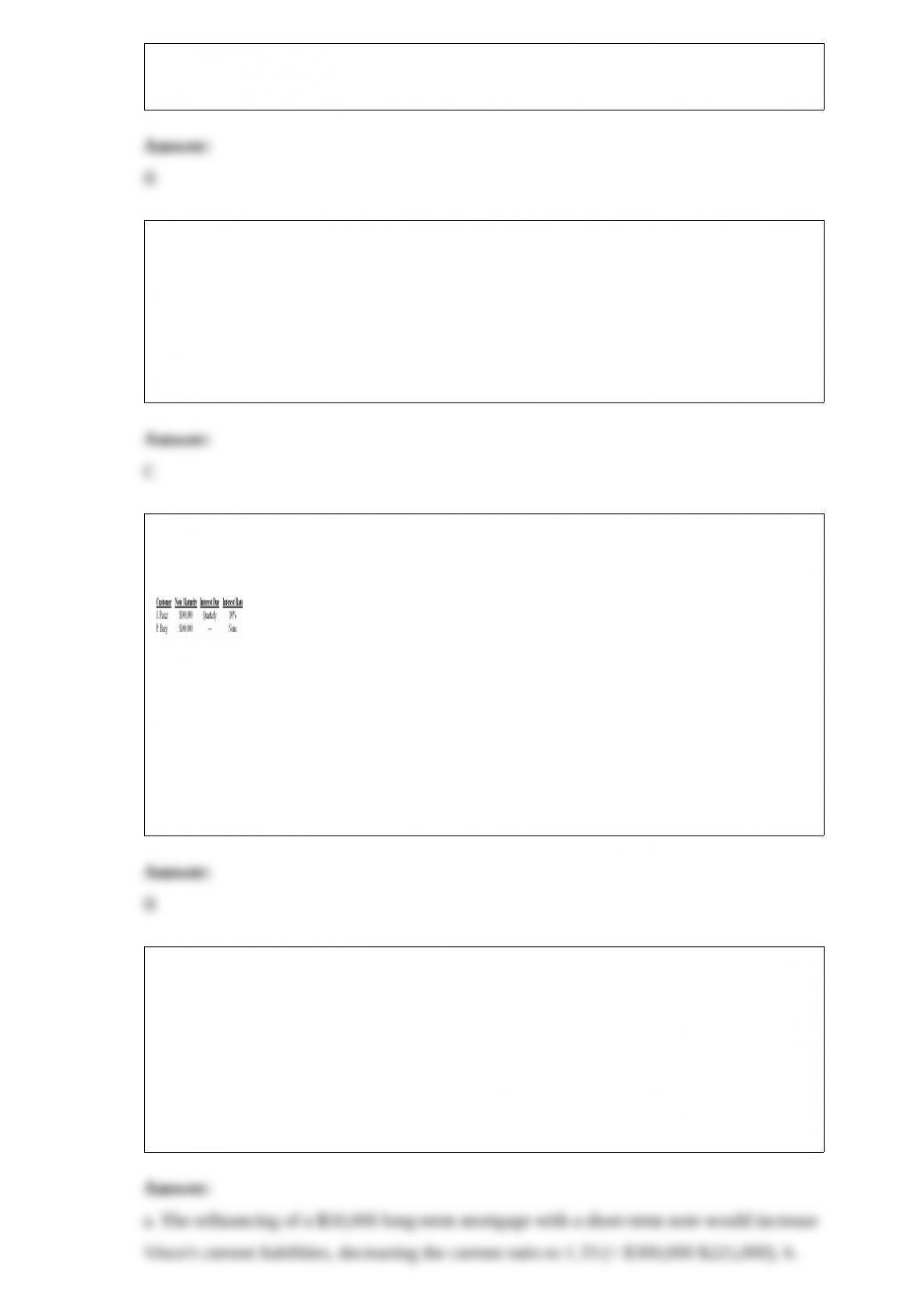
23) The Palmer Corporation sells goods to its customers on a note basis with 10% credit
terms and interest payable at the end of each quarter. All notes are due in one year.
Palmer makes the following sales on July 1, 2011:
To encourage sales, Berg was given a special deal on interest. Additional information:
Future value of $100,000 in one year (quarterly interest) is $110,381.
Present value of $100,000 for one year (quarterly interest) is $90,595.
What amount will Palmer use to record the sale to Berg?
A.$90,000
B.$90,595
C.$100,000
D.$110,382
24) Vince Corporation has current assets of $300,000 and current liabilities of
$175,000.
Required:
Compute the effect of each of the following transactions on Vince’s current ratio:
a. Refinanced a $50,000 long-term mortgage with a short-term note.
b. Purchasing $80,000 of merchandise inventory with short-term accounts payable.
c. Paying $30,000 of short-term accounts payable.
d. Collecting $40,000 of short-term accounts receivable.

25) Cash flows arising from the purchase or sale of a company’s own stock are cash
flows from
A.investing activities
B.operating activities
C.financing activities
D.research activities
26) Smith Company reported $350,000 in book income before income tax during 2012,
its first year of operation. The tax depreciation exceeded its book depreciation by
$30,000. The tax rate for 2012 and all future years was 40%.
If Smith paid no estimated taxes, what amount of income taxes payable should Smith
report in its December 31, 2012, balance sheet?
A.$100,000
B.$120,000
C.$128,000
D.$140,000
27) When determining the fair value of an asset using an exit price approach,
A.fair value is determined by how the company uses the asset
B.management may choose to reduce the fair value of the asset by the approximate
amount of expected transaction costs (i.e., costs to dispose of the asset) if such costs are
deemed to be material
C.transaction costs do not reduce the asset’s fair value
D.transaction costs reduce the asset’s fair value

28) The carrying cost of inventory should include all of the following costs except
A.purchase costs
B.sales taxes and transportation costs paid by the purchaser
C.general administrative costs associated with the purchase of inventory
D.insurance and storage costs
29) Business enterprises enter into many different types of contracts. Examples of such
contracts that often contain language that refers to verifiable financial statement
numbers include all of the following except
A.royalty contracts with inventors
B.sales contracts with customers
C.compensation contracts with managers
D.debt contracts with bankers
30) The cash flow statement of the United Company is in process for 2012 . The United
Company is reporting the following balances:
During 2012, United sold equipment costing $30,000 for $12,000 and made several
purchases of new equipment for cash.
Equipment purchases in 2012 were
A.$30,000
B.$70,000
C.$100,000
D.$120,000
31) Harry Jones accepted a six-month, 8% $40,000 note receivable from a customer on
July 1, 2011 . Jones has an arrangement with the National Bank to discount selected
customer notes at 10%.
On August 1, 2011, Jones discounted the note under the arrangement with National
Bank. How much were the proceeds of the discounted note?
A.$38,267
B.$39,867
C.$40,000

D.$41,600
32) The inventory under dollar-value LIFO at the end of Year 4 is
A.$240,000
B.$263,657
C.$274,074
D.$286,000
33) A major problem facing financial analysts who compare long-lived assets on
balance sheets of various companies is that different companies often use different
A.formats of balance sheet
B.estimated lives
C.salvage values
D.tax methods of depreciation
34) Refer to the 2003 IBM financial statement excerpts presented on the subsequent
pages to answer these questions. All questions relate to fiscal year 2003 unless stated
otherwise.
Required:
1> Explain the risks that IBM is trying to manage with its derivatives.
2> Explain how the gains and losses on the fair value hedges affect net income and
other comprehensive income during 2003 . Give specific accounts and amounts where
possible.
3> Explain how the gains and losses on non-hedge/other derivatives affect net income
and other comprehensive income during 2003 . Give specific accounts and amounts
where possible.
4> Explain how the gains and losses on the cash flow hedges affect net income and
other comprehensive income during 2003 . Give specific accounts and amounts where
possible.
5> Was it a good idea for IBM to enter into its cash flow hedges?
Excerpt from IBM December 31, 2003 Financial Statements

K
BORROWINGS
SHORT-TERM DEBT
(dollars in millions)
The weighted-average interest rates for commercial paper at December 31, 2003 and
2002, were 1.0 percent and 1.7 percent, respectively. The weighted-average interest rate
for short-term loans was 2.5 percent at both December 31, 2003 and 2002 .
Pre-Swap Activity (dollars in millions)
* On October 1, 2002, as part of the purchase price consideration for the PwCC
acquisition, as addressed in note C, Acquisitions/ Divestitures, on pages 89 to 92, the
company issued convertible notes bearing interest at a stated rate of 3.43 percent with a
face value of approximately $328 million to certain of the acquired PwCC partners. The
notes are convertible into 4,764,543 shares of IBM common stock at the option of the
holders at any time after the first anniversary of their issuance based on a fixed
conversion price of $68.81 per share of the company’s common stock. As of December
31, 2003, a total of 274,347 shares had been issued under this provision.
** In accordance with the requirements of SFAS No. 133, the portion of the company’s
fixed rate debt obligations that is hedged is reflected in the Consolidated Statement of
Financial
Position as an amount equal to the sum of the debt s carrying value plus a SFAS No.
133 fair value adjustment representing changes recorded in the fair value of the hedged
debt obligations attributable to movements in market interest rates and applicable
foreign currency exchange rates.
L. DERIVATIVES AND HEDGING TRANSACTIONS
The company operates in approximately 35 functional currencies and is a significant
lender and borrowerin the global markets. In the normal course of business, the
company is exposed to the impact of interest rate changes and foreign currency
fluctuations, and to a lesser extent equity price changes and client credit risk. The
company limits these risks by following established risk management policies and
procedures including the use of derivatives and, where cost-effective, financing with
debt in the currencies in which assets are denominated. For interest rate exposures,
derivatives are used to align rate movements between the interest rates associated with
the company’s lease and other financial assets and the interest rates associated with its
financing debt. Derivatives are also used to manage the related cost of debt. For foreign
currency exposures, derivatives are used to limit the effects of foreign exchange rate
fluctuations on financial results.
The company does not use derivatives for trading or speculative purposes, nor is it a
party to leveraged derivatives. Further, the company has a policy of only entering into
contracts with carefully selected major financial institutions based upon their credit
ratings and other factors, and maintains strict dollar and term limits that correspond to
the institution’s credit rating.
In its hedging programs, the company employs the use of forward contracts, futures
contracts, interest rate and currency swaps, options, caps, floors or a combination
thereof depending upon the underlying exposure.
A brief description of the major hedging programs follows.
DEBT RISK MANAGEMENT
The company issues debt in the global capital markets, principally to fund its financing

lease and loan portfolio. Access to cost-effective financing can result in interest rate
and/or currency mismatches with the underlying assets. To manage these mismatches
and to reduce overall interest cost, the company primarily uses interest-rate and
currency instruments, principally swaps, to convert specific fixed-rate debt issuances
into variable-rate debt (i.e., fair value hedges) and to convert specific variable-rate debt
and anticipated commercial paper issuances to fixed rate (i.e., cash flow hedges).
The resulting cost of funds is lower than that which would have been available if debt
with matching characteristics was issued directly. The weighted-average remaining
maturity of all swaps in the debt risk management program is approximately four years.
A significant portion of the company’s foreigncurrency denominated debt portfolio is
designated as a hedge of net investment to reduce the volatility in stockholders equity
caused by changes in foreign currencyexchange rates in the functional currency of
major foreign subsidiaries with respect to the U.S. dollar. The company also uses
currencyswaps and foreignexchange forward contractsfor this risk management
purpose.The currency effectsof these hedges (approximately $200 million for the
currentperiod, net of tax) are reflected as a loss in the Accumulated gains and
(losses)not affecting retainedearnings section of the Consolidated Statement of
Stockholders Equity, thereby offsetting a portion of the translation of the applicable
foreign subsidiaries net assets.
ANTICIPATED ROYALTIES AND COST TRANSACTIONS
The company’s operations generate significant nonfunctional currency, third party
vendor
payments and intercompany payments for royalties, and goods and services among the
company’s non-U.S. subsidiaries and with the parent company. In anticipation of these
foreign currency cash flows and in view of the volatility of the currency markets, the
company selectively employs foreign exchange forward and option contracts to manage
its currency risk. These contracts may have extended maturities beyond one year and
from time to time that extend to three years. As of December 31, 2003, the maximum
remaining maturity of these derivative instruments was approximately 18 months,
commensurate with the underlying hedged anticipated cash flows.
SUBSIDIARY CASH AND FOREIGN CURRENCY ASSET/LIABILITY
MANAGEMENT
The company uses its Global Treasury Centers to manage the cash of its subsidiaries.
These centers principally use currency swaps to convert cash flows in a cost-effective
manner. In addition, the company uses foreign exchange forward contracts to hedge, on
a net basis, the foreign currency exposure of a portion of the company’s nonfunctional
currency assets and liabilities. The terms of these forwardand swap contractsare
generally less than one year. The changes in fair value from these contracts and from
the underlying hedged exposures are generally offsetting and are recordedin Other
(income)and expense in the Consolidated Statement of Earnings.
EQUITY RISK MANAGEMENT
The company is exposed to certain equity price changes related to certain obligations to
employees. These equity exposures are primarily related to market value movements in
certain broad equity market indices and in the company’s own stock. Changes in the
overall value of this employee compensation obligation are recorded in SG&A expense
in the Consolidated Statement of Earnings. Although not designated as accounting
hedges, the company utilizes equity derivatives, including equity swaps and futures to
economically hedge the equity exposures relating to this employee compensation
obligation. To match the exposures relating to this employee compensation obligation,
these derivatives are linked to the total return of certain broad equity market indices
and/or the total return of the company’s common stock. These derivatives are recorded
at fair value with gains or losses also reported in SG&A expense in the Consolidated
Statement of Earnings.
OTHER DERIVATIVES
The company holds warrants in connection with certain investments that, although not
designated as hedging instruments, are deemed derivatives since they contain net share
settlement clauses. During the year, the company recorded the change in the fair value
of these warrants in net income.
The company is exposed to a potentialloss if a client fails to pay amounts due the
companyunder contractual terms (credit risk). The companyhas established policiesand
procedures for mitigating credit risk on principal transactions, including reviewing and
establishing limits for credit exposure, maintaining collateral, and continually assessing
the creditworthiness of counterparties. In 2003, the company began utilizing credit
default swaps to economically hedge certain credit exposures. These derivatives have
terms of two years. The swaps are not designated as accounting hedges and are
recorded at fair value with gains and losses reported in SG&A in the Consolidated
Statement of Earnings.
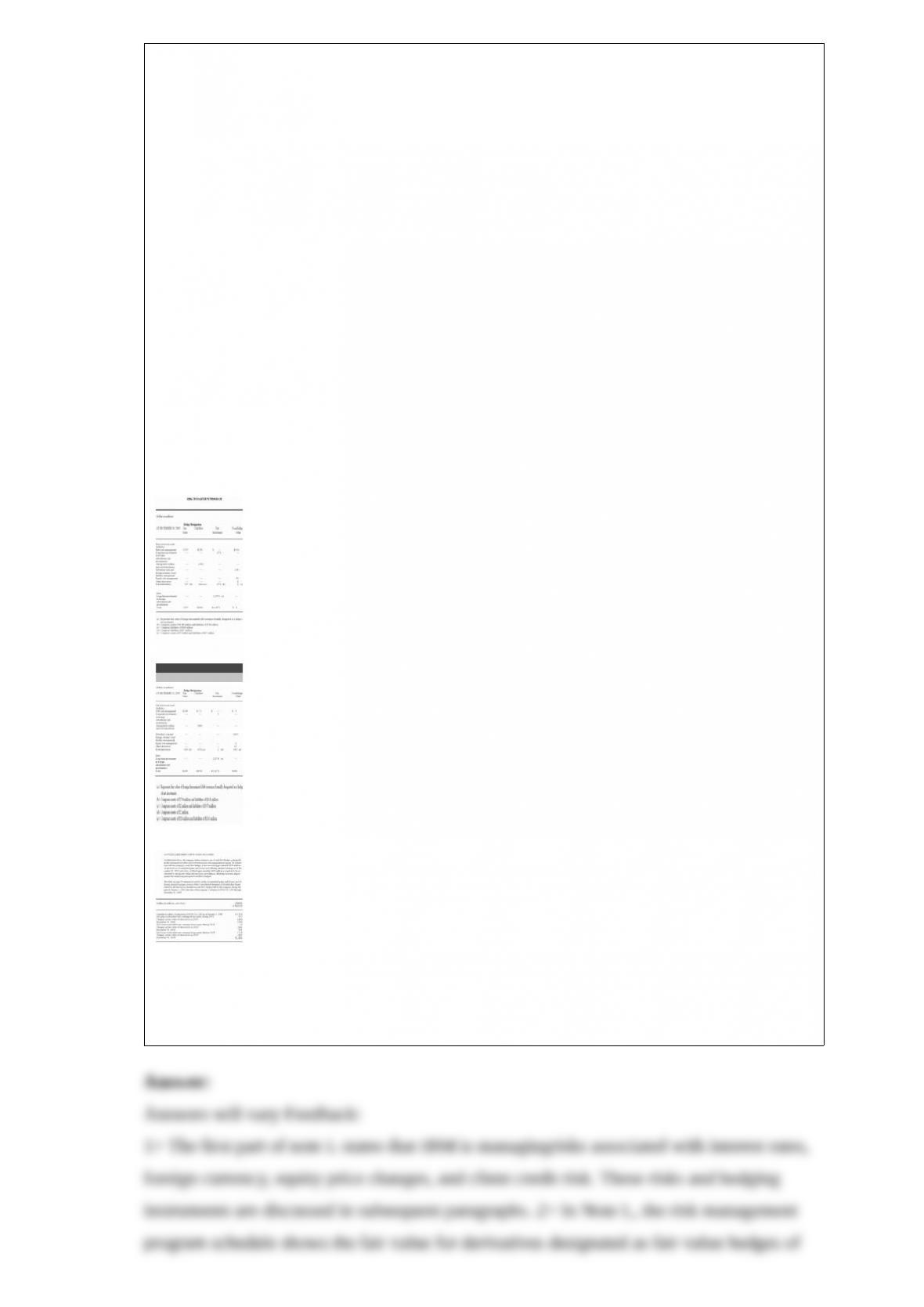
The tables on page 98 summarize the net fair value of the company’s derivative and
other risk management instruments at December 31, 2003 and 2002 (included in the
Consolidated Statement of Financial Position).
At December 31, 2003, there were no significant gains or losses on derivative
transactions or portionsthereof that were either ineffective as hedges, excludedfrom the
assessment of hedge effectiveness, or associated with an underlying exposure that did
not occur; nor are there any anticipated in the normal course of business.

35) Financial ratios used to determine credit risk include an assessment of
A.liquidity and asset utilization
B.asset utilization and profitability
C.solvency and liquidity
D.profitability and solvency
36) Frank Ritter, Inc. enters into an arrangement with Hisker Enterprises whereby
Hisker will assume $100,000 of Ritter’s receivables for a 6% fee. These receivables
have a related allowance for doubtful accounts of $3,500.
Assuming that the transaction was a factoring arrangement without recourse, which one
of the following entries will Ritter make?
A.Option a
B.Option b
C.Option c
D.Option d
37) For income tax purposes, pension plan sponsors deduct the amount of the
A.pension expense
B.service cost
C.plan contribution
D.service cost plus net amortization and deferral