1) The bid price is the price that a dealer will pay for a security; the asked price is the
price at which she will sell a security.
2) Accounting profits is the most relevant variable the financial manager uses to
measure returns.
3) A common stock with an expected dividend growth rate of zero would be valued in
the same way as preferred stock, that is, the expected dividend divided by the required
return.
4) The cash budget represents a detailed plan of future cash flows.
5) The amount that can be obtained on an inventory loan depends on both the
marketability and perishability of the items in the inventory.
6) Part of the U.S. Government’s huge deficit is financed by foreign countries, such as
China, which is a savings surplus unit.
7) A balance sheet is a statement of the financial position of the firm on a given date,
including its asset holdings, liabilities, and equity.

8) In break-even analysis, semivariable costs are segregated into their fixed and variable
components over the relevant range of output.
9) Operating leverage means financing a portion of a firm’s earnings per share with
debt.
10) In order to profit from an expected near-term increase in the relative value of the
British pound versus the U.S. dollar, an investor would be wise to maintain a short
position in pounds, then sell when the pound rises in relative value.
11) Because risk is measured by variability of returns, how long we hold our
investments does not matter very much when it comes to reducing risk.
12) Preferred stock is similar to a bond in the following way
A) preferred stock always contains a maturity date
B) both investments provide a stated income stream
C) both contain a growth factor similar to common stock
D) both provide interest payments
13) High dividends may increase stock values due to all of the following reasons
EXCEPT
A) dividends are more certain than capital gains
B) higher dividends are used to signal higher expected future earnings
C) dividends are used as a tool to minimize agency costs
D) higher dividends allow companies to increase their proportion of external equity
financing
14) Which of the following is used to manage a firm’s cash disbursements?
A) lockbox system
B) bankers’ acceptances
C) repurchase agreements
D) zero balance accounts
15) Based on the information in Table 4-1, the times interest earned ratio is
A) 32.33 times
B) 23.75 times
C) 19.00 times
D) 12.33 times
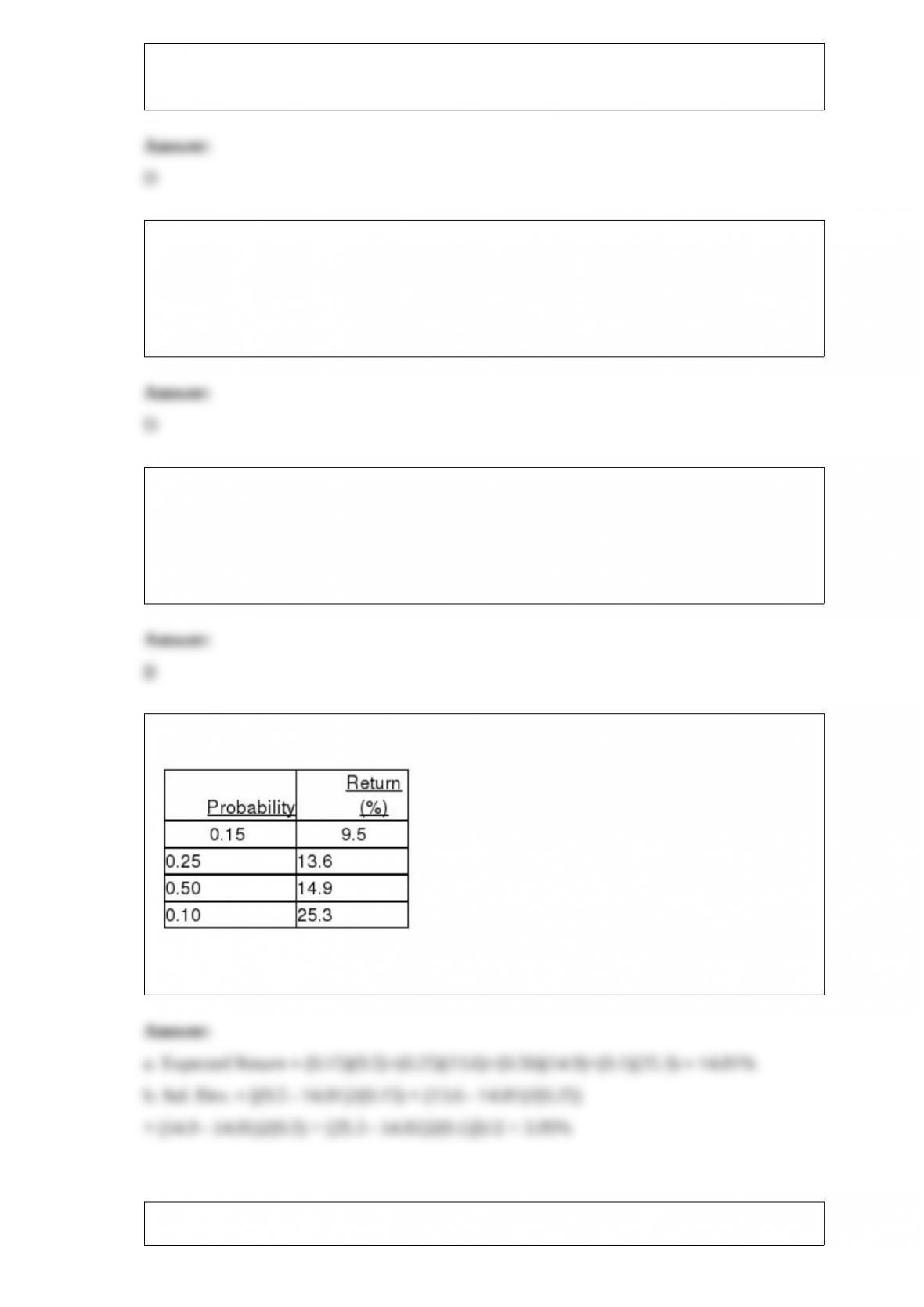
16) You are considering a security with the following possible rates of return:
a. Calculate the expected rate of return.
b. Calculate the standard deviation of the returns.
17) Your firm is considering an investment that will cost $920,000 today. The

investment will produce cash flows of $450,000 in year 1, $270,000 in years 2 through
4, and $200,000 in year 5. The discount rate that your firm uses for projects of this type
is 11.25%. What is the investment’s equivalent annual annuity?
A) $52,377
B) $42,923
C) $41,387
D) $40,399
18) What differentiates “discretionary financing needs” from “external financing
needs”?
A) assets
B) retained earnings
C) sales
D) spontaneous liabilities
19) A stock’s beta is a measure of its
A) unsystematic risk
B) systematic risk
C) company-unique risk
D) diversifiable risk
20) Table 4-2
Drummond Company
Balance Sheet
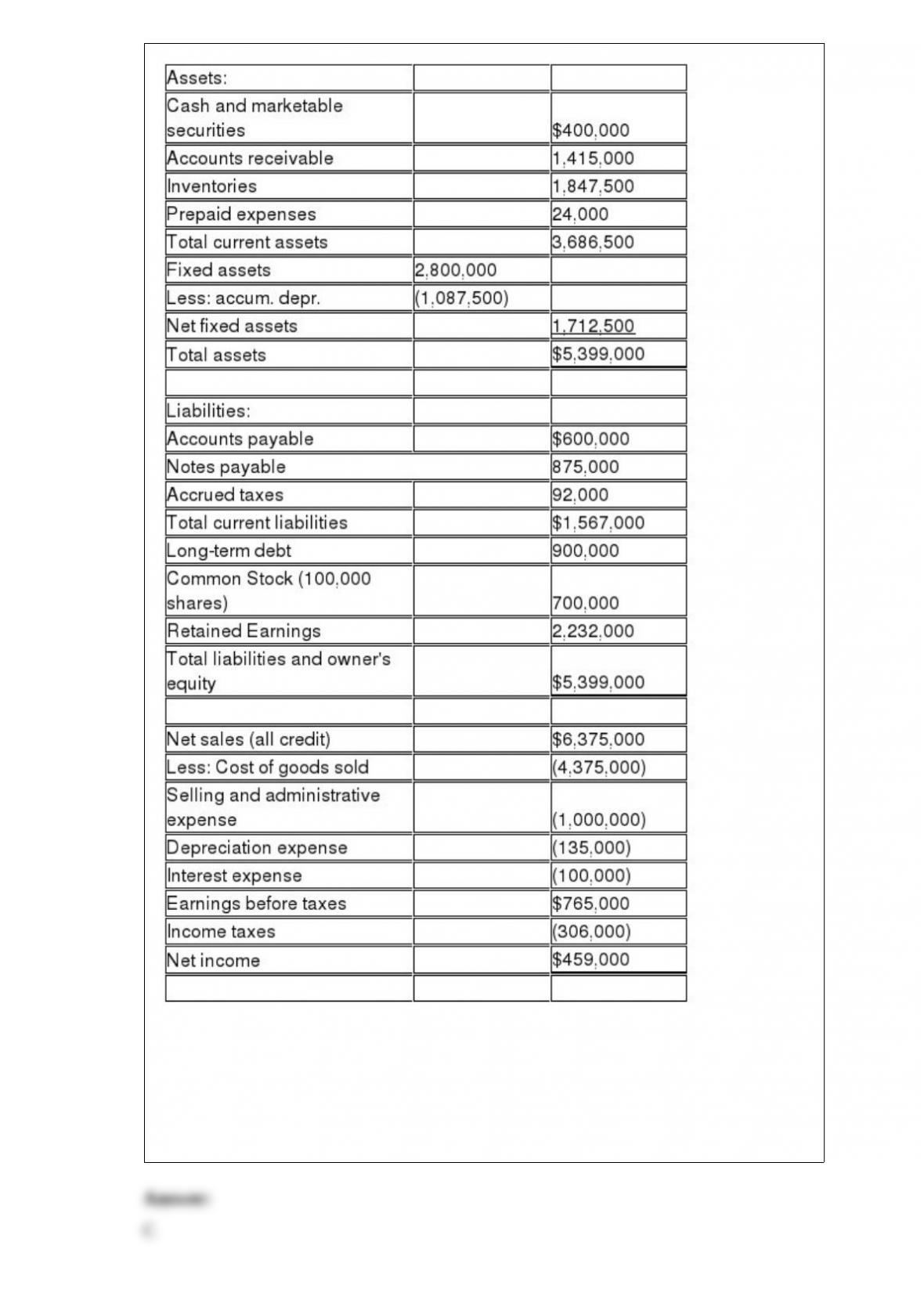
Based on the information in Table 4-2, the current ratio is
A) 2.97
B) 2.46
C) 2.35
D) 2.23
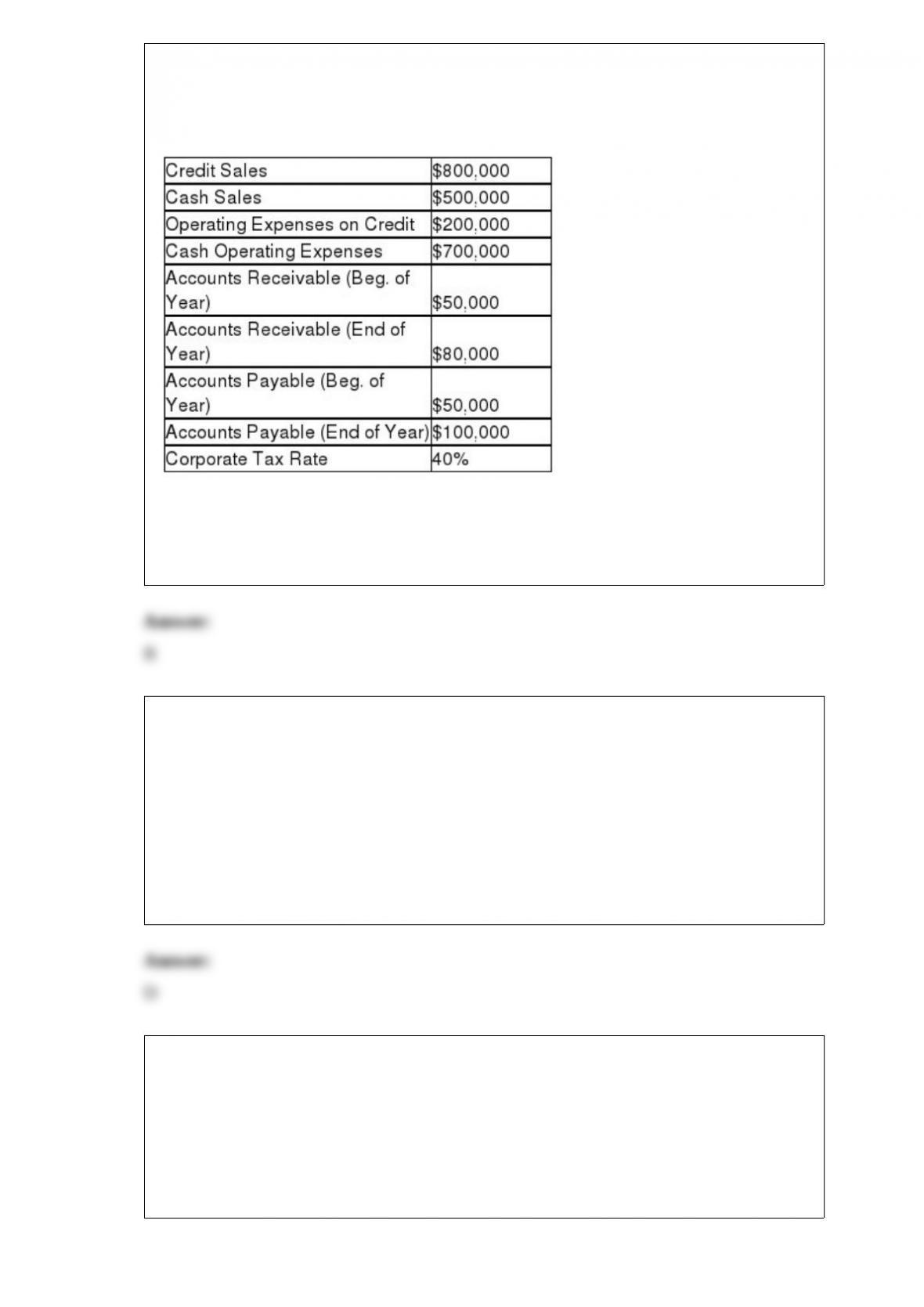
21) Use the following information to calculate the company’s accounting net income for
the year.
A) $300,000
B) $240,000
C) $125,000
D) $120,000
22) Which of the following statements about Generally Accepted Accounting Principles
(GAAP) is NOT true?
A) GAAP is a set of rule-based accounting standards established by the Financial
Accounting Standards Board (FASB)
B) GAAP sets out the standards, conventions, and rules that accountants must follow
when preparing audited financial statements
C) GAAP is complex, providing more than 150 “pronouncements” as to how to account
for different types of transactions
D) All of the statements above are true
23) Master Craft Control Inc. has bonds that mature in 6 1/2 years with a par value of
$1,000. They pay a coupon rate of 9% with semiannual payments. If the required rate of
return on these bonds is 11% what is the bond’s value?
A) $1,026.73
B) $973.76
C) $1,022.74
D) $908.83

24) The present value of the expected future cash flows of an asset represents the asset’s
A) liquidation value
B) book value
C) intrinsic value
D) par value
25) Prices of securities that are traded on the organized exchanges are determined by
A) a “bid” and “ask” negotiation process amongst brokers who hold these securities in
their own account
B) the Securities Exchange Commission
C) a continuous auction process reflecting the sentiments of buyers and sellers
D) the sellers of the securities
26) Two factors that cause the investor’s required rate of return to differ from the
company’s cost of capital are
A) taxes and risk
B) transactions costs and risk
C) taxes and transactions costs
D) risk and opportunity cost differences
27) J.B. Enterprises purchased a new molding machine for $85,000. The company paid
$8,000 for shipping and another $7,000 to get the machine integrated with the
company’s existing assets. J.B. must maintain a supply of special lubricating oil just in
case the machine breaks down. The company purchased a supply of oil for $4,000. The
machine is to be depreciated on a straight-line basis over its expected useful life of 8
years. Which of the following statements concerning the change in working capital is
most accurate?
A) The $4,000 paid for oil is added to the initial outlay, offset by the tax savings $1600
B) The $4,000 may be expensed each year over the life of the project as part of the
incremental free cash flows
C) The $4,000 is added to the initial outlay and recaptured during the terminal year,
hence having no impact on the projects NPV or IRR
D) Even if the $4,000 is fully recovered at the end of the project, the project’s NPV and
IRR will be lower if the change in working capital is included in the analysis

28) Common-sized income statements
A) assist in the comparison of companies of different sizes
B) show each income statement account as a percentage of total assets
C) compare companies with the same level of total sales
D) compare companies with the same level of net income
29) The risk-free rate of interest is 4% and the market risk premium is 9%. Howard
Corporation has a beta of 2.0, and last year generated a return of 16% with a standard
deviation of returns of 27%. The required return on Howard Corporation stock is
A) 36%
B) 34%
C) 26%
D) 22%
30) Transit float is caused by
A) the time necessary for a deposited check to clear the banking system and become
usable funds to the company
B) the time funds are not available, through the company’s bank account, until its
payment check has cleared the banking system
C) the elapsed time from the moment a customer mails his remittance check until the
firm begins to process it
D) the time required for the firm to process remittance checks
31) All of the following are methods available to a corporation that desires to
repurchase stock EXCEPT
A) offering to employees who own an interest in the firm
B) open market
C) tender offer to all existing stockholders
D) offer to one or more major stockholders on a negotiated basis

32) When forecasting fixed asset requirements, the projected fixed asset balance will
A) not increase proportionally with sales if the existing level of fixed assets is sufficient
to support current sales
B) not increase proportionally if excess capacity exists
C) remain the same since the balance is fixed
D) always increase proportionally with sales
33) If a corporation were to choose between issuing a debenture, a mortgage bond, or a
subordinated debenture, which would have the highest yield to maturity, everything else
equal?
A) the debenture
B) the mortgage bond
C) the subordinated debenture
D) all of the above
34) GPS Inc. wishes to estimate its cost of retained earnings. The firm’s beta is 1.3. The
rate on 6-month T-bills is 2%, and the return on the S&P 500 index is 15%. What is the
appropriate cost for retained earnings in determining the firm’s cost of capital?
A) 17.0%
B) 19.5%
C) 18.9%
D) 22.1%
35) Last National Bank is offering you a loan at 10%; payments on the loan are to be
made monthly. Credit Onion is offering you a loan where payments are to be made
semiannually; the rate on the loan is also 10%. Local Bank down the street is also
offering a loan at 10% where the payments are made quarterly. Which loan has the
lowest annual cost?
A) Last National Bank’s loan
B) Local Bank’s loan
C) Credit Onion’s loan
D) All of the loans will have the same annual cost

36) Southeast Compositions, Inc. is considering a project with the following cash flows:
Initial Outlay = $126,000
Cash Flows:Year 1 = $44,000
Year 2 = $59,000
Year 3 = $64,000
Compute the net present value of this project if the company’s discount rate is 14%.
A) -$249,335
B) -$138,561
C) $239,209
D) $725,000
37) Two investors are considering the purchase of Corporation LMQ bonds. The bonds
are selling at their par value of $1,000 with a coupon rate of 9%. Investor A decides to
buy the bonds and Investor B does not buy the bonds.
A) Investor A must have a required return higher than the bond’s yield to maturity
B) The yield to maturity for Investor A must be higher than the yield to maturity for
Investor B
C) Investor B must have required return lower than the bond’s yield to maturity
D) Investor A must have a required return less than or equal to 9%
38) Determine the five-year equivalent annual annuity of the following project if the
appropriate discount rate is 16%:
Initial Outflow = $150,000
Cash Flow Year 1 = $40,000
Cash Flow Year 2 = $90,000
Cash Flow Year 3 = $60,000
Cash Flow Year 4 = $0
Cash Flow Year 5 = $80,000
A) $7,058
B) $8,520
C) $9,454
D) $9,872
39) Which of the following statements is an example of a futures market transaction?
A) An investor purchases 100 shares of IBM hoping to sell it in two years for a profit
B) A company purchases an option to buy 1000 barrels of oil anytime between now and
the end of the year

C) A company agrees to purchase 1000 barrels of oil for delivery in six months at a
price of $70 per barrel
D) An executive has a portion of his current year salary deferred until he retires
40) Sunk costs are
A) recoverable
B) incremental
C) not relevant in capital budgeting
D) not deductible for tax purposes
41) What is the value of a preferred stock that pays a $5.55 dividend to an investor with
a required rate of return of 10%?
A) $22.22
B) $27.83
C) $45
D) $55.50
42) A project’s equivalent annual annuity (EAA) is the annuity cash flow that yields the
same present value as the project’s NPV.
43) Which of the following is the most relevant measure of risk for capital budgeting
purposes?
A) project standing alone risk
B) contribution-to-firm risk
C) symbiotic risk
D) unsystematic risk
44) Problems of multinationals include

A) cash management and positioning of funds
B) managing receivables
C) global control
D) all of the above
45) Racing Horse Corporation reported net income for 2010 of $200,000, sales of
$540,000, expenses (excluding depreciation) of $180,000, and depreciation expense of
$60,000. The company’s accounts receivable balance increased by $40,000 during the
year and its accounts payable balance remained the same. The company’s change in
cash for the year is estimated to be
A) $100,000
B) $160,000
C) $220,000
D) $380,000
46) Cindy wants $2.5 million for her retirement at age 65. Cindy is 25 years old today
and plans to deposit equal amounts each year starting on her 26th birthday and ending
on her 65th birthday. If her investments earn 6% per year, how much must each deposit
be?
47) Calculate the value of a bond that is expected to mature in 18 years with a $1,000
face value. The coupon rate is 4%, and the required rate of return is 8%. Interest is paid
annually.
48) You are currently 25 years of age. You have developed a lifetime budget that
includes $50,000 at age 40 for a college fund for your kids and $25,000 per year for 20
years to supplement your retirement, the first payment on your 60th birthday and the
last payment on your 79th birthday. You open an investment account on your 25th
birthday that promises to pay 9% interest compounded annually. You want to deposit
equal annual amounts into the account every year on your birthday, starting today (your
25th birthday) and continuing until you are 40 years old (i.e., the last deposit is made on
your 40th birthday). How much will each deposit have to be if you want to meet your
financial goals?
49) Tannerly Worldwide’s common stock is currently selling for $48 a share. If the
expected dividend at the end of the year is $2.40 and last year’s dividend was $2.00,
what is the rate of return implicit in the current stock price?
50) You are considering the purchase of Zee Company stock. You anticipate that the
company will pay dividends of $3.50 per share next year and $4.00 per share the
following year. You believe that you can sell the stock for $20.00 per share two years
from now. If your required rate of return is 10 percent, what is the maximum price that
you would pay for a share of Zee Company stock?