
Iota Industries is an all-equity firm with 50 million shares outstanding. Iota has $200
million in cash and expects future free cash flows of $75 million per year. Management
plans to use the cash to expand the firm’s operations, which in turn will increase future
free cash flows by 12%. Iota’s cost of capital is 10% and assume that capital markets are
perfect.
The NPV of Iota’s expansion project is closest to:
A) -$110 million
B) -$137.5 million
C) $0
D) $75 million
(Include the MACRS Table from the Appendix.)
Casa Grande Farms is considering purchasing multiple tractors for a total purchase
price of $540,000. These tractors are expected to generate EBITDA of $250,000 for
each of the next three years. Casa Grande Farms has a 35% tax rate and has a cost of
capital of 10%.
Assuming that Casa Grande Farms depreciates these tractors straight line over the three
year life, then the NPV of buying the tractors is closest to:
A) 20,785
B) 36,225
C) 81,715
D) 513,235

A sole proprietorship is owned by:
A) one person.
B) two of more persons.
C) shareholders.
D) bankers.
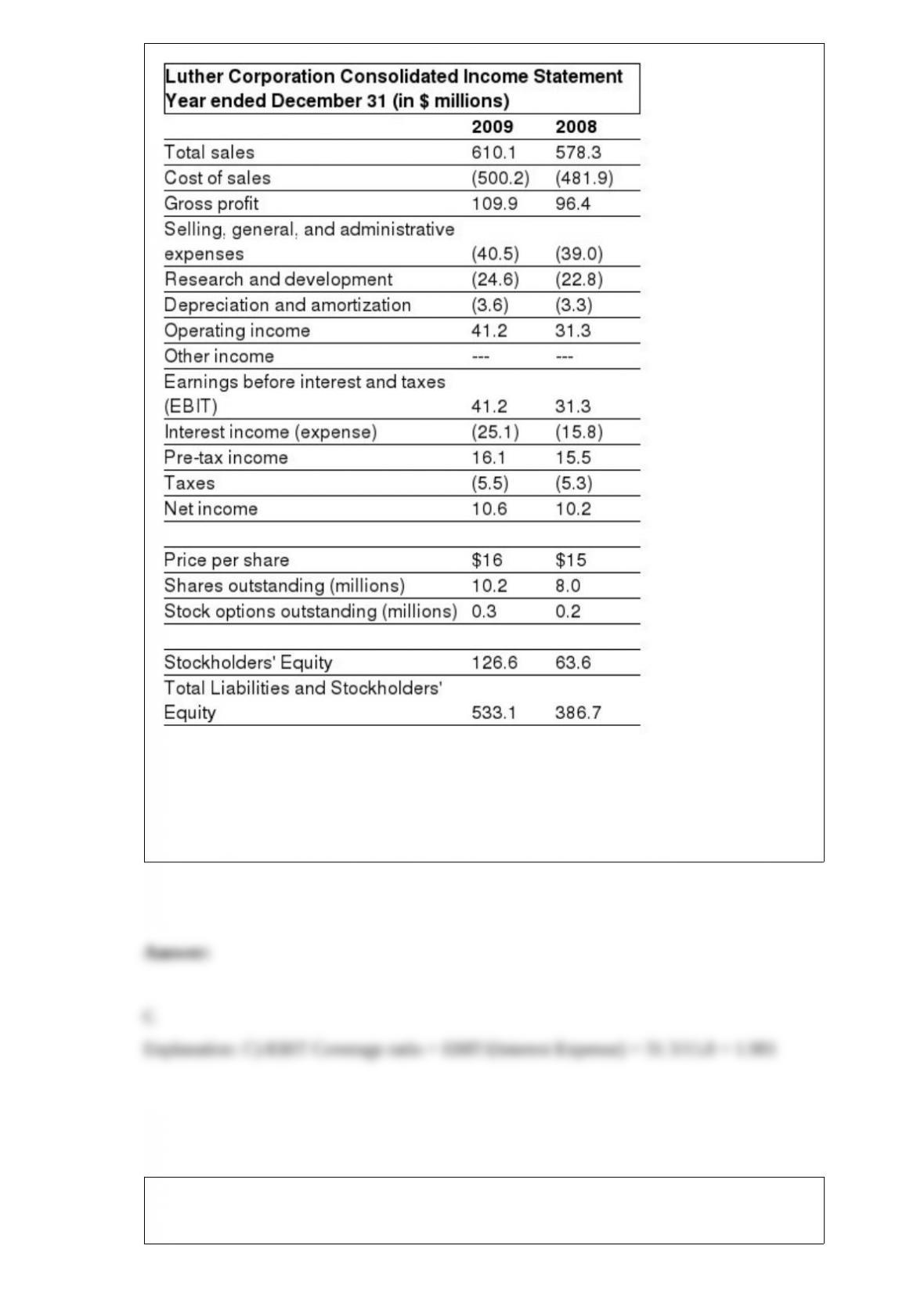
Luther’s EBIT coverage ratio for the year ending December 31, 2009 is closest to:
A) 1.64
B) 1.78
C) 1.98
D) 2.19
Two years ago the Krusty Krab Restaurant purchased a grill for $50,000. The owner,
Eugene Krabs, has learned that a new grill is available that will cook Krabby Patties

twice as fast as the existing grill. This new grill can be purchased for $80,000 and
would be depreciated straight line over 8 years, after which it would have no salvage
value. Eugene Krab expects that the new grill will produce EBITDA of $50,000 per
year for the next eight years while the existing grill produces EBITDA of only $35,000
per year. The current grill is being depreciated straight line over its useful life of 10
years after which it will have no salvage value. All other operating expenses are
identical for both grills. The existing grill can be sold to another restaurant now for
$30,000. The Krusty Krab’s tax rate is 35%.The incremental cash flow that the Krusty
Krab will incur in year 1 if they elect to upgrade to the new grill is closest to:
A) 6,500
B) 7,800
C) 10,800
D) 11,500
Which of the following equations is INCORRECT?
A) xi=
B) Rp= ΣixiRi
C) Rp= x1R1+ x2R2+ … + xnRn
D) E[Rp] = E[ΣixiRi]
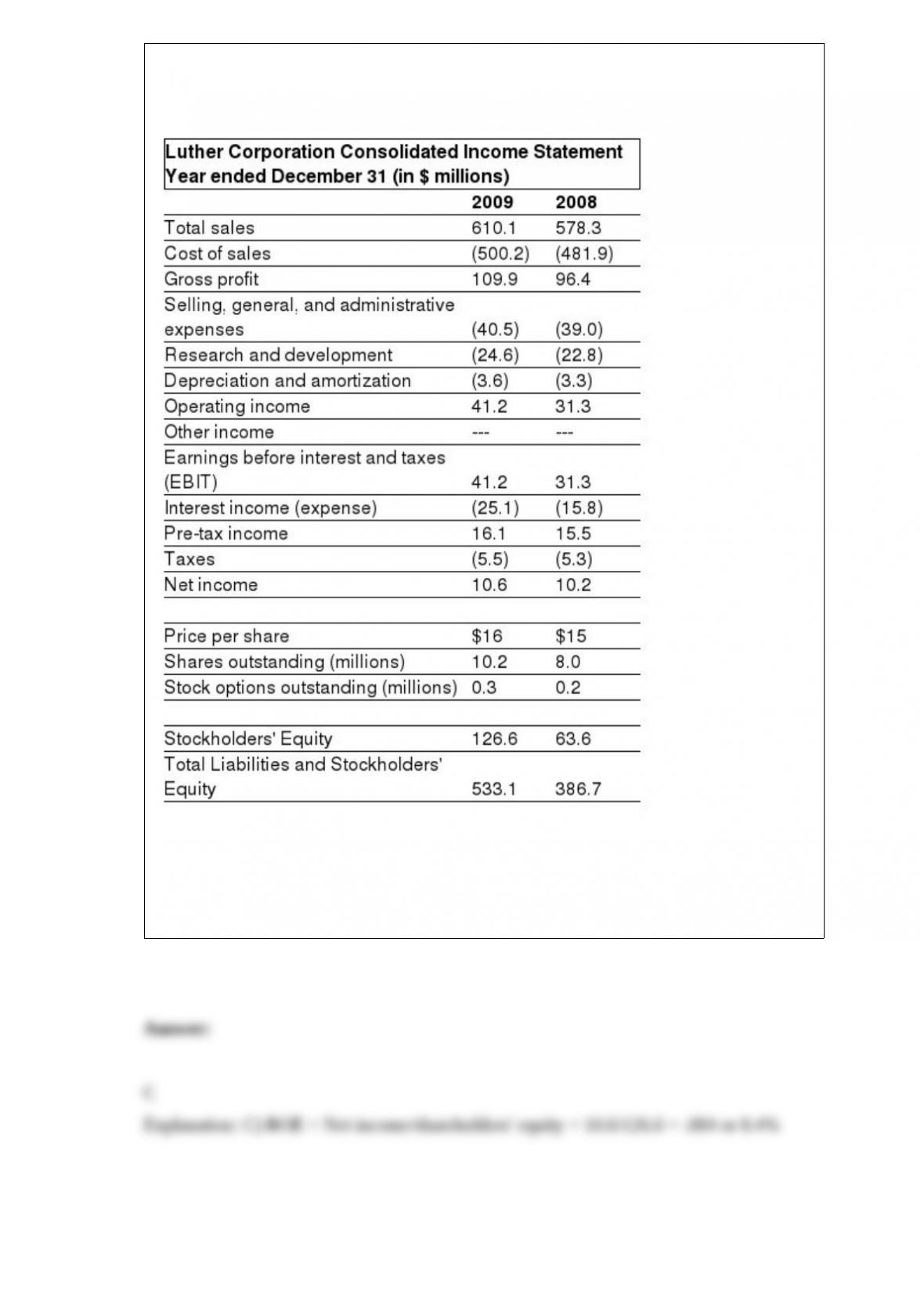
Luther’s return on equity (ROE) for the year ending December 31, 2009 is closest to:
A) 2.0%
B) 6.5%
C) 8.4%
D) 12.7%
Which of the following statements is FALSE?
A) Nonzero alphas may merely indicate that the wrong market proxy is beings used;
they do not necessarily indicate forgone positive NPV investment opportunities.
B) The true market portfolio contains much more than just stocks, it includes bonds,
real estate, art, precious metals, and any other investment vehicles available.
C) If the true market portfolio is efficient, but the proxy portfolio is not highly
correlated with the true market portfolio, then the true market portfolio will not be
efficient and stocks will have nonzero alphas.
D) Much of the investment wealth cannot be included in the proxy for the market
portfolio since it does not trade in competitive markets.
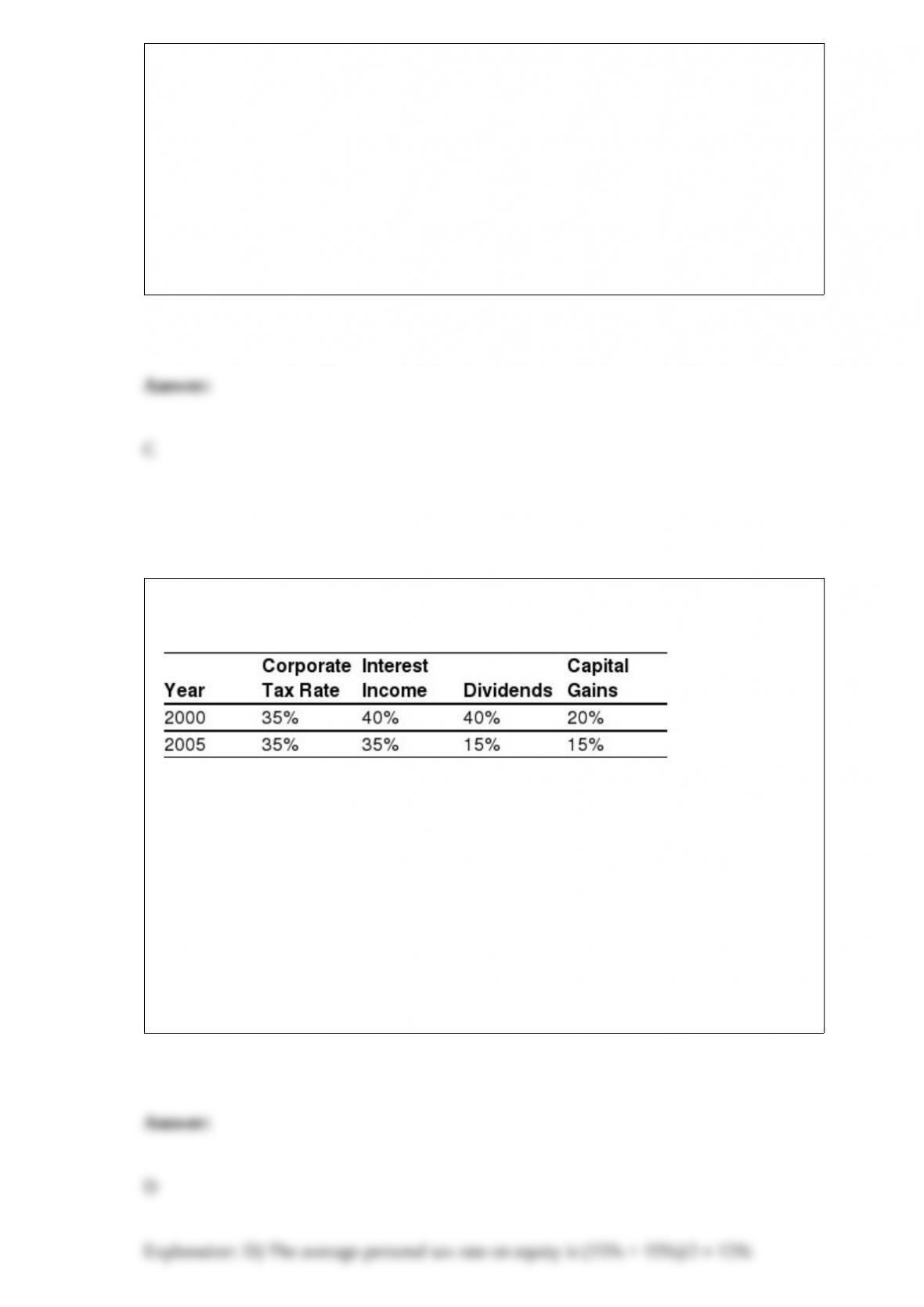
Consider the following top federal tax rates in the United States:
Personal Tax Rates
In 2005, assuming an average dividend payout ratio of 50%, the effective tax advantage
for debt (Ï„*) was closest to:
A) 24%
B) 18%
C) 35%
D) 15%

d’Anconia Copper is an all-equity firm with 60 million shares outstanding, which are
currently trading at $20 per share. Last month, d’Anconia announced that it will change
its capital structure by issuing $300 million in debt. The $200 million raised by this
issue, plus another $200 million in cash that d’Anconia already has, will be used to
repurchase existing shares of stock. Assume that capital markets are perfect.
Suppose you are a shareholder in d’Anconia Copper holding 300 shares, and you
disagree with the decision to lever the firm. You can undo the effect of this decision by
A) borrowing $2,000 and buying 100 shares of stock.
B) selling 100 shares of stock and lending $2,000.
C) borrowing $1,200 and buying 60 shares of stock.
D) selling 60 shares of stock and lending $1,200.
Flagstaff Enterprises expected to have free cash flow in the coming year of $8 million,
and this free cash flow is expected to grow at a rate of 3% per year thereafter. Flagstaff
has an equity cost of capital of 13%, a debt cost of capital of 7%, and it is in the 35%
corporate tax bracket.
If Flagstaff currently maintains a debt to equity ratio of 1, then the value of Flagstaff’s
interest tax shield is closest to:
A) $10 million
B) $18 million

C) $11 million
D) $24 million
Consider two banks. Bank A has 1000 loans outstanding each for $100,000, that it
expects to be fully repaid today. Each of Bank A’s loans have a 6% probability of
default, in which case the bank will receive $0 for each of the defaulting loans. Bank B
has 100 loans of $1 million outstanding, which it also expects to be fully repaid today.
Each of Bank B’s loans have a 5% probability of default, in which case the bank will
receive $0 for each of the defaulting loans. The chance of default is independent across
all the loans.
The standard deviation of the overall payoff to Bank A is closest to:
A) $689,000
B) $751,000
C) $2,179,000
D) $2,375,000
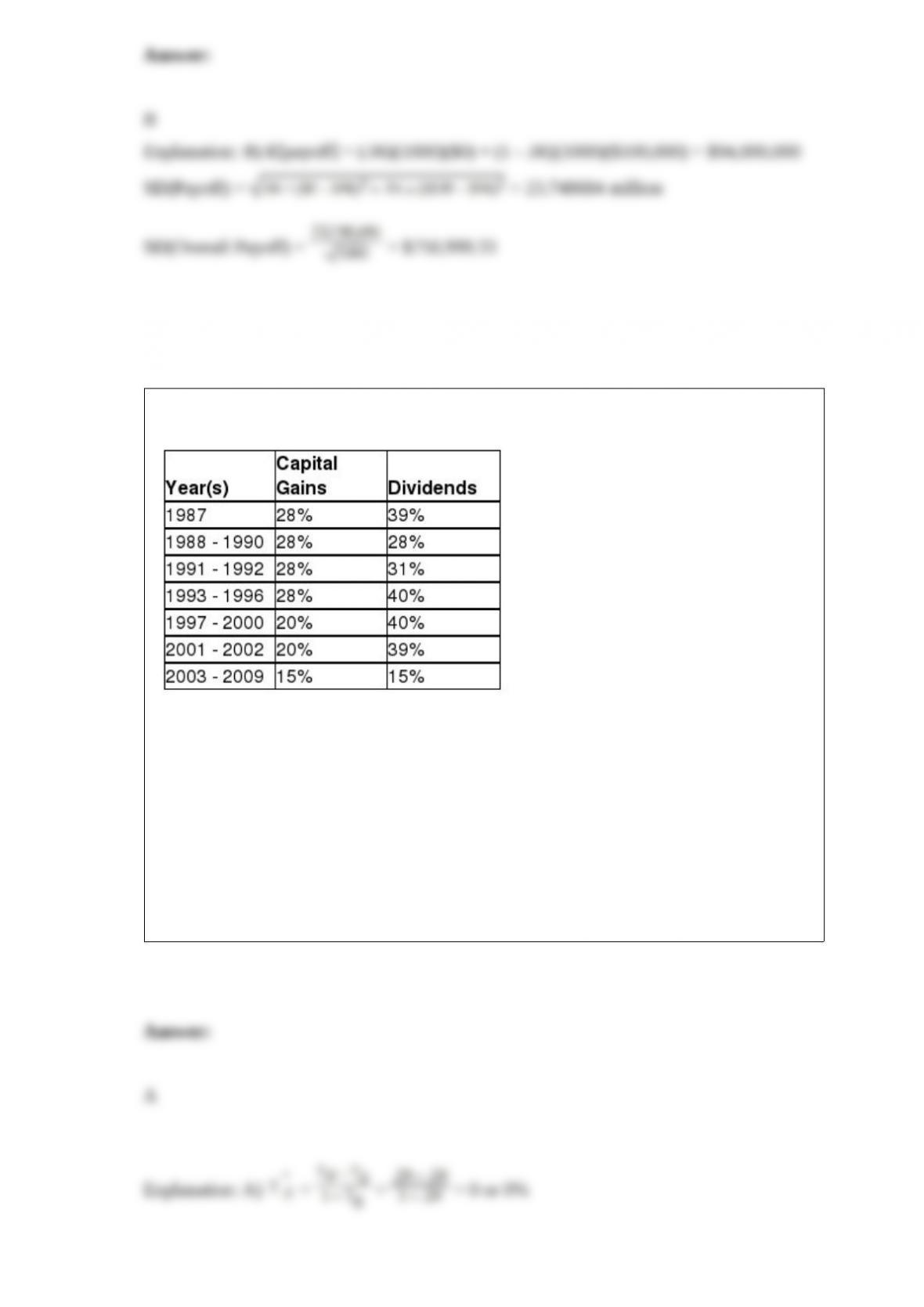
The effective dividend tax rate in 1989 is closest to:
A) 0%
B) 20%
C) 25%
D) 30%
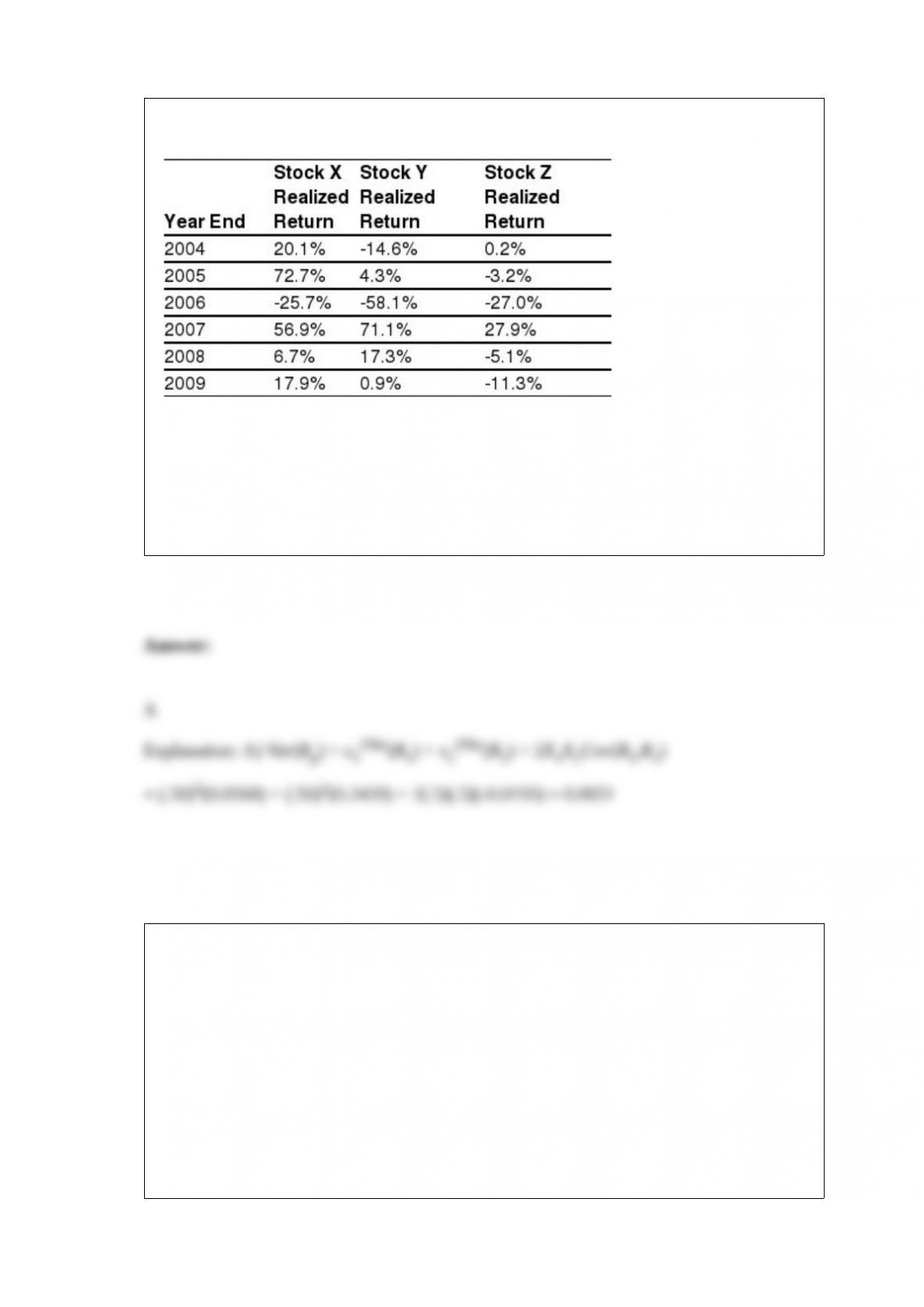
Consider the following returns:
The variance on a portfolio that is made up of equal investments in Duke Energy and
Microsoft stock is closest to:
A) .065
B) 0.090
C) .149
D) -0.020
Suppose the market portfolio’s excess return tends to increase by 30% when the
economy is strong and decline by 20% when the economy is weak. A type S firm has
excess returns that increase by 45% when the economy is strong and decrease by 30%
when the economy is weak. A type I firm will also have excess returns of either 45% or
-30%, but the type I firm’s excess returns will depend only upon firm-specific events
and will be completely independent of the state of the economy.
What is the Beta for a type S firm?
A) 1.5
B) 0.0
C) 1.0
D) 0.75

Kinston Enterprises has no debt and a debt obligation of $47 million that is due now.
The market value of Kinston’s assets is $102 million, and the firm has no other
liabilities. Assume that capital markets are perfect and that Kinston has 5 million shares
outstanding.
Kinston’s current share price is closest to:
A) $20.40
B) $9.40
C) $11.00
D) $10.00
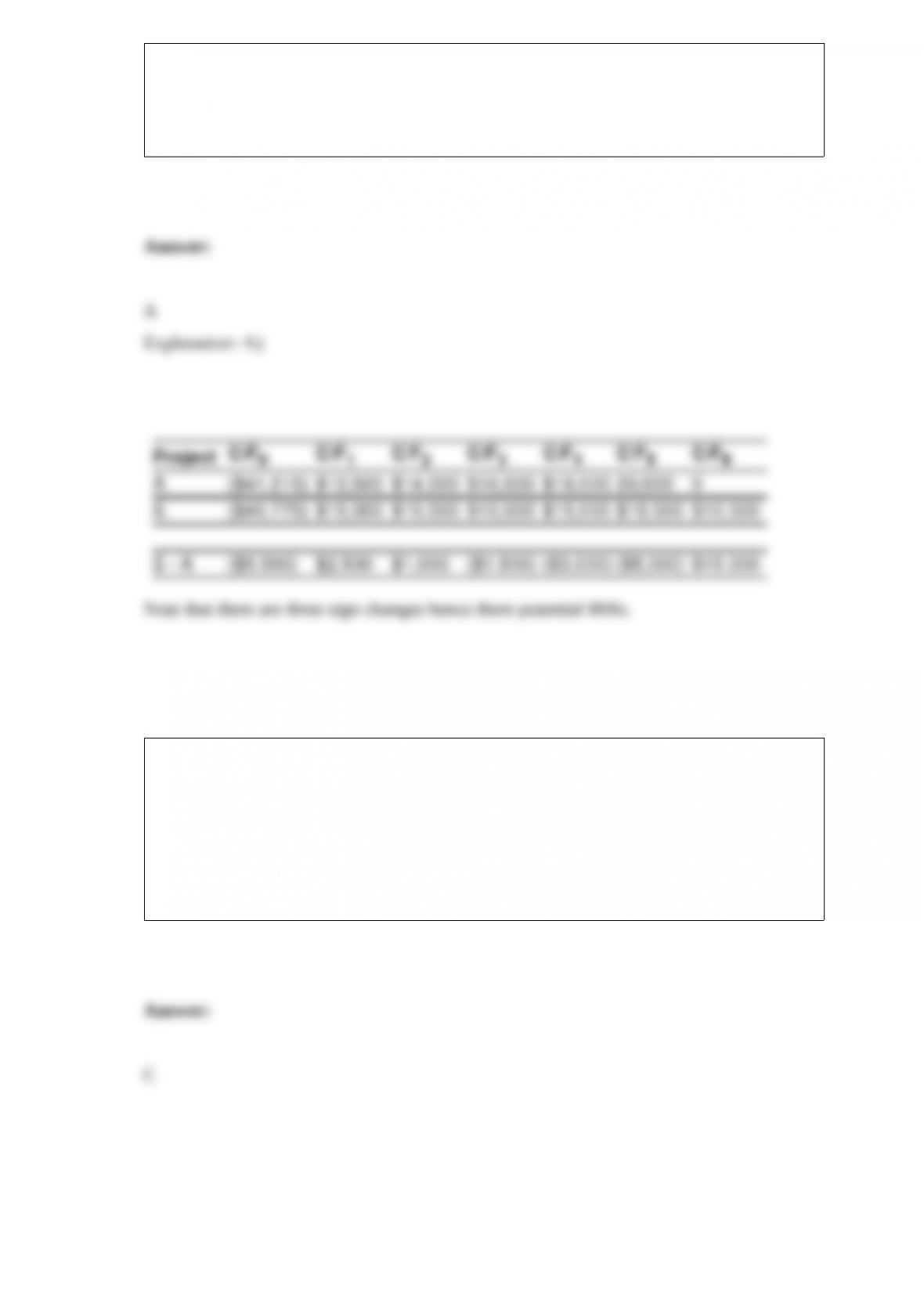
Consider two mutually exclusive projects with the following cash flows:
You are considering using the incremental IRR approach to decide between the two
mutually exclusive projects A & B. How many potential incremental IRRs could there
be?
A) 3
B) 0
C) 2
D) 1
The difference between scenario analysis and sensitivity analysis is that:
A) scenario analysis is based upon the IRR and sensitivity analysis is based upon NPV.
B) only sensitivity analysis allows us to change our estimated inputs of our NPV
analysis.
C) scenario analysis considers the effect on NPV of changing multiple project
parameters.
D) only scenario analysis breaks the NPV calculation into its component assumptions.