
1) a u.s. firm has sold an italian firm 1,000,000 worth of product. in one year the u.s.
firm gets paid. to hedge, the u.s. firm bought put options on the euro with a strike price
of $1.65. they paid an option premium $0.01 per euro. if at maturity, the exchange rate
is $1.60,
a.the firm will realize $1,145,000 on the sale net of the cost of hedging
b.the firm will realize $1,150,000 on the sale net of the cost of hedging
c.the firm will realize $1,140,000 on the sale net of the cost of hedging
d.none of the above
2) emerald energy is an oil exploration and production company that trades on the
london stock market. over the past year, the stock has enjoyed a 20 percent return in
pound terms, but over the same period, the exchange rate has fallen from $2.00 = £1 to
$1.80 = £1. calculate the investor’s annual percentage rate of return in terms of the u.s.
dollars.
a.3.5%
b.9.25%
c.8%
d.there is not enough information to compute the investor’s annual percentage rate of
return in terms of the u.s. dollars
3) fundamentally, there are two types of tax jurisdiction:
a.the worldwide and the territorial
b.the residential and the visiting
c.the passive and the active income
d.the earned and the unearned
4) suppose you are a citizen of the united states with foreign-source income. in the
foreign country the tax rate is 40 percent and your u.s. rate is 30%. for every $10,000 of
foreign-source income you will
a.receive a tax credit of $3,000
b.receive a tax credit of $3,500
c.receive a tax credit of $4,000
d.receive a tax credit of $1,000
5) private placement bond issues
a.do not have to meet the strict information disclosure requirements of publicly traded
issues
b.have auditing requirements that do no adhere to publicly traded issues
c.meet the strict information disclosure requirements of publicly traded issues, but have
larger minimum denominations
d.none of the above
6) suppose that country a is twice as good at producing widgets as country b. if the
currency of b is twice as valuable as the currency of a,
a.the comparative advantage will be canceled out
b.trade will be an improved outcome for both a and b
c.the comparative advantage could possible be canceled out depending on how much it
costs to produce the widget in country b
d.none of the above
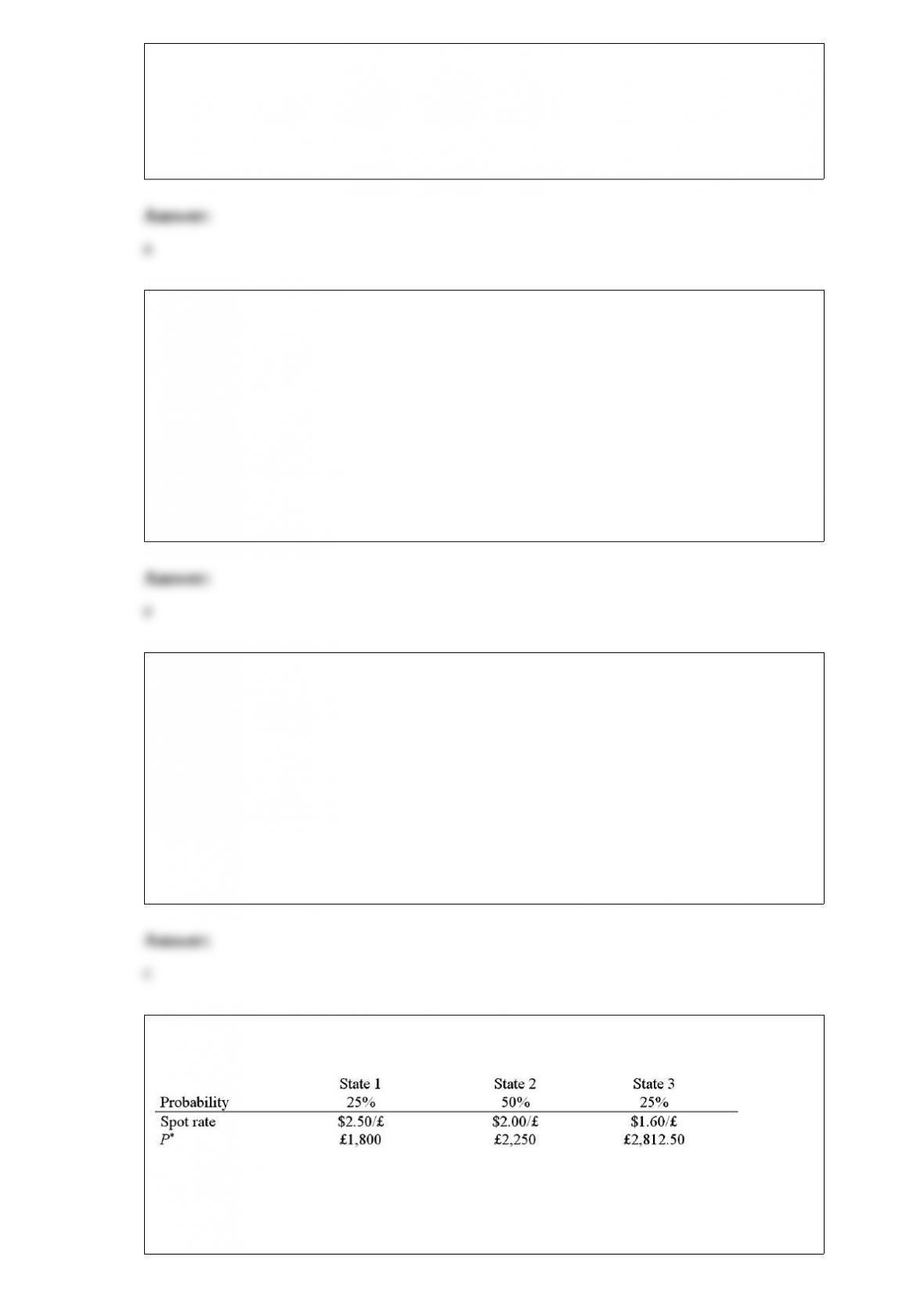
7) a u.s. firm holds an asset in great britain and faces the following scenario:
where
p* = pound sterling price of the asset held by the u.s. firm

the cfo decides to hedge his exposure by selling forward the expected value of the
pound denominated cash flow at f1($/£) = $2/£. as a result
a.the firm’s exposure to the exchange rate is made worse
b.he has a nearly perfect hedge
c.he has a perfect hedge
d.none of the above
8) suppose your firm needs to raise 100,000,000 with a one-year bond with a coupon
rate of 8 percent per annum. the underwriting spread is 2 percent. what should the
amount of the bond offering be?
a.102,000,000
b.102,040,816.30
c.94,482,237
d.110,204,081.60
9) a bank may establish a multinational operation for the reason of growth. the rationale
being that
a.growth prospects in a home nation may be limited by a market largely saturated with
the services offered by domestic banks
b.multinational banks are often not subject to the same regulations as domestic banks.
there may be reduced need to publish adequate financial information, lack of required
deposit insurance and reserve requirements on foreign currency deposits, and the
absence of territorial restrictions
c.greater stability of earnings is possible with international diversification. offsetting
business and monetary policy cycles across nations reduces the country-specific risk of
any one nation
d.by maintaining foreign branches and foreign currency balances, banks may reduce
transaction costs and foreign exchange risk on currency conversion if government
controls can be circumvented

10) open interest in currency futures contracts
a.tends to be greatest for the near-term contracts
b.tends to be greatest for the longer-term contracts
c.typically decreases with the term to maturity of most futures contracts
d.both a and c
11) in the notation of the book, k = (1 – )kl + (1 – )i
which of the following are correct?
a.the debt-to-equity ratio is
b.the cost of equity capital for a levered firm is k
c.the pre-tax cost of debt capital is i
d.all of the above
12) assuming that the bond sells at par, the implicit $/£ exchange rate at maturity of a
british poundu.s. dollar dual currency bonds that pay £581.40 at maturity per $1,000 of
par value is:
a.$1.95/£1.00
b.$1.72/£1.00
c.$1.58/£1.00
d.$0.5814/£1.00
13) the first two columns give the maximum daily amounts of beer and whiskey that
southern ireland and northern ireland can produce when they completely specialize in
one or other product. the last two columns give each country’s consumption without
trade.
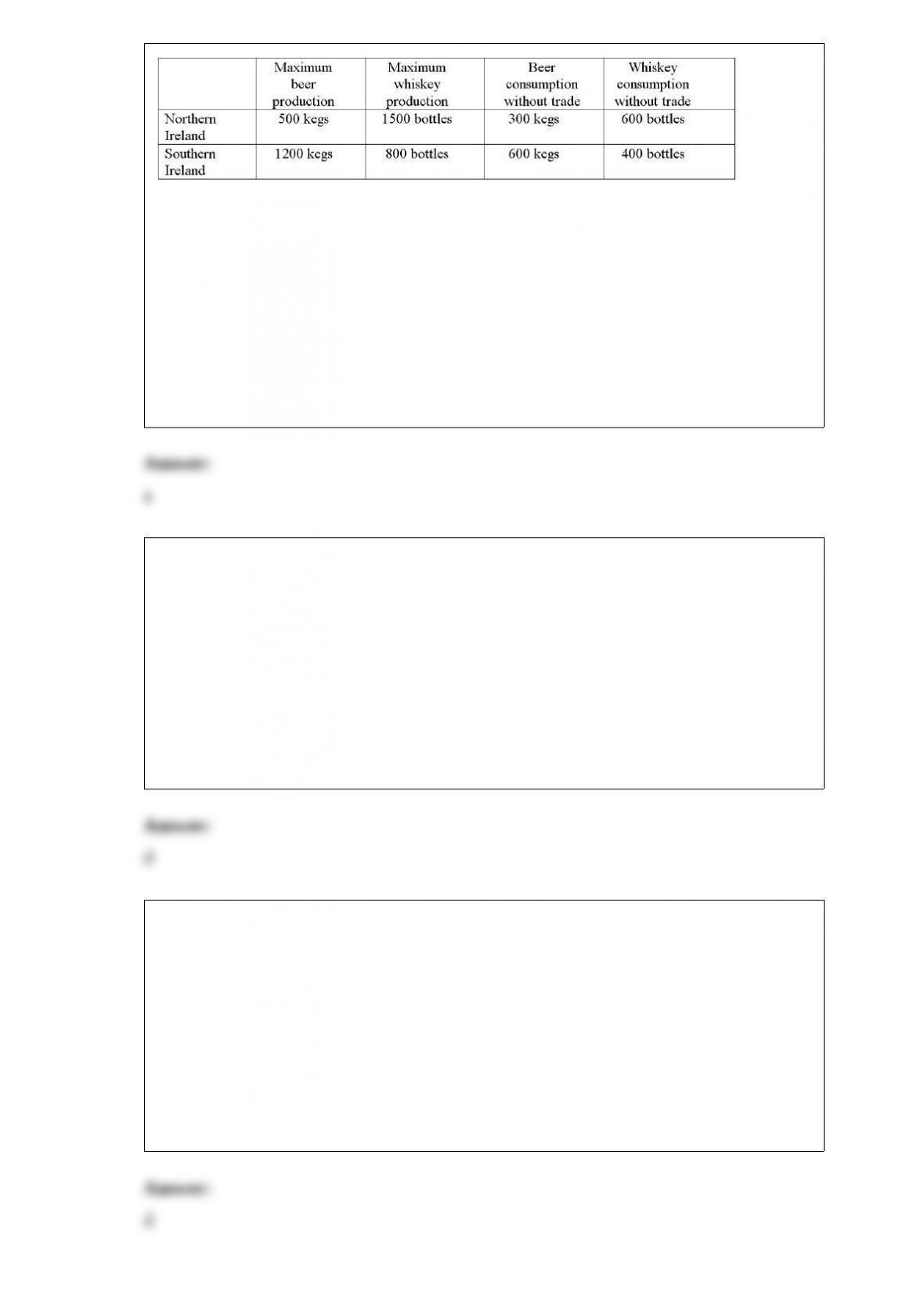
suppose that trade occurs. each country completely specializes and 500 kegs of beer are
traded for 500 bottles of whiskey. what is the international price of beer?
a.1 bottle of whiskey = 1 keg of beer
b.3 bottles of whiskey = 1 keg of beer
c.2/3 bottle of whiskey = 1 keg of beer
d.1 bottle of whiskey = 3 kegs of beer
14) deregulation of world financial markets
a.provided a natural environment for financial innovations, like currency futures and
options
b.has promoted competition among market participants
c.has encouraged developing countries such as chile, mexico, and korea to liberalize by
allowing foreigners to directly invest in their financial markets
d.all of the above
15) if cross-border acquisitions generate synergistic gains,
a.then both the acquiring and target shareholders gain wealth at the same time
b.then one can argue that cross-border acquisitions are mutually beneficial and thus
should not be thwarted both from a national and global perspective
c.then the value of the combined firm is greater than the stand-alone valuations of the
individual (acquiring and target) firms
d.all of the above
16) an all-or-none order is a limit order either to buy or to sell a security in which the
broker is directed to attempt to fill the entire amount of the order or none of it. an
all-or-none order differs from a fill-or-kill order in that
a.with an all-or-none order immediate execution is not required
b.with an all-or-none order immediate execution is required
c.with an all-or-none order oversubscription is allowedfilling the order for more shares
d.none of the above
17) purchasing power parity (ppp) theory states that
a.the exchange rate between currencies of two countries should be equal to the ratio of
the countries’ price levels
b.as the purchasing power of a currency sharply declines (due to hyperinflation) that
currency will depreciate against stable currencies
c.the prices of standard commodity baskets in two countries are not related
d.both a and b
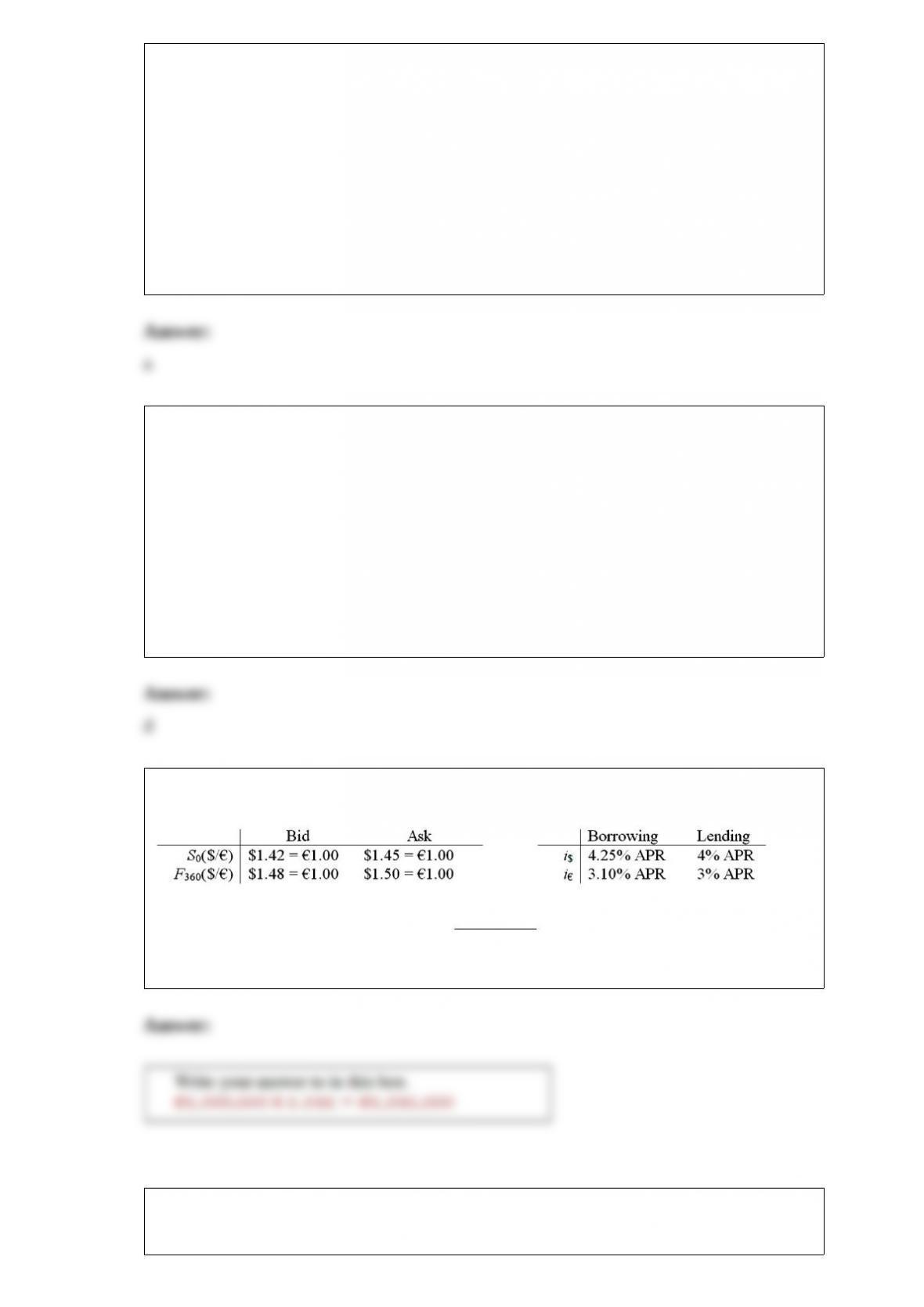
18) assume that you are a retail customer.
please note that your answers are worth zero points if they do not include currency
symbols ($, )
if you borrowed 1,000,000 for one year, how much money would you owe at maturity?
19) consider an option to buy £10,000 for 12,500. in the next period, if the pound
appreciates against the dollar by 37.5 percent then the euro will appreciate against the
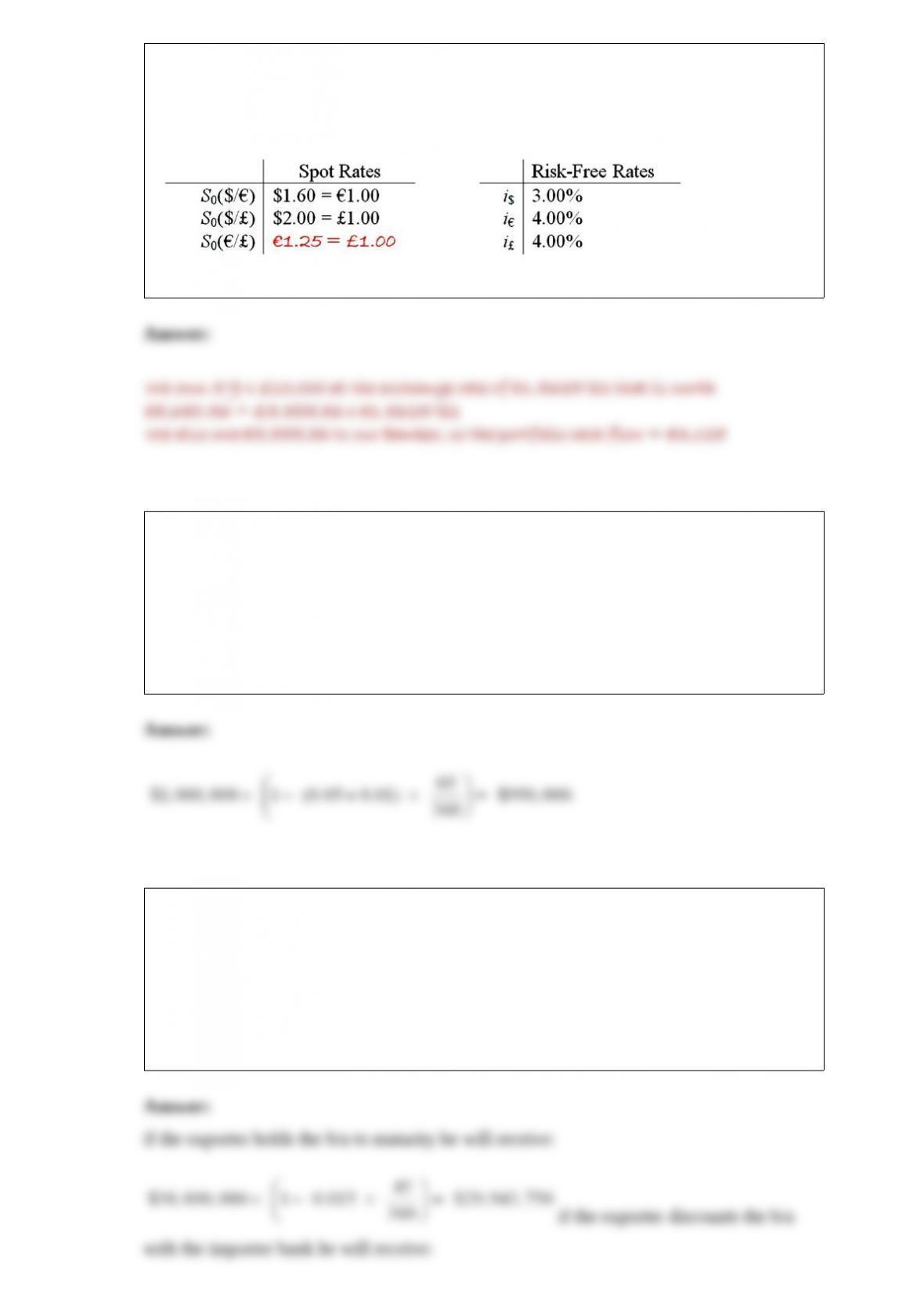
dollar by ten percent. on the other hand, the euro could depreciate against the pound by
20 percent.
big hint: don’t round, keep exchange rates out to at least 4 decimal places.
if the call finishes in-the-money what is your replicating portfolio cash flow?
20) the time from acceptance to maturity on a $1,000,000 banker’s acceptance is 60
days.
the importing bank’s acceptance commission is 1.00 percent and that the market rate for
60-day b/as is 5 percent.
determine the amount the exporter will receive if he discounts the b/a with the
importer’s bank.
21) the time from acceptance to maturity on a $30,000,000 banker’s acceptance is 45
days.
the importing bank’s acceptance commission is 1.5 percent and that the market rate for
45-day b/as is 4 percent.
determine the bond equivalent yield the importer’s bank will earn from discounting the
b/a with the exporter.
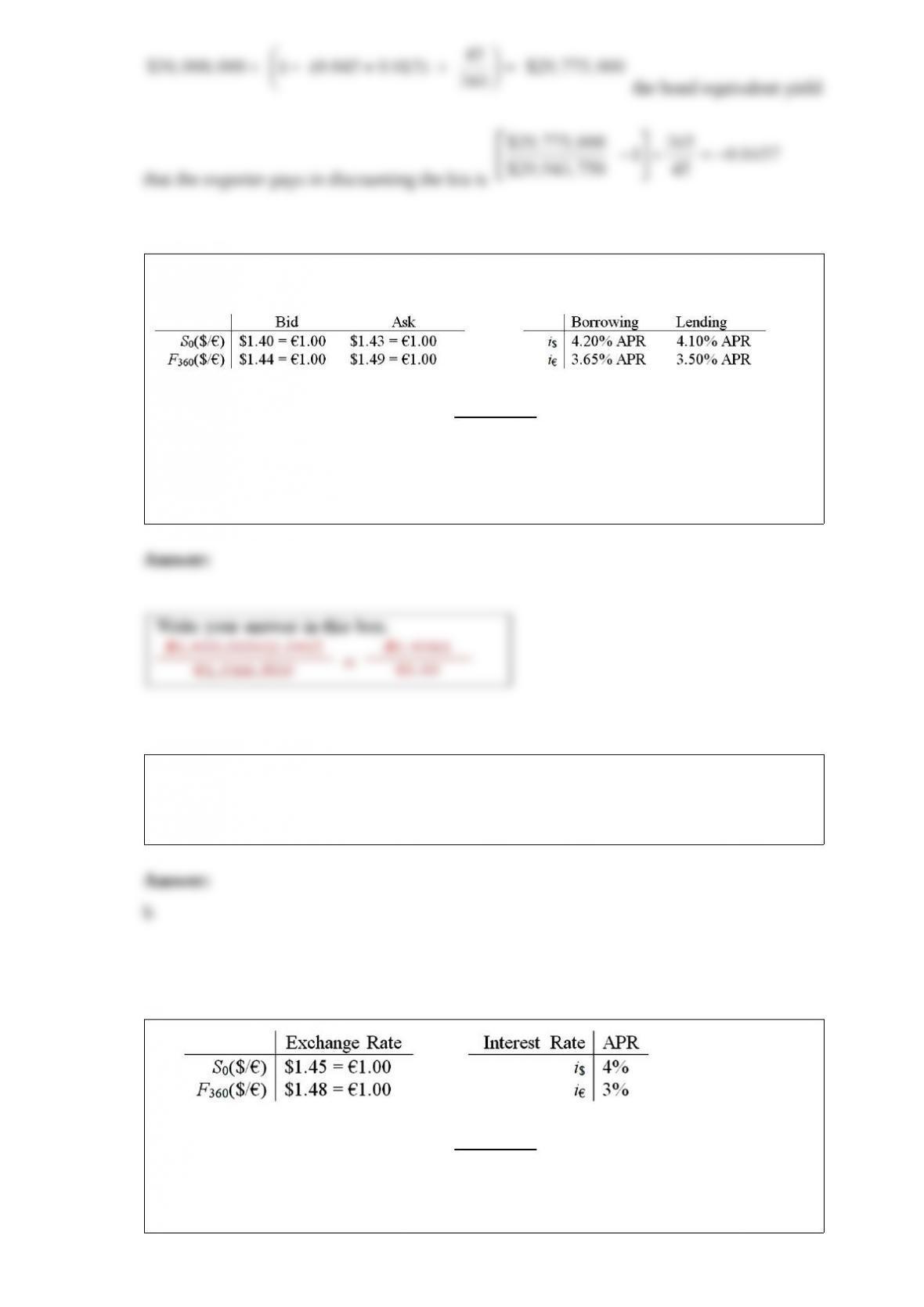
22) assume that you are a retail customer.
please note that your answers are worth zero points if they do not include currency
symbols ($, )
using your previous answers and a bit more work, find the 1-year forward ask exchange
rate in $ per that that satisfies irp from the perspective of a customer.
23) in the years leading to the collapse of the bretton woods system
a. it became clear that the dollar was undervalued
b. it became clear that the dollar was overvalued
24)
please note that your answers are worth zero points if they do not include currency
symbols ($, )
if you had 1,000,000 and traded it for usd at the spot rate, how many usd will you get?