
The operating cycle is the elapsed time between the
a. purchase of goods or services and the ultimate collection of cash from customers
related to the sale of those goods.
b. sale of goods or services to customers and the payment to suppliers for those goods.
c. purchase of goods from suppliers and the performance of the related service for
customers.
d. sale of goods and the delivery of those goods to customers.
Ending inventory is equal to the cost of items on hand plus
a. merchandise in transit sold to customers with terms FOB shipping point.
b. merchandise in transit sold to customers with terms FOB destination.
c. merchandise returned to sellers in transit with terms FOB shipping point.
d. merchandise purchased from buyers in transit with terms FOB destination.
A financial analyst is comparing two companies using a top-down approach. Which of
the following would cause problems in the evaluation process?
a. One company’s fiscal year-end is October 31, while the other company’s fiscal
year-end is December 31.
b. One company has been in business significantly longer than the other company.
c. Inflation has been low for several years.
d. The companies operate in different industries.

Which of the following accounts would most likely appear on the income statement of a
merchandise company, but not on the income statement of a service company?
a. cost of goods sold
b. selling expenses
c. administrative expenses
d. income tax expense
Which of the following types of inventory accounts would be used by a wholesaler or
retailer?
a. merchandise inventory
b. raw materials inventory
c. work in process inventory
d. finished goods inventory
Which of the following statements is true regarding horizontal analysis?
a. It can only be used with balance sheet accounts.
b. It can only be used with income statement accounts.
c. It expresses each financial statement line item as a percent of the largest amount on
the statement.
d. It expresses each financial statement line item as a percent of an earlier year amount.
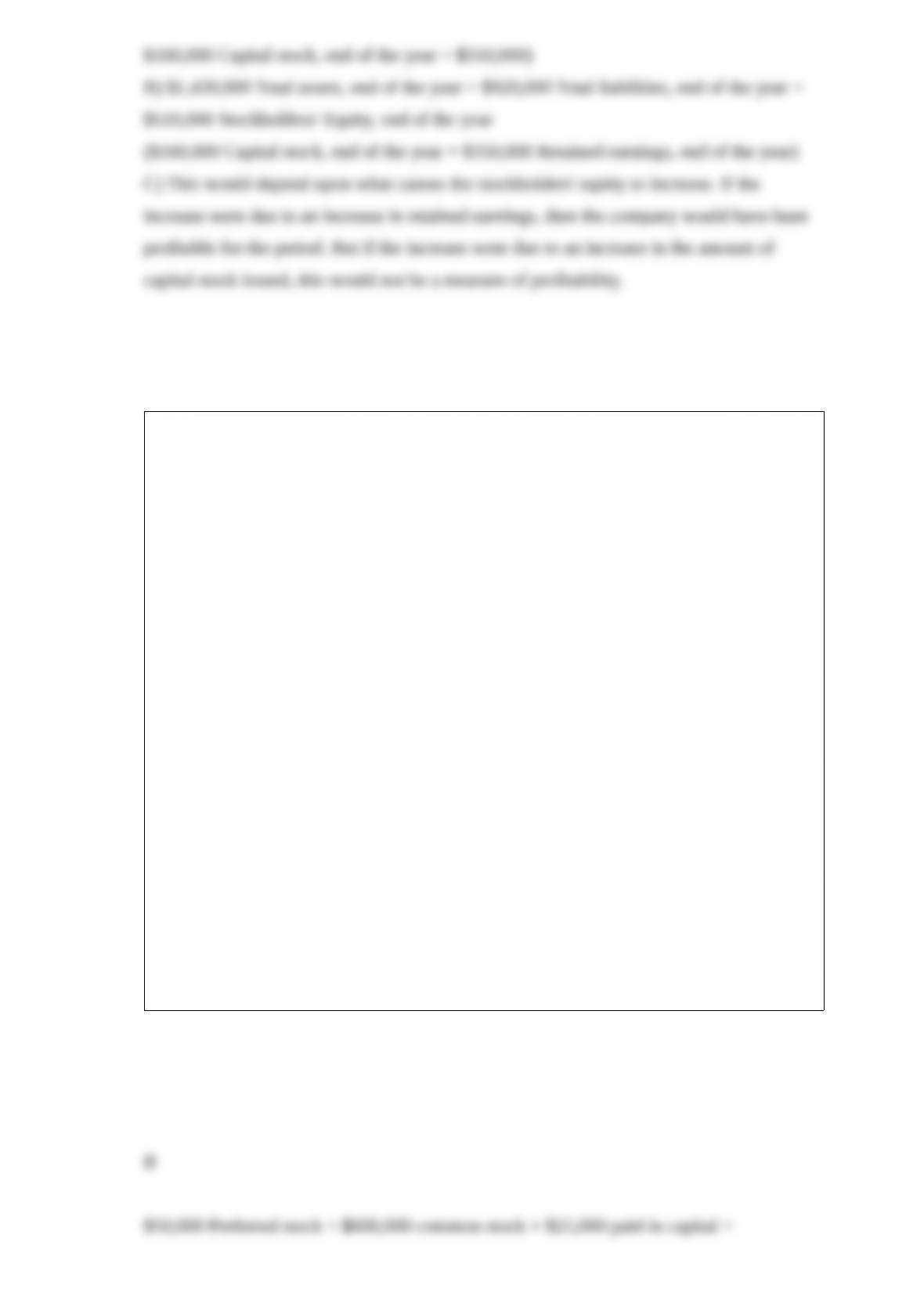
The following accounts were taken from a company’s accounting records. Answer the
questions that follow.
A) How much is the balance of Retained Earnings at the end of the year?
B) Show the company’s accounting equation at the end of the year with the respective
dollar amounts.
C) If stockholders’ equity increases during the year, does that mean that the company is
profitable? Explain your answer.
Landmark Company
This company reported the following information in the stockholders’ equity section of
its December 31, 2014, balance sheet:
7% Cumulative, Non-participating Preferred Stock, $100 par, 500
shares authorized, issued, and outstanding, callable at par value $ 50,000
Common Stock, $12 par, 100,000 shares authorized 600,000
Paid-in Capital in Excess of Par–Common Stock 25,000
Retained Earnings 825,000
Refer to Landmark Company. The company’s total capital stock is
a. $ 650,000.
b. $ 675,000.
c. $ 625,000.
d. $1,500,000.

On June 1, a board of directors declared a $3 per share cash dividend, payable on June
30 to all common stockholders of record on June 15. The company has 10,000 shares of
common stock authorized, 1,000 shares issued, and 200 shares in the treasury. The entry
to record the dividend declaration increases
a. a liability account by $2,400.
b. an asset account by $3,000.
c. an expense account by $2,400.
d. a stockholders’ equity account by $3,000.
Use the following codes to indicate how the cash flow effect, if any, of each transaction
would be reported on a statement of cash flows if the operating activities section is
prepared using the direct method. (Choices may be used more than once.)
a. Inflow from operating activity
b. Outflow from operating activity
c. Inflow from investing activity
d. Outflow from investing activity
e. Inflow from financing activity
f. Outflow from financing activity
g. Noncash investing and financing activity
h. Not reported on statement of cash flows
1/ Purchased truck for cash.

2/ Sold common stock for cash.
3/ Paid employee insurance expense.
4/ Repaid a long-term bonds payable.
5/ Received payments from accounts receivable.
6/ Issued long term mortgage to acquire land and a building.
7/ Declared stock dividends.
8/ Paid the cash dividends.
9/ Sold office building for cash.
10/ Paid interest on a capital lease.
A company should choose a depreciation method that
a. best allocates the original cost of the asset to the periods benefited by the use of the
asset.
b. saves the most taxes.
c. minimizes net income
d. shows the highest amount of net income.

Delco Construction
The following items relate to the company’s March bank reconciliation:
Bank statement balance $29,600
Unadjusted cash balance according to company records ?
Deposit in transit 2,200
Outstanding checks 3,100
Bank service charges 200
Interest earned on the bank account 100
Customer’s NSF check returned by the bank 300
Refer to the information provided for Delco Construction. What is the company’s
adjusted cash balance at March 31st?
a. $28,700
b. $29,100
c. $28,300
d. $29,600
A company’s unadjusted bank balance is $3,000. Outstanding checks amount to $500
and deposits in transit total $300. Based on this information alone, what is the
company’s adjusted cash balance for the purpose of preparing a bank reconciliation?
a. $3,200

b. $3,300
c. $2,800
d. $2,700
What happens to the accounting equation when the adjustment is recorded to recognize
earned revenue previously recorded as unearned revenue?
a. assets increase and liabilities increase
b. liabilities decrease and Stockholders’ equity increases
c. assets decrease and liabilities decrease
d. stockholders’ equity increases and decreases by the same amount
A&B Foods
Data for the year ended December 31, 2013, are presented below.
Sales (100% on credit) $2,100,000
Sales returns 150,000
Accounts Receivable (December 31, 2013) 420,000
Allowance for Doubtful Accounts
(Before adjustment at December 31, 2013) 25,000
Estimated amount of uncollected accounts based on an aging analysis 75,000
Refer to A&B Foods. If the company estimates its bad debts at 4% of net credit sales,
what amount will be reported as bad debt expense for 2013?
a. $50,000
b. $75,000
c. $78,000
d. $84,000
If a company’s current ratio is 1.5 and the current liabilities are $150,000, then the
current assets are
a. $300,000
b. $225,000
c. $100,000
d. $75,000
Gbane Company
The following information is from Gbane Company’s 2013 accounting records:
Purchases $218,400
Transportation-in 13,200
Inventory, January 1, 2013 31,800
Inventory, December 31, 2013 34,560
Purchase Returns and Allowances 10,080
Refer to the information provided for Gbane Company. How much will the company
report as net purchases for 2013?
a. $221,520
b. $231,600
c. $241,680
d. $253,320
Refer to Ready Mix USA. Complete a common size vertical analysis of the company’s
income statement for the three years. Your answers should be expressed as percentages
and rounded to one decimal place.
Because of its relationship to dividends and market price, which of the following ratios
is most important to investors?
a. current ratio
b. debt-to-equity ratio
c. dividend yield ratio
d. asset turnover ratio
A corporation issued $150,000 of 10-year bonds at the stated rate of 8%, with interest
payable semiannually. How much cash will the bond investors receive at the end of the
first interest period?
a. $3,000
b. $6,000
c. $12,000
d. $24,000
Refer to HVAC Service. The journal entry to record payment for the office equipment
and supplies will include a debit to
a. salary expense.
b. salaries payable.
c. prepaid expenses.
d. accounts payable.
Refer to the information provided for Pham Enterprises. What is the company’s
average-days-to-sell inventory measure?
a. 58.98
b. 60.53
c. 22.29

d. 59.78
L.A. Sports Novelties has the following information related to purchases and sales of
one of its popular products, autographed photographs of the local lacrosse star,
Christian Chance. Each photograph is unique, so the inventory is accounted for under
the specific identification method.
Dec. 1 Beginning inventory, 4 units at $50 each
3 Purchase, 6 units at $52 each
11 Sale, 8 units for $77 each
20 Purchase, 5 units for $54 each
27 Purchase, 5 units for $55 each
29 Sale, 8 units for $77 each
A review of purchase and sale information reveals that the following units remain in
ending inventory at the end of the month:
Description Units Sold Units Remaining
Beginning inventory 4 0
Dec. 3rd purchase 4 2
Dec. 20th purchase 4 1
Dec. 27th purchase 4 1
Total 16 4
Compute cost of goods sold and cost of ending inventory.
Which of the following preferred stock features authorizes the corporation to redeem
shares at a fixed price on or after a specified date?
a. the call provision
b. the preemptive right
c. the conversion privilege
d. the residual claim
The journal entry to record the interest income from an annuity would include a
a. debit to interest income.
b. credit to interest income.
c. debit to interest expense.
d. None of the above.

A corporation reported the following amounts on its balance sheet at December 1, 2015:
8% Preferred Stock, $10 par, 400 shares issued and outstanding $ 4,000
Common Stock, $2 par, 3,000 shares issued and outstanding 6,000
Paid-in Capital in Excess of Par–Common Stock 22,000
Total Capital Stock 32,000
Retained Earnings 48,000
Total Stockholders’ Equity $80,000
During December of 2015, the following transactions occurred:
December 5 Declared and paid a 20% preferred stock dividend when the market price
of the preferred stock was $12 per share.
December 21 Distributed a 2-for-1 stock split of the common stock when the market
price of the common stock was $10 per share.
A) What journal entries are required to record these stock transactions?
B) How many preferred shares are outstanding at December 31, 2015?
C) How many common shares are outstanding at December 31, 2015?
D) What effect did the stock dividend have on the par value of the preferred stock?
E) What effect did the stock split have on the par value of the common stock?
Working capital is calculated by which of the following?
a. Current assets divided by current liabilities.
b. Total assets minus total liabilities.
c. Current assets minus current liabilities.
d. Current assets plus current liabilities.
Assume a company has a current ratio of 0.75. The purchase of inventory on account
would cause the current ratio to
a. decrease.
b. increase.
c. be unchanged since the effects offset one another.
d. be unchanged since it has no impact on any current asset or liability accounts.
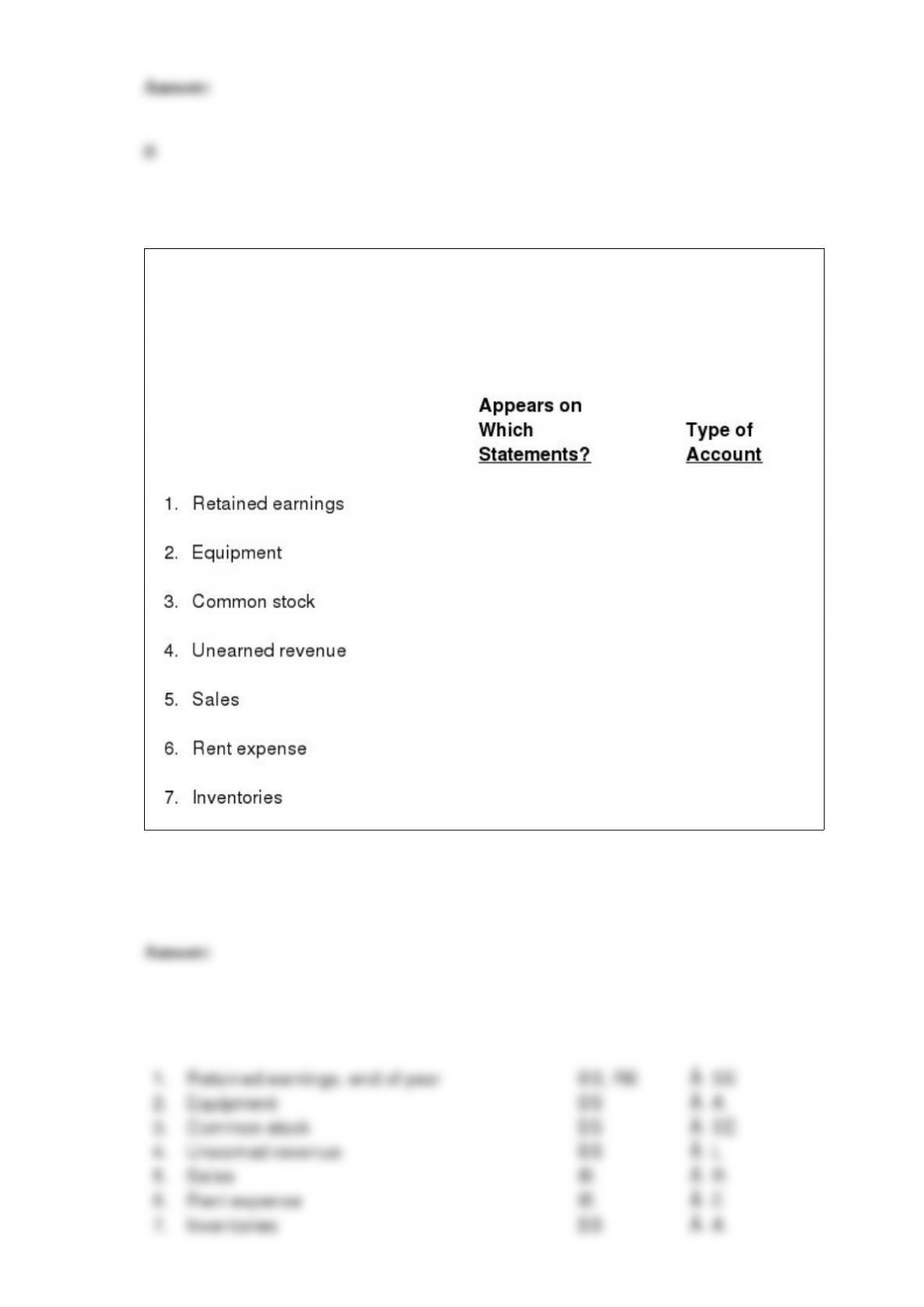
Classify the following items according to the financial statements on which each
belongs, either the income statement (IS), statement of retained earnings (RE), or the
balance sheet (BS). Also indicate whether each is a revenue (R), expense (E), asset (A),
liability (L), or stockholders’ equity (SE) item.
Annual reports are filed with the SEC on
a. Form 8-K.
b. Form 10-Q.
c. Form 10-K
d. the MD&A section.
Describe how the inventories of manufacturers differ from the inventories of retailers.
The lower of cost or market (LCM) rule violates the historical cost principle.
Net Sales = Total credit sales – Sales Discounts – Sales Returns and Allowances
If ending inventory is understated, then cost of goods sold is understated.
A company with a capital structure that shifts more toward debt financing will appear to
be in a stronger position to pay interest and any principal amount that may be maturing
by using its cash flows generated by operating activities.
Tarpley & Underwood
Selected data from the financial statements for Tarpley & Underwood are presented
below:
Net sales $170,000
Cost of goods sold 136,000
Selling, general, & administrative expenses 63,000
Other operating expenses 600
Income tax expense 3,000
Beginning inventory 13,000
Ending inventory 11,000
Ending retained earnings 39,000
Refer to the information presented for Tarpley & Underwood. First, determine the
dollar amount of cost of goods purchased. Then, prepare a cost of goods sold schedule
using the cost of goods sold model illustrated in the text.
The longer a customer’s account balance remains outstanding, the greater the likelihood
that it will be collected in the near future.
Plant assets, current assets, property, plant and equipment, and fixed assets are all
tangible assets.
The following information is available at January 1, 2015:
Common Stock, $1 par, 100,000 shares authorized, 50,000 shares issued
and outstanding $50,000
During 2015, the following transactions occurred:
June 10 Repurchased 1,000 shares of its outstanding common stock for $10 per
share.
July 1 Reissued 500 shares of treasury stock for $11 per share.
September 1 Reissued 500 shares of treasury stock for $8.50 per share.
Record journal entries for each of these 2015 transactions.
Refer to H&R Clock Company. Prepare a trial balance in proper format. Assume that
the company had no additional accounts or balances other than those created from the
July transactions.