
You are planning a trip to the UK and plan on spending 3,800 pounds. How many
dollars will this trip cost you if the currency per U.S. dollar is 0.6789 pound?
A. $2,579.82
B. $3,892.16
C. $5,597.29
D. $5,890.01
E. $6,044.04
Answer:
One year ago, you purchased a 7.5 percent annual coupon bond for a clean price of
$980. The bond now has seven years remaining until maturity. Today, the yield to
maturity on this bond is 6.87 percent. How does today’s clean price of this bond
compare to your purchase price?
A. 4.24 percent lower
B. 4.70 percent lower
C. 5.48 percent lower
D. 5.52 percent higher
E. 6.61 percent higher
Answer:

Aardvaark & Co. has sales of $291,200, cost of goods sold of $163,300, net profit of
$11,360, net fixed assets of $154,500, and current assets of $89,500. What is the total
asset turnover rate?
A. 1.08
B. 1.11
C. 1.19
D. 1.24
E. 1.28
Answer:
When a bond’s yield to maturity is less than the bond’s coupon rate, the bond:
A. had to be recently issued.
B. is selling at a premium.
C. has reached its maturity date.
D. is priced at par.

E. is selling at a discount.
Answer:
Suppose the spot exchange rate for the Hungarian forint is HUF 238. Interest rates in
the United States are 4.1 percent per year. They are 3.6 percent in Hungary. What do
you predict the exchange rate will be in three years?
A. HUF 234.45
B. HUF 236.90
C. HUF 241.59
D. HUF 236.81
E. HUF 239.19
Answer:
Which one of the following is directly related to increases in a firm’s current assets?
A. Reorder costs

B. Shortage costs
C. Restocking costs
D. Out-of-stock events
E. Carrying costs
Answer:
University Furniture sells 2,500 sofas a year at an average price per sofa of $1,250. The
carrying cost per unit is $11.60. The company orders 80 sofas at a time and has a fixed
order cost of $55 per order. The sofas are sold out before they are restocked. What is the
economic order quantity?
A. 154 sofas
B. 172 sofas
C. 181 sofas
D. 198 sofas
E. 211 sofas
Answer:

The Men’s Warehouse charges 1.6 percent interest per month. What rate of interest are
its credit customers actually paying?
A. 18.00 percent
B. 18.92 percent
C. 19.26 percent
D. 19.31 percent
E. 20.98 percent
Answer:
A portfolio has an expected return of 12.3 percent. This portfolio contains two stocks
and one risk-free security. The expected return on Stock X is 9.7 percent and on Stock
Y it is 17.7 percent. The risk-free rate is 3.8 percent. The portfolio value is $78,000 of
which $18,000 is the risk-free security. How much is invested in Stock X?
A. $18,600
B. $19,667
C. $21,375
D. $22,204
E. $24,800
Answer:

Stock A has a beta of 1.47 while Stock B has a beta of 1.08 and an expected return of
13.2 percent. What is the expected return on Stock A if the risk-free rate is 4.5 percent
and both stocks have equal reward-to-risk premiums?
A. 12.12 percent
B. 15.07 percent
C. 16.34 percent
D. 16.89 percent
E. 17.78 percent
Answer:
Which one of the following is an aftermarket function performed by the underwriters of
a securities issue?
A. Distributing the registration statements
B. Distributing the red herrings
C. Filing a letter of comment with the SEC
D. Exercising the Green Shoe option

E. Setting the market price
Answer:
The internal rate of return is unreliable as an indicator of whether or not an investment
should be accepted given which one of the following?
A. One of the time periods within the investment period has a cash flow equal to zero.
B. The initial cash flow is negative.
C. The investment has cash inflows that occur after the required payback period.
D. The investment is mutually exclusive with another investment under consideration.
E. The cash flows are conventional.
Answer:
In relation to bonds, which one of the following terms has the same meaning as the term
“crossover”?

A. Speculative
B. 5B
C. Fallen angel
D. Junk
E. Triple A
Answer:
Rochester, Inc. has 7,500 shares of stock outstanding at a market price of $42 each and
earnings per share of $1.90. The firm has decided to repurchase $63,000 worth of stock.
What will the PE ratio be after the repurchase, all else held constant?
A. $1.30
B. $1.44
C. $1.90
D. $2.02
E. $2.38
Answer:

Lester’s is a globally diverse company with multiple divisions and a cost of capital of
15.8 percent. Med, Inc. is a specialty firm in the medical equipment field with a cost of
capital of 13.7 percent. With the aging of America, both firms recognize the
opportunities that exist in the medical field and are considering expansion in this area.
At present, there is an opportunity for multiple firms to be involved in a new medical
devices project. Each project will require an initial investment of $8.4 million with
annual returns of $2.2 million per year for seven years. Which firm or firms, if either,
should become involved in the new projects?
A. Lester’s only
B. Med, Inc. only
C. Both Lester’s and Med, Inc.
D. Neither Lester’s nor Med, Inc.
E. The answer cannot be determined based on the information provided.
Answer:
Which one of the following is the need to hold cash simply as a financial reserve?
A. Precautionary motive
B. Opportunistic motive

C. Speculative motive
D. Activity motive
E. Transaction motive
Answer:
Cash flow to stockholders is defined as:
A. cash flow from assets plus cash flow to creditors.
B. operating cash flow minus cash flow to creditors.
C. dividends paid plus the change in retained earnings.
D. dividends paid minus net new equity raised.
E. net income minus the addition to retained earnings.
Answer:
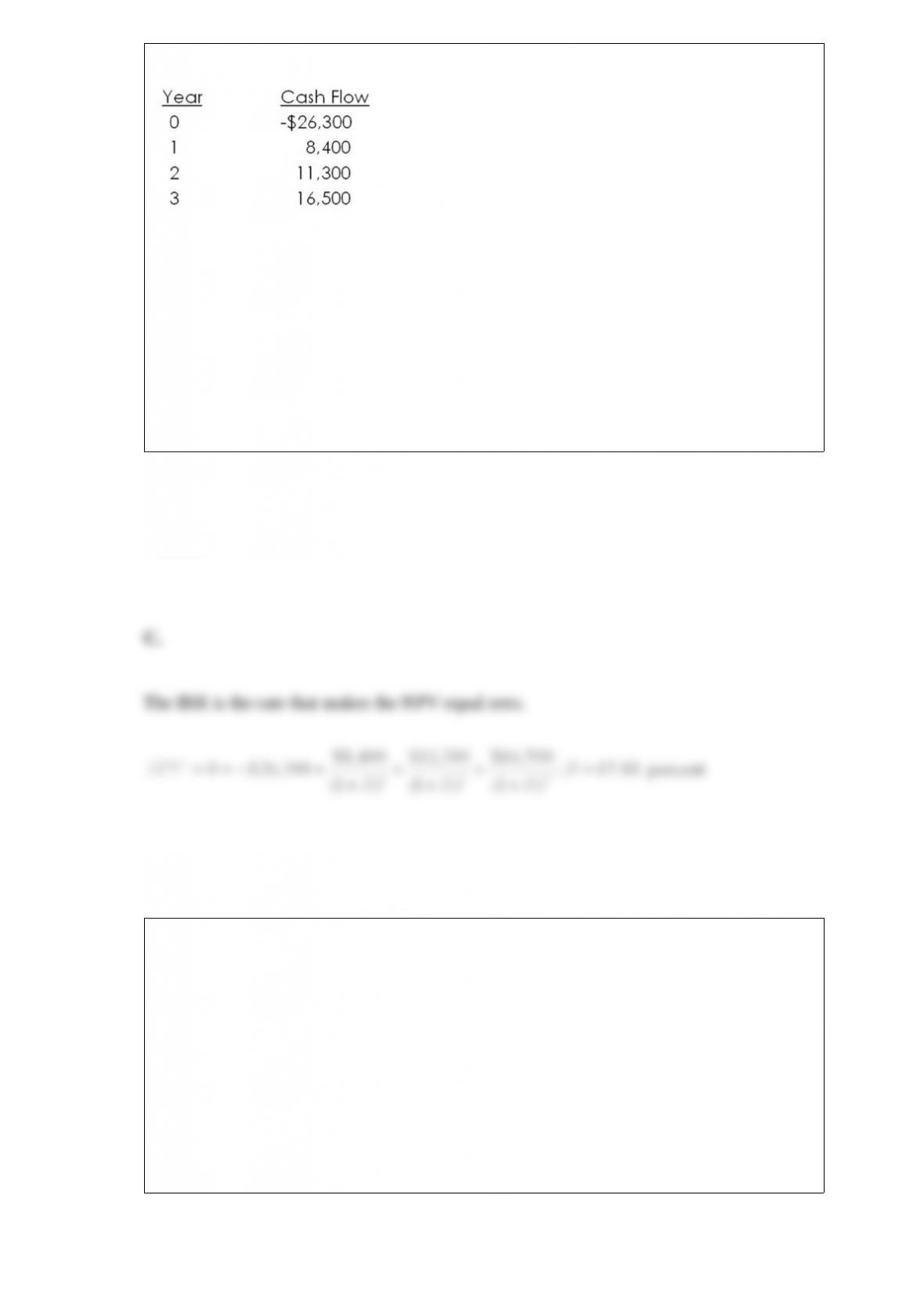
What is the IRR of the following set of cash flows?
A. 12.93 percent
B. 14.90 percent
C. 15.81 percent
D. 16.33 percent
E. 17.78 percent
Answer:
The cost of preferred stock:
A. increases when a firm’s tax rate decreases.
B. is constant over time.
C. is unaffected by changes in the market price.
D. is equal to the stock’s dividend yield.
E. increases as the price of the stock increases.

Answer:
Which one of the following statements related to the security market line is correct?
A. An underpriced security will plot below the security market line.
B. A security with a beta of 1.54 will plot on the security market line if it is correctly
priced.
C. A portfolio with a beta of 0.93 will plot to the right of the overall market.
D. A security with a beta of 0.99 will plot above the security market line if it is correctly
priced.
E. A risk-free security will plot at the origin.
Answer: