
1) Assume a firm has positive net earnings. The operating cash flow of this firm:
A.ignores both depreciation and taxes
B.is unaffected by the depreciation expense
C.must be negative
D.increases when tax rates decrease
E.is equal to net income minus depreciation
2) Which one of the following best matches the primary goal of financial management?
A.Increasing the dollar amount of each sale
B.Increasing traffic flow within the firm’s stores
C.Transforming fixed costs into variable costs
D.Increasing the firm’s liquidity
E.Increasing the market value of the firm
3) You have $5,000 you want to invest for the next 45 years. You are offered an
investment plan that will pay you 6 percent per year for the next 15 years and 10
percent per year for the last 30 years. How much will you have at the end of the 45
years? How much will you have if the investment plan pays you 10 percent per year for
the first 15 years and 6 percent per year for the next 30 years?
A.$201,516.38; $201,516.38
B.$209,092.54; $201,516.38
C.$209,092.54; $119,959.94
D.$209,092.54; $209,092.52
E.$221,408.97; $119,949.94
4) Miser Materials paid $27,500 in dividends and $28,311 in interest over the past year
while net working capital increased from $13,506 to $18,219. The company purchased
$42,000 in net new fixed assets and had depreciation expenses of $16,805. During the
year, the firm issued $25,000 in net new equity and paid off $21,000 in long-term debt.
What is the amount of the cash flow from assets?
A.$21,811
B.$30,811
C.$36,189
D.$49,811
E.51,811
5) Baxter’s, Inc. generally holds $125,000 in cash in case an unexpected investment
opportunity arises. Which one of the following refers to holding cash for this type of
purpose?
A.Precautionary motive
B.Opportunistic motive
C.Speculative motive
D.Reserve motive
E.Transaction motive
6) Which one of the following statements is correct?
A.Exchange rates are adjusted each morning and held constant until the next morning
B.The four most common currencies traded in the foreign exchange market are the U.S.
dollar, franc, euro, and peso
C.All countries of South America uses the peso as their currency
D.New Zealand uses the same currency as Australia and that is the A$
E.The foreign exchange market is the largest financial market in the world
7) International Travel Services has net income of $48,400, total assets of $219,000,
total equity of $154,800, and total sales of $411,700. What is the common-size
percentage for the net income?
A.9.00 percent
B.11.76 percent
C.15.53 percent
D.22.10 percent
E.850.62 percent

8) Which one of the following terms is inclusive of both direct and indirect bankruptcy
costs?
A.Financial distress costs
B.Capital structure costs
C.Financial leverage
D.Homemade leverage
E.Cost of capital
9) Jersey T’s is preparing to sell new shares of stock to the general public. As part of
this process, the firm just filed the required paperwork with the SEC that contains the
material information related to this issue of stock. What is the name associated with this
paperwork?
A.Prospectus
B.Red herring
C.Security agreement
D.Comment letter
E.Registration statement
10) Which one of the following indicates that a project should be rejected?
A.Average accounting return that exceeds the requirement
B.Payback period that is shorter than the requirement period
C.Positive net present value
D.Profitability index less than 1.0
E.Internal rate of return that exceeds the required return
11) Which one of the following refers to the option to expand into related businesses in
the future?
A.Strategic option
B.Contingency option
C.Soft rationing
D.Hard rationing
E.Capital rationing option
12) Doris’s Fashions has just signed a $2.2 million contract. The contract calls for a
payment of $0.6 million today, $0.8 million one year from today, and $0.8 million two
years from today. What is this contract worth today if the firm can earn 8.2 percent on
its money?
A.$2,038,616.67
B.$2,022,709.37
C.$2,108,001.32
D.$2,124,339.07
E.$2,202,840.91
13) Tennessee Valley Antiques would like to issue new equity shares if its cost of equity
declines to 10.5 percent. The company pays a constant annual dividend of $1.80 per
share. What does the market price of the stock need to be for the firm to issue the new
shares?
A.$14.48
B.$14.83
C.$17.14
D.$17.92
E.$18.80
14) A debt-free firm has net income of $228,400, taxes of $46,200, and depreciation of
$21,300. What is the operating cash flow?
A.$182,200
B.$103,500
C.$107,100
D.$249,700
E.$295,900
15) Organic Foods, Inc. has a cash cycle of 13.5 days, an operating cycle of 21 days,
and an inventory period of 2 days. The company reported cost of goods sold in the
amount of $280,000, and credit sales were $430,000. What is the company’s average
balance in accounts payable?
A.$5,753
B.$8,414
C.$10,203
D.$11,844
E.$13,515
16) Which one of the following characteristics generally applies to commercial paper?
A.Issued only by financial institutions
B.Issued only by corporations
C.Maturities limited to 90 days or less
D.Unsecured
E.Secured by accounts receivable
17) Your friend claims that he invested $5,000 seven years ago and that this investment
is worth $38,700 today. For this to be true, what annual rate of return did he have to
earn? Assume the interest compounds annually.
A.28.87 percent
B.31.39 percent
C.33.96 percent
D.36.01 percent
E.37.87 percent
18) Valentino’s maintains a constant debt-equity ratio of 0.45 . The firm had net income
of $11,800 for the year and paid $6,500 in dividends. The firm has total assets of
$92,000. What is the sustainable growth rate?
A.7.38 percent
B.8.27 percent
C.9.11 percent
D.9.62 percent
E.10.38 percent
19) A six-year, semiannual coupon bond is selling for $991.38. The bond has a face
value of $1,000 and a yield to maturity of 9.19 percent. What is the coupon rate?
A.4.50 percent
B.4.60 percent
C.6.00 percent
D.9.00 percent
E.9.19 percent
20) Which one of the following statements is true concerning the price-earnings (PE)
ratio?
A.A high PE ratio may indicate that a firm is expected to grow significantly
B.A PE ratio of 16 indicates that investors are willing to pay $1 for every $16 of current
earnings
C.PE ratios are unaffected by the accounting methods employed by a firm
D.The PE ratio is classified as a profitability ratio
E.The PE ratio is a constant value for each firm
21) Jensen Shipping has four open seats on its board of directors. How many shares will
a shareholder need to control to ensure that his or her candidate is elected to the board
given the fact that the firm uses straight voting? Assume one share equals one vote.
A.20 percent of the shares plus one vote
B.25 percent of the shares plus one vote
C.one-third of the shares plus one vote
D.50 percent of the shares plus one vote
E.51 percent of the shares plus one vote
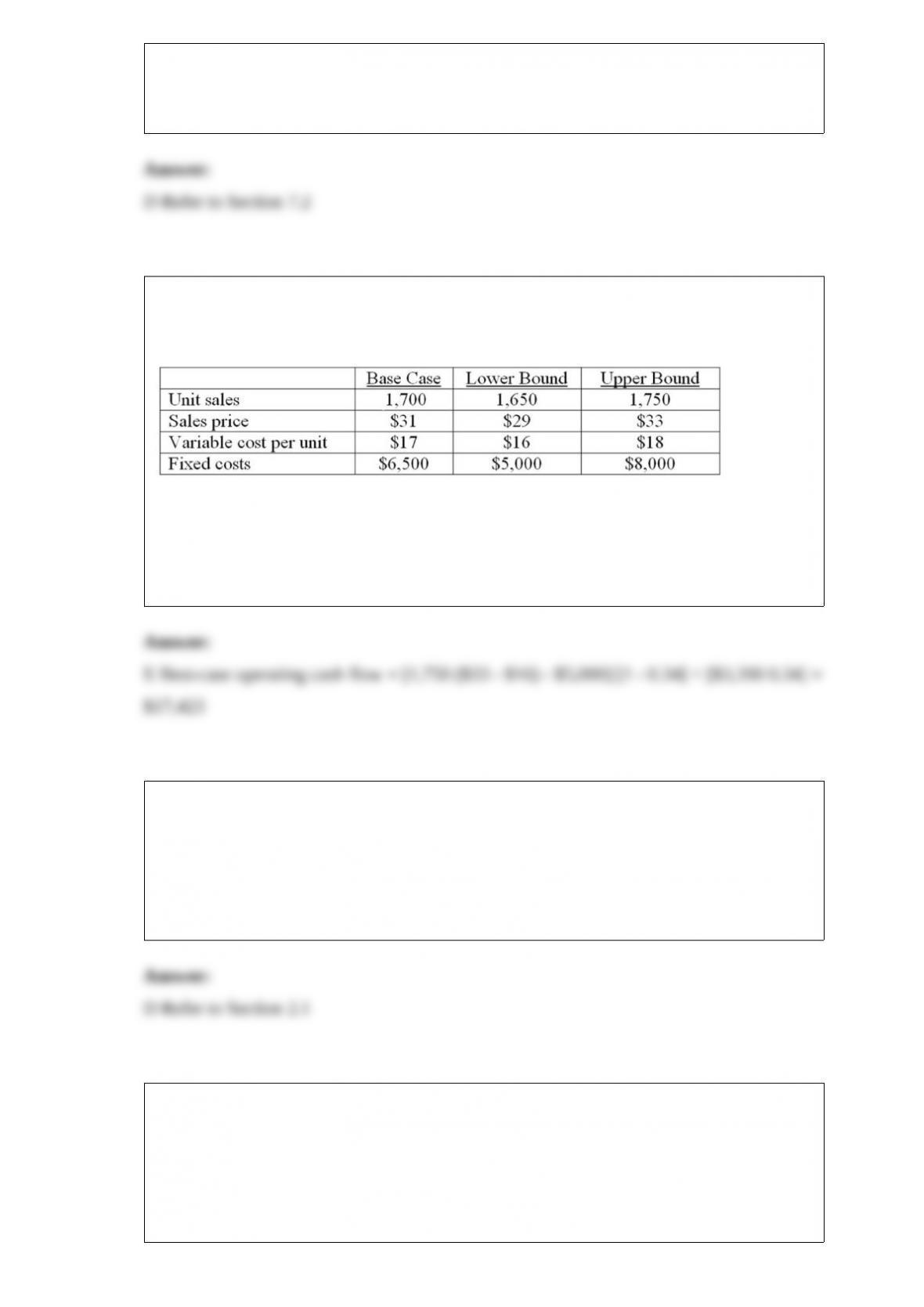
22) You are analyzing a project and have developed the following estimates. The
depreciation is $3,200 a year and the tax rate is 34 percent. What is the best-case
operating cash flow?
A.$13,473
B.$14,196
C.$15,280
D.$16,701
E.$17,423
23) Highly liquid assets:
A.increase the probability a firm will face financial distress
B.appear on the right side of a balance sheet
C.generally produce a high rate of return
D.can be sold quickly at close to full value
E.include all intangible assets
24) Limited liability companies are primarily designed to:
A.allow a portion of their owners to enjoy limited liability while granting the other
portion of their owners control over the entity
B.provide the benefits of the corporate structure to foreign-based entities
C.spin off a wholly owned subsidiary
D.allow companies to reorganize themselves through the bankruptcy process
E.provide limited liability while avoiding double taxation
25) Sticks and Stuff Furniture is offering a bedroom suite for $3,000. The credit terms
are 60 months at $50 per month. What is the interest rate on this offer?
A.0.00 percent
B.1.50 percent
C.1.65 percent
D.1.15 percent
E.1.30 percent
26) In which one of the following situations would the payback method be the preferred
method of analysis?
A.A project that can easily be expanded
B.Two mutually exclusive projects
C.A proposed expansion of a firm’s current operations
D.Different-sized projects
E.Investment funds available only for a limited period of time