
Assume that the risk-free rate is 6% and the market risk premium is 5%. Given this
information, which of the following statements is CORRECT?
a.An index fund with beta = 1.0 should have a required return of 11%.
b.If a stock has a negative beta, its required return must also be negative.
c.An index fund with beta = 1.0 should have a required return less than 11%.
d.If a stock’s beta doubles, its required return must also double.
e.An index fund with beta = 1.0 should have a required return greater than 11%.
Chapter 7 of the Bankruptcy Act is designed to do all of the following EXCEPT:
a.Provides safeguards against the withdrawal of assets by the owners of the bankrupt
firm.
b.Allows insolvent debtors to discharge all of their obligations and to start over
unhampered by a burden of prior debt.
c.Provides for an equitable distribution of the assets among the creditors.
d.Details the procedures to be followed when a firm is liquidated.
e.Establishes the rules of reorganization for firms with projected cash flows that
eventually will be sufficient to meet debt payments.
The annual rate of return on any given stock can be found as the stock’s dividend for the
year plus the change in the stock’s price during the year, divided by its
beginning-of-year price. If you obtain such data on a large portfolio of stocks, like those
in the S&P 500, find the rate of return on each stock, and then average those returns,
this would give you an idea of stock market returns for the year in question.
a.True
b.False
Which of the following statements is CORRECT?
a.If you purchase 100 shares of Disney stock from your brother-in-law, this is an
example of a primary market transaction.
b.If Disney issues additional shares of common stock through an investment banker,
this would be a secondary market transaction.
c.The NYSE is an example of an over-the-counter market.
d.Only institutions, and not individuals, can engage in derivative market transactions.
e.As they are generally defined, money market transactions involve debt securities with
maturities of less than one year.
Assume one bank offers you a nominal annual interest rate of 6% compounded daily
while another bank offers you continuous compounding at a 5.9% nominal annual rate.
You decide to deposit $1,000 with each bank. Exactly two years later you withdraw
your funds from both banks. What is the difference in your withdrawal amounts
between the two banks?
a.$2.24
b.$2.35
c.$2.47
d.$2.59
e.$2.72
Jill Angel holds a $200,000 portfolio consisting of the following stocks. The portfolio’s
beta is 0.875.
If Jill replaces Stock A with another stock, E, which has a beta of 1.50, what will the
portfolio’s new beta be?
a.1.07
b.1.13
c.1.18
d.1.24
e.1.30
Heavy use of off-balance-sheet lease financing will tend to
a.make a company appear more risky than it actually is because its stated debt ratio will
be increased.
b.make a company appear less risky than it actually is because its stated debt ratio will
appear lower.
c.affect a company’s cash flows but not its degree of risk.
d.have no effect on either cash flows or risk because the cash flows are already reflected
in the income statement.
e.affect the lessee’s cash flows but only due to tax effects.
Which of the following statements is most CORRECT?
a.The high value of the U.S. dollar relative to Japanese and European currencies in the
1980s, made U.S. companies comparatively inexpensive to foreign buyers, spurring
many mergers.
b.During the 1980s, the Reagan and Bush administrations tried to foster greater
competition and they were adamant about preventing the loss of competition; thus, most
large mergers were disallowed.
c.The expansion of the junk bond market made debt more freely available for large
acquisitions and LBOs in the 1980s, and thus, it resulted in an increased level of merger
activity.
d.Increased nationalization of business and a desire to scale down and focus on
producing in one’s home country has virtually halted cross-border mergers today.
e.Because strategic alliances and joint ventures are easy to form and enable firms to
compete better in the global economy than would mergers, merger activity has virtually
come to a halt in the 21st century.
What would be the priority of the claims as to the distribution of assets in a liquidation
under Chapter 7 of the Bankruptcy Act?
1)Trustees’ costs to administer and operate the firm.
2)Common stockholders.
3)General, or unsecured, creditors.
4)Secured creditors who have claim to the proceeds from the sale of a specific property
pledged for a mortgage.
5)Taxes due to federal and state governments.
a.1, 4, 3, 5, 2
b.5, 4, 1, 3, 2
c.4, 1, 5, 3, 2
d.5, 1, 4, 2, 3
e.1, 5, 4, 3, 2
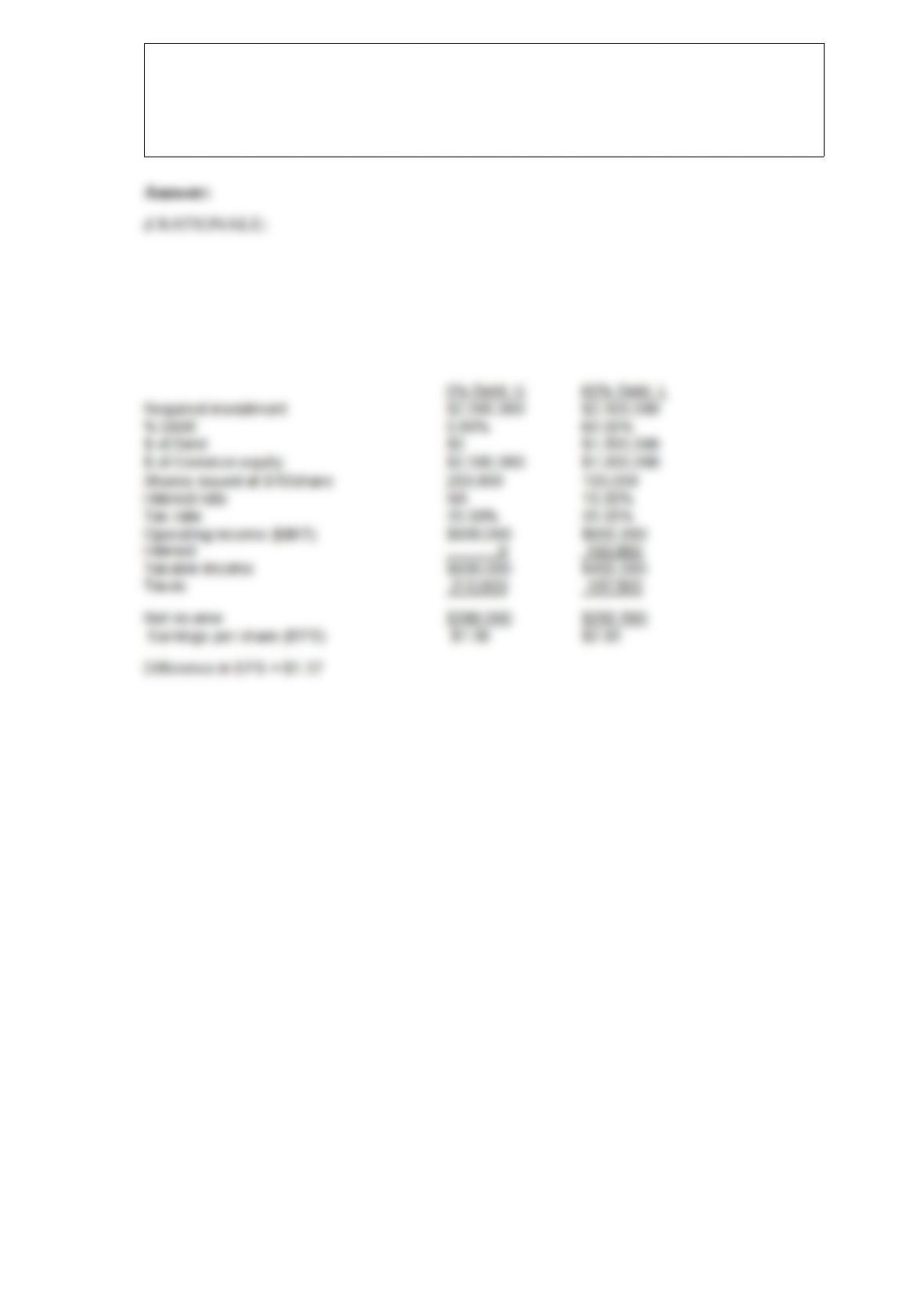
You work for the CEO of a new company that plans to manufacture and sell a new type
of laptop computer. The issue now is how to finance the company, with only equity or
with a mix of debt and equity. Expected operating income is $600,000. Other data for
the firm are shown below. How much higher or lower will the firm’s expected EPS be if
it uses some debt rather than only equity, i.e., what is EPSL – EPSU?
a.$1.00
b.$1.11
c.$1.23
d.$1.37
e.$1.50