
Taggart Transcontinental has issued at par a zero-coupon bond with a ten-year maturity.
Investors believe there is a 10% chance that Taggart Transcontinental will default on
these bonds. If they do default, investors expect to receive only 50 cents per dollar they
are owned. If investors require an 8% return on their investment in these bonds, then the
yield to maturity on these bonds will be closest to (assume annual compounding):
A) 6.0%
B) 6.5%
C) 7.0%
D) 8.0%
Consider the following zero-coupon yields on default free securities:
The YTM of a 4 year default free security with a face value of $1000 and an annual
coupon rate of 5.25% is closest to:
A) 5.2%
B) 5.0%
C) 4.9%
D) 5.25%

The Sisyphean Company is planning on investing in a new project. This will involve
the purchase of some new machinery costing $450,000. The Sisyphean Company
expects cash inflows from this project as detailed below:
The appropriate discount rate for this project is 16%.
The profitability index for this project is closest to:
A) .44
B) .26
C) 0.39
D) .34
If you want to value a firm that has consistent earnings grow, but varies how it pays out
these earnings to shareholders between dividends and repurchases, the simplest model
for you to use is the:
A) enterprise value model.
B) dividend discount model.
C) total payout model.
D) discounted free cash flow model.
The Sisyphean Company has a bond outstanding with a face value of $1000 that
reaches maturity in 15 years. The bond certificate indicates that the stated coupon rate
for this bond is 8% and that the coupon payments are to be made semiannually.
Assuming the appropriate YTM on the Sisyphean bond is 7.5%, then the price that this
bond trades for will be closest to:
A) $1,045
B) $691
C) $1,000
D) $957
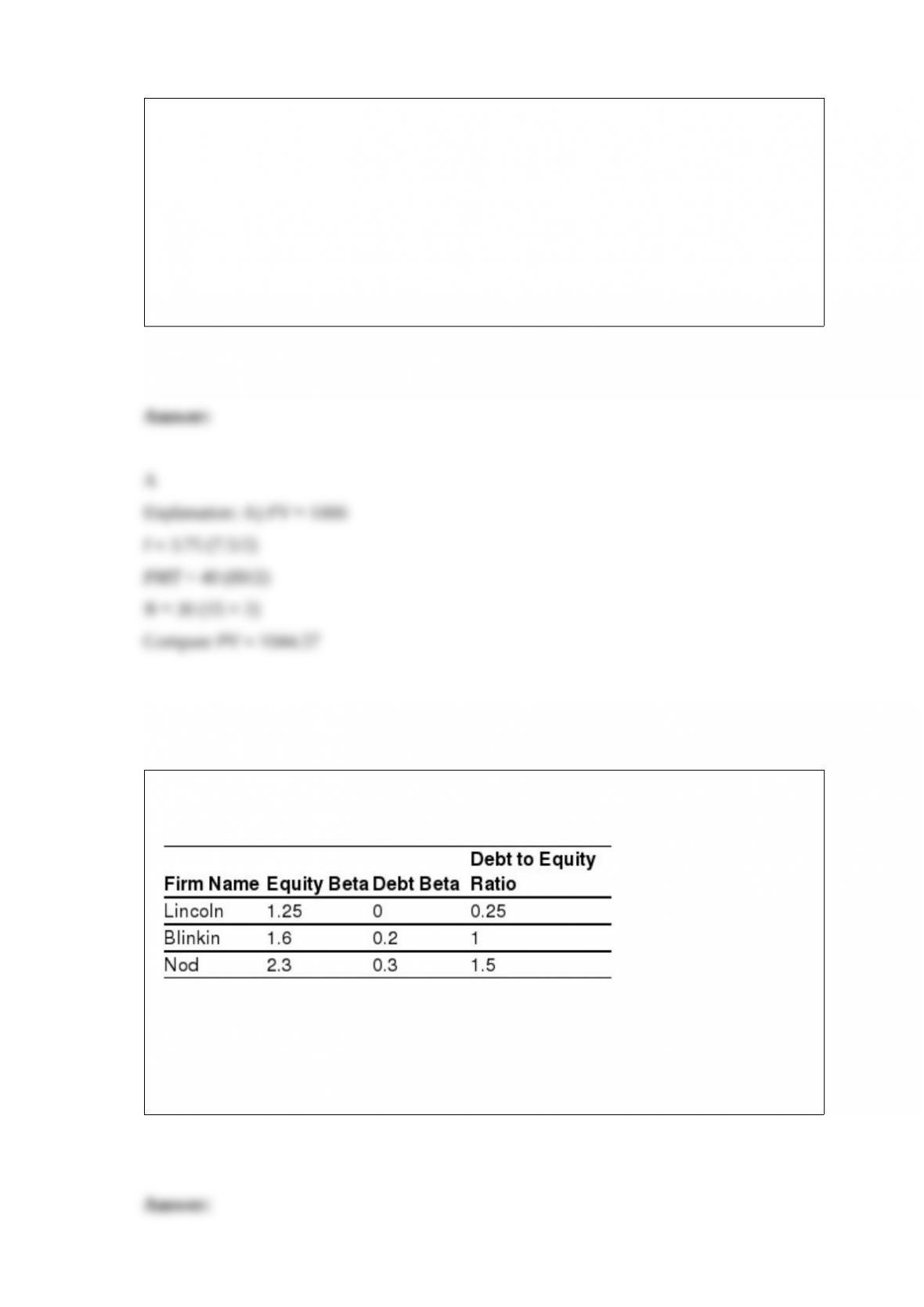
You are evaluating a new project and need an estimate for your project’s beta. You have
identified the following information about three firms with comparable projects:
The unlevered beta for Lincoln is closest to:
A) 0.95
B) 1.00
C) 1.05
D) 0.90
You are a shareholder in a “C” corporation. This corporation earns $4 per share before
taxes. After it has paid taxes, it will distribute the remainder of its earnings to you as a
dividend. The dividend is income to you, so you will then pay taxes on these earnings.
The corporate tax rate is 35% and your tax rate on dividend income is 15%. The
effective tax rate on your share of the corporations earnings is closest to:
A) 15%
B) 35%
C) 45%
D) 50%

A 30 year mortgage loan is a:
A) long-term liability.
B) current liability.
C) current asset.
D) long-term asset.
Rearden Metals expects to have earnings this coming year of $2.50 per share. Rearden
plans to retain all of its earnings for the next year. For the subsequent three years, the
firm will retain 50% of its earnings. It will ten retain 25% of its earnings from that point
onward. Each year, retained earnings will be invested in new projects with an expected
return of 20% per year. Any earnings that are not retained will be paid out as dividends.
Assume Rearden’s shares outstanding remains constant and all earnings growth comes
from the investment of retained earnings. If Rearden’s equity cost of capital is 10%,
then Rearden’s stock price is closest to:
A) $40.80
B) $44.60
C) $59.80
D) $63.50

Assets $200 million
Shareholder Equity $100 million
Sales $300 million
Net Income $15 million
Interest Expense $2 million
If ECE reported $15 million in net income, then ECE’s Return on Equity (ROE) is:
A) 5.0%
B) 7.5%
C) 10.0%
D) 15.0%
Which of the following is NOT an investment likely to be found in any proxy for the
market portfolio?
A) Human capital

B) Stocks
C) Bonds
D) Precious metals
Which of the following is unlikely to influence a firm’s choice of capital structure?
A) Taxes
B) Agency costs and benefits of leverage
C) Transaction costs
D) All of the above influence capital structure decisions.
Consider the price paths of the following stocks over a six-month period:
None of these stocks pay dividends.
Assume that you are an investor with the disposition effect and you bought each of
these stocks in January. Suppose that it is currently the end of March, which stocks are
you most inclined to sell?
1. Taggart Transcontinental

2. Rearden Metal
3. Wyatt Oil
4. Nielson Motors
A) 1 only
B) 1 and 3 only
C) 2 only
D) 2 and 4 only
Luther Corporation
Consolidated Balance Sheet
December 31, 2009 and 2008 (in $ millions)
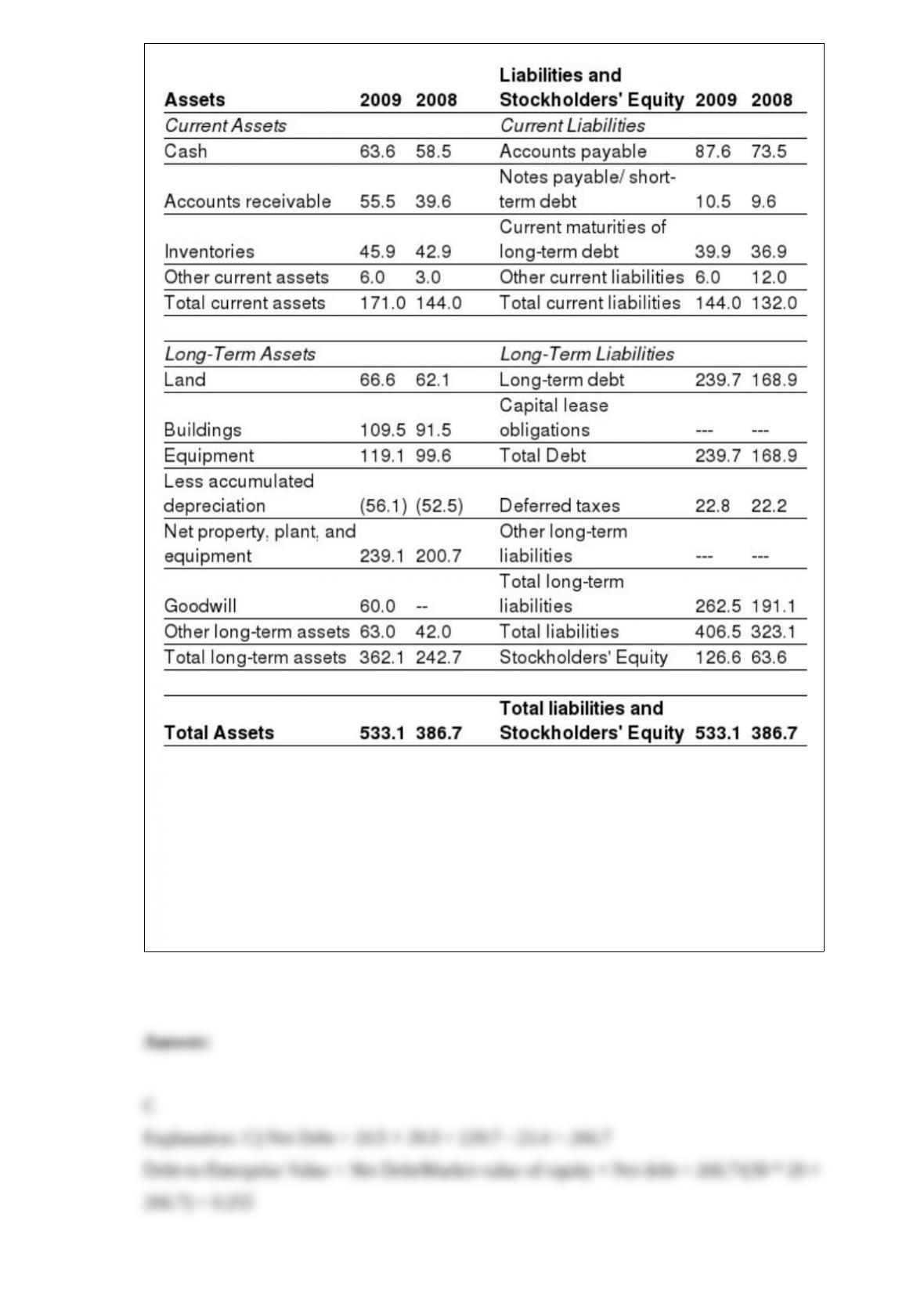
Luther Corporation’s cash ratio for 2009 is closest to:
Luther Corporation’s stock price is $39 per share and the company has 20 million shares
outstanding. Its excess cash in 2009 is $23.4. Its Debt-to-Enterprise Value Ratio in 2009
is closest to:
A) 0.696
B) 0.37
C) 0.255
D) 0.654

Rosewood Industries has EBIT of $450 million, interest expense of $175 million, and a
corporate tax rate of 35%.
The amount of Rosewood’s interest tax shield is closest to:
A) $115 million
B) $290 million
C) $175 million
D) $60 million
Wyatt Oil is considering an investment in a new project with an unlevered cost of
capital of 11%. Wyatt’s marginal corporate tax rate is 35% and its debt cost of capital is
6%. The project has free cash flows of $25 million per year which are expected to
decline by 3% per year.
If Wyatt adjusts its debt once per year to maintain a constant debt-equity ratio of 50%,
then the appropriate WACC for this new project is closest to:
A) 7.5%
B) 8.67%
C) 10.27%
D) 10.8%
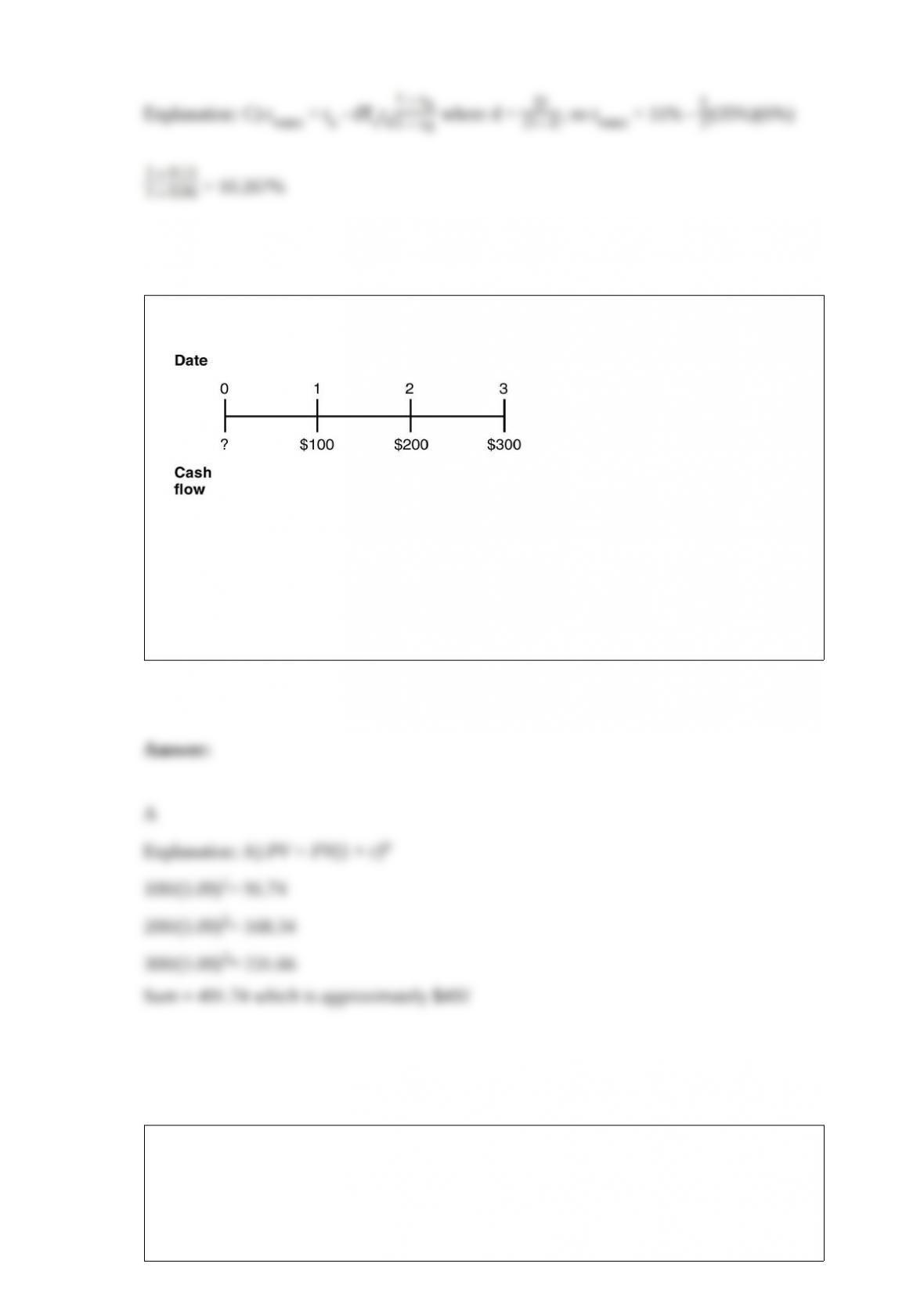
Consider the following timeline:
If the current market rate of interest is 9%, then the present value of this timeline as of
year 0 is closest to:
A) $492
B) $637
C) $600
D) $400
Which of the following statements is FALSE?
A) The U.S. bankruptcy code was created to organize this process so that creditors are
treated fairly and the value of the assets is not needlessly destroyed.

B) Because the assets of the firm might be more valuable if kept together, creditors
seizing assets in a piecemeal fashion might destroy much of the remaining value of the
firm.
C) Debt holders can then take legal action against the firm to collect payment by seizing
the firm’s assets.
D) Because most firms have multiple creditors, coordination makes it difficult to
guarantee that each creditor will be treated fairly.