
The more liberal the accounting methods used by a company, the lower the quality of
earnings.
An increase in the current ratio due to increased inventory and receivables could be
consistent with a recession in the economy.
Cyclical companies often like to retain extra cash or marketable securities during the
“good” times, in order to ensure that they have sufficient liquidity when the inevitable
downturn in the business cycle arrives.
A long-term asset is said to be impaired when its fair value is below its book value.

A gain on sale of an asset would require adjusting net income, if preparing the
statement of cash flows using the indirect method.
When calculating return on net operating assets it may be necessary to adjust assets to
reflect the fact that not all assets are operating assets.
Software development costs are treated the same way as research and development
costs under GAAP (Generally Accepted Accounting Principles).

Debt-to-equity ratio is a commonly used measure of liquidity.
Theoretically, the value of a stock should equal the sum of the present value of future
expected dividends, discounted at the cost of equity.
If the write-off is occurring because of an industrywide downturn or market crash, it is
useful to compare the percentages of the write-off with those taken by other companies
in the industry.
Guaranteed debt of unconsolidated subsidiaries should generally be ignored when
analyzing the long-term solvency of a parent company, as subsidiaries are separate legal
entities.

Interest income is recorded as an operating inflow of cash.
For companies in an expansion phase, capitalizing interest may result in higher earnings
over an extended period of time, compared to expensing interest.
One advantage of FIFO over LIFO is that it minimizes the distortion caused by inflation
on net income.

Minority shareholders’ interest on the balance sheet represents a liability to the
company and should always be included in debt when calculating the debt to equity
ratio.
An increase in a liability is a use of cash.
Dividends on preferred stock with characteristics of debt such as mandatory
redemption, fixed maturity or sinking fund must be tax-affected and treated as debt for
calculation of common stock dividend coverage.
An increase in the credit days offered to customers by a company will improve the
company’s financial situation because of the likely increase in sales.

Common-size analysis of the statement of cash flows is a useful tool in determining
major sources and uses of cash.
A company that operates in a highly competitive industry with low barriers to entry is
likely to have low net operating profit margins compared to companies that operate in
less competitive industries.
If a company factors its accounts receivables, this will have the effect of making its
cash cycle appear shorter.

The use of LIFO will inflate the current ratio under normal economic conditions.
The SEC requires disclosure of the ratio of combined fixed charges and preferred
dividends in the prospectus of all preferred stock offerings.
Accounting distortions arise from the nature of accrual accounting.
The income statement is the only one of the four basic financial statements that does not
contain balances at a specific point in time.

Deferred tax assets should be deducted from the assets and equity, if they are not
expected to reverse.
In order to determine permanent income for the year being analyzed, it is necessary to
consider special charges from other years.
In a common-size income statement, net income is expressed as 100 percent.

One would expect restaurants to have lower inventory turnover than general
merchandise stores.
Accounting standards issued by the SEC are applicable to all US companies being
audited.
If a company has a return on equity that is lower than its cost of equity capital, it could
be said to be destroying value.
The statement of cash flows is separated into four parts: operating, investing, financing,
and planning.

Income shifting is not one of the earnings management mechanics.
Creditors of a business are more concerned with the future cash flows of a business than
the future return on equity.
The cost of software developed for internal use should be capitalized only after it has
reached technological feasibility.

Depreciation is a valuation exercise.
When examining a company’s current ratio, it is important to also assess the quality of
the current assets and liabilities.
Which of the following statements is correct?
A. Restructuring is a major use of cash for Georgey.
B. Accounts receivable increased in 2005.
C. Depreciation is a major source of cash for Georgey.
D. Major use of cash for paying long-term debt resulted in decreased leverage.
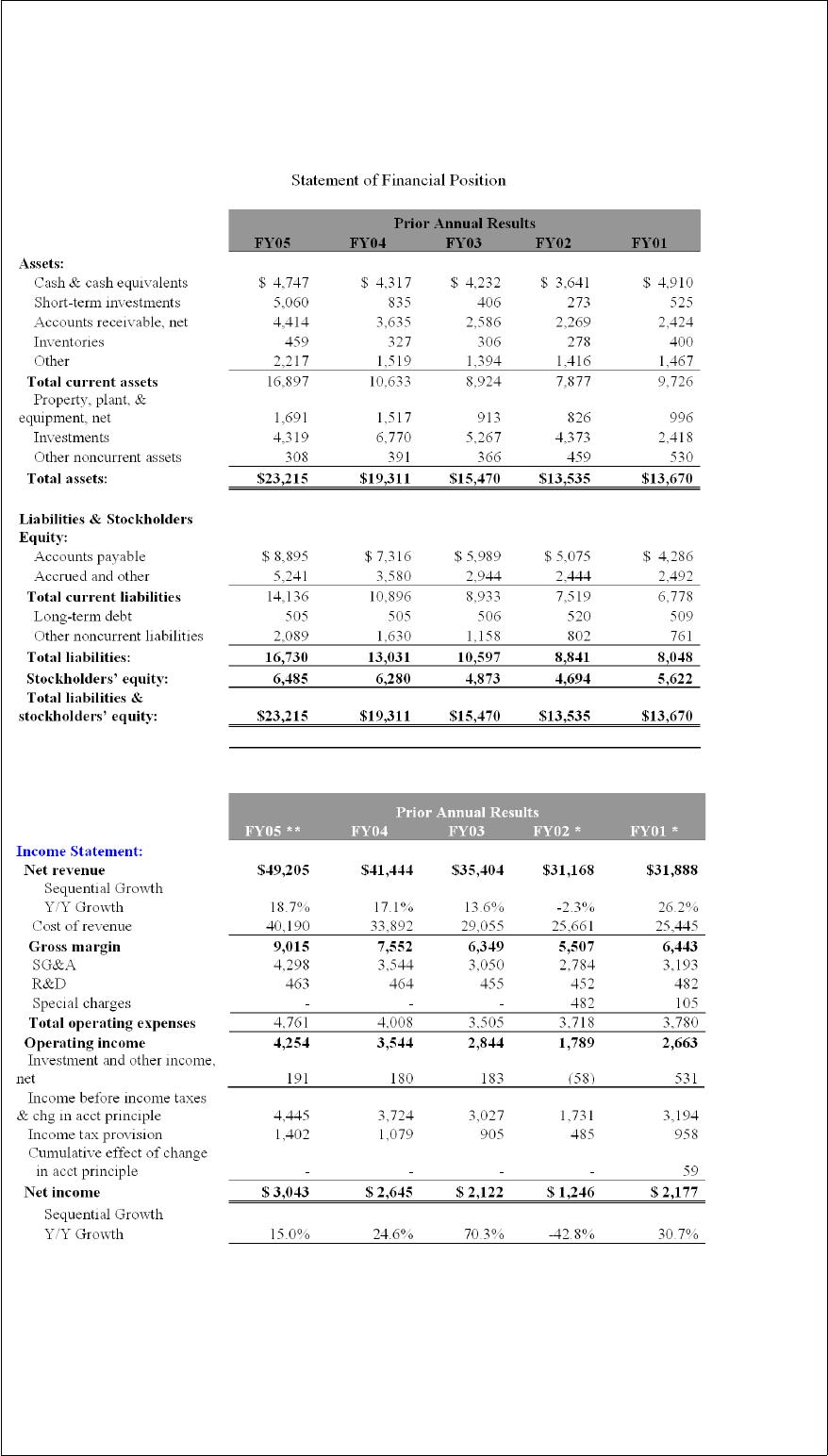
Dell Financial Risk
Following are Dell’s condensed consolidated statement of financial position and
condensed consolidated statement of operations, in millions (unaudited).
a. Assume all net revenue are from credit sales. Using the above information, calculate
the following ratios for FY05 to FY02:
1/ Current ratio
2/ Quick ratio
3/Working capital
4/ Days’ sales in accounts receivable
5/Days’ sales in inventory
6/ Days’ purchases in accounts payable
7/Net days’ working capital
8/Long-term debt to assets ratio
9/ Total debt-to-equity ratio
10/ Total liabilities to total assets
Note: Use average inventory, average accounts receivable, and average accounts
payable in the calculation of days’ sales in inventory, days’ sales in accounts receivable,
and days’ purchases in accounts payable respectively.
b. Comment on the changes to Dell’s liquidity risk
c. Comment on the changes to Dell’s solvency risk

A company’s net income is $100,000, and its weighted-average shares outstanding are
20,000. During the year, the company issues 5,000 ESOs at an exercise price of $20.
What will be the basic EPS if average stock price during the year is $35 and treasury
shares that can be purchased are 1,000?
A. $3
B. $6
C. $5
D. $4.17
Which of the following statements concerning quality of earnings is correct?
A. All other things being equal, the more cyclical the industry within which a company
operates, the lower its quality of earnings.
B. The smoother the earnings stream of a company, the greater the quality of the
earnings.
C. Quality of earnings is independent of business risk.
D. Quality of earnings is largely beyond management’s control.
You wish to compare the performance of two companies. Which of the following
statements is most likely to be incorrect?
A. If the companies operate in different industries, this will hinder comparability.

B. The use of different accounting methods will hinder comparability.
C. If the companies are of significantly different sizes, this will hinder comparability.
D. If companies have different auditors, this will hinder comparability.
Which of the following is true concerning bond covenants?
A. Bond covenants are restrictions placed on bondholders to protect rights of equity
holders.
B. Violation of a bond covenant requires that a company declares bankruptcy.
C. If a company violates a bond covenant, it means it has failed to make interest or
principal repayments on debt in a timely manner.
D. Bond covenants are legal restrictions placed in order to minimize the risk of default
on bonds.
Which of the following statements is true?
I. Pretax cost of debt is generally higher than the pretax cost of equity.
II. Interest is tax deductible.
III. Preferred dividends are tax deductible.
IV. Total cost of capital is always greater than or equal to cost of equity.

A. II and IV
B. II, III, and IV
C. I, II, and IV
D. II only
When considering whether an earnings coverage ratio is acceptable, consideration is
least likely to be given to:
A. earnings variability.
B. earnings persistence.
C. cash flow variability.
D. dividend policy for common stock.
Which one of the following is not an example of a red flag to one should be aware of
when evaluating earnings quality?
A. Qualified audit report
B. Net income this year is higher than net income from last year
C. Reported earnings consistently higher than operating cash flows
D. Frequent or unexplained changes in accounting policies

Simmons Company is in a high growth industry. You are examining its long-term
solvency and notice that they have significant deferred tax liabilities. Upon further
examination of the tax footnote you find that virtually all of the deferred tax liabilities
are due to plant and equipment. For purposes of analysis the deferred tax liability
should be treated as:
A. a liability as you do not expect it to reverse in the near future.
B. a liability as you expect it to reverse in the near future.
C. equity as you do not expect it to reverse in the near future.
D. equity as you do expect it to reverse in the near future.
What will be the retained earnings for 2006 if ABC used FIFO valuation?
A. $3,205,271
B. $3,566,918
C. $3,893,000
D. $4,096,430

The majority of financing for most companies comes from which of the following
sources?
A. Owners and customers
B. Creditors and customers
C. Owners and managers
D. Creditors and owners
Trading marketable securities:
A. are considered noncurrent assets.
B. are recorded at amortized cost.
C. are marked to the lower of cost or market each accounting period.
D. are marked to market each accounting period.
Which of the following is correct?
I. If a company uses straight-line depreciation for financial reporting purposes, it is very
likely they have a deferred tax liability with respect to its depreciable assets.
II. Straight-line depreciation yields an increasing rate of return on book value over the

life of an asset.
III. Straight-line depreciation results in lower tax payments than accelerated
depreciation methods over the life of an asset.
IV. If a company revises its estimate of the useful life of an asset upwards this will
decrease annual depreciation expense.
A. I, II, III, and IV
B. I, II, and IV
C. I, II, and III
D. I and IV
Which of the following steps is required to adjust LIFO to FIFO?
A. Inventory needs to be calculated as reported LIFO inventory plus LIFO reserve.
B. Increase deferred tax payable by LIFO reserve times Tax rate.
C. Retained earnings need to be calculated as reported retained earnings plus LIFO
reserve times (1 – Tax rate).
D. All of the above
Foreign Currency Translation
Flowers Inc. an American company has two overseas subsidiaries located in Great
Britain (Roses PLC) and in Holland (Tulips Inc.). Flowers prepares consolidated
financial statements. The reporting currency is the U.S. dollar.
Most of Roses operations and sales take place in Britain, and the transactions are
denominated in the British pound. Additionally, Roses makes its own financing and
operating decisions, independently of Flowers Inc.
Tulip Inc. is a sales outlet for Roses PLC and operating decisions are made by the
British subsidiary, Roses.
a. Identify the method(s) Flowers Inc. should use to convert the financial results of
Roses PLC into the U.S. dollar for purposes of consolidation.
b. Identify the method(s) Flowers Inc. should use to convert the financial results of
Tulip Inc. into the U.S. dollar for purposes of consolidation.
c. Explain how a decline in the value of the British pound relative to the U.S. dollar will
affect Flowers’ earnings in the reporting currency.

Which of the following ratios best measures the profitability of a company?
A. Return on equity
B. Gross margin
C. Current ratio
D. Net operating asset turnover
What is net cash flow from financing?
A. ($5,000)
B. ($10,000)
C. ($11,000)
D. ($13,000)
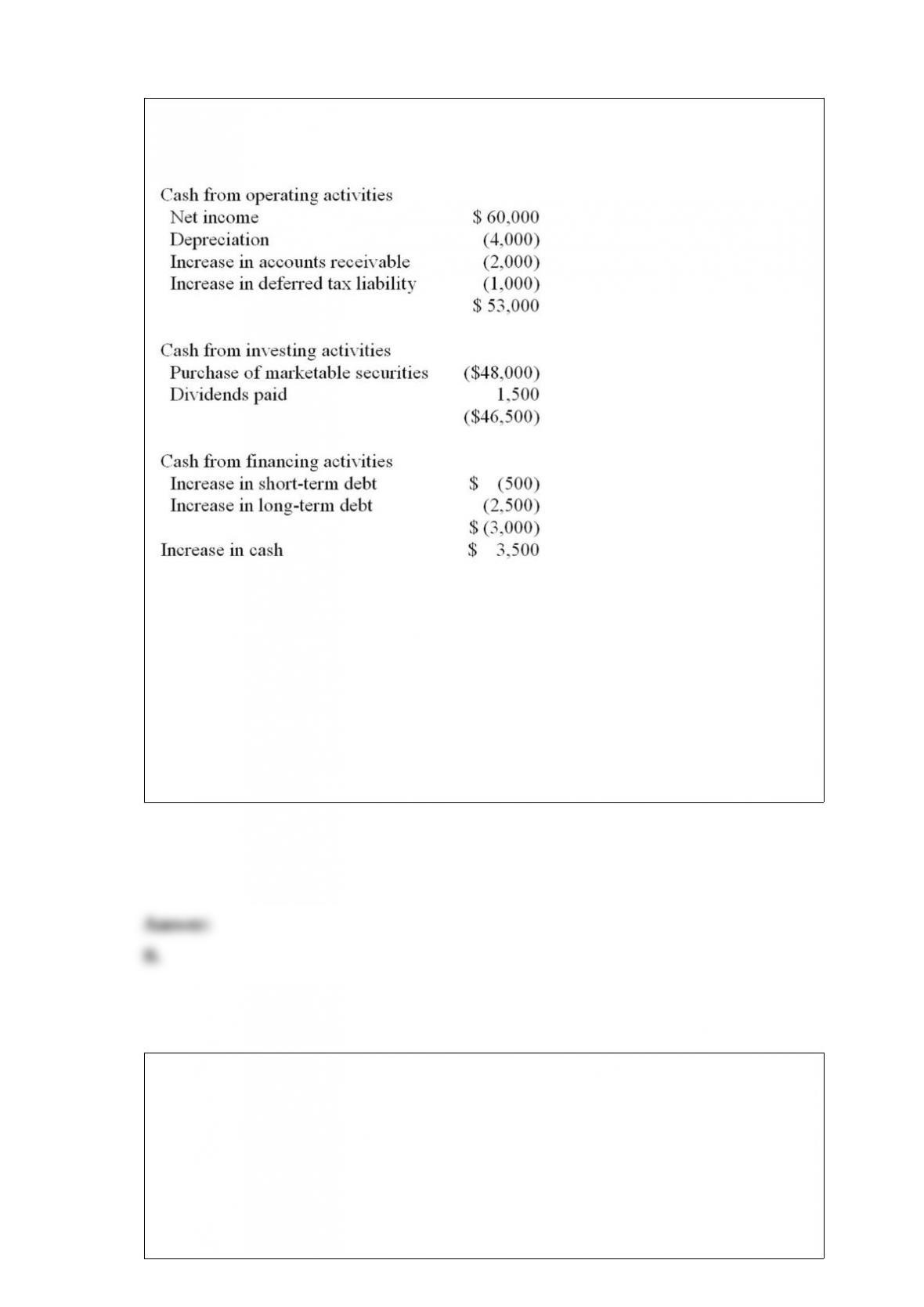
Below is an example of an incorrectly prepared statement of cash flows. The
descriptions of activities are correct.
The correct cash flows from operating activities is:
A. $65,500.
B. $63,500.
C. $53,500.
D. None of the above
Which of the following statements is most correct?
A. The cheapest form of capital is equity.
B. Companies with the highest current ratios have the most liquidity.
C. The best indicator of short-term financing needs is the cash flow adequacy ratio.

D. A faster growing company is more likely to need external financing than a slower
growing company.
What would be total assets in the consolidated financial statements for the date on
which the merger became effective, assuming any excess purchase price relates to
goodwill?
A. $50,008
B. $49,498
C. $41,508
D. $44,113
Which of the following would not be found listed as a liability on a company’s balance
sheet?
A. Operating lease obligations
B. Capital lease obligations
C. Bonds payable
D. Taxes payable

A growing company with disappointing profitability would generally have:
A. high price-to-book ratio and high price-to-earnings ratio.
B. high price-to-book ratio and low price-to-earnings ratio.
C. low price-to-book ratio and high price-to-earnings ratio.
D. low price-to-book ratio and low price-to-earnings ratio.
The intrinsic value approach ignores two types of costs:
A. interest cost and opportunity cost.
B. opportunity cost and exercise cost.
C. interest cost and option cost.
D. carrying cost and interest cost.
Which of the following could explain a decrease in net operating asset turnover for a
company?

A. Switching from straight line to accelerated depreciation for financial reporting
purposes
B. An increase in the financial leverage of the company
C. Addition of a new plant for production purposes
D. Decrease cost of production inputs
What is the value of Yutter’s stock at the end of Year 1 using the dividend discount
model assuming that the dividend payout ratio remains constant and Yutter grows at its
sustainable equity growth rate?
A. $83,333
B. $157,642
C. $500,000
D. $557,000
What is the anticipated inventory level at the end of March?
A. $1,252.35
B. $1,197.90
C. $1,089
D. $900
Fixed Assets
Below is selected information taken from the balance sheet of LongLi Corporation as of
12/31/06.
From the operating section of the statement of cash flows, you determine that the
depreciation expense for the year was $2,000 and loss on sales of assets was $5,000.
The investing section reveals that the company purchased equipment for $14,000 and
sold equipment for $2,000.
In the footnotes to the financial statements, the company states:
At the beginning of 2006, we determined that the useful life of our assets was higher
than originally believed. Accordingly we have increased the useful life from 10 years to
15 years in 2006.
a. What was the gross book value of the equipment that was sold?
b. What was the net book value of the equipment that was sold?
c. With respect to the change in the useful lives of the assets:
i. What is the effect on 2005’s financial statements?
ii. What is the effect on 2006’s financial statements?
When an acquisition is made and accounted for using the purchase method, the
post-acquisition common stock account:
A. is the sum of the pre-acquisition common stock accounts of the two combining
companies.
B. is the pre-acquisition common stock account of the acquired company only.
C. is the pre-acquisition common stock account of the acquiring company plus the par
value of new stock issued to affect the acquisition.
D. is the pre-acquisition common stock account of the acquiring company plus the fair
value of new stock issued to affect the acquisition.

Which of the following is true of depreciation?
A. It is recorded so that net book value represents fair value of assets.
B. It does not affect the amount of cash realized from operations as it is a noncash flow.
C. It is added back to net income to calculate cash from operations under the direct
method.
D. It represents a fund from which to purchase future assets.
Fair Value Accounting
ABC Co. starts its business raising $110,000 in cash; $60,000 from issuing equity and
$50,000 from issuing 6% bonds at par. ABC used the whole amount of cash to buy a
building, which it rents out for $10,000 per year. Given below is the opening balance
sheet of ABC Co. for the first year of operations.
At the end of Year 1, the building is valued at $150,000. Also, the market value of
bonds has fallen to $49,000. Assume the useful life of the building is 30 years, and its
salvage value is $50,000 at the end of that period. The rental income is received on the
last day of the year. Interest on bonds is also paid on this day.
Prepare the year-end balance sheet and income statement of ABC Co. based on Fair
value. Compare the historical and fair values at year-end.
Preparation of Statement of Cash Flows
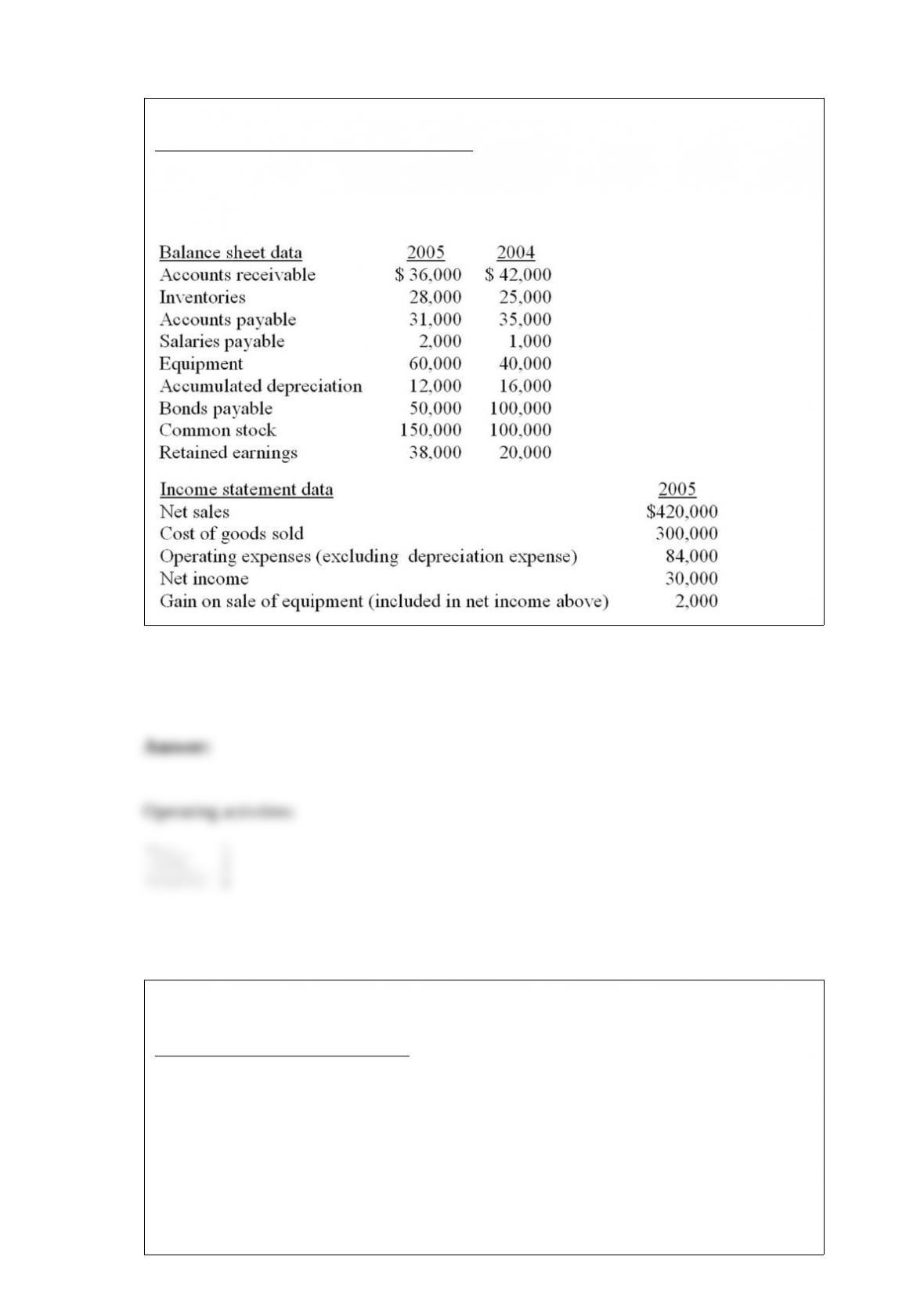
Use the following selected data about Tiles Ltd. and prepare the operating activities
section of a statement of cash flows for the company for 2005 using the indirect
method.
Acquisitions and Comparability
You are analyzing the financial statements of Floyd Corp. Floyd has made several
acquisitions in the past few years using newly issued stock. These acquisitions have all
been accounted for using purchase accounting. In each case, the purchase price
exceeded the book value and fair value of the net assets of the acquired company. The
book value and fair value of debt of acquired companies were the same. Floyd uses
FIFO for inventory valuation purposes.
Explain why Floyd’s acquisition history makes it difficult to analyze the trend of its

financial results.
Equity Valuation
A friend tells you that you should buy Leclerc Company stock as it is a “great deal.” It
is January 1, 2006 and the stock is trading at $25 per share. You obtain the financial
statements for Leclerc and determine the following:
1/ Book value is $12 per share as of December 31, 2005.
2/ Earnings for 2005 were $4.0 per share.
3/ Earnings are expected to grow at 20% for the next four years.
4/ Dividend payout is 40%.
5/ Residual income is expected to be zero from 2007 onwards.
6/ Cost of equity capital is 15%.
Determine, using the residual income method, whether you should buy Leclerc stock as
of January 1, 2006.
Return on Net Operating Assets
When calculating return on net operating assets analysts sometimes make adjustments
to the net operating asset base used in the denominator or the ratio. Three possible
adjustments are listed below. Explain what these adjustments are, and discuss the merits
of these adjustments.
1. Non-operating asset adjustment
2. Intangible asset adjustment
3. Accumulated depreciation adjustment
Discretionary Expenditures
Discretionary expenditures are outlays that management can vary across periods to
conserve resources and/or manage earnings. Give three examples and explain their
potential impact on earnings quality when analyzing a company.
Earnings Management
Earnings management can be defined as the “purposeful intervention by management in
the earnings process, usually to satisfy selfish objectives” (Schipper, 1989).
Earnings management techniques can be separated into those that are “cosmetic”
(without cash flow consequences) and those that are “real” (with cash flow
consequences).
The management of a company wishes to increase earnings this period.
List three “cosmetic” and three “real” techniques that can be used to achieve this
objective and explain why they will achieve the objective.
Information contained in Financial Statements
List ten different items you would expect to find in an average annual report to
shareholders.

Leases
Compare the effects of operating leases as compared to capitalized leases, in the first
year of a lease, on the following items listed. Explain your answer.
1. EBIT
2. Net income
3. Return on assets (levered)
4. Cash flow from operations
5. Current ratio

Earnings Management
Management of earnings has been a newsworthy subject, above and beyond the
business press. Analysts are forced to devote time and attention to ferreting out the real
numbers, when the clues are available. Explain four kinds of earnings management,
giving examples.
Earnings Persistence/Future Earnings
Consider each of the scenarios below independently.
1/ Luxury Limos is in the business of renting limousines in New York City. It has a fleet
of 200 limos. It owns the limousines that it rents, and keeps them on average for five
years. In Year 3, Luxury Limos showed a loss on the sale of limos of $5,000. In Years 1
and 2, it recorded a loss on sale of $2,000 and $1,000, respectively. Should the gains
and losses on the sale of limos be ignored when determining earnings persistence or
not?
2/Turnaround Corporation has just hired new top management. In the new
management’s first year, they take a huge restructuring charge (looks as though they are
taking a “big bath”). Included in the restructuring charge are:
– Recognition of a contingent liability for probable environmental clean-up
– Write-down of assets (which amounted to a 50% write-down of all assets)
– A charge for a future upgrade of its computer system
For each of the items included in the restructuring charge, and considering
management’s possible motivation for taking a “big bath”, identify how these items
might affect future recorded income?
Taxes
Below are selected portions from Quaker Oats’ tax footnote in its X6 annual report.
Provisions for income taxes on income before cumulative effect of accounting change
were as follows:
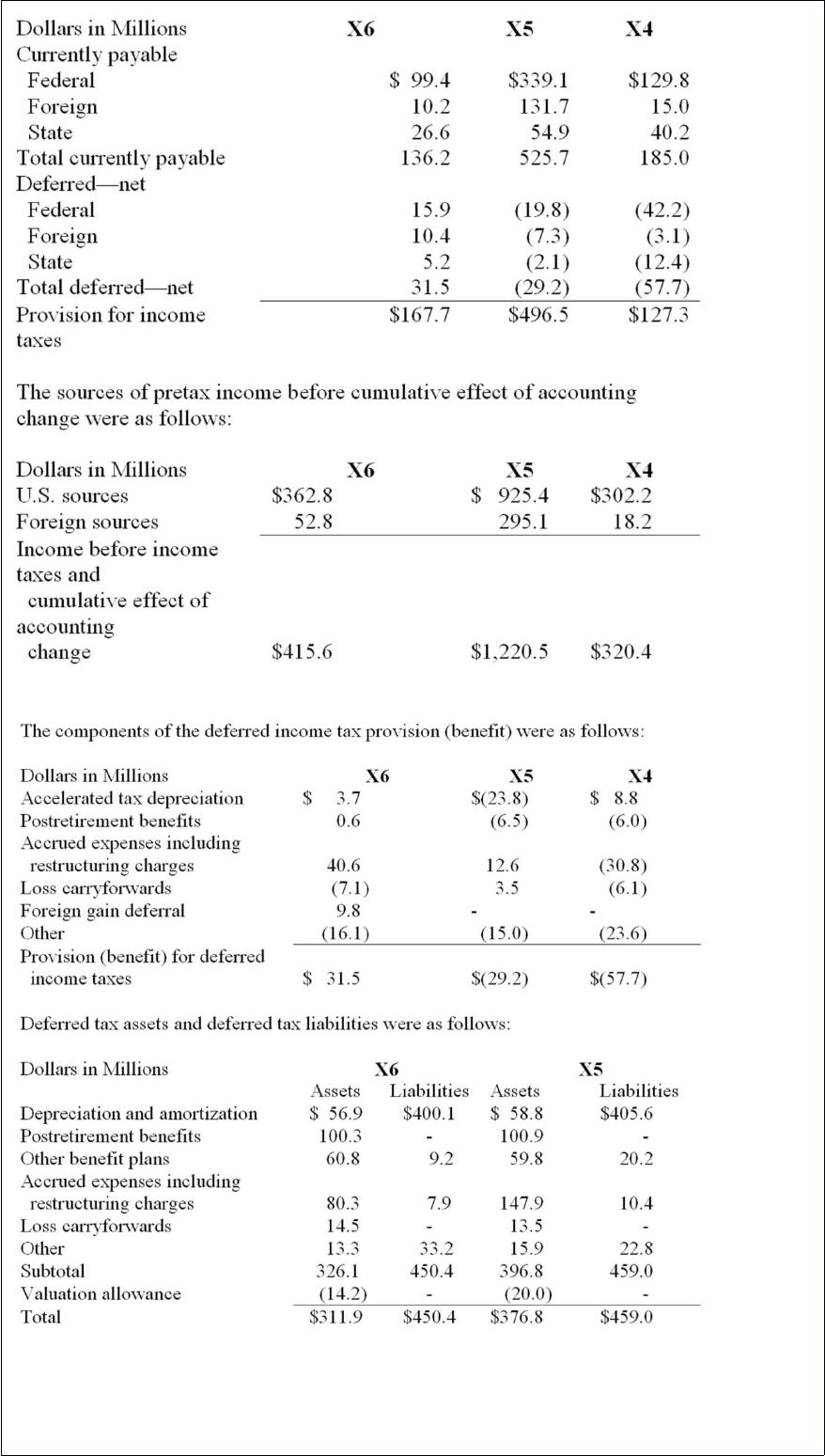
1a. What was the effective tax rate on all income for fiscal X6?
1b. What was the effective tax rate on foreign income for fiscal X6?
2a. How much did Quaker Oats record in deferred taxes for fiscal X6? Was this an asset
or liability?
2b. What was the major item contributing to the deferred tax for X6? Explain fully how
this arose.