1) Assume the annual British interest rate is above the annual U.S. interest rate. Also
assume the pound’s forward rate of $1.75 equals the pound’s spot rate. Given this
information, interest rate parity ____ exist, and the U.S. firm ____ lock in a lower
financing cost by borrowing pounds for one year.
a. does; could
b. does; could not
c. does not; could not
d. does not; could
2) You are the treasurer of Arizona Corporation and must decide how to hedge (if at all)
future receivables of 350,000 Australian dollars (A$) 180 days from now. Put options
are available for a premium of $.02 per unit and an exercise price of $.50 per Australian
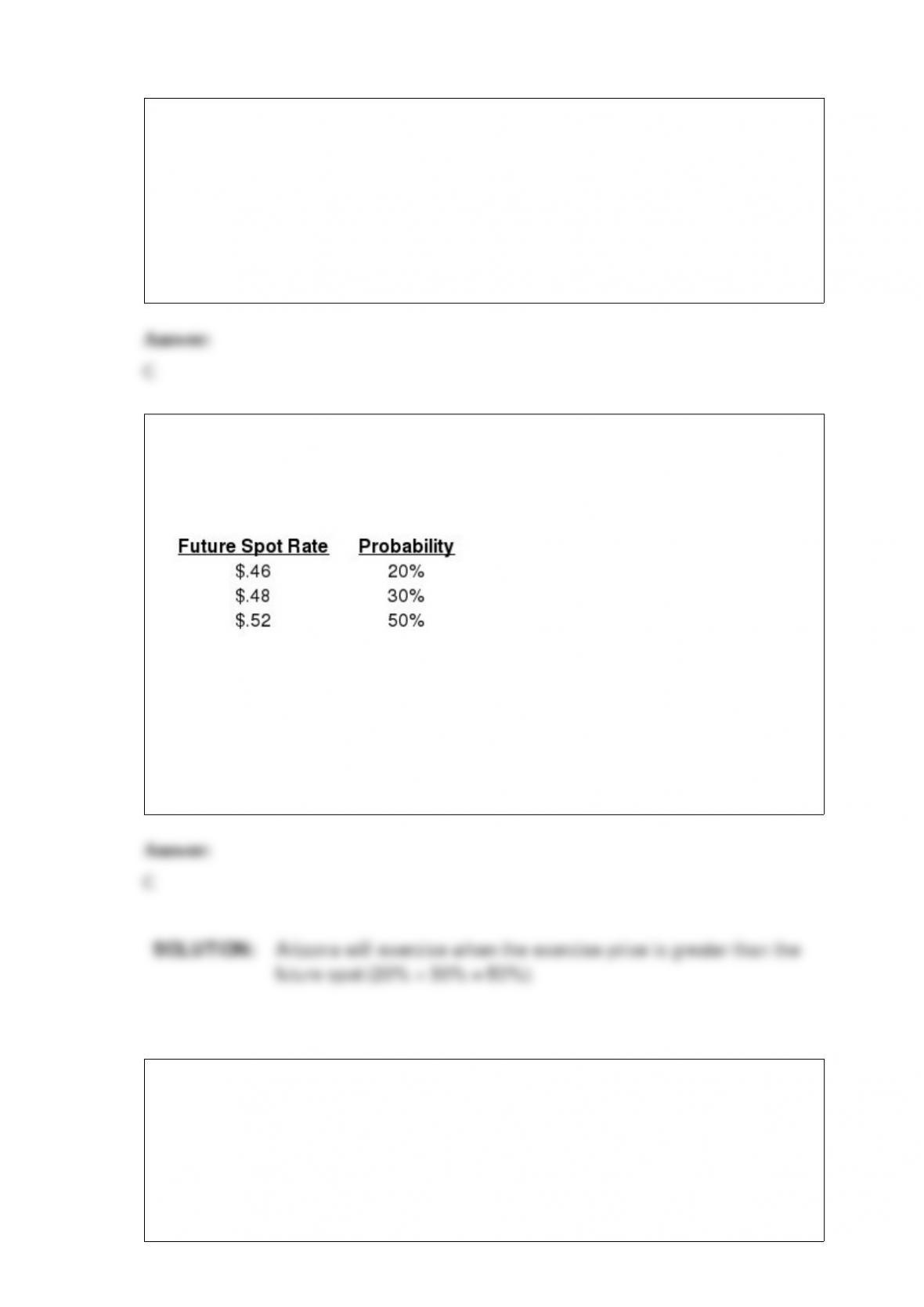
dollar. The forecasted spot rate of the Australian dollar in 180 days is:
The 90-day forward rate of the Australian dollar is $.50.
What is the probability that the put option will be exercised (assuming Arizona
purchased it)?
a. 0%
b. 80%
c. 50%
d. none of the above
3) When the “real” interest rate is relatively low in a given country, then the currency of
that country is typically expected to be:
a. weak, since the country’s quoted interest rate would be high relative to the inflation
rate
b. strong, since the country’s quoted interest rate would be low relative to the inflation
rate
c. strong, since the country’s quoted interest rate would be high relative to the inflation

rate
d. weak, since the country’s quoted interest rate would be low relative to the inflation
rate
4) The valuation of a newly privatized business is generally more difficult than the
valuation of a publicly traded firm because:
a. It has previously operated in environments of very high competition
b. Interest rates in the countries where privatization takes place are extremely high
c. The stock markets in the countries where privatization takes place are overvalued
d. Economic conditions in the countries where privatization takes place are very
uncertain
e. None of the above
5) Depreciation of the euro relative to the U.S. dollar will cause a U.S.-based
multinational firm’s reported earnings (from the consolidated income statement) to
____. If a firm desired to protect against this possibility, it could stabilize its reported
earnings by ____ euros forward in the foreign exchange market.
a. be reduced; purchasing
b. be reduced; selling
c. increase; selling
d. increase; purchasing
6) Regression analysis cannot be used to assess the sensitivity of a company’s
performance to economic conditions because economic conditions are unpredictable.
a. True
b. False
7) The standard deviation should be applied to values rather than percentage
movements when comparing volatility among currencies.
a. True
b. False

8) Eurenasia is a country that has frequently been assigned low macro-assessment
ratings of country risk in the recent past due to its tendency to war with neighboring
nations. MNC A is considering the establishment of a subsidiary to manufacture
personal computers, while MNC B is considering the establishment of a subsidiary to
manufacture tanks. Which of the two MNCs is likely to be less affected by the low
macro-assessment?
a. MNC A
b. MNC B
c. both will be equally affected, since the macro-assessment does not vary
d. none of the above
9) ____ promises to pay the beneficiary if they buyer fails to pay as agreed.
a. A standby L/C
b. A transferable L/C
c. Assignment of proceeds
d. None of the above
10) Assume that U.S. annual inflation equals 8%, while Japanese annual inflation
equals 5%. If purchasing power parity is used to forecast the future spot rate, the
forecast would reflect an expectation of:
a. appreciation of yen’s value over the next year
b. depreciation of yen’s value over the next year
c. no change in yen’s value over the next year
d. information about interest rates is needed to answer this question
11) Crown Co. is expecting to receive 100,000 British pounds in one year. Crown
expects the spot rate of British pound to be $1.49 in a year, so it decides to avoid
exchange rate risk by hedging its receivables. The spot rate of the pound is quoted at
$1.51. The strike price of put and call options are $1.54 and $1.53 respectively. The
premium on both options is $.03. The one-year forward rate exhibits a 2.65% premium.
Assume there are no transaction costs. What is the best possible hedging strategy and
how many U.S. dollars Crown Co. will receive under this strategy?
a. buy a put option and receive $150,000
b. sell pounds forward and receive $155,000
c. sell a call option and receive $156,000
d. sell a put option and receive $157,000
12) Recently, the U.S. experienced an annual balance of trade representing a ____.
a. large surplus (exceeding $100 billion)
b. small surplus
c. level of zero
d. deficit
13) The purchase of a currency put option would be appropriate for which of the
following?
a. Investors who expect to buy a foreign bond in one month
b. Corporations who expect to buy foreign currency to finance foreign subsidiaries
c. Corporations who expect to collect on a foreign account receivable in one month
d. all of the above
14) Which of the following operations benefit(s) from depreciation of the firm’s local
currency?
a. borrowing in a foreign country and converting the funds to the local currency prior to
the depreciation

b. purchasing foreign supplies
c. investing in foreign bank accounts denominated in foreign currencies prior to
depreciation of the local currency
d. A and B
15) The maximum one-day loss computed for the value-at-risk (VAR) method does not
depend on:
a. the expected percentage change in the currency for the next day
b. the standard deviation of the daily percentage changes in the currency over a
previous period
c. the current level of interest rates
d. the confidence level used
16) Assume that Swiss investors have francs available to invest in securities, and they
initially view U.S. and British interest rates as equally attractive. Now assume that U.S.
interest rates increase while British interest rates stay the same. This would likely cause:
a. the Swiss demand for dollars to decrease and the dollar will depreciate against the
pound
b. the Swiss demand for dollars to increase and the dollar will depreciate against the
Swiss franc
c. the Swiss demand for dollars to increase and the dollar will appreciate against the
Swiss franc
d. the Swiss demand for dollars to decrease and the dollar will appreciate against the
pound
17) A possible reason why China was less affected by the Asian crisis is that its
government exerts more influence on private enterprise than the governments of other
Asian countries.
a. True
b. False
18) Relatively high Japanese inflation may result in an increase in the supply of yen for
sale and a reduction in the demand for yen, other things being equal.

a. True
b. False
19) Also known as the “central banks’ central bank,” the ____ attempts to facilitate
cooperation among countries with regard to international transactions and provides
assistance to countries experiencing a financial crisis.
a. World Bank
b. International Financial Corporation (IFC)
c. World Trade Organization
d. International Development Association (IDA)
e. Bank for International Settlements (BIS)
20) Since the cash flows generated by a foreign target will eventually be converted to
the parent’s currency, there is no need to consider the foreign exchange rate in the
capital budgeting process.
a. True
b. False
21) Assume the British pound appreciates against the dollar while the Japanese yen
depreciates against the dollar. Which of the following is true?
a. Japanese exporters can increase American sales by shifting operations from their
British subsidiaries to Japan
b. British exporters can increase American sales by shifting operations from their
Japanese subsidiaries to Britain
c. American exporters can increase sales to Japan by shifting operations from Japanese
subsidiaries to American subsidiaries
d. B and C
22) An international acquisition is different from the establishment of a new subsidiary
in that the MNC can immediately expand its international business since the target is
already in place.
a. True
b. False

23) Assume that some U.S. firms will purchase supplies from either China or from U.S.
firms. If the Chinese yuan appreciates against the dollar, it should reduce the U.S.
balance of trade deficit with China.
a. True
b. False
24) Which of the following does not constitute a form of direct foreign investment?
a. Franchising
b. International trade
c. Joint ventures
d. Acquisitions of existing operations
e. Establishment of new foreign subsidiaries
25) If a multinational project is assessed from the subsidiary’s perspective, withholding
taxes are ignored for project assessment.
a. True
b. False
26) Which of the following is an example of direct foreign investment?
a. exporting to a country
b. establishing licensing arrangements in a country
c. purchasing existing companies in a country
d. investing directly (without brokers) in foreign stocks
27) A call option on Australian dollars has a strike (exercise) price of $.56. The present
exchange rate is $.59. This call option can be referred to as:
a. in the money
b. out of the money
c. at the money
d. at a discount
28) Assume the spot rate of a currency is $.37 and the 90-day forward rate is $.36. The
forward rate of this currency exhibits a ____ of ____ on an annualized basis.
a. discount; 11.11%
b. premium; 11.11%
c. premium; 10.81%
d. discount; 10.81%
29) According to the text, a disadvantage of licensing is that:
a. it prevents a firm from importing
b. it is difficult to ensure quality control of the production process
c. it prevents a firm from exporting
d. none of the above
30) Everything else being equal, the ____ the depreciation expense is in a given year,
the ____ a foreign project’s NPV will be.
a. higher; lower
b. higher; higher
c. lower; higher
d. none of the above
31) A large increase in the income level in Mexico along with no growth in the U.S.
income level is normally expected to cause (assuming no change in interest rates or
other factors) a(n) ____ in Mexican demand for U.S. goods, and the Mexican peso

should ____.
a. increase; appreciate
b. increase; depreciate
c. decrease; depreciate
d. decrease; appreciate
32) The transaction exposure of two inflow currencies is offset when the correlation
between the currencies is high.
a. True
b. False
33) The U.S. risk-free rate is currently 3%. The expected U.S. market return is 10%.
Solso, Inc. is considering a project that has a beta of 1.2. What is the cost of
dollar-denominated equity?
a. 8.4%
b. 11.4%
c. 10%
d. None of the above
34) A balance of trade deficit indicates an excess of imports over exports.
a. True
b. False