
1) Common-sized income statements restate the numbers in the income statement as a
percentage of sales to assist in the comparison of a firm’s financial performance across
time and with competitors.
2) The risk-adjusted discount rate method implicitly assumes that distant cash flows
have the same risk as near cash flows.
3) If we ignore bankruptcy and agency costs then the optimal capital structure for a firm
under the moderate view would be 100% debt.
4) The realized rate of return, or holding period return, is equal to the holding period
dollar gain divided by the price at the beginning of the period.
5) Non-uniform demand can be accommodated in the EOQ model by allowing for
non-uniform ordering costs.
6) Owners equity increases each period by the amount of the corporation’s positive net
cash flow.
7) The initial outlay includes the cost of purchasing the asset and getting it operational,
including the purchase price, shipping and installation, and any training costs for

employees who will be operating the equipment, and any increases in working capital
requirements.
8) $10,000 invested at 10% per year for 5 years earns interest equal to $6,105.10;
therefore, $10,000 invested at 10% per year for 10 years will earn interest equal to
$12,210.20 (2 times $6,105.10).
9) An example of a Eurobond is a bond issued in Asia by a U.S. Corporation with
interest and principal payments made in U.S. dollars.
10) S-type corporations and limited liability companies are taxed like partnerships, but
have the advantage of limited liability for their owners.
11) The present value of a single future sum of money is inversely related to both the
number of years until payment is received and the discount rate.
12) If market interest rates decline
A) short-term bonds will decline in value more than long-term bonds
B) short-term bonds will rise in value more than long-term bonds
C) long-term bonds will decline in value more than short-term bonds
D) long-term bonds will rise in value more than short-term bonds
13) The correct order of dividend process dates is

A) date of record, declaration date, ex-dividend date, payment date
B) declaration date, date of record, ex-dividend date, payment date
C) ex-dividend date, date of record, declaration date, payment date
D) declaration date, ex-dividend date, date of record, payment date
14) You have $25,000 in an investment account today. How much will be in the account
in 30 years if the account earns (a) 8% per year, (b) 8% compounded semiannually, (c)
8% compounded quarterly, (d) 8% compounded monthly, and (e) 8% compounded
daily? Comment on the effect of more frequent compounding.
15) What is the economic difference between a stock dividend and a stock split?
A) Stock splits create greater economic benefits to shareholders than stock dividends
B) Stock splits increase EPS more than stock dividends
C) There is no economic difference between a stock dividend and a stock split
D) Stock dividends create greater economic benefits to shareholders than stock splits
16) Parsons Company has a cash flow problem. The company owes its suppliers
$300,000 on credit terms of 2/10 net 40, but Parsons doesn’t have the cash to pay during
the discount period. Parsons, however, can borrow the $300,000 at annual rate of 24%.
Should Parsons borrow the money to pay its accounts payable?
A) No, additional borrowing will cost more for interest ($60,000 per year) than the
discount is worth
B) Yes, the effective cost of forgoing the discount is greater than 24%
C) No, the effective cost of forgoing the discount is equal to 24%, and there are
transactions costs associated with borrowing
D) It doesn’t matter because the present value of the cost of borrowing is exactly equal
to the amount of the discount for paying within 10 days
17) Company A and Company B both report the same level of sales and net income.
Therefore

A) both A and B will report the same Earnings Per Share
B) both A and B will report the same Gross Profit Margin
C) both A and B will report the same Net Profit Margin
D) both A and C are true
18) Assume that Bunch Inc. has an issue of 18-year $1,000 par value bonds that pay 7%
interest, annually. Further assume that today’s required rate of return on these bonds is
5%. How much would these bonds sell for today? Round off to the nearest $1.
A) $1,233.79
B) $1,201.32
C) $1,134.88
D) $1,032.56
19) QRM, Inc.’s marginal tax rate is 35%. It can issue 10-year bonds with an annual
coupon rate of 7% and a par value of $1,000. After $12 per bond flotation costs, new
bonds will net the company $966 in proceeds. Determine the appropriate after-tax cost
of new debt for the firm to use in a capital budgeting analysis.
A) 2.62%
B) 4.87%
C) 7.50%
D) 7.8%
20) As interest rates, and consequently investors’ required rates of return, change over
time the ________ of outstanding bonds will change as a result.
A) maturity date
B) coupon interest payment
C) par value
D) price
21) Forward rates are all of the following EXCEPT
A) quoted in both direct and indirect form
B) quoted at a premium or discount
C) beneficial to risk-reduction

D) equal to future spot rates
22) You must add one of two investments to an already well- diversified portfolio.
Security ASecurity B
Expected Return = 14%Expected Return = 12%
Standard Deviation ofStandard Deviation of
Returns = 15.0%Returns = 11%
Beta = 1.5Beta = 1.5
If you are a risk-averse investor, which one is the better choice?
A) Security A
B) Security B
C) Either security would be acceptable
D) cannot be determined with information given
23) A significant disadvantage of the payback period is that it
A) is complicated to explain
B) increases firm risk
C) does not properly consider the time value of money
D) provides a measure of liquidity
24) You inherit $300,000 from your parents and want to use the money to supplement
your retirement. You receive the money on your 65th birthday, the day you retire. You
want to withdraw equal amounts at the end of each of the next 20 years. What constant
amount can you withdraw each month and have nothing remaining at the end of 20
years if you are earning 7% interest compounded monthly?
A) $1,200
B) $1,829
C) $2,326
D) $2,943
25) JPR Company is financed 75 percent by equity and 25 percent by debt. If the firm
expects to earn $30 million in net income next year and retain 40% of it, how large can
the capital budget be before common stock must be sold?

A) $7.5 million
B) $12.0 million
C) $15.5 million
D) $16.0 million
26) Matterhorn, Inc. had the following sales for the past six months. Matterhorn collects
its credit sales 30% in the month of sale, 60% one month after the sale, and 10% two
months after the sale.
Cash SalesCredit Sales
January$50,000$50,000
February$70,000$110,000
March$55,000$95,000
April$78,000$130,000
May$80,000$105,000
June$75,000$148,000
What are Matterhorn’s total cash receipts for the month of May?
A) $185,000
B) $199,000
C) $119,000
D) $176,000
27) What is the net present value’s assumption about how cash flows are reinvested?
A) They are reinvested at the IRR
B) They are reinvested at the APR
C) They are reinvested at the firm’s discount rate
D) They are reinvested only at the end of the project
28) A financial manager is considering two projects, A and B. A is expected to add $2
million to profits this year while B is expected to add $2 million to profits this year
while B is expected to add $1 million to profits this year. Which of the following
statements is MOST correct?
A) The manager should select project A because it maximizes profits
B) The manager should select the project that maximizes long-term profits, not just one
year of profits
C) The manager should select project A or he is irrational
D) The manager should select the project that causes the stock price to increase the
most, which could be A or B

29) QuadCity Manufacturing, Inc. reported the following items: Sales = $6,000,000;
Variable Costs of Production = $1,500,000; Variable Selling and Administrative
Expenses = $550,000; Fixed Costs = $1,350,000; EBIT = $2,600,000; and the Marginal
Tax Rate =35%. QuadCity’s break-even point in sales dollars is
A) $2,050,633
B) $2,197,500
C) $2,438,750
D) $2,785,000
30) Capital rationing may be imposed because of all of the following EXCEPT
A) capital market conditions are poor
B) management has a fear of debt
C) stockholder control problems prevent issuance of additional stock
D) the company’s stock price is at an historically high level
31) Grainery Distillers, Inc. is experiencing high demand for its products and high
growth rates. The company just reported earnings per share of $5 for the most recent
year and has many positive NPV projects to fund. One vice president wants to pay a
dividend of $5 per share, arguing that this will maximize shareholder value. You argue
that a much smaller dividend will maximize value. Your argument may be based on
A) the bird-in-the-hand theory
B) the residual dividend theory
C) the information effect
D) the very high agency costs of the corporation
32) Humongous Corporation is a multidivisional conglomerate. The Food Division is
undergoing a capital budgeting analysis and must estimate the division’s beta. This
division has a different level of systematic risk than is typical for Humongous
Corporation as a whole. The most appropriate method for estimating this beta is
A) the regression coefficient from a time series regression of Humongous Corporation
stock returns on a market index
B) to multiply the company’s beta by the ratio of the Food Division’s total
assets/Humongous Corporation total assets
C) the regression coefficient from a time series regression of Food Division’s net

income on the Humongous Corporation’s return on assets
D) the regression coefficient from a time series regression of Food Division’s return on
assets on a market index
33) Which of the following statements about financial leverage is true?
A) Financial leverage is the responsiveness of the firm’s EBIT to fluctuations in sales
B) Financial leverage involves the incurrence of fixed operating costs in the firm’s
income stream
C) Financial leverage is the responsiveness of the firm’s EPS to fluctuations in EBIT
D) Financial leverage reduces a firm’s risk
34) An investment is expected to yield $300 in three years, $500 in five years, and $300
in seven years. What is the present value of this investment if our opportunity rate is
5%?
A) $735
B) $864
C) $885
D) $900
35) The selection of a proper marketable-securities mix involves evaluation of certain
criteria. What are these criteria and why are they important?
36) Financing a portion of a firm’s assets with securities bearing a fixed rate of return in

hopes of increasing the return to stockholders refers to
A) business risk
B) financial leverage
C) operating leverage
D) combined leverage
37) The correct relationship for a premium bond is
A) current yield > yield to maturity > coupon rate
B) current yield > coupon rate > yield to maturity
C) coupon rate > yield to maturity > current yield
D) coupon rate > current yield > yield to maturity
38) If a firm were to experience financial insolvency, the legal system provides an order
of hierarchy for the payment of claims. Assume that a firm has the following
outstanding securities: mortgage bonds, common stock, debentures, and preferred stock.
Rank the order in which investors that own mortgage bonds would have their claim
paid?
A) first
B) second
C) third
D) fourth
39) Blackjack Inc. wants to replace a 9-year-old machine with a new machine that is
more efficient. The old machine cost $70,000 when new and has a current book value of
$15,000. Blackjack can sell the machine to a foreign buyer for $14,000. Blackjack’s tax
rate is 35%. The effect of the sale of the old machine on the initial outlay for the new
machine is
A) ($14,350)
B) ($13,650)
C) ($9,100)
D) $1,000
40) What is the payback period for a project with an initial investment of $180,000 that

provides an annual cash inflow of $40,000 for the first three years and $25,000 per year
for years four and five, and $50,000 per year for years six through eight?
A) 5.80 years
B) 5.20 years
C) 5.40 years
D) 5.59 years
41) Lithium, Inc. is considering two mutually exclusive projects, A and B. Project A
costs $95,000 and is expected to generate $65,000 in year one and $75,000 in year two.
Project B costs $120,000 and is expected to generate $64,000 in year one, $67,000 in
year two, $56,000 in year three, and $45,000 in year four. Lithium, Inc.’s required rate
of return for these projects is 10%. Which project would you recommend using the
replacement chain method to evaluate the projects with different lives?
A) Project B because its NPV is higher than Project A’s replacement chain NPV of
$47,623
B) Project A because its replacement chain NPV is $76,652, which exceeds the NPV for
Project B
C) Project A because its replacement chain NPV is $45,642, which is less than the NPV
for Project B
D) Both projects will be valued the same since they are now both four year projects
42) Assume that a firm has a steady record of paying stable dividends for years. Market
analysts had expected management to increase the dividend by 7.5% in the latest
quarter. However, management announced a 15% increase in the current year’s
dividend. The market value of the stock rose 20% on the day of the announcement.
Which of the following would best explain the stock market’s reaction to the
announcement?
A) expectations theory
B) dividend irrelevance theory
C) residual dividend theory
D) agency theory
43) The Clydesdale Corporation has an optimal capital structure consisting of 70
percent debt and 30 percent equity. The marginal cost of capital is calculated to be
14.75 percent. Total earnings available to common stockholders for the coming year
total $1,200,000. Investment opportunities are:
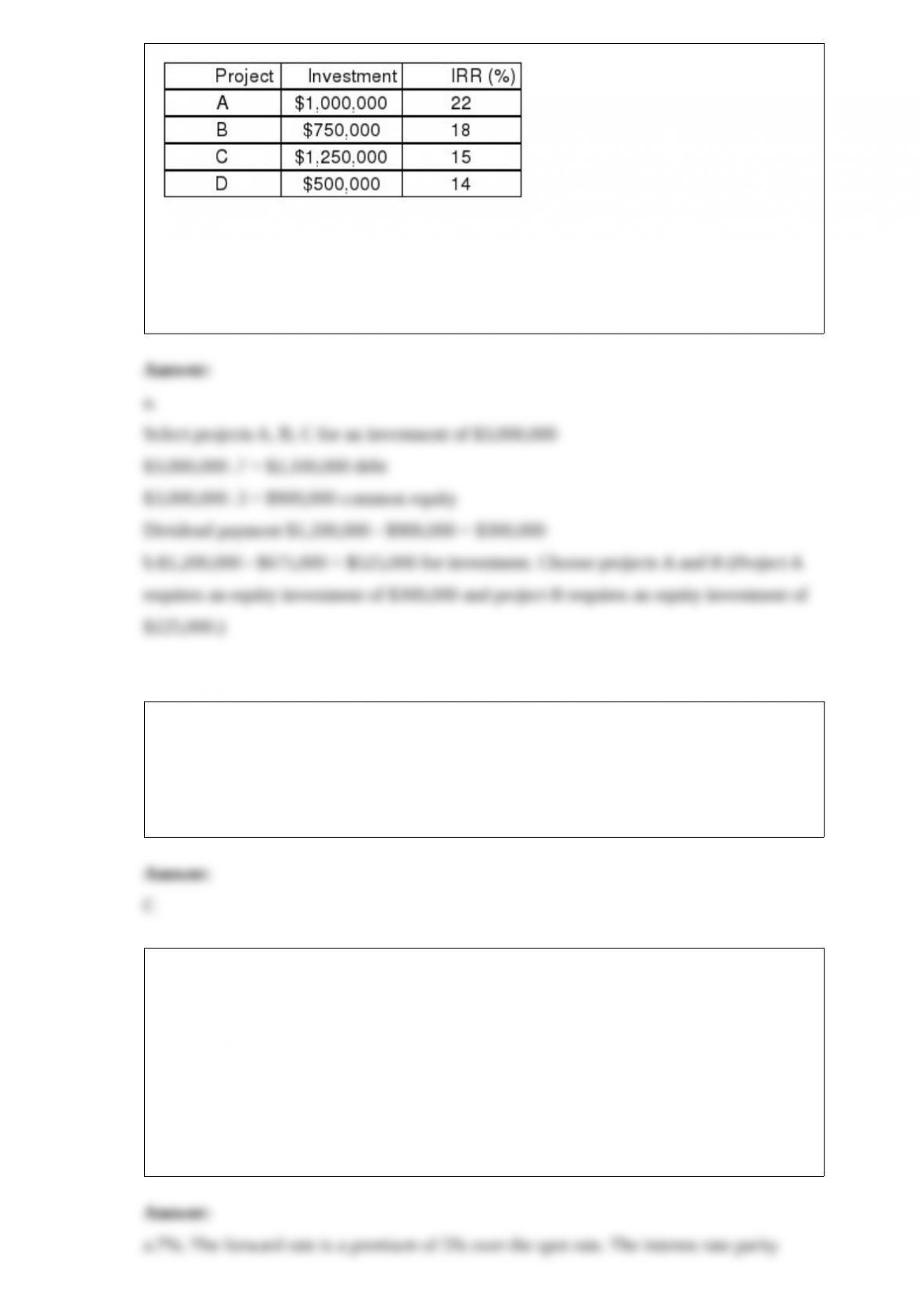
a.According to the residual dividend theory, what should the firm’s total dividend
payment be?
b.If the firm paid a total dividend of $675,000, and restricted equity financing to
internally generated funds, which projects should be selected? Assume the marginal
cost of capital is constant.
44) A basis point is equal to
A) one percent
B) one-tenth of one percent
C) one-hundredth of one percent
D) one-half of one percent
45) The spot exchange rate in New York is 1.600 dollars per British pound. The
360-day forward exchange rate is 1.680 dollars per pound. The one-year interest rate in
Great Britain is 2% while the one-year interest rate in the United States is 4%.
a.If the interest rate in Great Britain remains at 2%, what should the interest rate be in
the United States according to the interest rate parity theory?
b.An American investor with $40,000 decides to take advantage of the differences in
rates. Ignoring transaction costs, how can the American investor exploit the
disequilibrium? Compare the amount of money the investor will have at the end of the
year if he or she invests in one-year U.S. securities versus one-year British securities.

46) Money-market hedges and forward market hedges rely on the
A) interest rate parity theory
B) purchasing power parity theory
C) law of large numbers
D) capital asset pricing model
47) Cyberco Corporation has 5 million shares of stock outstanding. Cyberco’s after-tax
profits are $15 million and the corporation’s stock is selling at a price-earnings multiple
of 10, for a stock price of $30 per share. Cyberco management issues a 25% stock
dividend.
a.Calculate Cyberco’s earnings per share before and after the stock dividend.
b.Suppose an investor owns 100 shares of Cyberco before the stock dividend. Use the
price earnings multiple to estimate the value of the investor’s holdings both before and
after the dividend.
c.Comment on the results of the stock dividend for current shareholders.