
A small open economy
(a) is unable to affect the world real interest rate by its borrowing and lending decisions.
(b) will always be a net borrower from abroad.
(c) will always be a net lender abroad.
(d) is almost never able to borrow abroad.
Answer:
In studying the gold price of greenbacks, researchers have shown that
(a) the gold price of greenbacks rose when the Union forces did well.
(b) the gold price of greenback fell when the Union forces did well.
(c) events in the Civil War had little impact on the gold price of greenbacks.
(d) currency markets during the Civil War were not efficient.
Answer:
Explain how each of the following might make use of the futures market.
(a) A lender who is worried that its cost of funds might rise during the term of a loan it
has made.

(b) A speculator who believes strongly that interest rates will rise.
Answer:
If the interest rate in the United States rises
(a) investors increase their demand for dollars and the U.S. exchange rate appreciates.
(b) investors increase their demand for dollars and the U.S. exchange rate depreciates.
(c) investors decrease their demand for dollars and the U.S. exchange rate appreciates.
(d) investors decrease their demand for dollars and the U.S. exchange rate depreciates.
Answer:
Which of the following assets made up the largest fraction of the portfolios of U.S.
households in 1950?
(a) Pension reserves
(b) Equities
(c) Mortgages

(d) U.S. government securities
Answer:
New Keynesian economists question the credibility of cold turkey disinflation in the
real world because
(a) the independence of central banks allows them to disregard public opinion.
(b) households and businesses do not form their expectations rationally.
(c) a reduction in money growth may reduce output and employment substantially in
the short run.
(d) central banks tools to bring the inflation rate down even in the long run.
Answer:
The information lag facing the Fed is
(a) the XOAXOA of becoming informed quickly of changes in public opinion about
which policy goal is most important.
(b) the delay in receiving accurate information about the state of the economy.
(c) the delay in Congress and the President communicating their policy goals for the
Fed to act on.

(d) the time required for monetary policy changes to affect output, employment, and
prices.
Answer:
The soaring dollar in the early 1980s
(a) increased the demand for U.S. exports.
(b) reduced the demand in the U.S. for foreign imports.
(c) hurt U.S. exporters.
(d) is attributable to low U.S. interest rates relative to foreign interest rates.
Answer:
The largest stock market crash during the 1980s and 1990s took place in
(a) October
(b) October
(c) July
(d) July

Answer:
Nominal interest rates are higher than real interest rates
(a) as long as expected inflation is positive.
(b) the government taxes interest income.
(c) inflation is expected to decline in the future.
(d) long-term interest rates are higher than short-term interest rates.
Answer:
A shift of the AD curve
(a) to the right is considered expansionary, and a shift to the left is considered
contractionary.
(b) to the left is considered expansionary, and a shift to the right is considered
contractionary.
(c) to the right or to the left is considered contractionary.
(d) to the right or to the left is considered expansionary.

Answer:
Deflation occurs when
(a) inflation is falling.
(b) inflation does not rise as quickly.
(c) the price level is falling.
(d) inflation domestically is lower than that found in other countries.
Answer:
Which of the following statements is true of rational expectations?
(a) Rational expectations forecasts are always correct.
(b) For a trader with rational expectations, the expectation of an asset’s price equals the
optimal price forecast.
(c) If traders have rational expectations, any announcement by a company will have an
effect on its stock price, even if the market was already aware of the facts being
announced.
(d) If a trade really has rational expectations, he or she was always earn a greater than
normal return on his or her financial portfolio.
Answer:
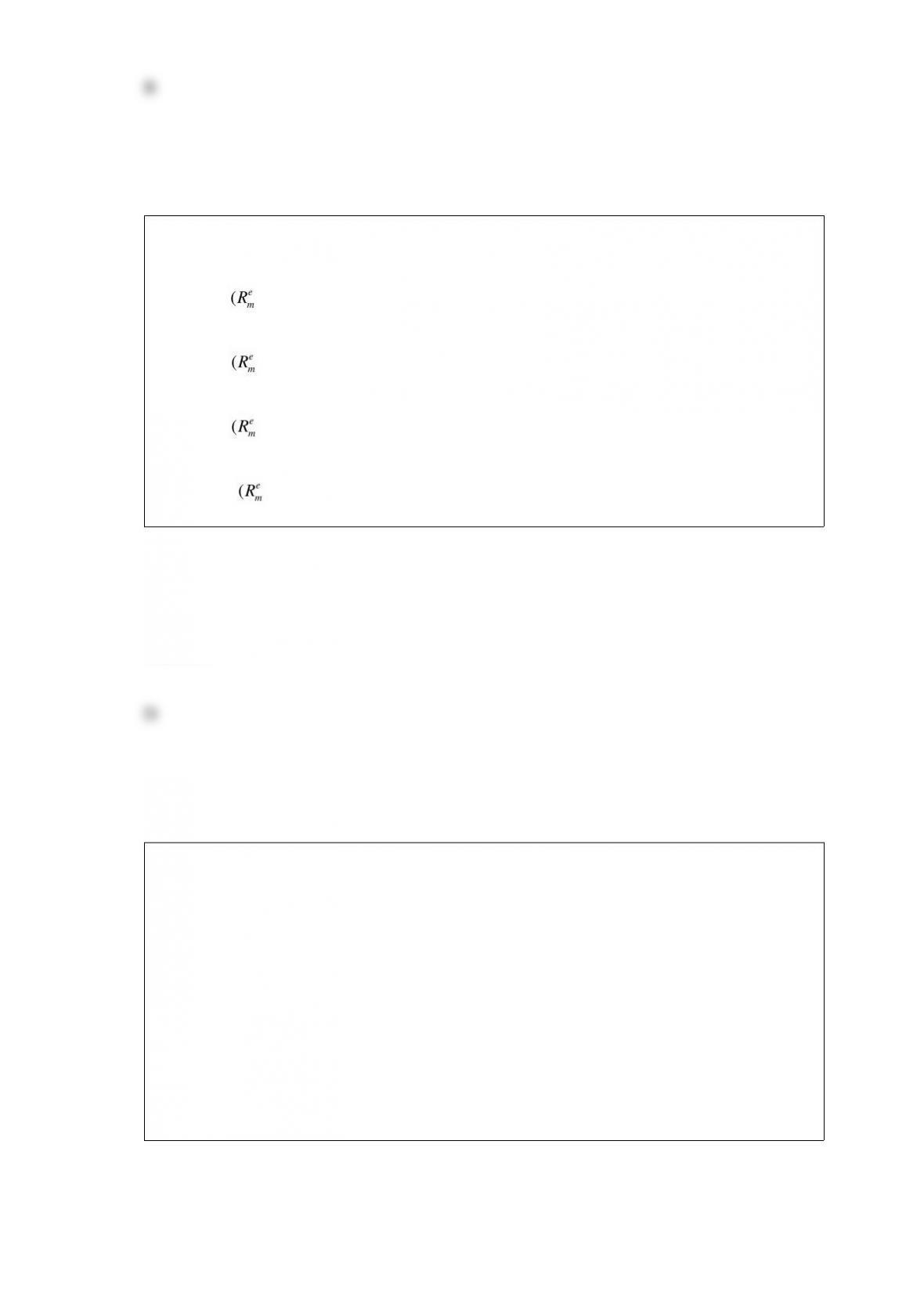
According to the capital asset pricing model, the expected return on asset j, Rj
e equals
(a) Rf ßj x Rf).
(b) Rf ßj + Rf).
(c) Rf+ ßj Rf).
(d) Rf+ ßj x Rf).
Answer:
Suppose that you expect during the next year the dollar will appreciate against the
pound from 0.5 pound to the dollar to 0.75 pound to the dollar. How much will you
expect to make on an investment of $10,000 in British government securities that will
mature in one year and pay interest of 8%?
(a) 59.5%
(b) 28%
(c) 8%
(d) 28%

Answer:
Which of the following is an investment institution?
(a) The New York Stock Exchange
(b) Greater Illinois Savings and Loan
(c) Prudential Insurance Company
(d) Fidelity Magellan Mutual Fund
Answer:
If the current price of a bond is greater than its face value
(a) an investor will receive a capital gain by holding the bond until maturity.
(b) the yield to maturity must be less than the coupon rate.
(c) the coupon rate must be less than the current yield.
(d) the coupon rate must be equal to the current yield.
Answer:

What is the payments system?
(a) The means of clearing transactions in the economy by check
(b) The system by which exchange rates between currencies are determined
(c) The means by which credit card companies calculate average daily balances for
purposes of imposing finance charges
(d) The system for transmitting funds from the U.S. Treasury to local banks for the
purpose of making purchases for the federal government
Answer:
A closed economy is one that
(a) has no government sector.
(b) neither borrows from nor lends to foreign countries.
(c) produces mainly agricultural goods.
(d) produces mainly manufactured goods.
Answer:

Under the theory of purchasing power parity, an increase in the U.S. price level of 10%
relative to the Japanese price level will result in
(a) a 10% appreciation of the yen.
(b) a 10% appreciation of the dollar.
(c) an appreciation of the yen by an amount that depends upon what happens to the real
exchange rate.
(d) an appreciation of the dollar by an amount that depends upon what happens to the
real exchange rate.
Answer:
Which of the following schools of thought among economists believe that activist
stabilization policy is ever desirable?
(a) Only new Keynesian
(b) Only new Keynesian and new classical
(c) Only new Keynesian and real business cycle
(d) New Keynesian, new classical, and real business cycle
Answer:

If in the short run prices did not respond at all to changes in aggregate demand, the
short-run aggregate supply curve would
(a) be vertical.
(b) be horizontal.
(c) slope up.
(d) slope down.
Answer:
During wars
(a) the supply curve for bonds shifts to the right, lowering the equilibrium interest rate.
(b) the demand curve for bonds shifts to the left, lowering the equilibrium interest rate.
(c) the demand curve for loanable funds shifts to the right, raising the equilibrium
interest rate.
(d) supply curve for loanable funds shifts to the right, lowering the equilibrium interest
rate.
Answer:
Which of the following is true of the New York Stock Exchange?

(a) It is an over-the-counter market.
(b) It maintains a liquid central market for small and medium-sized investors.
(c) It accounted for a larger fraction of all shares traded in the United States in 1991
than in 1971.
(d) Trading on it takes place over the telephone and by computer.
Answer:
Which of the following money market instruments had the largest amount outstanding
in 2003?
(a) U.S. Treasury bills
(b) Commercial paper
(c) Negotiable CDs
(d) Federal funds
Answer:
If the expected gains on stocks rise, while the expected returns on bonds do not change,
then

(a) the demand curve for bonds will shift to the right.
(b) the supply curve for loanable funds will shift to the right.
(c) the equilibrium interest rate will fall.
(d) the equilibrium interest rate will rise.
Answer:
By 2000, banks in the United States with more than $10 billion of assets
(a) made up less than 1% of banks, but held more than two-thirds of bank assets.
(b) made up more than two-thirds of banks, but held less than 1% of bank assets.
(c) made up about half of banks and held about half of bank assets.
(d) made up less than 1% of banks and held about 1% of bank assets.
Answer: