
Which of the following statements is false?
A) The value of a firm is equal to the amount of money the firm can raise by issuing
securities.
B) By reducing a firm’s corporate tax liability, debt allows the firm to pay more of its
cash flows to investors.
C) Equity investors must pay taxes on dividends but not capital gains.
D) For individuals, interest payments received from debt are taxed as income.
Answer:
You are considering adding a microbrewery on to one of your firm’s existing
restaurants. This will entail an increase in inventory of $8,000, an increase in Accounts
payable of $2,500, and an increase in property, plant, and equipment of $40,000. All
other accounts will remain unchanged. The change in net working capital resulting from
the addition of the microbrewery is:
A) $45,500
B) $10,500
C) $6,500
D) $5,500
Answer:

Consider a zero coupon bond with 20 years to maturity. The percentage change in the
price of the bond if its yield to maturity decreases from 7% to 5% is closest to:
A) 46%
B) 17%
C) 22%
D) 38%
Answer:
You are thinking about investing in a mine that will produce $10,000 worth of ore in the
first year. As the ore closest to the surface is removed it will become more difficult to
extract the ore. Therefore, the value of the ore that you mine will decline at a rate of 8%

per year forever. If the appropriate interest rate is 6%, then the value of this mining
operation is closest to:
A) $71,429
B) $500,000
C) $166,667
D) This problem cannot be solved.
Answer:
Due to a pre-existing contract, Recycle America Inc. has the opportunity to acquire
10,000 pounds of scrap aluminum and 2,500 pounds of scrap lead for $10,750. If the
current market price for scrap aluminum is $0.83 per pound and the current market
price for lead is $1.06 per pound, then the added benefit (cost) to you if you acquire this
metal is?
A) ($200)
B) $200
C) ($1,925)
D) $1,925
Answer:

Which of the following statements is false?
A) The incremental IRR investment rule applies the IRR rule to the difference between
the cash flows of the two mutually exclusive alternatives.
B) When a manager must choose among mutually exclusive investments, the NPV rule
provides a straightforward answer.
C) The likelihood of multiple IRRs is greater with the regular IRR rule than with the
incremental IRR rule.
D) Problems can arise using the IRR method when the mutually exclusive investments
have differences in scale.
Answer:
Use the following timeline to answer the question(s) below.
0 1 2 3
$600 $1,200 $1,800
At an annual interest rate of 7%, the future value of this timeline in year 2 is closest to:
A) $3,080
B) $3,525
C) $3,770
D) $4,035
Answer:

Which of the following statements is false?
A) The actual cash flow that the investor will get to keep will be reduced by the amount
of any tax payments.
B) The equivalent after-tax interest rate is r(1 – τ).
C) The right discount rate for a cash flow is the rate of return available in the market on
other investments of comparable risk and term.
D) To compensate for the risk that they will receive less if the firm defaults, investors
demand a lower interest rate than the rate on U.S. Treasuries.
Answer:
Use the information for the question(s) below.
You founded your own firm three years ago. You initially contributed $200,000 of your
own money and in return you received 2 million shares of stock. Since then, you have
sold an additional 1 million shares of stock to angel investors. You are now considering
raising capital from a venture capital firm. This venture capital firm would invest $5
million and would receive 2 million newly issued shares in return.
Assuming that this is the venture capitalist’s first investment in your firm, the
post-money valuation of your shares are closest to:
A) $5.0 million
B) $12.5 million

C) $4.0 million
D) $2.5 million
Answer:
Use the information for the question(s) below.
Monsters Incorporated (MI) in ready to launch a new product. Depending upon the
success of this product, MI will have a value of either $100 million, $150 million, or
$191 million, with each outcome being equally likely. The cash flows are unrelated to
the state of the economy (i.e. risk from the project is diversifiable) so that the project
has a beta of 0 and a cost of capital equal to the risk-free rate, which is currently 5%.
Assume that the capital markets are perfect.
Assume that in the event of default, 20% of the value of MI’s assets will be lost in
bankruptcy costs and suppose that MI has zero-coupon debt with a $125 million face
value due next year. The total value of MI with leverage is closest to:
A) $140 million
B) $100 million
C) $125 million
D) $134 million

Answer:
Use the information for the question(s) below.
Rosewood Industries has EBIT of $450 million, interest expense of $175 million, and a
corporate tax rate of 35%.
If Rosewood had no interest expense, its net income would be closest to:
A) $405 million
B) $160 million
C) $450 million
D) $290 million
Answer:

You are considering investing in a start up project at a cost of $100,000. You expect the
project to return $500,000 to you in seven years. Given the risk of this project, your cost
of capital is 20%.
The NPV for this project is closest to:
A) $29,200
B) $39,500
C) $129,200
D) $139,500
Answer:
Use the information for the question(s) below.
The Sisyphean Company has a bond outstanding with a face value of $1000 that
reaches maturity in 15 years. The bond certificate indicates that the stated coupon rate
for this bond is 8% and that the coupon payments are to be made semiannually.
Assuming the appropriate YTM on the Sisyphean bond is 9.0%, then the price that this
bond trades for will be closest to:
A) $946
B) $919
C) $1,086
D) $1,000
Answer:
Use the table for the question(s) below.
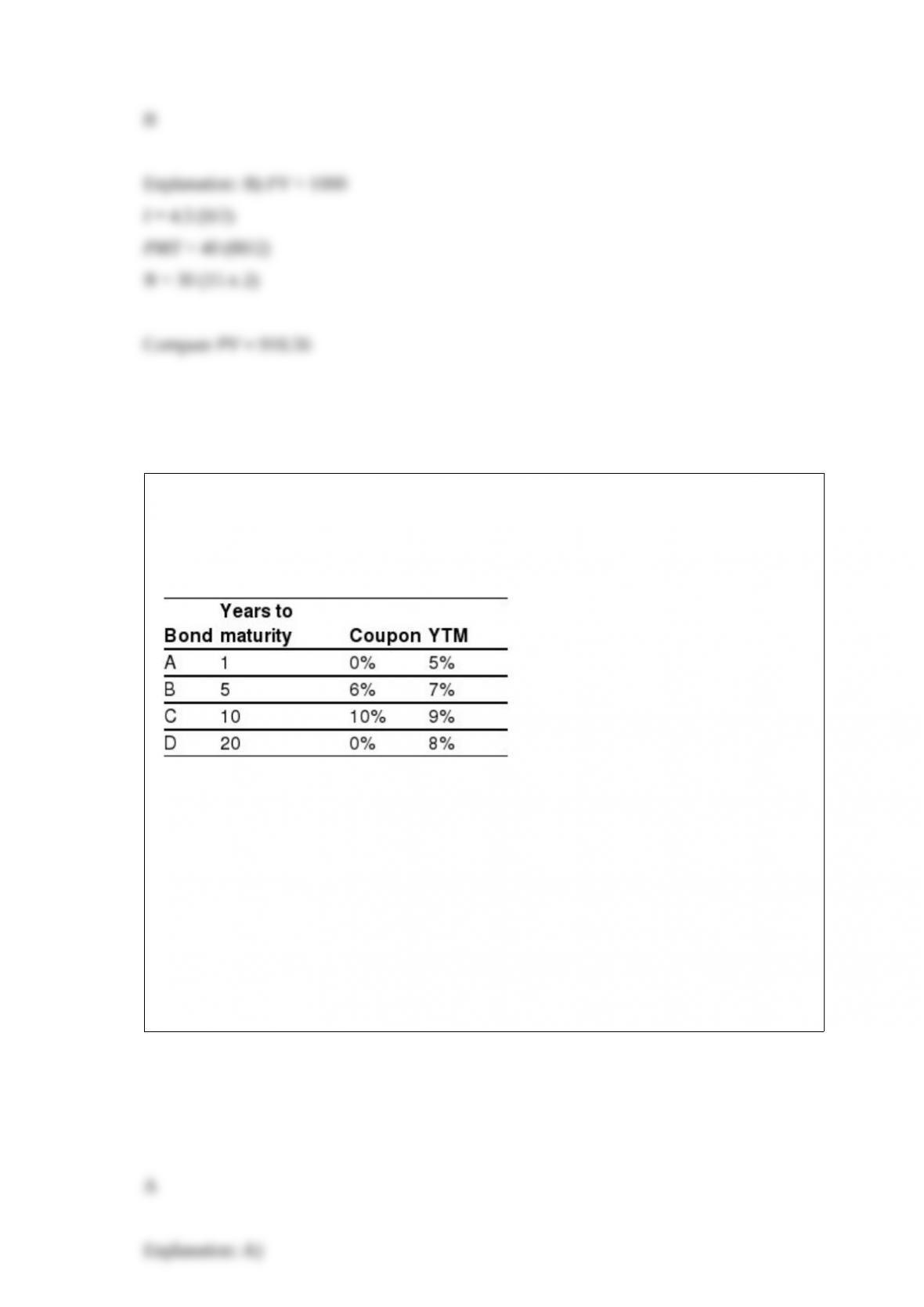
Consider the following four bonds that pay annual coupons:
The amount that the price of bond “D” will change if its yield to maturity increases
from 8% to 9% is closest to:
A) -$36
B) -$39
C) $36
D) $9
Answer:
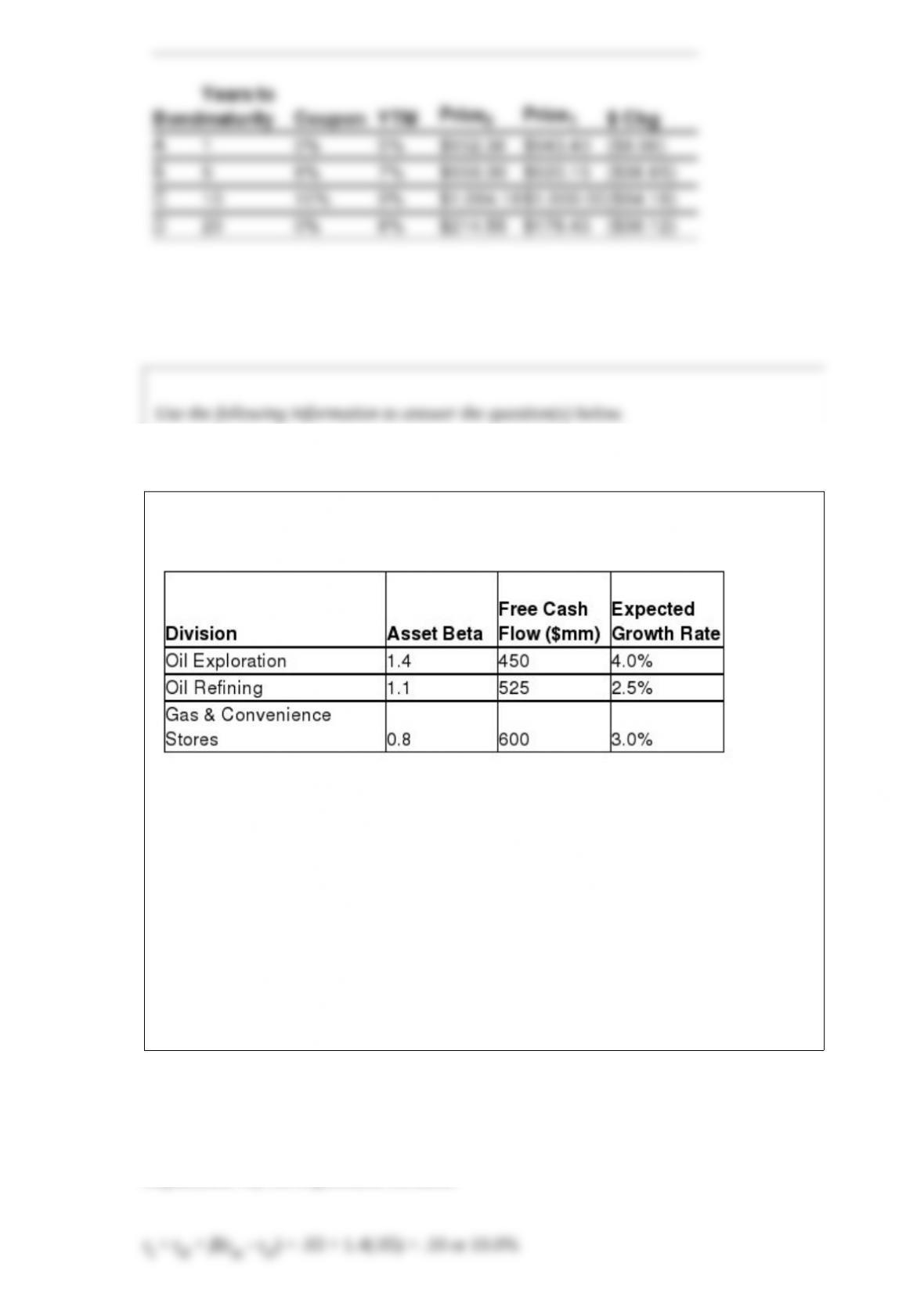
Use the following information to answer the question(s) below.
The risk-free rate of interest is 3% and the market risk premium is 5%.
The overall asset beta for Wyatt Oil is closest to:
A) 0.95
B) 1.05
C) 1.15
D) 1.25
Answer:

Which of the following statements is false?
A) The expected return of a portfolio is equal to the weighted average expected return,
but the volatility of a portfolio is less than the weighted average volatility.
B) Each security contributes to the volatility of the portfolio according to its volatility,
scaled by its covariance with the portfolio, which adjusts for the fraction of the total
risk that is common to the portfolio.
C) Nearly half of the volatility of individual stocks can be eliminated in a large
portfolio as a result of diversification.

D) The overall variability of the portfolio depends on the total co-movement of the
stocks within it.
Answer:
Which of the following is / are an advantage of incorporation?
A) Access to capital markets
B) Limited liability
C) Unlimited life
D) All of the above
Answer:
Boulderado has come up with a new composite snowboard. Development will take
Boulderado four years and cost $250,000 per year, with the first of the four equal
investments payable today upon acceptance of the project. Once in production the
snowboard is expected to produce annual cash flows of $200,000 each year for 10
years. Boulderado’s discount rate is 10%.
The IRR for Boulderado’s snowboard project is closest to:
A) 10.4%
B) 10.0%
C) 11.0%

D) 15.1%
Answer:
In a world with taxes, which of the following is the rate we should use to evaluate an
all-equity financed project with the same risk as the firm?
A) The weighted-average cost of capital
B) The pre-tax WACC
C) The cost of equity

D) The cost of debt
Answer:
Which of the following statements is false?
A) Long-term supply contracts such contracts cannot be entered into anonymously; the
buyer and seller know each other’s identity. This lack of anonymity may have strategic
disadvantages.
B) A futures contract is an agreement to trade an asset on some future date, at a price
that is locked in today.
C) An alternative to vertical integration or storage is a long-term supply contract.
D) Long-term supply contracts are unilateral contracts negotiated by a seller.
Answer:
Which of the following statements is false?
A) Once investors know the recap will occur, the share price will rise immediately to a
level that reflects the value of the interest tax shield that the firm will receive from its
recapitalization.
B) When securities are fairly priced, the original shareholders of a firm capture the full
benefit of the interest tax shield from an increase in leverage.
C) In the presence of corporate taxes, we do not include the interest tax shield as one of
the firm’s assets on its market value balance sheet.
D) We can analyze the recapitalization using the market value balance sheet; it states
that the total market value of a firm’s securities must equal the total market value of the
firm’s assets.
Answer:
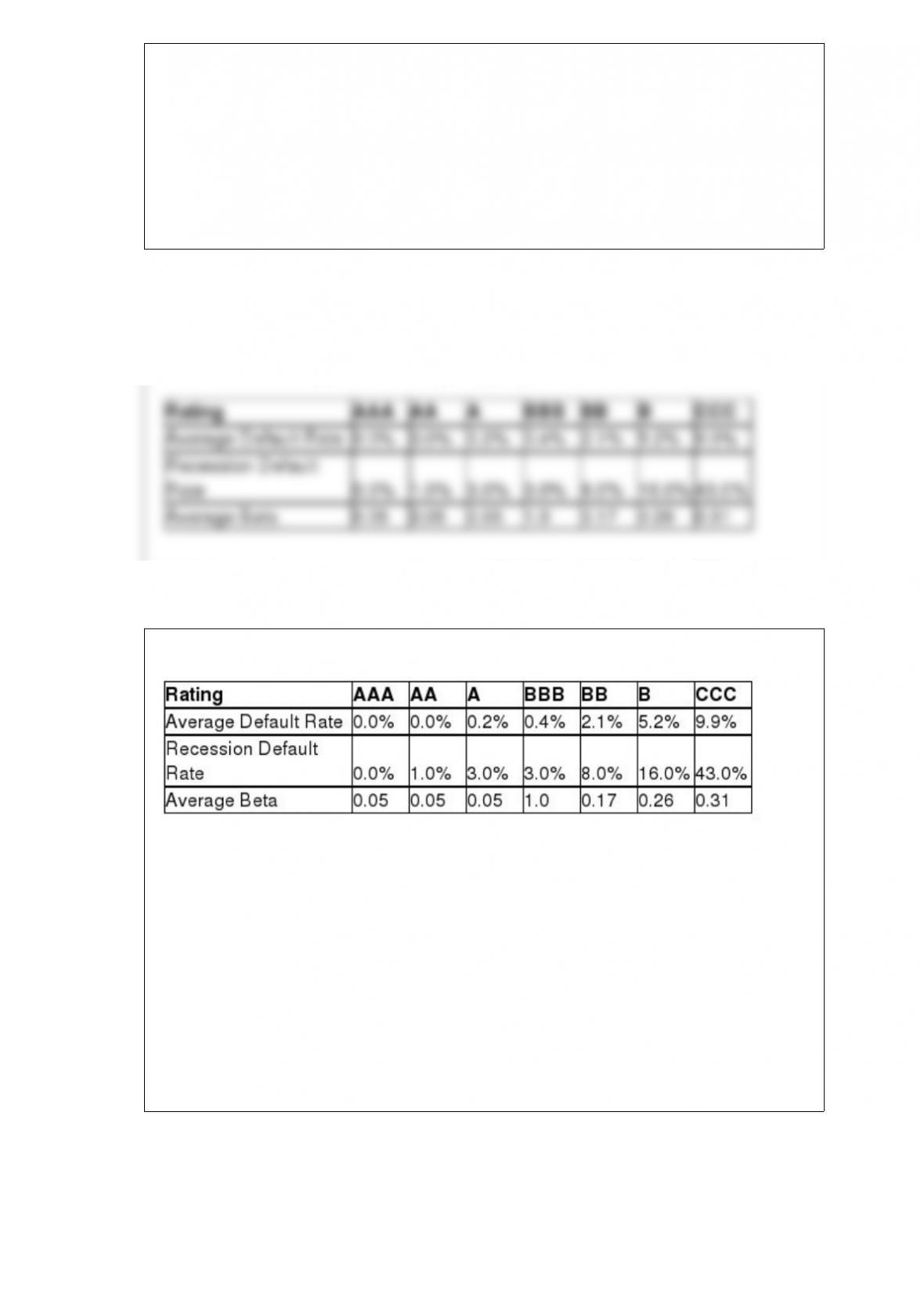
Consider the following information regarding corporate bonds:
Galt Industries has a market capitalization of $50 billion, $30 billion in BBB rated debt,
and $8 billion in cash. If Galt’s equity beta is 1.15, then Galt’s underlying asset beta is
closest to:
A) 0.84
B) 0.92
C) 1.00
D) 1.15
Answer:

Use the following information to answer the question(s) below.
Galt Motors currently produces 500,000 electric motors a year and expects output levels
to remain steady in the future. It buys armatures from an outside supplier at a price of
$2.50 each. The plant manager believes that it would be cheaper to make these
armatures rather than buy them. Direct in-house production costs are estimated to be
only $1.80 per armature. The necessary machinery would cost $700,000 and would be
obsolete in 10 years. This investment would be depreciated to zero for tax purposes
using a 10-year straight line depreciation. The plant manager estimates that the
operation would require additional working capital of $40,000 but argues that this sum
can be ignored since it is recoverable at the end of the ten years. The expected proceeds
from scrapping the machinery after 10 years are estimated to be $10,000. Galt Motors
pays tax at a rate of 35% and has an opportunity cost of capital of 14%.
The incremental cash flow that Galt Motors will incur in year 4 if they elect to
manufacture armatures in house is closest to:
A) 25,000
B) 350,000
C) 375,000
D) 1,250,000
Answer:
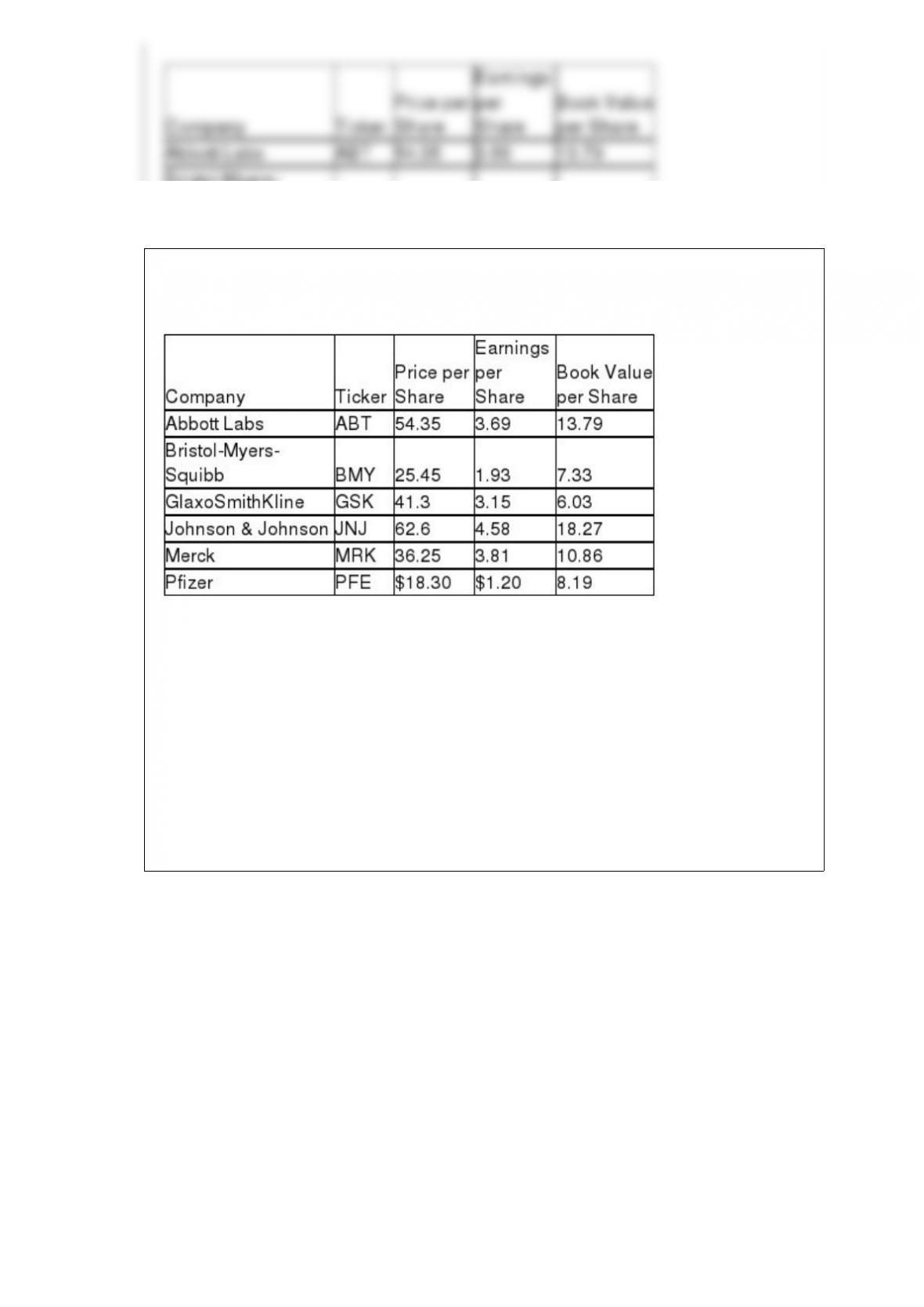
Use the following information to answer the question(s) below.
Assuming that Novartis AG (NVS) has an EPS of $3.35, based upon the average
price-to-book ratio for its competitors, Novartis’ stock price is closest to:
A) $13.00
B) $22.95
C) $39.70
D) $44.35
Answer:

Use the following information to answer the question(s) below.
Galt Motors currently produces 500,000 electric motors a year and expects output levels
to remain steady in the future. It buys armatures from an outside supplier at a price of
$2.50 each. The plant manager believes that it would be cheaper to make these
armatures rather than buy them. Direct in-house production costs are estimated to be
only $1.80 per armature. The necessary machinery would cost $700,000 and would be
obsolete in 10 years. This investment would be depreciated to zero for tax purposes
using a 10-year straight line depreciation. The plant manager estimates that the
operation would require additional working capital of $40,000 but argues that this sum
can be ignored since it is recoverable at the end of the ten years. The expected proceeds
from scrapping the machinery after 10 years are estimated to be $10,000. Galt Motors
pays tax at a rate of 35% and has an opportunity cost of capital of 14%.
The NPV for Galt Motors of manufacturing the armatures in house is closest to:
A) 1,095,000
B) 1,215,000
C) 1,225,000
D) 1,250,000
Answer:

Use the information for the question(s) below.
Consider a project with free cash flows in one year of $90,000 in a weak economy or
$117,000 in a strong economy, with each outcome being equally likely. The initial
investment required for the project is $80,000, and the project’s cost of capital is 15%.
The risk-free interest rate is 5%.
Suppose that to raise the funds for the initial investment the firm borrows $40,000 at the
risk free rate and issues new equity to cover the remainder. In this situation, the cash
flow that equity holders will receive in one year in a strong economy is closest to:
A) $117,000
B) $75,000
C) $50,000
D) $0
Answer:
Your firm is planning to invest in a new power generation system. Galt Industries is an

all equity firm that specializes in this business. Suppose Galt’s equity beta is 0.75, the
risk-free rate is 3%, and the market risk premium is 6%. If your firm’s project is all
equity financed, then your estimate of your cost of capital is closest to:
A) 5.25%
B) 6.00%
C) 6.75%
D) 7.50%
Answer:
Consider the following formula:
The term represents
A) the reduction due to the interest tax shield.
B) the present value of the interest tax shield.
C) the preset value of the future interest payments.
D) the interest tax shield each year.
Answer:

Which of the following formulas is incorrect?
A) Divt = x Dividend Payout Rate
B) PN =
C) earnings growth rate = retention rate x return on new investment
D) P0 = + + … + + x
Answer:
Use the following information to answer the question(s) below.
Wyatt Oil issued $100 million in perpetual debt (at par) with an annual coupon of 7%.
Wyatt will pay interest only on this debt. Wyatt’s marginal tax rate is expected to be
40% for the foreseeable future.
Assuming its risk is the same as the loan, the present value of Wyatt’s annual interest
tax shield is closest to:
A) $4.2 million
B) $7.0 million
C) $40 million
D) $60 million

Answer:
Which of the following statements is false?
A) If two stocks move in opposite directions, one will tend to be above average when to
other is below average, and the covariance will be negative.
B) The correlation between two stocks has the same sign as their covariance, so it has a
similar interpretation.
C) The covariance of a stock with itself is simply its variance.
D) The covariance allows us to gauge the strength of the relationship between stocks.
Answer:
Which of the following statements regarding annuities is false?

A) PV of an annuity = C x
B) The difference between an annuity and a perpetuity is that a perpetuity ends after
some fixed number of payments.
C) An annuity is a stream of N equal cash flows paid at regular intervals.
D) Most car loans, mortgages, and some bonds are annuities.
Answer:
Which of the following statements is false?
A) The interest rates that banks offer on investments or charge on loans depends on the
horizon of the investment or loan.
B) The Federal Reserve determines very short-term interest rates through its influence
on the federal funds rate.
C) The interest rates that are quoted by banks and other financial institutions are
nominal interest rates.
D) Fundamentally, interest rates are determined by the Federal Reserve.
Answer:
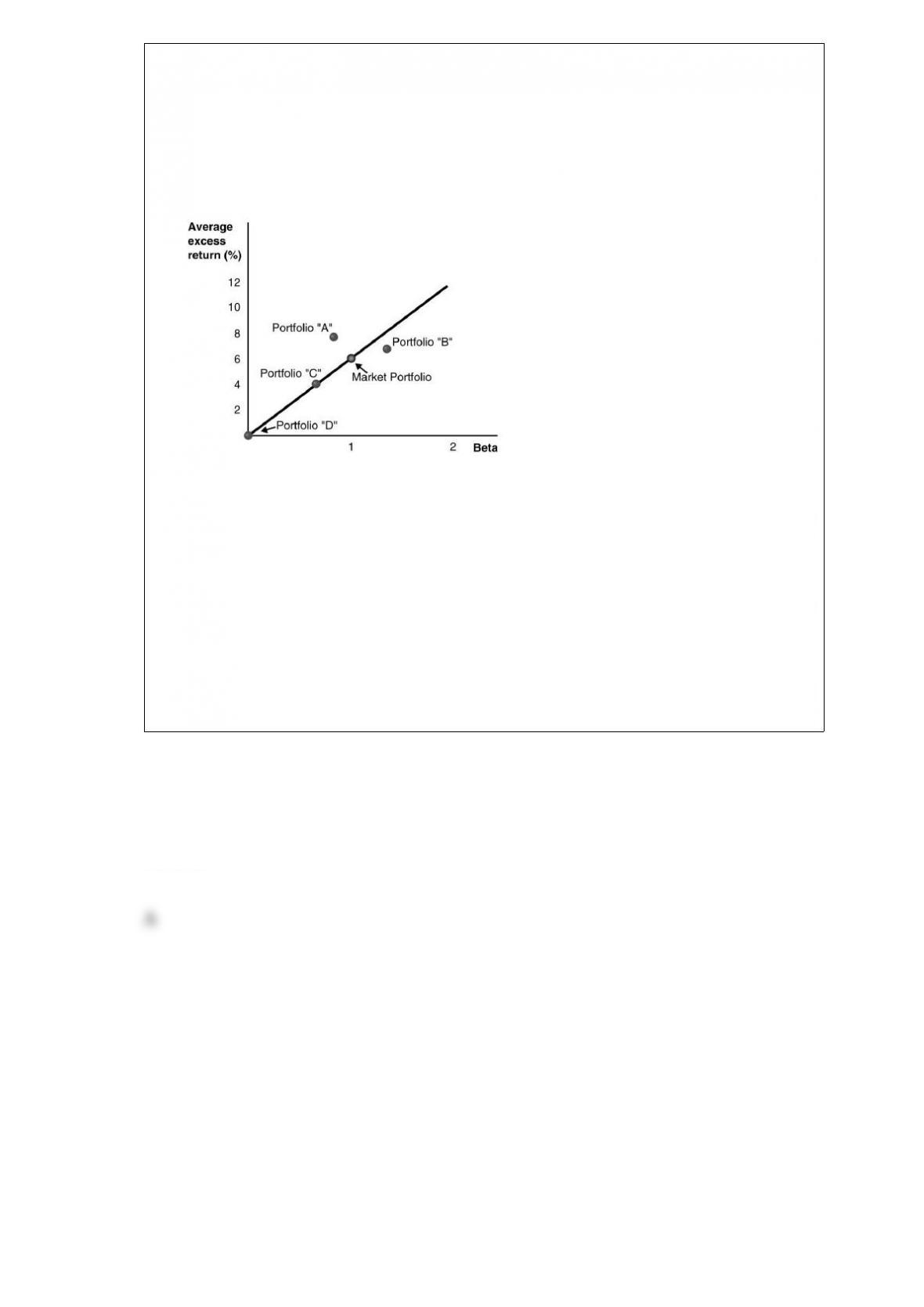
Use the figure for the question(s) below.
Consider the following graph of the security market line:
Portfolio “C”
A) is less risky than the market portfolio.
B) has a relatively lower expected return than predicted.
C) is underpriced.
D) has a negative alpha.
Answer: