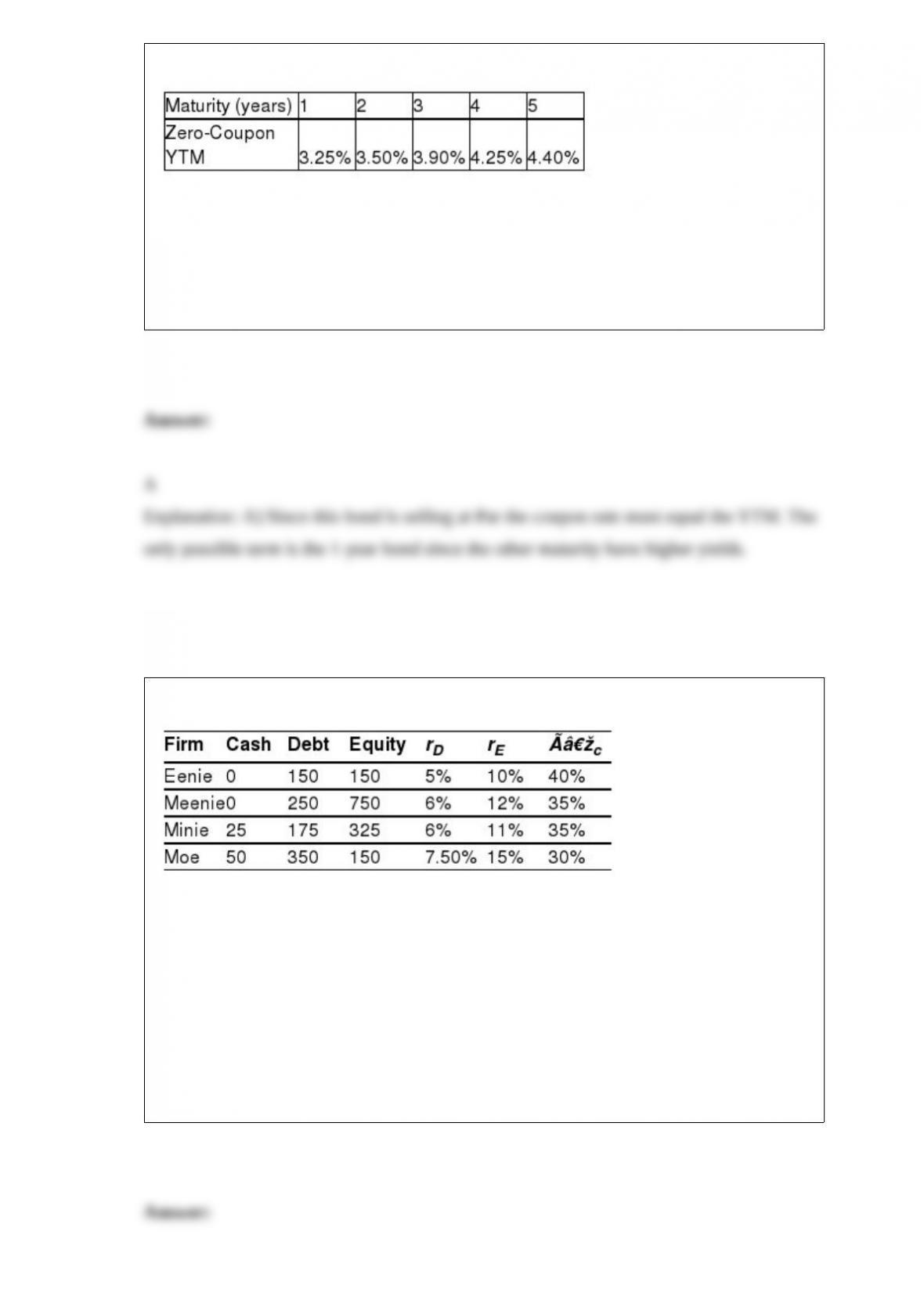
A default-free security has an annual coupon rate of 3.25% and sells for par. This bond
will mature in:
A) 1 year
B) 2 years
C) 3 years
D) 4 years
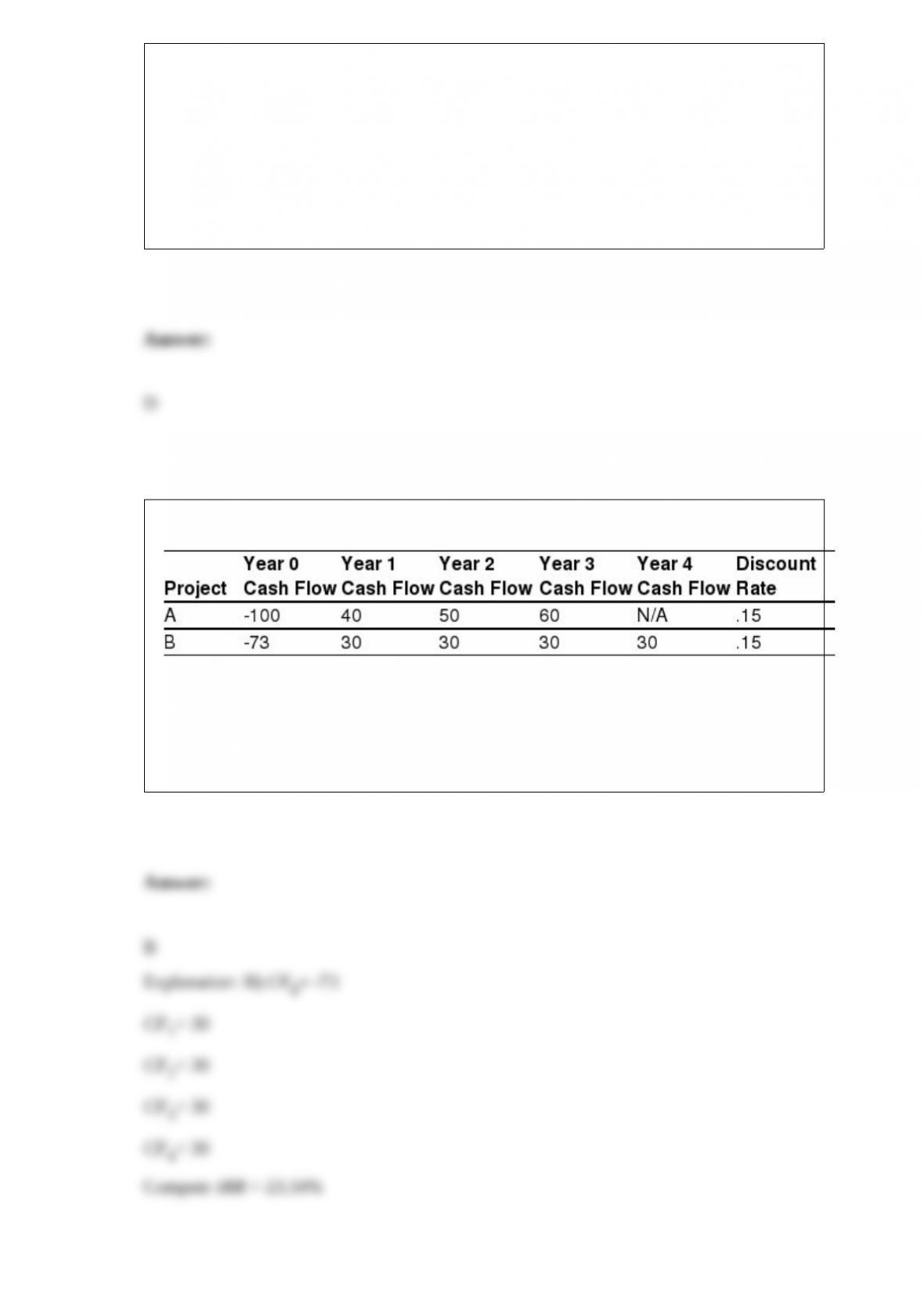
The weighted average cost of capital for “Minie” is closest to:
A) 9.50%
B) 8.75%
C) 6.75%
D) 8.25%

Which of the following statements is FALSE?
A) Personal taxes have the potential to offset some of the corporate tax benefits of
leverage.
B) The actual interest tax shield depends on the reduction in the total taxes (both
corporate and personal) that are paid.
C) The amount of money an investor will pay for a security ultimately depends on the
benefits the investor will receive’”namely, the cash flows the investor will receive
before all taxes have been paid.
D) Just like corporate taxes, personal taxes reduce the cash flows to investors and
diminish firm value.

Consider the following formula:
rwacc= rE+ rD– rDÏ„c
The term rDÏ„c represents:
A) the reduction due to the interest tax shield.
B) the present value of the interest tax shield.
C) the preset value of the future interest payments.
D) the interest tax shield each year.
In November 2009, Perrigo Co. (PRGO) had a share price of $39.20. They had 91.33
million shares outstanding, a market-to-book ratio of 3.76. In addition, PRGO had
$845.01 million in outstanding debt, $163.82 million in net income, and cash of
$257.09 million.
Perrigo’s market debt to equity ratio is closest to:
A) 0.24
B) 0.50
C) 0.75
D) 0.89
Which of the following methods are used in capital budgeting decisions?
A) WACC method
B) APV method
C) FTE method
D) All of the above are used in capital budgeting decisions.
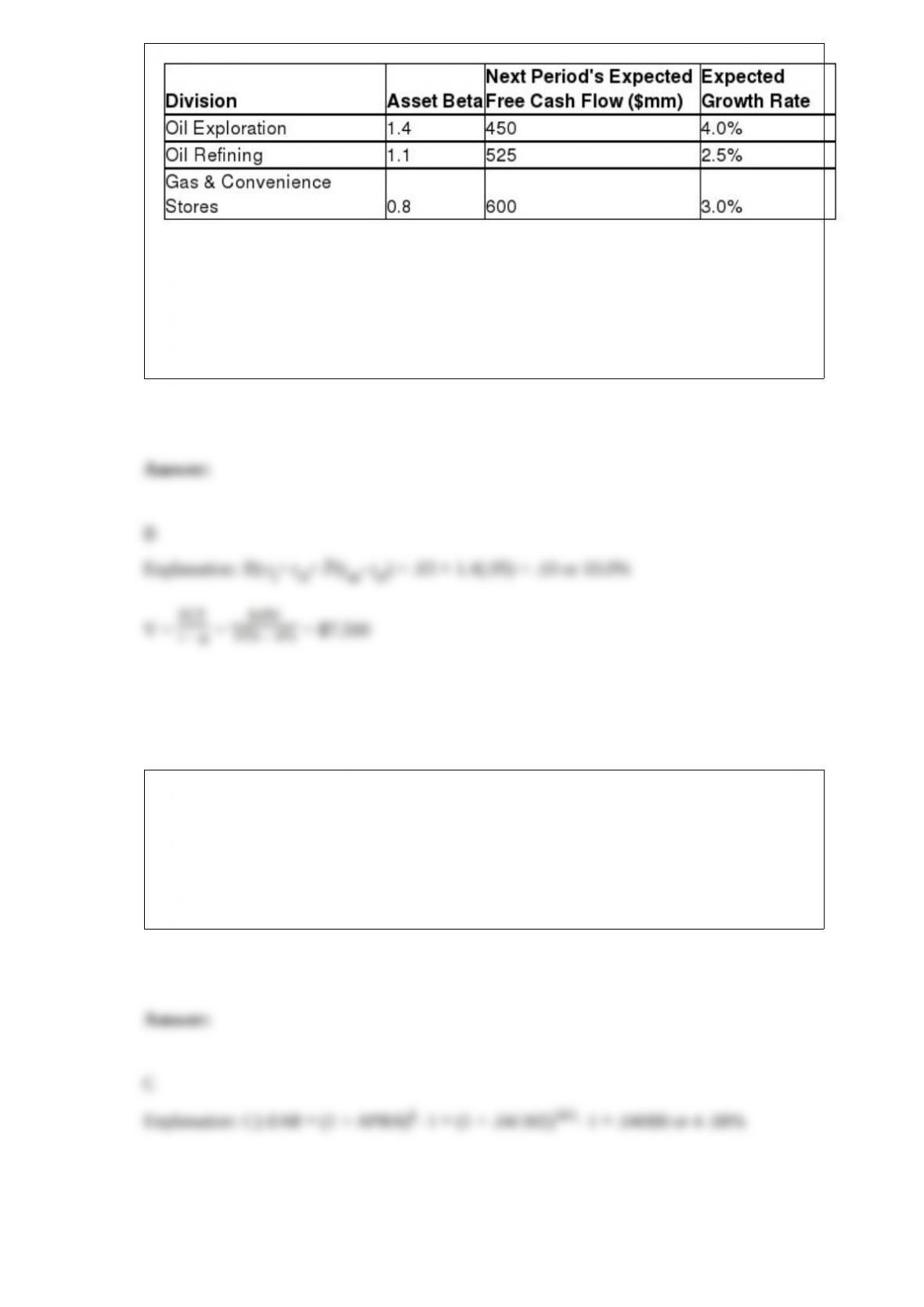
Consider the following two projects:
The internal rate of return (IRR) for project B is closest to:
A) 21.6%
B) 23.3%
C) 42.9%
D) 7.7%

The following table summarizes prices of various default-free zero-coupon bonds
(expressed as a percentage of face value):
The yield to maturity for the three year zero-coupon bond is closest to:
A) 5.4%
B) 5.8%
C) 5.6%
D) 6.0%
Consider the following equation:
Dt = d ×
the term Dt in this equation is:
A) the firms target debt to value ratio.
B) the firms target debt to equity ratio.
C) the investment’s debt capacity.
D) the dollar amount of debt outstanding at time t.

Galt Motors currently produces 500,000 electric motors a year and expects output levels
to remain steady in the future. It buys armatures from an outside supplier at a price of
$2.50 each. The plant manager believes that it would be cheaper to make these
armatures rather than buy them. Direct in-house production costs are estimated to be
only $1.80 per armature. The necessary machinery would cost $700,000 and would be
obsolete in 10 years. This investment would be depreciated to zero for tax purposes
using a 10-year straight line depreciation. The plant manager estimates that the
operation would require additional working capital of $40,000 but argues that this sum
can be ignored since it is recoverable at the end of the ten years. The expected proceeds
from scrapping the machinery after 10 years are estimated to be $10,000. Galt Motors
pays tax at a rate of 35% and has an opportunity cost of capital of 14%.
The NPV for Galt Motors of manufacturing the armatures in house is closest to:
A) 1,095,000
B) 1,215,000
C) 1,225,000
D) 1,250,000
The Principal-Agent Problem arises:
A) because managers have little incentive to work in the interest of shareholders when
this means working against their own self-interest.
B) because of the separation of ownership and control in a corporation.
C) Both A and B
D) None of the above

Which of the following statements is FALSE?
A) With no debt, the WACC is equal to the unlevered equity cost of capital.
B) With perfect capital markets, a firm’s WACC is dependent of its capital structure and
is equal to its equity cost of capital only the firm it is unlevered.
C) As the firm borrows at the low cost of capital for debt, its equity cost of capital rises,
but the net effect is that the firm’s WACC is unchanged.
D) Although debt has a lower cost of capital than equity, leverage does not lower a
firm’s WACC.
Which of the following formulas is incorrect?
A) Yield to maturity for an n-period zero-coupon bond =
B) Price of an n-period bond = + + … +
C) Price of an n-period bond = Coupon × +
D) Coupon =
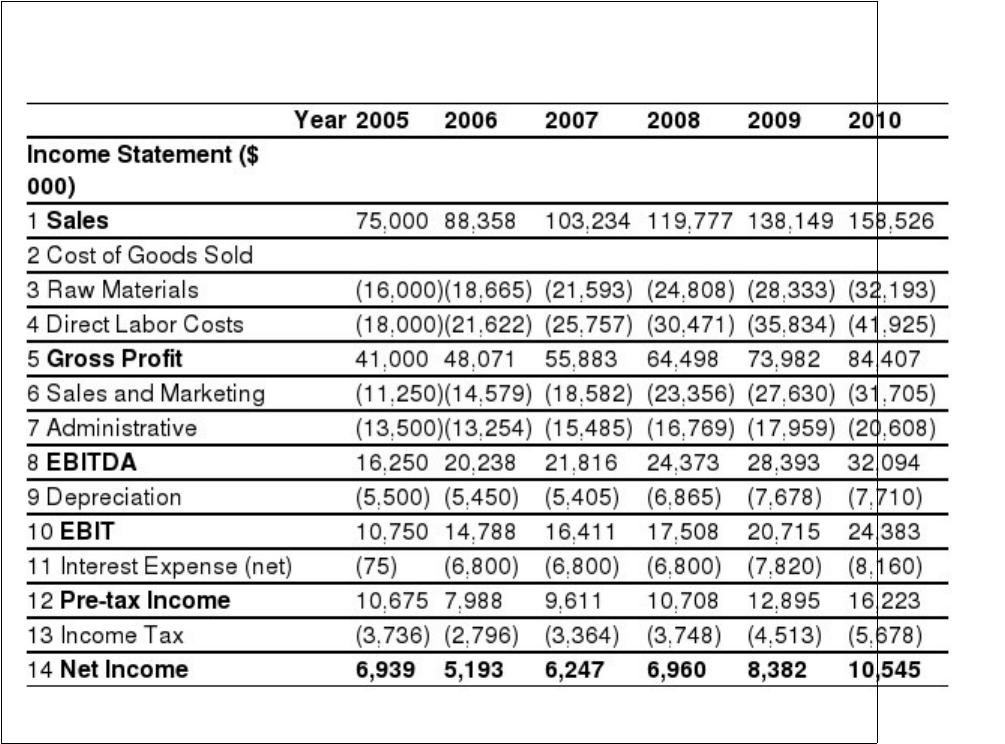
The risk-free rate of interest is 3% and the market risk premium is 5%.
The value of the oil exploration division is closest to:
A) $4,500
B) $7,500
C) $8,750
D) $10,000
The effective annual rate (EAR) for a savings account with a stated APR of 4%
compounded daily (use 365 day year) is closest to:
A) 3.92%
B) 4.00%
C) 4.08%
D) 14.60%

If investors have relative wealth concerns, they care most about:
A) the return on their portfolio relative to their overall current wealth.
B) the performance of their portfolio relative to that of their peers.
C) their current portfolio performance relative to their past portfolio performance.
D) the performance of their current wealth relative to their past wealth.
The owner of the Krusty Krab is considering selling his restaurant and retiring. An
investor has offered to buy the Krusty Krab for $350,000 whenever the owner is ready
for retirement. The owner is considering the following three alternatives:
1. Sell the restaurant now and retire.
2. Hire someone to manage the restaurant for the next year and retire. This will require
the owner to spend $50,000 now, but will generate $100,000 in profit next year. In one
year the owner will sell the restaurant.
3. Scale back the restaurant’s hours and ease into retirement over the next year. This will
require the owner to spend $40,000 on expenses now, but will generate $75,000 in
profit at the end of the year. In one year the owner will sell the restaurant.
If the discount rate is 15%, the alternative with the highest NPV is:
A) #1 with an NPV of approximately $350,000
B) #2 with an NPV of approximately $341,300
C) #3 with an NPV of approximately $329,570
D) #2 with an NPV of approximately $400,000
E) None of the above
Pro Forma Income Statement for Ideko, 2005-2010
Pro Forma Balance Sheet for Ideko, 2005-2010
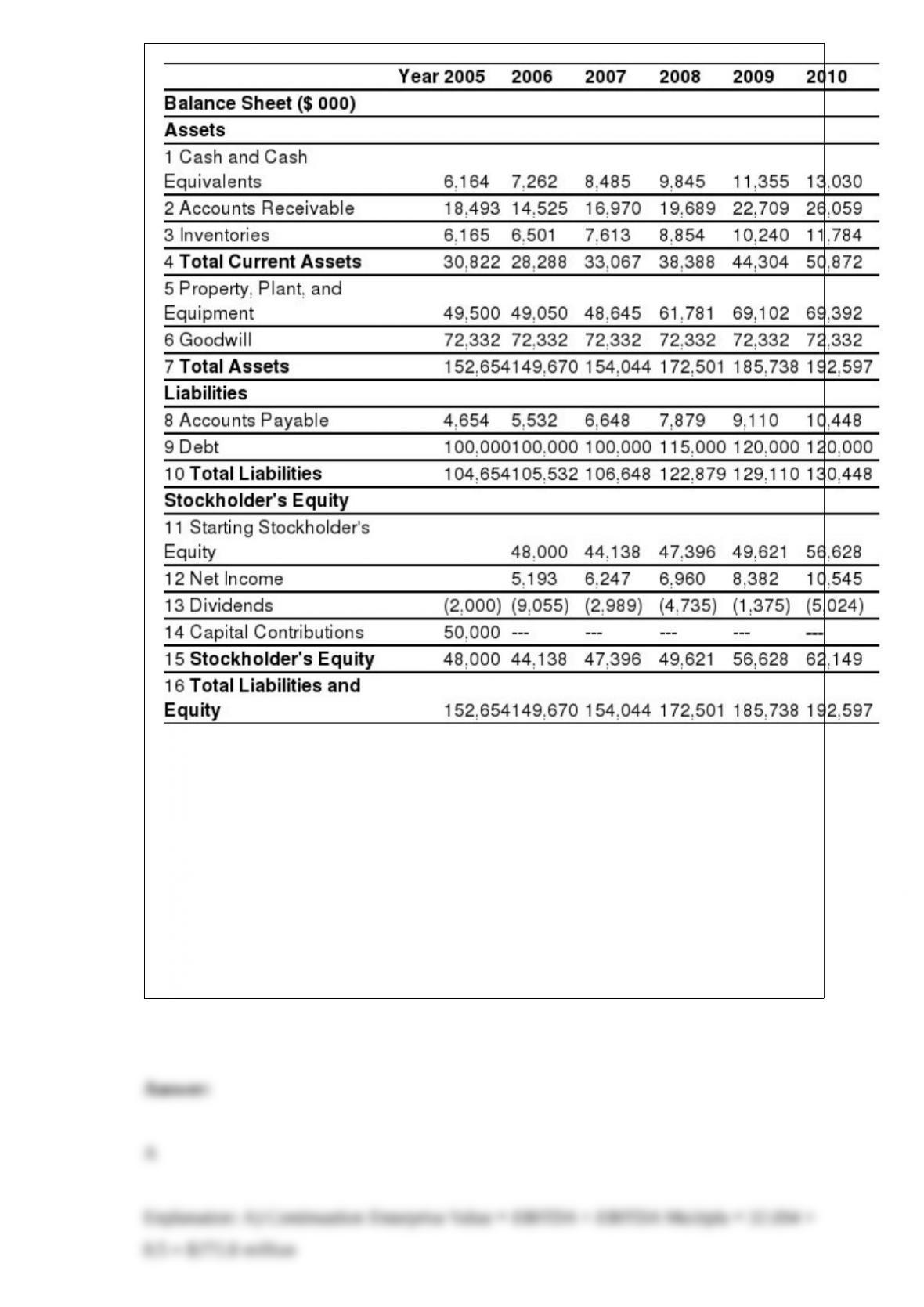
Assuming that Ideko has a EBITDA multiple of 8.5, then the continuation unlevered
P/E ratio of Ideko in 2010 is closest to:
A) 17.6
B) 16.4
C) 14.5
D) 19.0