
On which one of the following dates is the principal amount of a bond repaid?
A. Coupon date
B. Issue date
C. Discount date
D. Maturity date
E. Face date
Answer:
A project has annual depreciation of $16,200, costs of $87,100, and sales of $123,000.
The applicable tax rate is 40 percent. What is the operating cash flow according to the
tax shield approach?
A. $21,540
B. $27,667
C. $27,458
D. $28,020
E. $29,878
Answer:
You are planning an extended trip to Hong Kong. You have located some housing that
you can lease for 11,250 Hong Kong dollars per month. What is the cost per month in
U.S. dollars if the exchange rate is HK$1 = $0.1290?
A. $1,208.15
B. $1,451.25
C. $78,311.27
D. $81,395.35
E. $87,209.30
Answer:
Dividends are best defined as:
A. cash payments to shareholders.
B. cash payments to either bondholders or shareholders.
C. cash or stock payments to shareholders.
D. cash or stock payments to either bondholders or shareholders.
E. distributions of stock to current shareholders.
Answer:
Gulf Coast Tours currently has a weighted average cost of capital of 11.3 percent based
on a combination of debt and equity financing. The firm has no preferred stock. The
current debt-equity ratio is 0.58 and the aftertax cost of debt is 6.4 percent. The
company just hired a new president who is considering eliminating all debt financing.
All else constant, what will the firm’s cost of capital be if the firm switches to an
all-equity firm?
A. 10.45 percent
B. 12.62 percent
C. 12.89 percent
D. 13.37 percent
E. 14.32 percent
Answer:
Radio Shack offers credit to its customers and charges interest of 1.2 percent per month.
What is the annual percentage rate?
A. 14.40 percent
B. 14.61 percent
C. 15.10 percent
D. 15.31 percent
E. 15.53 percent
Answer:
Travis recently purchased a callable bond. However, that bond cannot be currently
redeemed by the issuer. Thus, the bond must currently be:
A. subject to a sinking fund provision.
B. a debenture.
C. a “fallen angel.”
D. call protected.
E. unrated.
Answer:

Which one of the following is most likely the fastest method of collecting cash?
A. Requiring customers to submit all payments to a lockbox
B. Requiring customers to submit all payments to the home office
C. Initiating a financial electronic data interchange at the time of sale
D. Offer customers credit terms of 1/5, net 15
E. Eliminating all disbursement float
Answer:
Which of the following costs will tend to increase if a firm switches to a restrictive
short-term financial policy from a flexible short-term policy?
I. lost sales due to out-of-stock items
II. inventory warehousing costs
III. cash-outs
IV. total annual order costs
A. I and III only
B. II and IV only
C. I, III, and IV only
D. I, II, and IV only
E. I, II, III, and IV

Answer:
The Bethlehem Inn is an all-equity firm with 18,000 shares outstanding at a value per
share of $14.50. The firm is issuing $50,000 of debt and using the proceeds to reduce
the number of outstanding shares. How many shares of stock will be outstanding once
the debt is issued? Ignore taxes.
A. 11,970 shares
B. 14,552 shares
C. 14,846 shares
D. 15,030 shares
E. 15,561 shares
Answer:
Daniel’s Market has sales of $36,600, costs of $28,400, depreciation expense of $3,100,
and interest expense of $1,500. If the tax rate is 34 percent, what is the operating cash
flow, OCF?
A. $4,811
B. $5,279
C. $6,466
D. $6,976
E. $7,013
Answer:
Which one of the following must equal zero if a firm pays a constant annual dividend?
A. Dividend yield
B. Capital gains yield
C. Total return
D. Market value per share
E. Book value per share
Answer:

Which one of the following is a use of cash?
A. Selling inventory at cost
B. Paying a supplier for inventory you purchased last month
C. Borrowing money from a local bank
D. Collecting payment from a customer
E. Selling a fixed asset such as a piece of machinery
Answer:
What percentage of capital gains are excluded from taxation for corporate shareholders?
A. 0 percent
B. 10 percent
C. 25 percent
D. 70 percent
E. 75 percent
Answer:
The Braxton Co. has beginning long-term debt of $64,500, which is the principal
balance of a loan payable to Centre Bank. During the year, the company paid a total of
$16,300 to the bank, including $4,100 of interest. The company also borrowed $11,000.
What is the value of the ending long-term debt?
A. $45,100
B. $53,300
C. $58,200
D. $63,300
E. $85,900
Answer:
Which one of the following statements is correct when a firm faces hard rationing?
A. All positive net present value projects will be accepted.
B. Each division within a firm will be allocated an amount for capital expenditures that
will be less than the total value of its positive net present value projects.
C. The firm does not have funds to finance any new projects.
D. The firm will fund only those projects that create value for its shareholders.
E. The firm will finance only the projects that have the highest profitability index
values.
Answer:
A stock has paid dividends of $1.80, $1.85, $2.00, $2.20, and $2.25 over the past five
years, respectively. What is the average capital gains yield?
A. 2.80 percent
B. 3.24 percent
C. 4.45 percent
D. 5.34 percent
E. 5.79 percent
Answer:
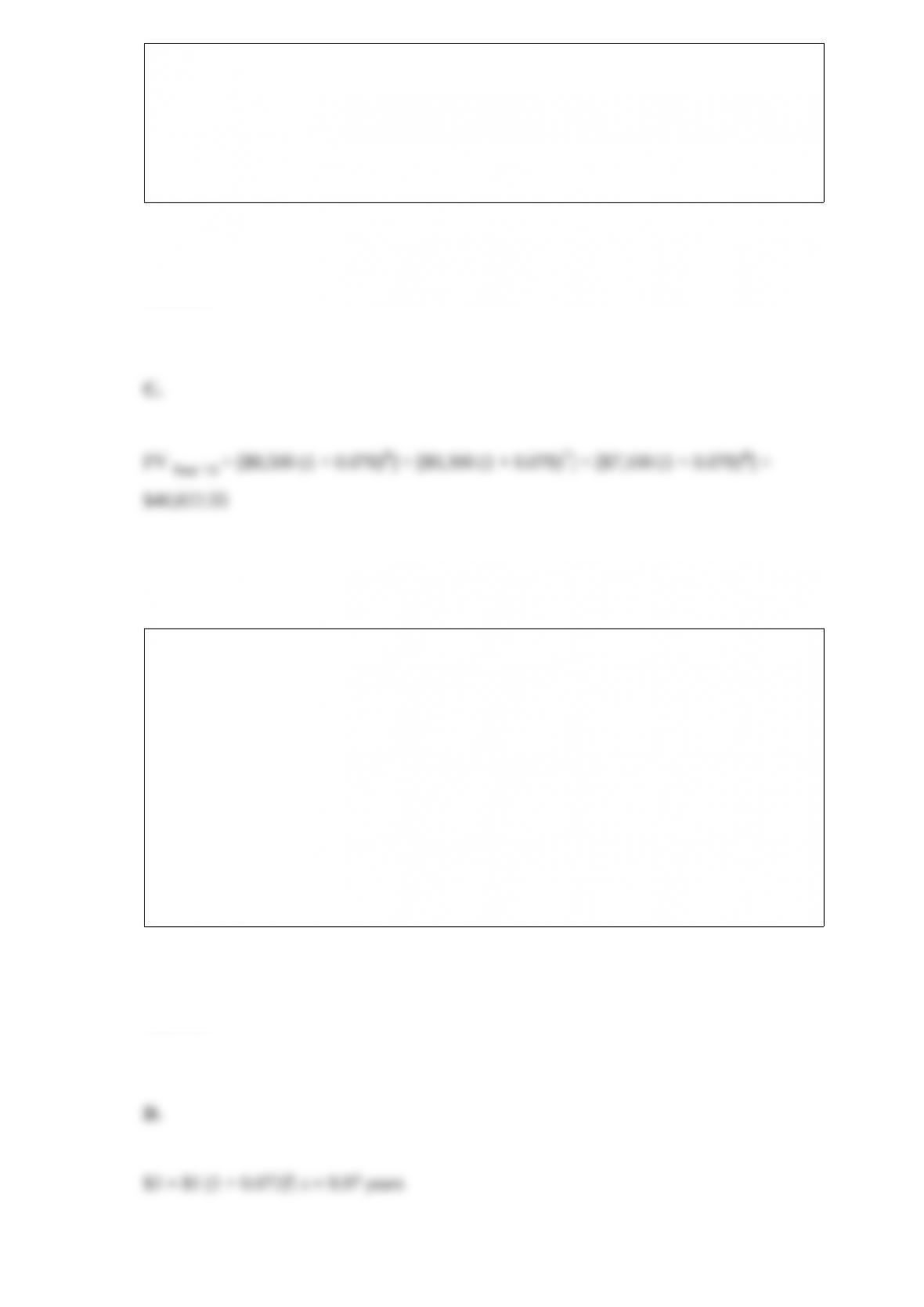
If today is year 0, what is the future value of the following cash flows 10 years from
now? Assume an interest rate of 7.8 percent per year.
A. $35,211.57
B. $37,235.16
C. $40,822.55
D. $42,321.68
E. $44,564.54
Answer:
How long will it take to double your savings if you earn 7.2 percent interest,
compounded annually?
A. 8.89 years
B. 9.02 years
C. 9.34 years
D. 9.97 years
E. 11 years
Answer:
Which one of the following is a correct statement, all else held constant?
A. The present value is inversely related to the future value.
B. The future value is inversely related to the period of time.
C. The period of time is directly related to the interest rate.
D. The present value is directly related to the interest rate.
Answer:
The static theory of capital structure assumes a firm:
A. maintains a constant debt-equity ratio.
B. has an all-equity structure.
C. is fixed in terms of its assets.
D. pays no taxes.
E. is operating at the point where financial distress costs are eliminated.
Answer:
A bond for which no specific property has been pledged as security is classified as a:
A. bearer bond.
B. trust deed bond.
C. registered bond.
D. debenture.
E. sinking fund bond.
Answer:
Letitia borrowed $6,000 from her bank two years ago. The loan term is four years. Each
year, she must repay the bank $1,500 plus the annual interest. Which type of loan does
she have?
A. Amortized
B. Blended discount
C. Interest-only
D. Pure discount
E. Complex
Answer:
The Tool Box needs to purchase a new machine costing $1.46 million. Management is
estimating the machine will generate cash inflows of $223,000 the first year and
$600,000 for the following three years. If management requires a minimum 12 percent
rate of return, should the firm purchase this particular machine? Why or why not?
A. Yes, because the IRR is 10.75 percent
B. Yes, because the IRR is 12.74 percent
C. No, because the IRR is 10.75 percent
D. No, because the IRR is 12.74 percent
E. The answer cannot be determined as there are multiple IRRs
Answer:
Discounted cash flow valuation is the process of discounting an investment’s:
A. assets.
B. future profits.
C. liabilities.
D. costs.
E. future cash flows.
Answer: