
1) A 15-year bond has an annual coupon rate of 8%. The coupon rate will remain fixed
until the bond matures. The bond has a yield to maturity of 6%. Which of the following
statements is CORRECT?
a.The bond is currently selling at a price below its par value
b.If market interest rates remain unchanged, the bond’s price one year from now will be
lower than it is today
c.The bond should currently be selling at its par value
d.If market interest rates remain unchanged, the bond’s price one year from now will be
higher than it is today
e.If market interest rates decline, the price of the bond will also decline
2) Kiley Corporation had the following data for the most recent year (in millions). The
new CFO believes (1) that an improved inventory management system could lower the
average inventory by $4,000, (2) that improvements in the credit department could
reduce receivables by $2,000, and (3) that the purchasing department could negotiate
better credit terms and thereby increase accounts payable by $2,000. Furthermore, she
thinks that these changes would not affect either sales or the costs of goods sold. If
these changes were made, by how many days would the cash conversion cycle be
lowered?
OriginalRevised
Annual sales: unchanged$110,000$110,000
Cost of goods sold: unchanged$80,000$80,000
Average inventory: lowered by $4,000$20,000$16,000
Average receivables: lowered by $2,000$16,000$14,000
Average payables: increased by $2,000$10,000$12,000
Days in year365365
a.34.0
b.37.4
c.41.2
d.45.3
e.49.8

3) Which of the following statements is CORRECT?
a.As the stock’s price rises, the time value portion of an option on a stock increases
because the difference between the price of the stock and the fixed strike price increases
b.Issuing options provides companies with a low cost method of raising capital
c.The market value of an option depends in part on the option’s time to maturity and
also on the variability of the underlying stock’s price
d.The potential loss on an option decreases as the option sells at higher and higher
prices because the profit margin gets bigger
e.An option’s value is determined by its exercise value, which is the market price of the
stock less its striking price. Thus, an option can’t sell for more than its exercise value
4) Suppose 6 months ago a Swiss investor bought a 6-month U.S. Treasury bill at a
price of $9,708.74, with a maturity value of $10,000. The exchange rate at that time was
1.420 Swiss francs per dollar. Today, at maturity, the exchange rate is 1.324 Swiss
francs per dollar. What is the annualized rate of return to the Swiss investor?
a.-7.92%
b.-4.13%
c.6.00%
d.8.25%
e.12.00%

5) Famous Farm’s payables deferral period (PDP) is 50 days (on a 365-day basis),
accounts payable are $100 million, and its balance sheet shows inventory of $125
million. What is the inventory turnover ratio?
a.4.73
b.5.26
c.5.84
d.6.42
e.7.07
6) Which of the following statements is CORRECT?
a.All corporations other than non-profit corporations are subject to corporate income
taxes, which are 15% for the lowest amounts of income and 35% for the highest
amounts of income
b.The income of certain small corporations that qualify under the Tax Code is
completely exempt from corporate income taxes. Thus, the federal government receives
no tax revenue from these businesses
c.All businesses, regardless of their legal form of organization, are taxed under the
Business Tax Provisions of the Internal Revenue Code
d.Small businesses that qualify under the Tax Code can elect not to pay corporate taxes,
but then their owners must report their pro rata shares of the firm’s income as personal
income and pay taxes on that income
e.Congress recently changed the tax laws to make dividend income received by
individuals exempt from income taxes. Prior to the enactment of that law, corporate
income was subject to double taxation, where the firm was first taxed on the income
and stockholders were taxed again on the income when it was paid to them as dividends
7) Which of the following statements is CORRECT?
a.Under current laws and regulations, corporations must use straight-line depreciation
for all assets whose lives are 5 years or longer
b.Corporations must use the same depreciation method (e.g., straight line or
accelerated) for stockholder reporting and tax purposes

c.Since depreciation is not a cash expense, it has no effect on cash flows and thus no
effect on capital budgeting decisions
d.Under accelerated depreciation, higher depreciation charges occur in the early years,
and this reduces the early cash flows and thus lowers a project’s projected NPV
e.Using accelerated depreciation rather than straight line would normally have no effect
on a project’s total projected cash flows but it would affect the timing of the cash flows
and thus the NPV
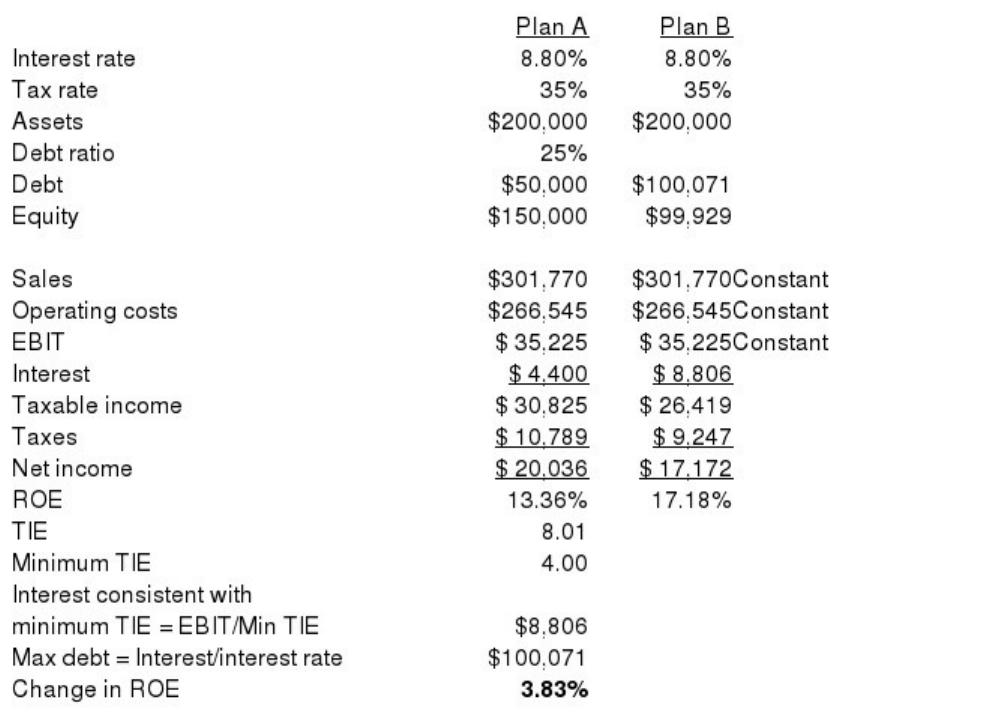
8) For the coming year, Crane Inc. is considering two financial plans. Management
expects sales to be $301,770, operating costs to be $266,545, assets to be $200,000, and
its tax rate to be 35%. Under Plan A it would use 25% debt and 75% common equity.
The interest rate on the debt would be 8.8%, but the TIE ratio would have to be kept at
4.00 or more. Under Plan B the maximum debt that met the TIE constraint would be
employed. Assuming that sales, operating costs, assets, the interest rate, and the tax rate
would all remain constant, by how much would the ROE change in response to the
change in the capital structure?
a. 3.83%
b. 4.02%
c. 4.22%
d. 4.43%
e. 4.65%
9) Swinnerton Clothing Company’s balance sheet showed total current assets of $2,250,
all of which were required in operations. Its current liabilities consisted of $575 of
accounts payable, $300 of 6% short-term notes payable to the bank, and $145 of
accrued wages and taxes. What was its net operating working capital that was financed
by investors?
a.$1,454
b.$1,530
c.$1,607
d.$1,687
e.$1,771

10) Which of the following statements is CORRECT?
a. If a firm increases its sales while holding its accounts receivable constant, then, other
things held constant, its days’ sales outstanding will decline
b. If a security analyst saw that a firm’s days’ sales outstanding (DSO) was higher than
the industry average and was also increasing and trending still higher, this would be
interpreted as a sign of strength
c. If a firm increases its sales while holding its accounts receivable constant, then, other
things held constant, its days’ sales outstanding (DSO) will increase
d. There is no relationship between the days’ sales outstanding (DSO) and the average
collection period (ACP). These ratios measure entirely different things
e. A reduction in accounts receivable would have no effect on the current ratio, but it
would lead to an increase in the quick ratio
11) The WACC for two mutually exclusive projects that are being considered is 12%.
Project K has an IRR of 20% while Project R’s IRR is 15%. The projects have the same
NPV at the 12% current WACC. Interest rates are currently high. However, you believe
that money costs and thus your WACC will soon decline. You also think that the
projects will not be funded until the WACC has decreased, and their cash flows will not
be affected by the change in economic conditions. Under these conditions, which of the
following statements is CORRECT?
a.You should delay a decision until you have more information on the projects, even if
this means that a competitor might come in and capture this market
b.You should recommend Project R, because at the new WACC it will have the higher
NPV
c.You should recommend Project K, because at the new WACC it will have the higher
NPV
d.You should recommend Project R because it will have both a higher IRR and a higher
NPV under the new conditions
e.You should reject both projects because they will both have negative NPVs under the

new conditions
12) Assume that the risk-free rate is 5%. Which of the following statements is
CORRECT?
a.If a stock’s beta doubled, its required return under the CAPM would also double
b.If a stock’s beta doubled, its required return under the CAPM would more than double
c.If a stock’s beta were 1.0, its required return under the CAPM would be 5%
d.If a stock’s beta were less than 1.0, its required return under the CAPM would be less
than 5%
e.If a stock has a negative beta, its required return under the CAPM would be less than
5%
13) JBS Inc. recently reported net income of $4,750 and depreciation of $885. How
much was its net cash flow, assuming it had no amortization expense and sold none of
its fixed assets?
a.$4,831.31
b.$5,085.59
c.$5,353.25
d.$5,635.00
e.$5,916.75
14) Which of the following statements is CORRECT? Assume a company’s target
capital structure is 50% debt and 50% common equity.
a.The WACC is calculated on a before-tax basis
b.The WACC exceeds the cost of equity
c.The cost of equity is always equal to or greater than the cost of debt
d.The cost of reinvested earnings typically exceeds the cost of new common stock
e.The interest rate used to calculate the WACC is the average after-tax cost of all the
company’s outstanding debt as shown on its balance sheet
15) Kellner Motor Co.’s stock has a required rate of return of 11.50%, and it sells for
$25.00 per share. Kellner’s dividend is expected to grow at a constant rate of 7.00%.
What was the last dividend, D0?
a.$0.95
b.$1.05
c.$1.16
d.$1.27
e.$1.40
16) Portfolio AB was created by investing in a combination of Stocks A and B. Stock A
has a beta of 1.2 and a standard deviation of 25%. Stock B has a beta of 1.4 and a
standard deviation of 20%. Portfolio AB has a beta of 1.25 and a standard deviation of
18%. Which of the following statements is CORRECT?
a.Stock A has more market risk than Stock B but less stand-alone risk
b.Portfolio AB has more money invested in Stock A than in Stock B
c.Portfolio AB has the same amount of money invested in each of the two stocks
d.Portfolio AB has more money invested in Stock B than in Stock A
e.Stock A has more market risk than Portfolio AB
17) Which of the following statements is CORRECT?

a.The total yield on a bond is derived from dividends plus changes in the price of the
bond
b.Bonds are riskier than common stocks and therefore have higher required returns
c.Bonds issued by larger companies always have lower yields to maturity (less risk)
than bonds issued by smaller companies
d.The market value of a bond will always approach its par value as its maturity date
approaches, provided the bond’s required return remains constant
e.If the Federal Reserve unexpectedly announces that it expects inflation to increase,
then we would probably observe an immediate increase in bond prices
18) Refer to Exhibit 15.4. Now assume that AJC is considering changing from its
original capital structure to a new capital structure that results in a stock price of $64
per share. The resulting capital structure would have a $336,000 total market value of
equity and a $504,000 market value of debt. How many shares would AJC repurchase
in the recapitalization?
a.4,250
b.4,500
c.4,750
d.5,000
e.5,250
19) Assume that the market is in equilibrium and that Portfolio AB has 50% invested in
Stock A and 50% invested in Stock B. Stock A has an expected return of 10% and a
standard deviation of 20%. Stock B has an expected return of 13% and a standard
deviation of 30%. The risk-free rate is 5% and the market risk premium, rM – rRF, is
6%. The returns of Stock A and Stock B are independent of one another, i.e., the
correlation coefficient between them is zero. Which of the following statements is
CORRECT?
a.Since the two stocks have zero correlation, Portfolio AB is riskless

b.Stock B’s beta is 1.0000
c.Portfolio AB’s required return is 11%
d.Portfolio AB’s standard deviation is 25%
e.Stock A’s beta is 0.8333
20) Which of the following statements is CORRECT?
a.All else equal, a bond that has a coupon rate of 10% will sell at a discount if the
required return for bonds of similar risk is 8%
b.The price of a discount bond will increase over time, assuming that the bond’s yield to
maturity remains constant
c.For a given firm, its debentures are likely to have a lower yield to maturity than its
mortgage bonds
d.When large firms are in financial distress, they are almost always liquidated, whereas
smaller firms are generally reorganized
e.The total return on a bond during a given year consists only of the coupon interest
payments received
21) Stock A’s stock has a beta of 1.30, and its required return is 12.00%. Stock B’s beta
is 0.80. If the risk-free rate is 4.75%, what is the required rate of return on B’s stock?
(Hint: First find the market risk premium.)
a.8.76%
b.8.98%
c.9.21%
d.9.44%
e.9.68%
22) Which of the following statements is CORRECT?
a.A bond’s current yield must always be either equal to its yield to maturity or between
its yield to maturity and its coupon rate
b.If a bond sells at par, then its current yield will be less than its yield to maturity
c.If a bond sells for less than par, then its yield to maturity is less than its coupon rate
d.A discount bond’s price declines each year until it matures, when its value equals its
par value
e.Assume that two bonds have equal maturities and are of equal risk, but one bond sells
at par while the other sells at a premium above par. The premium bond must have a
lower current yield and a higher capital gains yield than the par bond
23) In historical data, we see that investments with the highest average annual returns
also tend to have the highest standard deviations of annual returns. This observation
supports the notion that there is a positive correlation between risk and return. Which of
the following answers correctly ranks investments from highest to lowest risk (and
return), where the security with the highest risk is shown first, the one with the lowest
risk last?
a.Large-company stocks, small-company stocks, long-term corporate bonds, U.S.
Treasury bills, long-term government bonds

b.Small-company stocks, large-company stocks, long-term corporate bonds, long-term
government bonds, U.S. Treasury bills
c.U.S. Treasury bills, long-term government bonds, long-term corporate bonds,
small-company stocks, large-company stocks
d.Large-company stocks, small-company stocks, long-term corporate bonds, long-term
government bonds, U.S. Treasury bills
e.Small-company stocks, long-term corporate bonds, large-company stocks, long-term
government bonds, U.S. Treasury bills
24) Which of the following statements is CORRECT, holding other things constant?
a.An increase in the personal tax rate is likely to increase the debt ratio of the average
corporation
b.If changes in the bankruptcy code make bankruptcy less costly to corporations, then
this would likely reduce the debt ratio of the average corporation
c.An increase in the company’s degree of operating leverage is likely to encourage a
company to use more debt in its capital structure
d.An increase in the corporate tax rate is likely to encourage a company to use more
debt in its capital structure
e.Firms whose assets are relatively liquid tend to have relatively low bankruptcy costs,
hence they tend to use relatively little debt
25) Which of the following statements is CORRECT?
a.The SML shows the relationship between companies’ required returns and their
diversifiable risks. The slope and intercept of this line cannot be influenced by a firm’s
managers, but the position of the company on the line can be influenced by its
managers
b.Suppose you plotted the returns of a given stock against those of the market, and you
found that the slope of the regression line was negative. The CAPM would indicate that
the required rate of return on the stock should be less than the risk-free rate for a
well-diversified investor, assuming investors expect the observed relationship to
continue on into the future
c.If investors become less risk averse, the slope of the Security Market Line will
increase
d.If a company increases its use of debt, this is likely to cause the slope of its SML to
increase, indicating a higher required return on the stock
e.The slope of the SML is determined by the value of beta
26) Hirshfeld Corporation’s stock has a required rate of return of 10.25%, and it sells for
$57.50 per share. The dividend is expected to grow at a constant rate of 6.00% per year.
What is the expected year-end dividend, D1?
a.$2.20
b.$2.44
c.$2.69
d.$2.96
e.$3.25
27) Which of the following statements is CORRECT? Assume that the project being
considered has normal cash flows, with one outflow followed by a series of inflows.
a.A project’s MIRR is always less than its regular IRR
b.If a project’s IRR is greater than its WACC, then the MIRR will be less than the IRR
c.If a project’s IRR is greater than its WACC, then the MIRR will be greater than the
IRR
d.To find a project’s MIRR, we compound cash inflows at the IRR and then discount the
terminal value back to t = 0 at the WACC
e.A project’s MIRR is always greater than its regular IRR

28) Because of the time value of money, the longer before an option expires, the less
valuable the option will be, other things held constant.
29) Because of differences in the expected returns on different investments, the standard
deviation is not always an adequate measure of risk. However, the coefficient of
variation adjusts for differences in expected returns and thus allows investors to make
better comparisons of investments’ stand-alone risk.
30) If a firm wants to maintain its ratios at their existing levels, then if it has a positive
sales growth rate of any amount, it will require some amount of external funding.
31) A portfolio’s risk is measured by the weighted average of the standard deviations of
the securities in the portfolio. It is this aspect of portfolios that allows investors to
combine stocks and thus reduce the riskiness of their portfolios.
32) The facts that a proprietorship, as a business, pays no corporate income tax, and that
it is easily and inexpensively formed, are two key advantages to that form of business.
33) In cash flow estimation, the existence of externalities should be taken into account
if those externalities have any effects on the firm’s long-run cash flows.
34) Suppose a firm wants to maintain a specific TIE ratio. It knows the amount of its
debt, the interest rate on that debt, the applicable tax rate, and its operating costs. With
this information, the firm can calculate the amount of sales required to achieve its target
TIE ratio.