
1) To add financial strength and stability, the countries of Greece and Portugal are now
considering joining the “Eurozone.”
2) Absolute values taken from financial statements are more useful than relative values.
3) Per the capital asset pricing model, the slope of the security market line (SML) must
be 1.0 .
4) Return on equity will not change if the firm increases its use of debt.
5) Senior debentures usually provide lower interest rates than junior secured debt.
6) Floating rate preferred stock allows shareholders to receive more or less than the
quoted dividend based on the firm’s success.
7) When the interest rate on a bond and its yield to maturity are equal, the bond will
trade at par value.

8) Stock classes are similar to bond ratings in that they are used to rank the performance
of different corporations’ stock.
9) An increase in accounts receivable and a decrease in accounts payable will usually
reduce the amount of new external funds required.
10) As the contribution margin rises, the break-even point goes down.
11) When a firm issues new stock, it always results in a dilution of earnings in the long
run.
12) The primary advantage of investing in floating rate bonds is that the bonds will
maintain a more stable market value within a reasonable limit.
13) Stockholders’ equity minus preferred stock is the same thing as what is sometimes
called net worth or book value.
14) Operating leverage determines how income from operations is to be divided

between debt holders and stockholders.
15) A corporation must have more than 75 stockholders to qualify for Subchapter S
designation.
16) In the management of cash and marketable securities, the primary concern is
profitability.
17) Industries most sensitive to inflation-induced profits are those with cyclical
products such as lumber, copper, and so on.
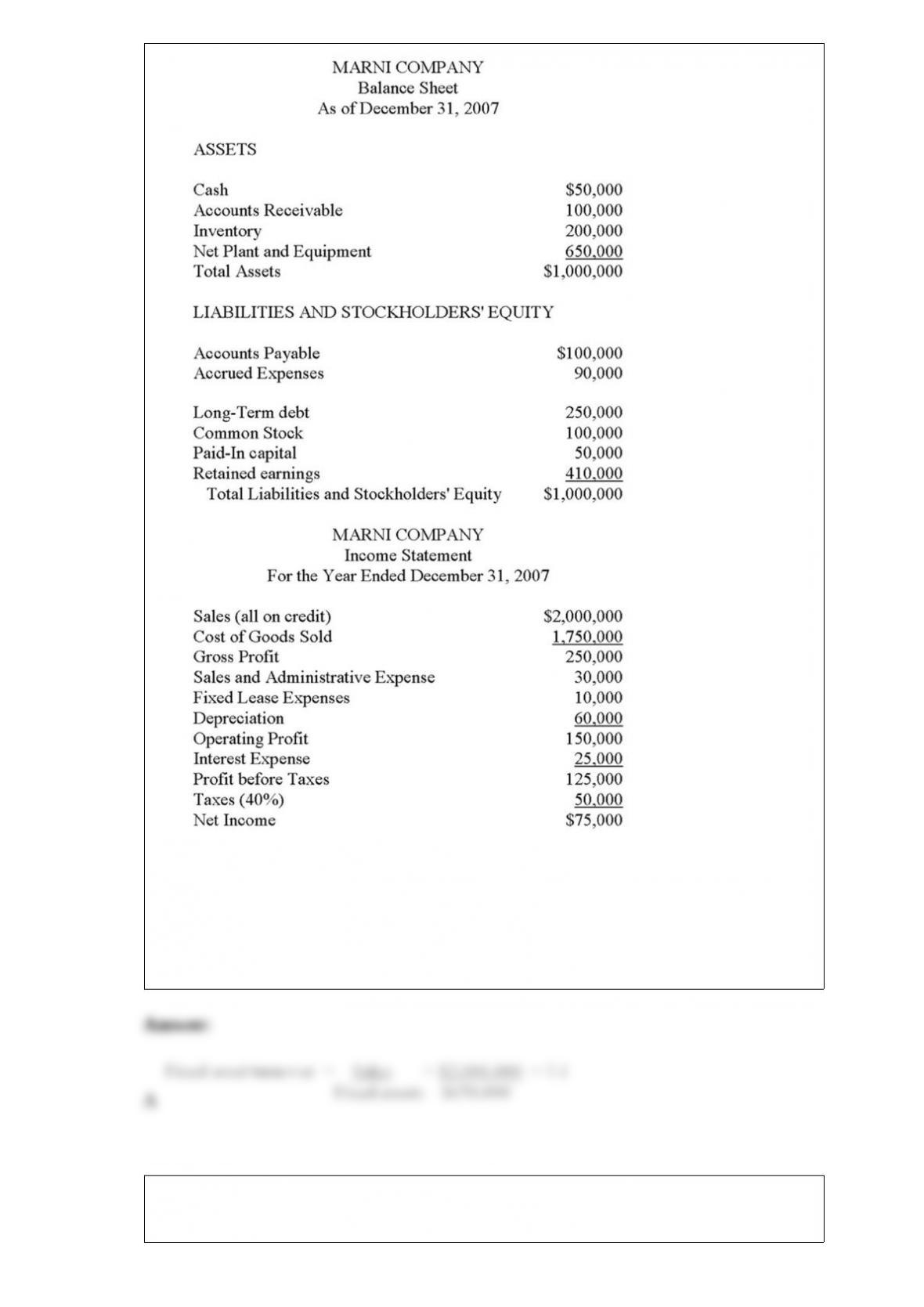
18)
Refer to the figure above. The firm’s fixed asset turnover ratio is ____.
A.3.1x
B.1.5x
C.2x
D.0.1x
19) Assume the following spot and forward rates for the New Zealand dollar ($/NZD).
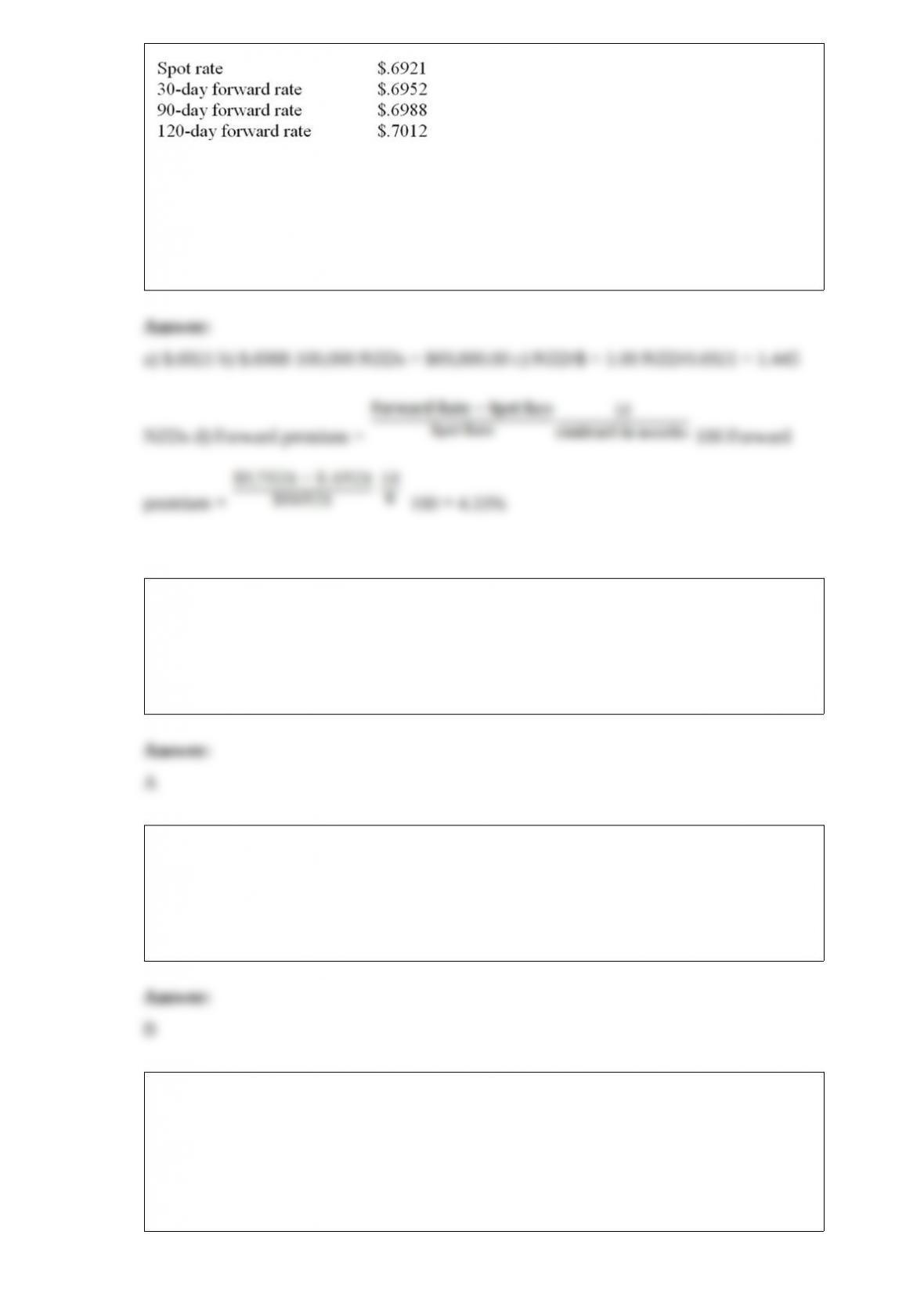
a) What is the U.S. dollar value of one New Zealand dollar in the spot market?
b) Suppose you issued a 90-day forward contract to exchange 100,000 New Zealand
dollars into U.S. dollars. How many U.S. dollars would be involved?
c) How many New Zealand dollars can you get for one U.S. dollar in the spot market?
d) What is the 120-day forward premium?
20) The market allocates capital to firms based on all of the following except:
A.Higher risk requires lower returns due to higher expectations
B.The level of efficiency
C.Expected returns
D.The degree of past performance
21) Agency theory examines the relationship between the
A.shareholders of the firm and the firm’s investment banker
B.owners of the firm and the managers of the firm
C.board of directors and large institutional investors
D.shareholders and the firm’s transfer agent
22) If a company’s stock price (P0) goes up, and nothing else changes, Ke (the required
rate of return) should
A.go up
B.go down
C.remain unchanged
D.More information is needed for an answer

23) Von Hayek’s Kayaks can borrow $12,500 for 60 days at a cost of $220 interest.
What is the effective rate of interest?
A.Less than 9.9%
B.More than 9.9% but less than 10%
C.More than 10.5% but less than 11.5%
D.More than 11.5%
24) A stock dividend will
A.increase the value of a share of stock
B.decrease the “capital in excess of par” account
C.decrease the retained earnings account
D.None of these options
25) In which phase of the life cycle would one most likely encounter stock dividends?
A.Phase II
B.Phase III
C.Phase IV
D.Phase II and Phase III
26) A firm’s earnings per share is not impacted by its financing plan at the point when
A.debt is equal to equity
B.return on assets equals return on equity
C.the cost of borrowed funds equals the return on equity
D.the cost of borrowed funds equals the return on assets

27) A 10-year zero-coupon bond that yields 5% is issued with a $1,000 par value. What
is the issuance price of the bond? Round to the nearest dollar.
A.$614
B.$64
C.$6,140
D.None of these options
28) Which of the following is most likely to increase the final number for notes payable
for short-term borrowing needs in the pro forma balance sheet?
A.A decrease in inventory
B.An increase in retained earnings
C.A decrease in accounts payable
D.A decrease in accounts receivable
29) Assume a corporation has earnings before depreciation and taxes of $82,000,
depreciation of $45,000, and that it has a 30% tax bracket. What are the after-tax cash
flows for the company?
A.$70,900
B.$82,000
C.$42,000
D.None of these options
30) Ambrin Corp. expects to receive $2,000 per year for 10 years starting one year from
now, and $3,500 per year for the next 10 years at the end of each year. What is the
approximate present value of this 20-year cash flow? Use an 11% discount rate.
A.$19,034
B.$27,870
C.$32,389
D.None of these options
31) If projected net cash outflow for January is ($6,500), the beginning cash balance is
$16,000, the minimum cash balance is $5,000, and the beginning loan balance is
$4,500, what will be the cash balance on the pro forma cash budget at the end of
January?
A.$5,000
B.$10,000
C.$12,000
D.$4,500
32) The higher the interest rate used in determining the future value of a $1 annuity,
A.the smaller the future value at the end of the period
B.the greater the future value at the end of a period
C.thegreater the present value at the beginning of a period
D.None of these options. The interest has no effect on the future value of an annuity
33) Match the following with the items below:
1>cumulative voting

2>margin requirement
3>preemptive right
4>preferred stock
5>rights offering
6>rights-on
7>ex-rights
8>common stock
9>majority voting
A. All directors may be elected by a controlling vote of more than 50%.
B. A “hybrid” security combining features of both common stock and debt.
C. Shareholders are allowed to multiply their total shares times the number of directors
being elected to determine their total number of votes.
D. The situation where the purchase of common stock includes an equal number of
rights attached to the stock.
E. Holders of this security are the owners of the company.
F. Commonly arises from the sale of new common stock to current stockholders.
G. The privilege accorded to current common stockholders of maintaining their
ownership percentage on new issues of common stock.
H. A situation where the purchase of common stock during a rights offering no longer
includes the rights to purchase additional shares of common stock.
I. Specifies the amount of cash or equity that must be deposited with a brokerage firm,
with the balance of funds eligible for borrowing.
34) Acme Corporation consists of 250 grocery stores throughout the Midwest. At the
beginning of 2010, its statement of net worth showed the following information:
Common stock ($2 par) $800,000; capital paid in excess of par $1,400,000; and
retained earnings $500,000. During the year, net income equaled $160,000.
Management was undecided on what to do with the income. Acme paid an annual
dividend of $.25 per share last year and the stock price is currently $14.50. Acme has a
6% growth rate in earnings and dividends, and is in the 40% tax bracket.
a) What return on investment would Acme have to earn in order to justify retaining
2010’s earnings? Use the formula from Chapter 10:
b) What changes would occur in stockholder’s equity if a $.15 cash dividend was paid?
What if a 5% stock dividend was given and no cash dividend was paid?
c) What would EPS be before and after the stock dividend?
35) How will widespread adoption of electronic funds transfer affect the use of “float”?
A.It will increase its use somewhat
B.It will decrease its use somewhat
C.It will virtually eliminate its use
D.It will have no effect on its use
36) Which of the following would represent a use of funds and, indirectly, a reduction
in cash balances?
A.An increase in inventories
B.A decrease in marketable securities
C.An increase in accounts payable
D.The sale of new bonds by the firm
37) A firm utilizes a strategy of capital rationing, which is currently $375,000 and is
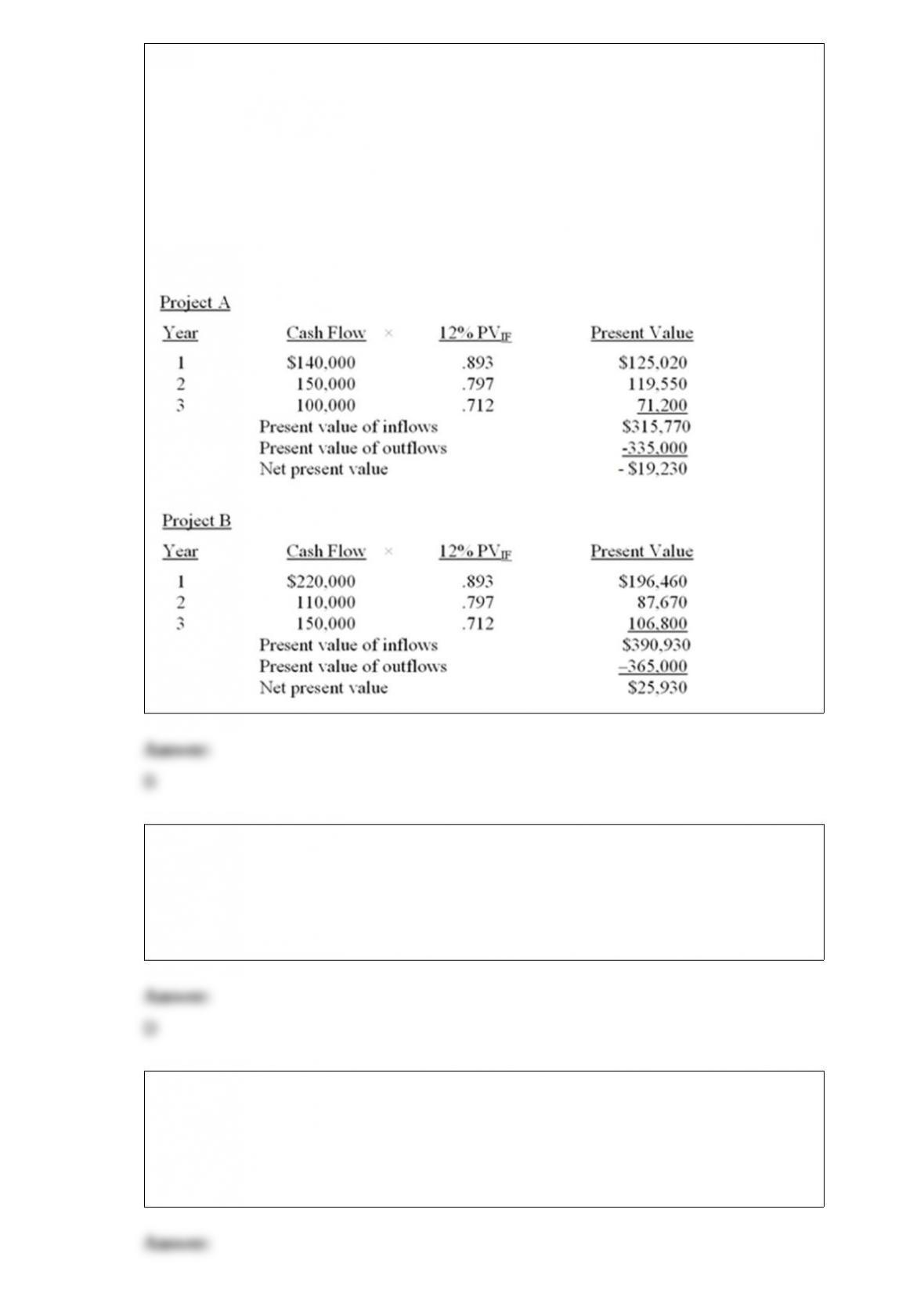
considering the following two projects: Project A has a cost of $335,000 and the
following cash flows: year 1 $140,000; year 2 $150,000; and year 3 $100,000. Project
B has a cost of $365,000 and the following cash flows: year 1 $220,000; year 2
$110,000; and year 3 $150,000. Using a 12% cost of capital, which decision should the
financial manager make?
A.Select project A
B.Select project B
C.Do not select either project
D.Select both projects
38) A firm’s cost of financing, in an overall sense, is equal to its
A.weighted average cost of capital
B.required yield that investors seek for various kinds of securities
C.required rate of return that investors seek for various kinds of securities
D.All of these options
39) The degree of operating leverage is computed as
A.percent change in operating profit divided by percent change in net income
B.percent change in unit volume divided by percent change in operating profit
C.percent change in EPS divided by percent change in operating income
D.percent change in operating income divided by percent change in unit volume

40) Which of the following securities typically trades on a discount basis?
A.Treasury notes
B.Treasury bills
C.Commercial paper
D.Certificates of deposit