
“Pyramiding of debt” refers to borrowing from one lender to repay another lender.
Answer:
The basic strength of the below-prime market pricing model is that there are narrow
margins or markups on loans.
Answer:
Working-capital loans, unlike most other types of business loans, usually require the
customer to keep a compensating deposit balance with the lending bank.
Answer:

Accommodating banks buy and sell Federal funds simultaneously to make a market for
the reserves of its customer institutions.
Answer:
Web-centered banks with little or no physical facilities are known as virtual banks.
Answer:
The Gramm-Leach-Bliley Act of 1999 essentially repeals the Glass-Steagall Act passed
in the 1930s.
Answer:

A bank’s net foreign-currency-denominated assets in a given currency are equal to the
volume of its assets denominated in that currency less any liabilities that the bank has
issued denominated in the same currency.
Answer:
Securitization is designed to turn illiquid loans into liquid assets in the form of
securities sold in the open market.
Answer:
In the field of banking, capital refers principally to those funds contributed by a bank’s
owners.
Answer:

Prepayment risk on securitized assets generally increases when interest rates rise.
Answer:
Foreclosure on property pledged behind a bank loan does not subject a bank to be held
liable to clean up any environmental damage the borrower may have caused.
Answer:
Under current federal laws, a lender is required to make an environmental site
assessment of the borrower’s property in order to avoid environmental liability.
Answer:

Under the so-called liability management view in banking, the key control lever banks
possess over the volume and mix of their liabilities is price.
Answer:
Competition for consumer loans tends to drive the interest rates on these loans down
closer to loan production costs.
Answer:
A bank’s nondeposit investment products include IRAs, Keoghs, and MMDAs.
Answer:

Credit card loans are generally more profitable for small and medium-size banks than
for the large banks.
Answer:
The federal law that states individuals and families cannot be denied a loan merely
because of their age, sex, race, national origin, or religious affiliation is known as the
Competitive Equality in Banking Act.
Answer:
Convexity is a direct measure of the price risk of a bond.
Answer:

There is little evidence for cost savings resulting from large financial institution
mergers.
Answer:
Net interest margin tends to rise for U.S. banks having positive maturity gap positions
when the yield curve is upward-sloping.
Answer:
Asset management strategy in banking assumes that the amount and kinds of deposits
and other borrowed funds a bank attracts are determined largely by its management.
Answer:

U.S. banks (especially those with $500 million or more in total assets) are required to
file financial statements, audited by an independent public accountant, with their
principal federal regulatory agency and with the FDIC.
Answer:
Banks are one of the principal buyers of credit derivatives.
Answer:
All central banks around the world have some specified reserve requirement.
Answer:

The agency problem described in the textbook is referred to the idea of bank managers
driven primarily by their own interest to increase salaries and benefits at the expense of
company stockholders.
Answer:
Core capital includes the surplus value of common stock.
Answer:
One of the benefits of applying for a federal banking charter is that banks need not join
the Federal Reserve System.
Answer:

State banking commissions, on average, impose tougher standards for chartering new
banks than the federal chartering agency, the Comptroller of the Currency.
Answer:
All central banks impose reserve requirements on the banks they regulate.
Answer:
When a loan is classified as nonperforming, any accrued interest recorded on the books,
but not actually received, must be deducted from the bank’s loan revenues.
Answer:

Domestic deposits generate legal reserves.
Answer:
Commercial banks are the largest originator of household loans.
Answer:
The number of futures contracts needed to hedge a position increases as the bank’s
duration gap increases.
Answer:

A hedging tool that provides “one-sided” insurance against interest rate risk is the
interest rate option, which, like financial futures contracts, obligates the parties to the
contract to either deliver or take delivery of securities.
Answer:
Interest in banks’ and financial service institutions’ liquidity management is a relatively
new phenomenon which arose following the 9/11 crisis.
Answer:
The credit derivatives market has grown many-fold during the recent years.
Answer:

The letter “M” in the CAMELS rating system for banks in the U.S. refers to the
“management quality” of a bank.
Answer:
A bank has a concern about the Wilson Company’s debt level. They feel that it is too
high. What ratio are they most likely to examine to answer this question?
A. Selling and administrative expenses/Net sales
B. Net sales/Total assets
C. Current assets – Current liabilities
D. Net income/Total assets
E. Long-term debt/(Long-term debt + Net worth)
Answer:
The Harris State Bank has $2,000 in total assets (all of which are earning assets), $500
of which will be repriced in the next 90 days. This bank also has $1,600 in total
liabilities, $1,000 of which will be repriced in 90 days. The bank currently earns 9
percent on its assets and pays 4 percent on its liabilities.If interest rates do not change in
the next 90 days, what is this bank’s net interest margin? A. 0.5 percent

B. 0.8 percent
C. 1.8 percent
D. 5.8 percent
E. None of the options is correct.
Answer:
Carter National Bank is worried because it knows that the municipal bonds it has in its
bond portfolio can be difficult to sell quickly. What type of risk would this be an
example of?
A. Default risk
B. Inflation risk
C. Liquidity risk
D. Call risk
E. Basis risk
Answer:

Offering institutions post lower yields on SNOWs than on MMDAs because:
A. ratings on institutions issuing SNOWs are higher.
B. SNOWs can be drafted more frequently by customers.
C. federal regulatory authorities classify MMDAs as transaction deposits.
D. MMDAs carry unlimited check-writing privileges.
E. MMDAs have longer maturities than SNOWs.
Answer:
A ‘blind spot’ may be built into the repayment schedule of a term loan wherein: A. no
installment will be due because of prepayment.
B. no installment will be due because of timely payment of the loan.
C. no installment will be due because of shortage of cash with the borrower.
D. installment will be collected before they are due.
E. no installment will be collected because of loan foreclosure.
Answer:

J.C. Penney, and Sears provided are among leading firms that in the 1980s organized
competitors with banks that are known as:
A. nonbank financial-service institutions.
B. discount security companies.
C. savings institutions.
D. credit unions.
E. commercial banks.
Answer:
A loan officer of Second National Bank of Laramie decides to review the insurance
coverage of one of its business customers. Which of the 6 Cs of lending would this
piece of information belong to?
A. Character
B. Capacity
C. Cash
D. Collateral
E. Conditions
Answer:

Which of the following is a strength of the customer profitability analysis method for
pricing loans?
A. It considers the competition from other lenders.
B. It allows the bank to compete more aggressively with the commercial paper market.
C. It considers the cost of loanable funds and the operating costs of running the bank.
D. It takes the whole customer relationship into account.
E. None of the options is correct.
Answer:
The common banking practice of selling those investment securities that have
appreciated in order to reap a capital gain and holding onto those securities whose
prices have declined is known as:
A. gains trading.
B. performance banking.
C. loss control trading.
D. selective portfolio management.
E. None of the options are correct.
Answer:

The HTR Bank is planning on raising $750 million in a new offering of commercial
paper through its holding company. It plans on using $725 million of it to fund new
loans. The current interest rate for similar commercial paper is 7.15 percent and it
expects 0.15 percent in issuing costs. What is the effective rate of interest on this issue
of commercial paper?
A. 7.30 percent
B. 7.15 percent
C. 7.40 percent
D. 7.55 percent
E. None of the options is correct
Answer:
The discount rate that equalizes the current market value of a loan or security with the
expected stream of future income payments from that loan or security is known as:
A. bank discount rate.
B. yield to maturity.
C. annual percentage rate.
D. net interest margin.
E. None of the options is correct.

Answer:
Banks perform the indispensable task of:
A. creating money without making loans.
B. absorbing the excess liquidity created by other financial institutions.
C. intermediating between surplus-spending parties and deficit-spending parties.
D. issuing risky deposits.
E. None of the options are correct
Answer:
The Harris State Bank has $2,000 in total assets (all of which are earning assets), $500
of which will be repriced in the next 90 days. This bank also has $1,600 in total
liabilities, $1,000 of which will be repriced in 90 days. The bank currently earns 9
percent on its assets and pays 4 percent on its liabilities.If interest rates on both assets
and liabilities rise by 2 percent in the next 90 days, what would be this bank’s net
interest margin? A. 4.2 percent
B. 5.3 percent
C. 5.8 percent

D. 6.2 percent
E. 7.8 percent
Answer:
The ratio of an acquired bank’s current stock price per share plus the additional amount
paid by the acquirer for each share of the acquired bank’s stock, divided by the acquired
bank’s current stock price is the:
A. price-earnings ratio.
B. merger premium.
C. exchange rate (of a merger transaction).
D. combined stock price of the merging banks.
E. None of the options is correct.
Answer:
The risk of a government’s ability to repay its debt owed to international lending
institutions is known as:

A. market risk.
B. credit risk.
C. operational risk.
D. sovereign risk.
E. legal risk.
Answer:
Emily Barnes has gone to the First State Bank and gotten a loan of $5,000 so she can go
on vacation. She plans on paying the loan back in one payment in three months. Which
of the following categories will this loan fall into?
A. Residential mortgage loan
B. Installment loan
C. Noninstallment loan
D. Revolving line of credit
E. None of the options is correct
Answer:
Which of the following bodies is created under the recently passed Dodd-Frank Wall
Street Reform and Consumer Protection Act?
A. Federal Reserve Board
B. Securities and Exchange Commission
C. Federal Deposit Insurance Commission
D. Comptroller of the Currency
E. Consumer Financial Protection Bureau
Answer:
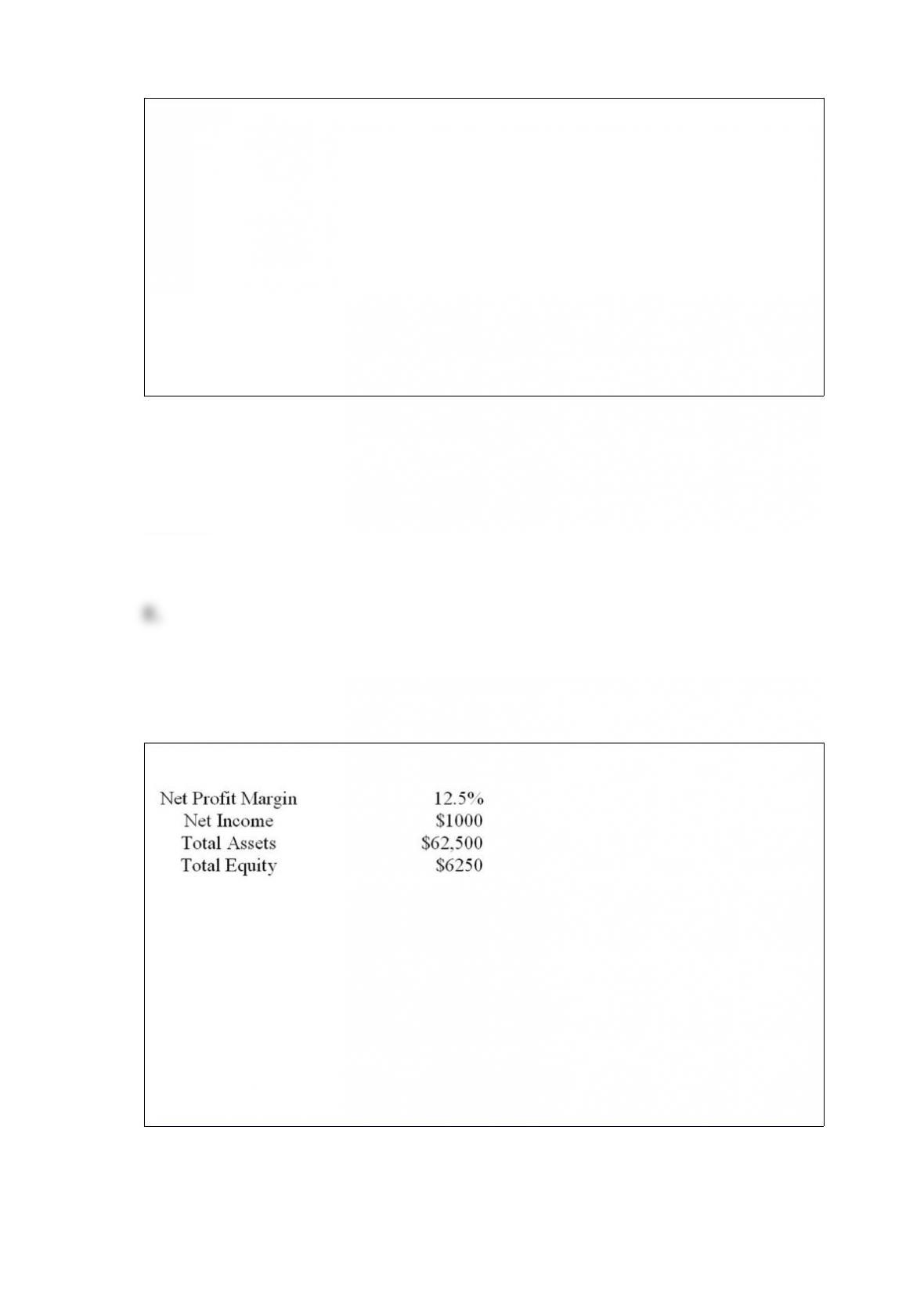
The following financial information pertains to Harrison Bank.
What is the bank’s equity multiplier? A. 1.6 times
B. 10 times
C. 12.8 times
D. 16 times
E. None of the options is correct
Answer:

What is the equity multiplier for a bank whose equity is equal to 10 percent of total
assets?
A. 90.0
B. 10.0
C. 1.1
D. 110.0
E. 1.0
Answer:
In the week to come, a bank expects $55 million in incoming deposits, $75 million in
acceptable loan requests, $35 million in money market borrowings, $10 million in
deposit withdrawals, and $30 million in loan repayments. The bank is expecting a:
A. liquidity deficit.
B. liquidity surplus.
C. balanced liquidity position.
D. liquidity reversal.
E. None of the options is correct.

Answer:
Which of the following is an advantage of securitizing loans?
A. Diversifying a lender’s credit risk exposure
B. Reducing the need to monitor each individual loan’s payment stream
C. Transforming illiquid assets into liquid securities
D. Serving as a new source of funds for lenders and attractive investments for investors
E. All the options are advantages of securitizing loans
Answer:
Which federal banking act forces more individuals to repay at least part of what they
owe and will push higher-income borrowers into more costly forms of bankruptcy?
A. The Sarbanes-Oxley Act
B. The USA Patriot Act
C. The Check 21 Act
D. The Fair and Accurate Credit Transactions Act
E. The Bankruptcy Abuse Prevention and Consumer Protection Act

Answer:
The requirement that banks must provide their consumer loan customers with a
statement of the APR for the proposed loan was established by the:
A. Fair Credit Reporting Act.
B. Equal Credit Opportunity Act.
C. Truth-in-Lending Act.
D. Community Reinvestment Act.
E. None of the options is correct
Answer:
The change in a bank’s net income that occurs due to changes in interest rates equals the
overall change in market interest rates (in percentage points) times ____________.
A. volume of interest-sensitive assets
B. price risk of the bank’s assets
C. price risk of the bank’s liabilities

D. size of the bank’s cumulative gap
E. None of the options is correct
Answer:
A bond has eight years to maturity and a coupon rate of 6.5 percent. Coupon payments
are made annually and the bond has a face value of $1,000. This bond is currently
selling in the market for $862. What is the yield-to-maturity on this bond?
A. 6.5 percent
B. 10 percent
C. 8.5 percent
D. 9 percent
E. None of the options is correct
Answer:
A group of six investors wants to open a new bank. In their application to the
Comptroller of the Currency, they discuss that new housing starts in the area are up
19% from a year ago with an additional 25 families moving into the community every

month. School enrollment has also increased 14% from the previous year. Which
decision factor are the investors discussing for seeking a new charter?
A. The level of economic activity in the community
B. The growth of economic activity in the community
C. The need for a new financial firm
D. The strength and character of the local competition
E. None of the options are correct
Answer:
Suppose India restricts entry of foreign banks until the end of the decade. This would be
in support of which reason for regulating international banks?
A. Protecting the safety of depositor funds
B. Promoting stable growth in money and credit
C. Providing foreign currency controls
D. Protecting domestic financial institutions
E. Restricting the outflow of scarce capital
Answer:

Under Basel III, more flexible capital standards which includes the “buffer concept”
means involvement of which two ratios?
A. Base capital and leverage ratio
B. Base capital and buffer ratio
C. Capital and risk-weighted assets ratio
D. Leverage and buffer ratio
E. Risk-weighted assets ratio and buffer ratio
Answer:
Term loans normally are secured by:
A. fixed assets.
B. accounts receivable.
C. inventories.
D. personal property.
E. None of the options is correct.
Answer:

Loan-backed securities, which closely resemble traditional bonds, carry various forms
of credit enhancements, which may include all of the following, except:
A. credit letter guaranteeing repayment of the securities.
B. set aside of a cash reserve.
C. division into different risk classes.
D. early payment clauses.
E. None of the options is correct.
Answer:
The Third National Bank of Edmond reports a net interest margin of 5.83 percent. It has
total interest revenues of $275 million and total interest expenses of $210 million. This
bank has earnings assets of $1,115. Suppose this bank’s interest revenues rise by 8
percent and its interest expenses and earnings assets rise by 10 percent next year, what
is this bank’s new net interest margin?
A. 5.83 percent
B. 7.09 percent
C. 3.59 percent
D. 5.38 percent
E. 7.80 percent

Answer:
The Roy State Bank has just purchased a portfolio of asset-backed securities. What type
of risk do these securities have that other securities do not have?
A. Credit risk
B. Interest rate risk
C. Business risk
D. Call risk
E. Prepayment risk
Answer:
Interest rate caps:
A. first developed in the 1980s.
B. protect the borrower from rising interest rates.
C. allow for the exchange of amounts in different currencies by two parties.
D. protect the lenders from falling interest rates.
E. allow for the exchange of amounts in different currencies by two parties and protect
the lenders from falling interest rates.

Answer:
The __________________________ component of interest rates is the risk premium
due to the probability that the borrower will miss some payments or will not repay the
loan.
Answer:
_________________________ allow the banks to generate fee income after they have
sold a loan. The bank continues to collect interest and principal from the borrowers and
passes these collections to the loan buyers.
Answer:

Marketable notes and bonds sold by agencies owned by the government or sponsored
by the government are known as _______________.
Answer:
The ___________________________ allows well-managed and well-capitalized
banking companies with satisfactory CRA ratings to affiliate with insurance companies
and securities firms either through a financial holding company or through a subsidiary
firm owned by a bank.
Answer:
A(n) _______________ is a draft for payment due and payable upon presentation to the
bank.
Answer:

The _____________________ Act prohibits banks and publicly owned firms from
publishing false or misleading financial performance information.
Answer:
When bank purchases stocks, bonds, mutual funds, and annuities on behalf of their
customers, these products are referred to as _______________________.
Answer:
Research suggests that _________ -income consumers appear to be more influenced by
the size of the financial institution.
Answer:

A(n) ________ sells shares mainly to upscale investors in a broad group of different
kinds of assets including nontraditional investments in commodities, real estate, loans
to new and ailing companies, and other risky assets.
Answer:
____________________________ are certain actions that a borrower must take during
a loan period. Examples include filing periodic financial statements with the bank and
purchasing insurance on any collateral pledged.
Answer:
A(n) ______________ is the process of resolving a troubled loan so that a bank can
recover its loaned funds.
Answer:

In an interest rate swap agreement, __________________ reduces the default risk. This
is where the swap parties exchange only the net difference between the interest
payments owed.
Answer:
The buyer of a(n) _________________________ option contract believes that the
market price of the underlying security will decline in the future.
Answer:
A security issued by the federal government with 1 to 10 years to maturity when it is
issued is called a(n) ________________________.
Answer:

An international loan risk evaluation system that uses expert opinion is the
______________.
Answer:
Passage of the __________________ of 1999 granted banks, securities firms, and
insurance companies the right to apply to the Federal Reserve Board to become
financial holding companies (FHCs).
Answer:
_________ for banks include assets like mortgage servicing rights and purchased credit
card relationships and such assets can be counted as part of bank capital.
Answer:

A rule of thumb used to determine how much interest income a bank is allowed to
accrue at any point in time from a consumer loan that is being paid off in monthly
installments is known as the ____________.
Answer:
The principal types of __________________________ include fee income, income
from fiduciary activities, and service charges on deposits.
Answer: