
1) Borrowing more money will always increase a company’s return on equity because
the company is using financial leverage, but it also adds to the riskiness of the company.
2) Credit terms of 1/10 net 30 means that the buyer may take a 10% discount (1/10)if
the bill in paid within 30 days.
3) A firm’s cost of capital is the required rate of return on the firm’s average project.
4) A corporation may lower its cost of capital by shifting a portion of its total financing
from a higher cost source of capital, such as common equity, to a lower cost source of
capital, such as debt.
5) Since stockholders are able to reduce their exposure to risk by efficiently
diversifying their holdings of securities, there is no reason for individual firms to seek
diversification of their holdings of assets.
6) Due to strict stock market controls, the most a stock’s value can drop in one trading
day is 5%.
7) The opportunity cost of any choice you make is the highest-valued alternative that
you had to give up when you made the choice.
8) A bond’s yield to maturity varies from investor to investor because each investor has
his or her own required return.
9) A liquidity-risk premium is the additional return required by investors for securities
that cannot quickly be converted into cash at a reasonably predictable price.
10) If a company in a perfect capital market decreased its dividend per share, an
investor would be forced to sell his common stock at a depressed price.
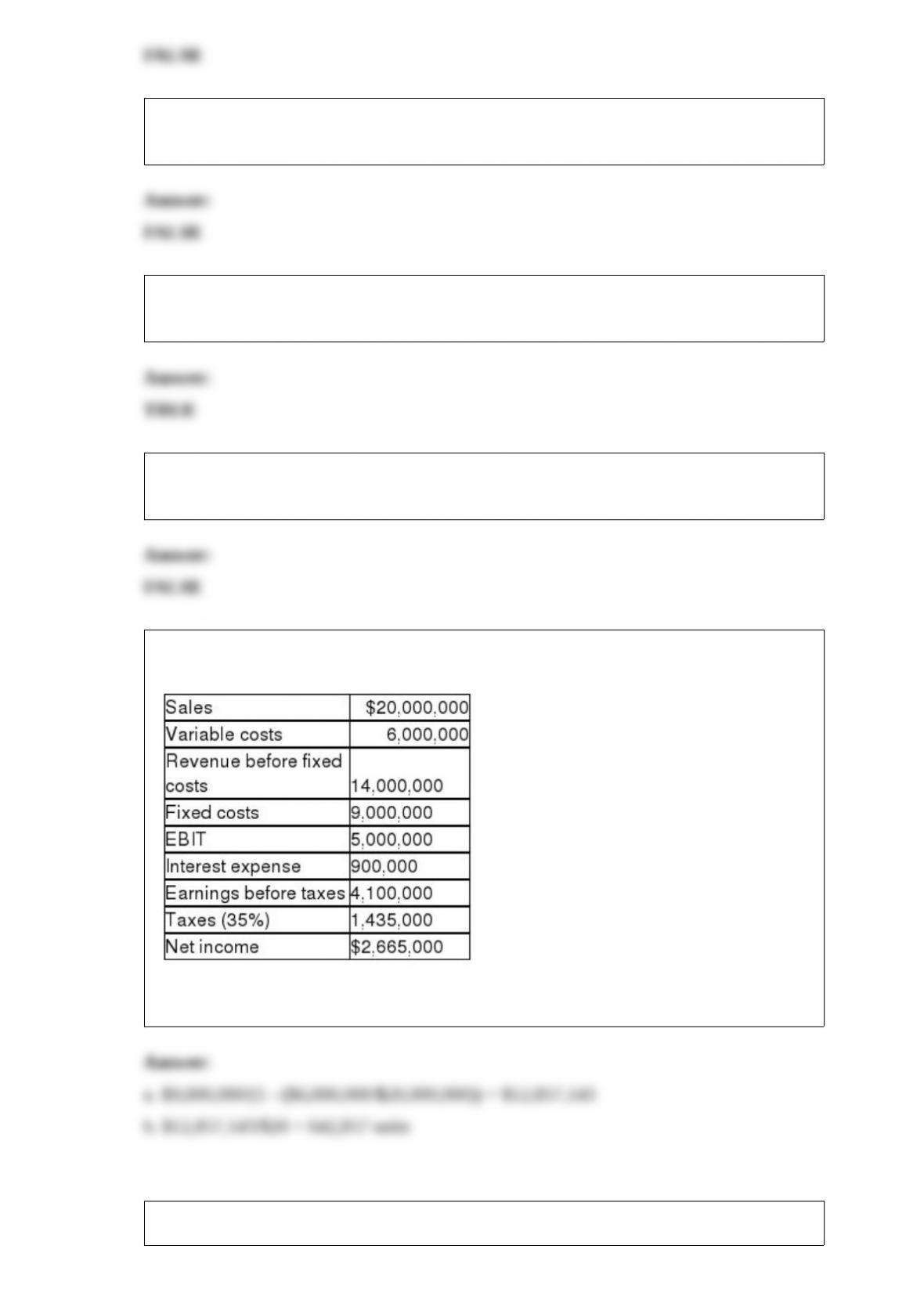
11) ABC Corp. has estimated the following income statement for its next fiscal year.
a.What is the break-even point in sales dollars for the firm?
b.If the average unit cost is $20, what is the break even point in units?
12) Kohler Manufacturing typically achieves one of three production levels in any

given year: 8 million pounds of steel, 10 million pounds of steel, or 16 million pounds
of steel. In tracking some of its costs, Kohler’s controller discovered one cost that was
$10 per pound no matter what the production level for the year. This is an example of a
A) variable cost
B) fixed cost
C) semivariable cost
D) semifixed cost
13) Using the percentage of sales method of forecasting
A) all asset and liability accounts increase or decrease proportionally with sales
B) only asset accounts increase or decrease proportionally with sales
C) accounts payable and accrued expenses are the only liabilities that increase or
decrease proportionally with sales
D) all balance sheet accounts increase or decrease proportionally with sales
14) You must add one of two investments to an already well- diversified portfolio.
Security ASecurity B
Expected Return = 14%Expected Return = 12%
Standard Deviation ofStandard Deviation of
Returns = 15.0%Returns = 11%
Beta = 1.5Beta = 1.5
If you are a risk-averse investor, which one is the better choice?
A) Security A
B) Security B
C) Either security would be acceptable
D) cannot be determined with information given
15) Investment banking firms offer to facilitate the sale of securities to the public in a
variety of ways. Which of the following methods guarantees the corporation with a
pre-determined price for the securities?
A) a best efforts basis
B) a commission basis
C) a competitive bid
D) an underwriting

16) A bond will sell at a discount (below par value) if
A) the market value of the bond is less than the present value of the discount rate of the
bond
B) current market interest rates are moving in the same direction as bond values
C) investor’s current required rate of return is above the coupon rate of the bond
D) the economy is booming
17) Dryden, Corp. has 500,000 shares of common stock outstanding, a P/E ratio of 11,
and $900,000 earnings available for common stockholders. The board of directors has
just voted a 5:2 stock split.
a.If you had 100 shares of stock before the split, how many shares will you have after
the split?
b.What was the total value of your investment in Dryden stock before the split?
c.What should be the total value of your investment in Dryden stock after the split?
d.In view of your answers to (b) and (c) above, why would a firm’s management want
to have a stock split?
18) Assume that a firm had such serious financial problems that it was about to be
liquidated after a bankruptcy. All of the firm’s assets are about to be sold in order to pay
the following claims against the firm: bondholders, preferred stockholders, common
stockholders, and federal income taxes. Of the claims mentioned, what priority would
common stockholders have?

A) first
B) second
C) third
D) fourth
19) One method of accounting for systematic risk for a project involves identifying a
publicly traded firm that is engaged in the same business as that project and using its
required rate of return to evaluate the project. This method is referred to as
A) the accounting beta method
B) scenario analysis
C) the pure play method
D) sensitivity analysis
20) ND Electric Company issued $1,000 bonds that have an annual coupon rate of
6.5%. The present market value of the bonds is $1,225. If the bonds have 17 years
remaining until maturity, what is the current yield on ND Electric Company bonds?
A) 5.3%
B) 6.5%
C) 7.2%
D) 13.2%
21) Assume that an investment is forecasted to produce the following returns: a 10%
probability of a $1,400 return; a 50% probability of a $6,600 return; and a 40%
probability of a $1,500 return. What is the expected amount of return this investment
will produce?
A) $4,040
B) $7,640
C) $12140
D) $1,540
22) The investment banker does NOT underwrite the securities to be issued in which of
the following?
A) initial public offering

B) primary market transaction
C) firm commitment
D) best efforts
23) The Boyles Ceramics, Inc. established a line of credit with a local bank. The
maximum amount that can be borrowed under the terms of the agreement is $1,000,000
at an annual rate of 8 percent. A compensating balance averaging 25 percent of the
amount borrowed is required. Prior to the agreement, Boyles had no deposit with the
bank. Shortly after signing the agreement, Boyles needed $240,000 to pay off a note
that was due. Boyles decides to borrow an amount sufficient to pay the $240,000 note
and also to cover the compensating balance. How much must Boyles Glass borrow?
A) $300,000
B) $320,000
C) $375,000
D) $400,000
24) Which of the following is an advantage of the use of current liabilities to finance
assets?
A) less risk of illiquidity
B) more flexibility
C) lower interest costs
D) Both B and C
25) The Western State Company’s common stock is expected to pay a $2.00 dividend in
the coming year. If investors require a 17% return and the growth rate in dividends is
expected to be 8%, what will the market price of the stock be?
A) $11.76
B) $24.00
C) $23.11
D) $22.22
26) Suppose the 360-day forward exchange rate is 1.657 dollars per British Pound, and
the current spot rate is 1.625 dollars per British Pound. If the 360-day interest rate in the

United States is 5% and the 360-day interest rate in Great Britain is 3%, is the market in
equilibrium according to the interest rate parity theory?
A) Yes, because the forward premium on the pound (2%) is exactly offset by the lower
interest rate in Great Britain
B) No, because the higher interest rate in the United States (2%) implies that the
forward exchange rate should be 2% lower than the current spot rate
C) No, because the forward premium on the pound is 2% while the interest rate in the
U.S is 67% higher than the interest rate in Great Britain
D) Cannot be determined without knowing the amount of money being exchanged
27) Which of the following items does NOT belong in a cash budget?
A) rent
B) taxes
C) depreciation
D) wages and salaries
28) The cash budget consists of all the following factors EXCEPT
A) cash receipts
B) cash disbursements
C) new financing needed
D) net income
29) If you want to have 1$2,500 in 57 months, how much money must you put in a
savings account today? Assume that the savings account pays 4.5% and it is
compounded quarterly (round to nearest $1).
A) $8,459
B) $10,106
C) $10,387
D) $11,129
30) The viewpoint that low dividends increase stock value is based on which of the
following principles?
A) time value of money

B) risk-return trade-off
C) taxes bias business decisions
D) the agency problem
31) HighLev Incorporated borrows heavily and uses the leverage to boost its return on
equity to 30% this year, nearly 10% higher than the industry average. However,
HighLev’s stock price decreases relative to its industry counterparts. How is this
possible?
A) Markets are inefficient and fail to recognize the benefits of leverage
B) The increased debt resulted in interest payments that made HighLev’s operating
income drop even though return on equity increased
C) Shareholders are not interested in return on equity
D) the high levels of debt increased the riskiness of HighLev relative to its competitors
32) A forward exchange contract
A) gives the owner the right, but not the obligation, to buy a foreign currency at a fixed
exchange rate for a fixed period of time
B) gives the owner the right to purchase a foreign currency at some point in the future
and any gains or losses are credited/debited to the account at the close of business each
day
C) requires delivery, at a specified future date, of one currency for a specified amount
of another currency
D) requires delivery, within two working days, of one currency for a specified amount
of another currency
33) Using the weighted average cost of capital as the required rate of return for every
project will
A) cause a firm to reject projects that should have been accepted
B) cause a firm to accept projects that were too risky
C) result in maximization of shareholder wealth
D) A and B above
34) The expected return on a riskless asset is greater than zero due to

A) an expected return for delaying consumption
B) an expected return for opportunity costs
C) an expected return for taxes
D) irrational investors who believe risk is always present
35) Septon Inc. has an average collection period of 74 days. What is the accounts
receivable turnover ratio for Septon Inc.?
A) 4.93
B) 2.47
C) 2.66
D) 1.74
36) You are considering investing in Ford Motor Company. Which of the following are
examples of diversifiable risk?
I.Risk resulting from possibility of a stock market crash.
II.Risk resulting from uncertainty regarding a possible strike against Ford.
III.Risk resulting from an expensive recall of a Ford product.
IV.Risk resulting from interest rates decreasing.
A) I only
B) I and IV
C) I, II, III, IV
D) II, III
37) Which of the following affect an asset’s value to an investor?
I.Amount of an asset’s expected cash flow
II.The riskiness of the cash flows
III.Timing of an asset’s cash flows
IV.Investor’s required rate of return
A) I, II, III
B) I, III, IV
C) I, II, IV
D) I, II, III, IV

38) If a firm relies on short-term debt or current liabilities in financing its asset
investments, and all other things remain the same, what can be said about the firm’s
liquidity?
A) The firm will be relatively more liquid
B) The firm will be relatively less liquid
C) The liquidity of the firm will be unchanged
D) The firm will be more liquid only if interest rates are below the company’s weighted
average cost of capital.
39) In the EOQ model, carrying costs of inventory include
A) the required rate of return on inventory
B) wages for warehouse workers
C) costs associated with inventory shrinkage
D) B and C
E) all of the above
40) The prime lending rate is the base rate on
A) mortgage loans
B) home equity loans
C) auto loans
D) corporate loans
41) A budget
A) records the amount and timing of the firm’s past financing needs
B) provides a basis for taking corrective action in the event that budgeted figures do not
match actual or realized figures
C) remains independent of the human resource performance evaluation task
D) only makes sense for annual periods of time
42) How frequently do corporations generally pay dividends?
A) annually
B) semiannually
C) quarterly

D) monthly
43) All of the following factors support the proposition that dividend policy matters
EXCEPT
A) investors desire to minimize and defer taxes, and capital gains get preferential tax
treatment over dividend income
B) perfect capital markets
C) information asymmetry exists between shareholders and managers
D) flotation costs significantly increase the cost of new common stock compared to
retained earnings
44) The Euro increased dramatically in value against the U.S. dollar between 2000 and
2009. The result has been that
A) U.S. exports are more competitive in Europe
B) U.S. goods cost more in Europe
C) U.S. travelers are finding it less expensive to travel in Europe
D) European exports to the United States are more competitive
45) What is the value of a preferred stock that pays a $5.55 dividend to an investor with
a required rate of return of 10%?
A) $22.22
B) $27.83
C) $45
D) $55.50
46) Table 4-2
Drummond Company
Balance Sheet
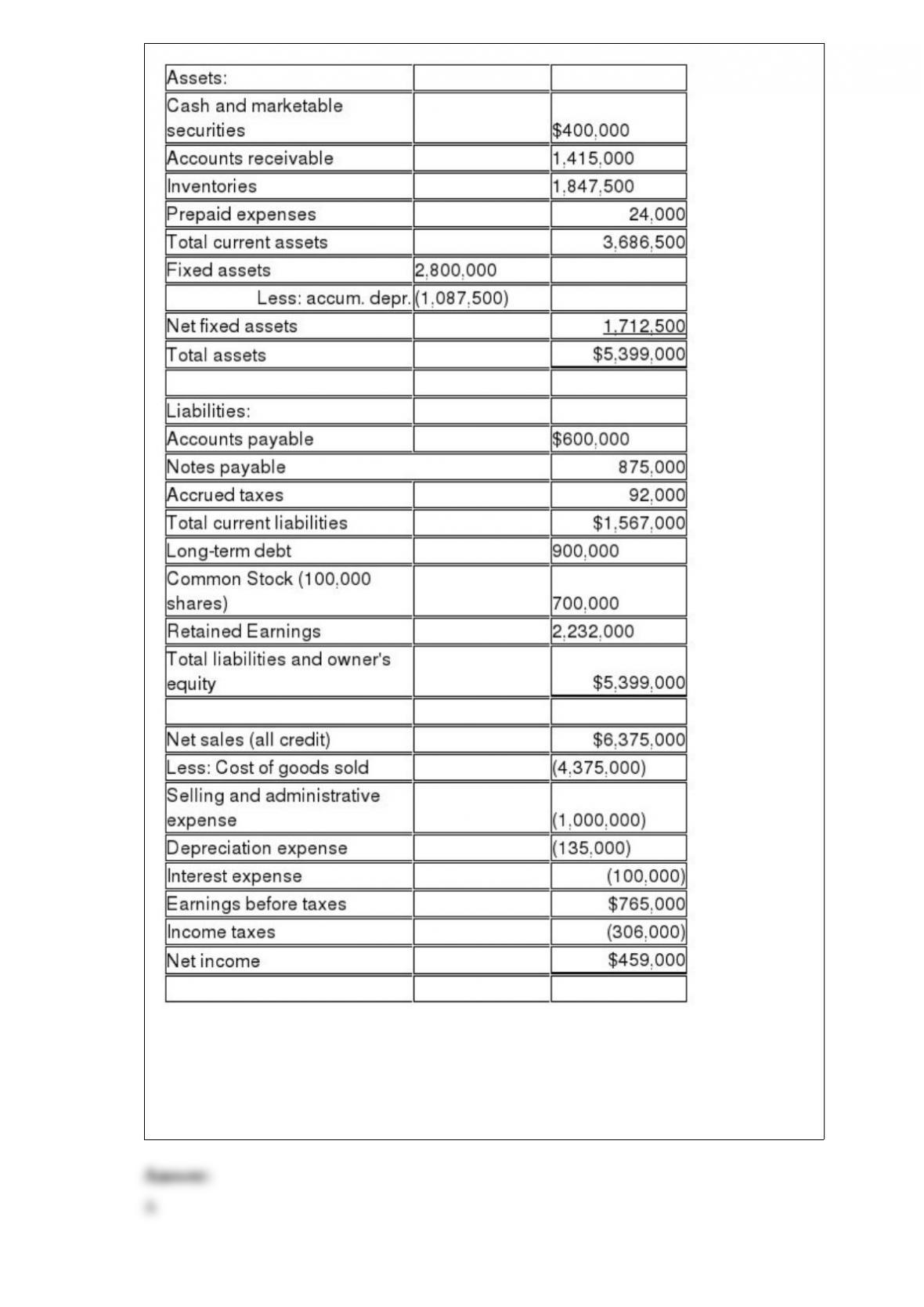
Assuming the company’s stock price is $50 per share, the P/E ratio is
A) 10.89
B) 14.33
C) 24.44
D) 27.50

47) Project LMK requires an initial outlay of $500,000 and has a profitability index of
1.4 . The project is expected to generate equal annual cash flows over the next ten
years. The required return for this project is 16%. What is project LMK’s internal rate of
return?
A) 19.88%
B) 22.69%
C) 24.78%
D) 26.12%
48) What is the value of a bond that matures in 17 years, makes an annual coupon
payment of $50, and has a par value of $1,000? Assume a required rate of return of
5.90%.
A) $823.48
B) $856.98
C) $895.23
D) $905.02
49) Which of the following is (are) TRUE?
A) In general, the higher the number of positive NPV investment opportunities for a
firm, the lower the dividend payout ratio
B) If the clientele effect is correct, firms should follow a constant dividend payout ratio
policy
C) According to the informational content of dividends, an increase in dividends is
always a positive signal
D) In industries with volatile earnings, the residual dividend policy results in the most
consistent dividend stream
50) If a corporation wants a guarantee that all of its shares of stock will be sold, it
should use which of the following distribution methods?
A) competitive bid purchase
B) privileged subscription with no standby agreement
C) commission or best-efforts contract
D) direct sale