Reserve requirements for banks are currently:
Amount of Bank’s Requirement
Transaction Deposits Reserve
The first $6.6 million 0 percent
Amounts from $6.6 to $45.4 million 3 percent
Amounts over $45.4 million 10 percent
Calculate the reserve requirements for three banks with the following amounts of
transaction deposits.
a. $38.8 million
b. $95.6 million
c. $3,400 million
Answer:

Because RBC models are complicated, researchers generally
a. solve the models analytically.
b. use econometric analysis on the models.
c. replicate the models.
d. simulate the models.
Answer:
An investor earns dividends of $360.27 during the course of the year. At the end of the
year, the stock is worth
$10,700. If the dividend yield on the stock over the year was calculated at 4%, the
approximate worth of the stock at the beginning of the year was
a. $9,007.
b. $9,457.
c. $9,907.
d. $10,357.
Answer:

The money multiplier equals
a. the money supply divided by the monetary base.
b. currency held by the non-bank public plus banks’ reserves.
c. currency held by the non-bank public plus transaction accounts.
d. M2 divided by M1.
Answer:
If the interest rate on three-month Treasury securities is 5 percent and the interest rate
on ten-year Treasury securities is 6 percent, then the odds of a recession are
a. less than 15 percent.
b. about 25 percent.
c. about 40 percent.
d. about 80 percent.
Answer:
In the dynamic model of money,
a. both people’s income and money supply are endogenous variables.
b. both people’s income and money supply are exogenous variables.
c. people’s income is an endogenous variable, while money supply is an exogenous
variable.
d. people’s income is an exogenous variable, while money supply is an endogenous
variable.
Answer:
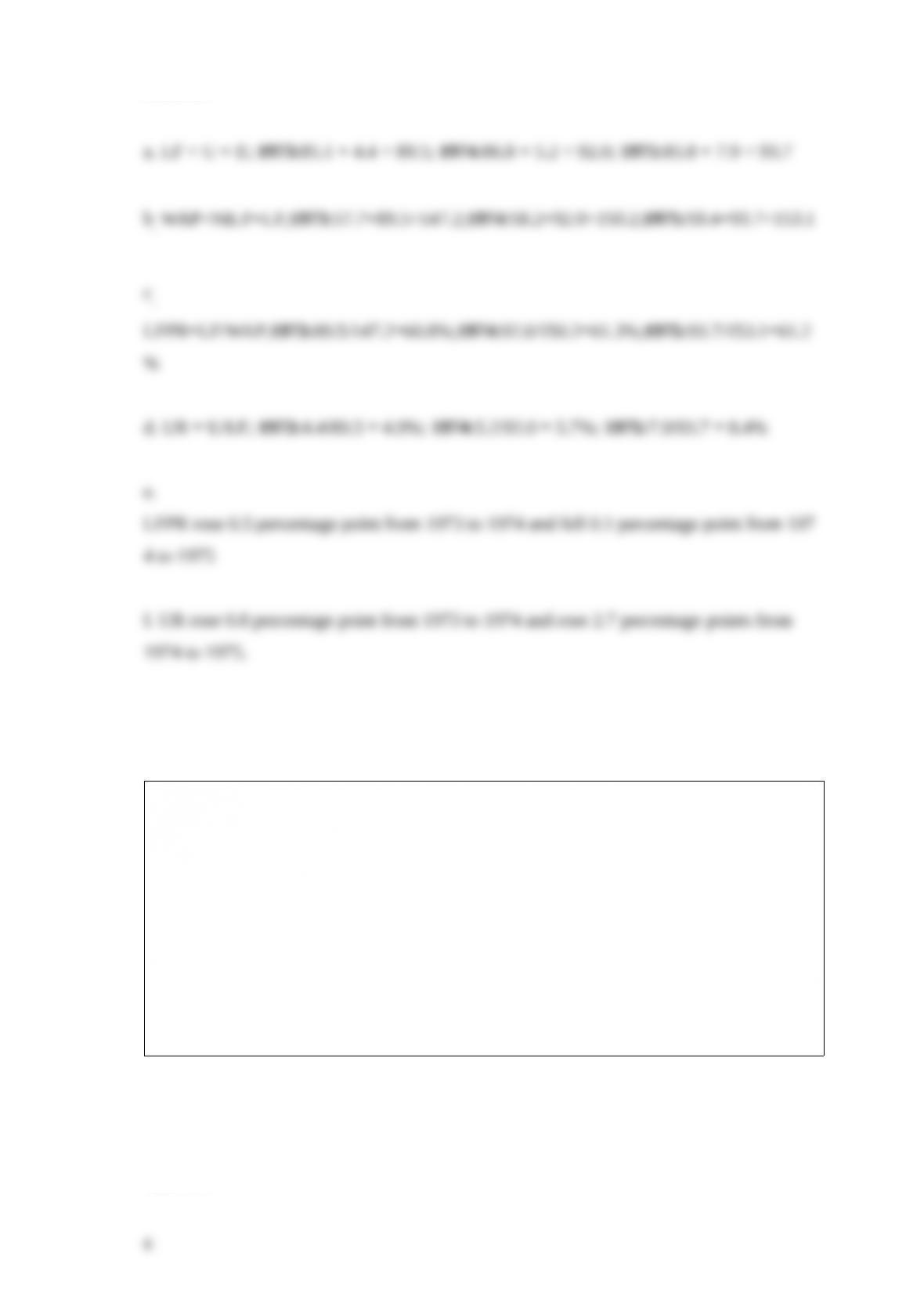
In the United States the number of people not in the labor force, employed, and
unemployed is shown in the table below for years 1973, 1974, and 1975 All numbers
are in millions.
a. For each year, calculate the number of people who are in the labor force.
b. For each year, calculate the number of people who are in the working-age population.
c. Calculate the labor-force participation rate.
d. Calculate the unemployment rate.
e. By how much did the labor-force participation rate change from 1973 to 1974 and
from 1974 to 1975?
f. By how much did the unemployment rate change from 1973 to 1974 and from 1974
to 1975?
Answer:
Which of the following statements is true?
a. Everything else remaining unchanged, higher the future value of an investment,
higher will be the present value.
b. Everything else remaining unchanged, higher the rate of discount on an investment,
higher will be the present value.
c. The future value of an investment is unrelated to the principal amount invested.
d. The future value of an investment is unrelated to the ongoing rate of interest.
Answer:

Usually inflation targets are set for a
a. low but positive inflation rate.
b. high and positive inflation rate.
c. negative inflation rate.
d. zero inflation rate.
Answer:
The mechanisms by which cash, checks, and electronic payments flow from buyers to
sellers are called
a. the transactions system.
b. float.
c. the payments system.
d. ACH.
Answer:

One half of a percentage point equals_____ basis points.
a.0.5
b. 5
c. 50
d. 500
Answer:
The proponents of repeal of the Glass-Steagall Act argued that repeal will
a. lead to an increase in operational and information costs of banks.
b. increase externalities because of banking problems.
c. reduce the international competitiveness of the commercial banks.
d. lead to the generation of a higher capital level.
Answer:
The change in output that is not accounted for by either changes in the amount of
capital or the amount of labor is known as
a. total factor productivity.

b. real output.
c. gross domestic value added.
d. attributable to net exports.
Answer:
A correlation of______between output growth in two regions would mean that output in
the two regions are inversely related.
a. 0
b. 1
c. 100
d. less than 0
Answer:
A financial intermediary
a. is a government-owned acceptor of deposits.
b. pools the funds of many people.

c. speculates in the stock market.
d. advances loans but does not accept deposits.
Answer:
Suppose that a change in the expected inflation rate leads supply and demand to adjust
so that the after-tax expected real interest rate is unchanged at 2.0 percent. The tax rate
is 30 percent. Initially, the expected inflation rate is 3.0 percent. If the expected inflation
rate falls from 6 percent to 0 percent, the nominal interest rate
a. rises by 8.5 percent.
b. rises by 4.25 percent.
c. falls by 4.25 percent.
d. falls by 8.5 percent.
Answer:
A debt security that pays interest forever and never repays the principal is a
a. fiduciary obligation.
b. federal funds loans.
c. perpetuity.

d. junk bond.
Answer:
Suppose the Federal Reserve is considering the applications of four different banks to
merge with XOAXOA banks. Given the level of the new HHI and the change in the
HHI shown below, in which case could the Fed challenge the merger?
a. New HHI = 1,900; change in HHI = 150
b. New HHI = 1,500; change in HHI = 400
c. New HHI = 1,200; change in HHI = 700
d. New HHI = 1,850; change in HHI = 250
Answer:
Which of the following is the main reason behind the financial crisis of 2008?
a. There was a sharp decline in the growth rate of money supply.
b. There was a sharp increase in the quantity of exports from the U.S. to Asian
countries.
c. Banks in the U.S. made subprime mortgage loans.

d. Banks had much higher requirements for borrowers to qualify for loans than normal.
Answer:
Which of the following best describes the reason why policymakers do not generally
like to commit to following a rule for monetary policy?
a. Because changes to the economy’s structure will prevent any rule from working well
for long
b. Because rules do not effectively prevent time-inconsistency
c. Because rules without credibility are worse than discretion
d. Because central bankers like to feel important
Answer:
RBC models are said to reproduce some important relationships between variables over
the U.S. business cycle.
Identify one such relationship from the given options.
a. Output growth is closely related to growth in investment expenditure over the
business cycle.
b. Over the course of the business cycle, consumption spending on physical capital
grow less than the investment spending on physical capital.

c. Over the course of the business cycle, consumption spending on physical capital
grow more than the investment spending on physical capital.
d. Output growth is closely related to growth in labor hours over the business cycle.
Answer:
A corporate bond with a financial rating of is likely to have the lowest yield to maturity.
a. Ccc
b. Baa
c. Aaa
d. BBB
Answer:
Which of the following is NOT a financial intermediary?
a. A credit union.
b. A life insurance company.
c. A mutual fund.

d. A labor union.
Answer:
A stock’s price is $20 at the beginning of a year. There is a 25 percent chance that the
price will be $17 at the end of the year, and a 75 percent chance that the price will be
$25 at the end of the year. The stock will pay a dividend of $3 during the year. The
expected return on the stock is _____percent.
a. 10
b. 20
c. 30
d. 40
Answer:
Consider a one-year discount bond that pays $1,500 one year from now. If the annual
rate of discount is 4 percent, the present value of the bond is
a. $1,560.00.
b. $1,540.00.
c. $1,440.00.

d. $1,442.31.
Answer:
M2 money multiplier equals
a. (nontransaction accounts + money market funds) ÷ monetary base
b. (M1 + nontransaction accounts money market funds) × reserves
c. (M2 money market funds) ÷ excess reserves
d. (M1 + nontransaction accounts + money market funds) ÷ monetary base
Answer:
In the CAMELS rating system, which is used to assess the health of the banks, the letter
C stands for
a. controls.
b. currency reserves.
c. capital adequacy.
d. compliance with regulations.

Answer:
There is strong evidence that political business cycles are prevalent in
a. Germany.
b. Japan.
c. the U.S.
d. New Zealand.
Answer:
Under the payoff method of handling a bank failure, the FDIC
a. takes over the bank and controls its operations.
b. closes the bank, sells off the assets, pays off insured depositors, and then pays off
creditors of the bank if funds remain.
c. keeps the bank open and lends funds to it so that it is able to continue its operation.
d. finds a buyer for the bank, giving the buyer the good assets of the bank, and assumes
the bad loans of the bank.
Answer:

Which of the following acts gives the responsibility as the lender of last resort to the
central bank in the U.S?
a. National Bank Act
b. Federal Reserve Act
c. Bank Holding Company Act
d. McFadden Act
Answer:
A thrift institution that obtains a federal charter obtains its charter from which
government agency?
a. The Federal Savings and Loan Insurance Corporation
b. Federal Reserve
c. The Office of Thrift Supervision
d. The Office of Comptroller of Currency
Answer:

Which terms in the equation for Taylor rule can be influenced by the government
through monetary policy?
a. Inflation gap and interest-rate spread
b. Unemployment gap and interest-rate spread
c. Interest-rate spread and unemployment gap
d. Output gap and inflation gap
Answer:
In the liquidity-preference model, the slope of the money supply curve implies that
a. money demand varies directly with the nominal interest rate.
b. money supply varies directly with the nominal interest rate.
c. nominal interest rate has no effect on the money demand.
d. nominal interest rate has no effect on the money supply.
Answer:

If a business firm takes out a loan from a bank, but does not use the funds as the bank
intended, the problem is
a. moral hazard.
b. adverse selection.
c. intermediation.
d. securitization.
Answer: