
Which one of the following is the primary determinant of an investment’s cost of
capital?
A. Life of investment
B. Initial cash outlay
C. Level of risk
D. Source of funds used for the investment
E. Investment’s net present value
Answer:
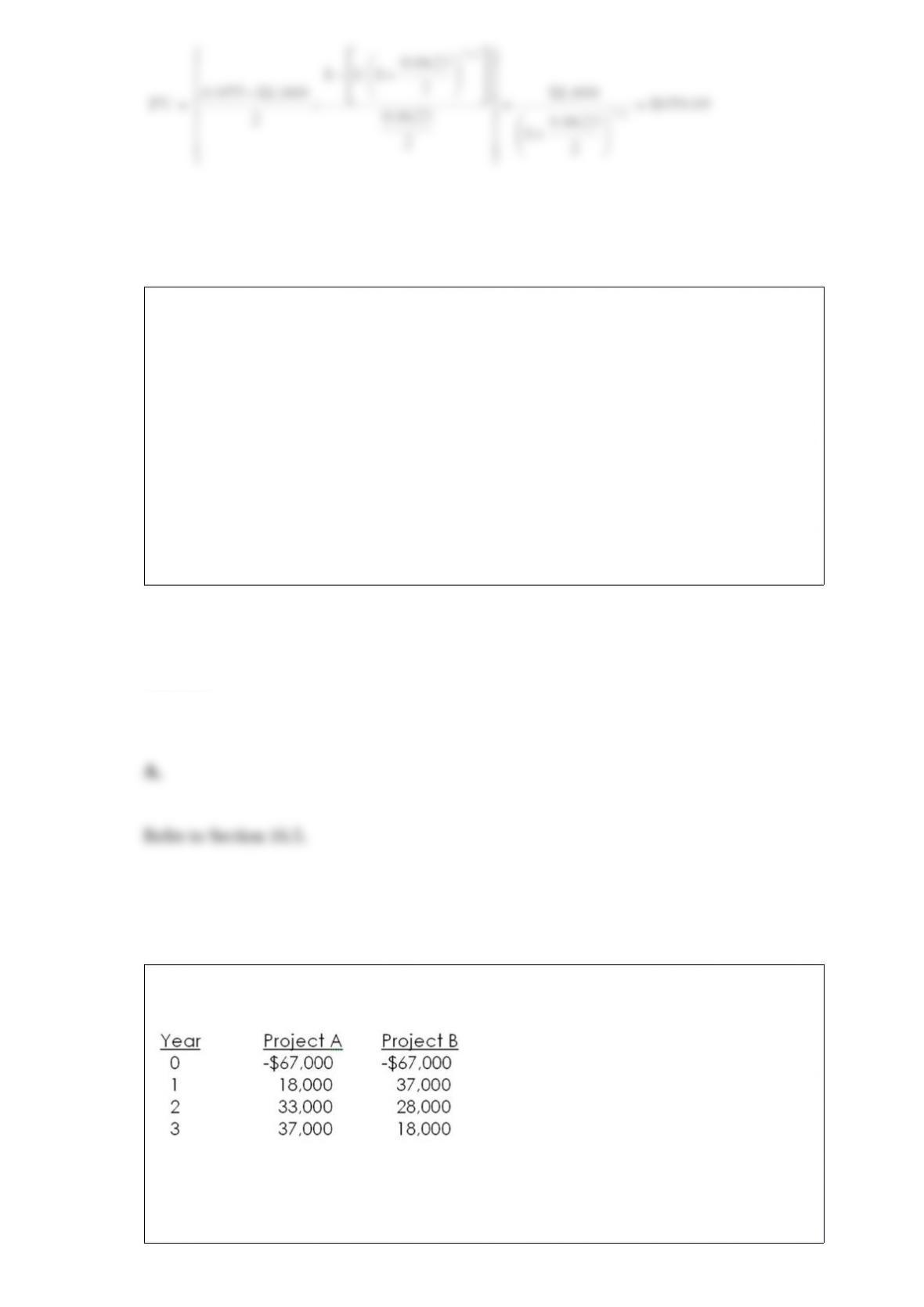
A 5.5 percent $1,000 bond matures in seven years, pays interest semiannually, and has a
yield to maturity of 6.23 percent. What is the current market price of the bond?
A. $945.08
B. $947.21
C. $959.09
D. $959.60
E. $962.40
Answer:
To ensure an unsecured line of credit is used solely for short-term purposes, the loan
arrangement frequently includes which one of the following?
A. Cleanup period
B. Grace period
C. Revolver
D. Factoring arrangement
E. Lien on the borrower’s inventory
Answer:
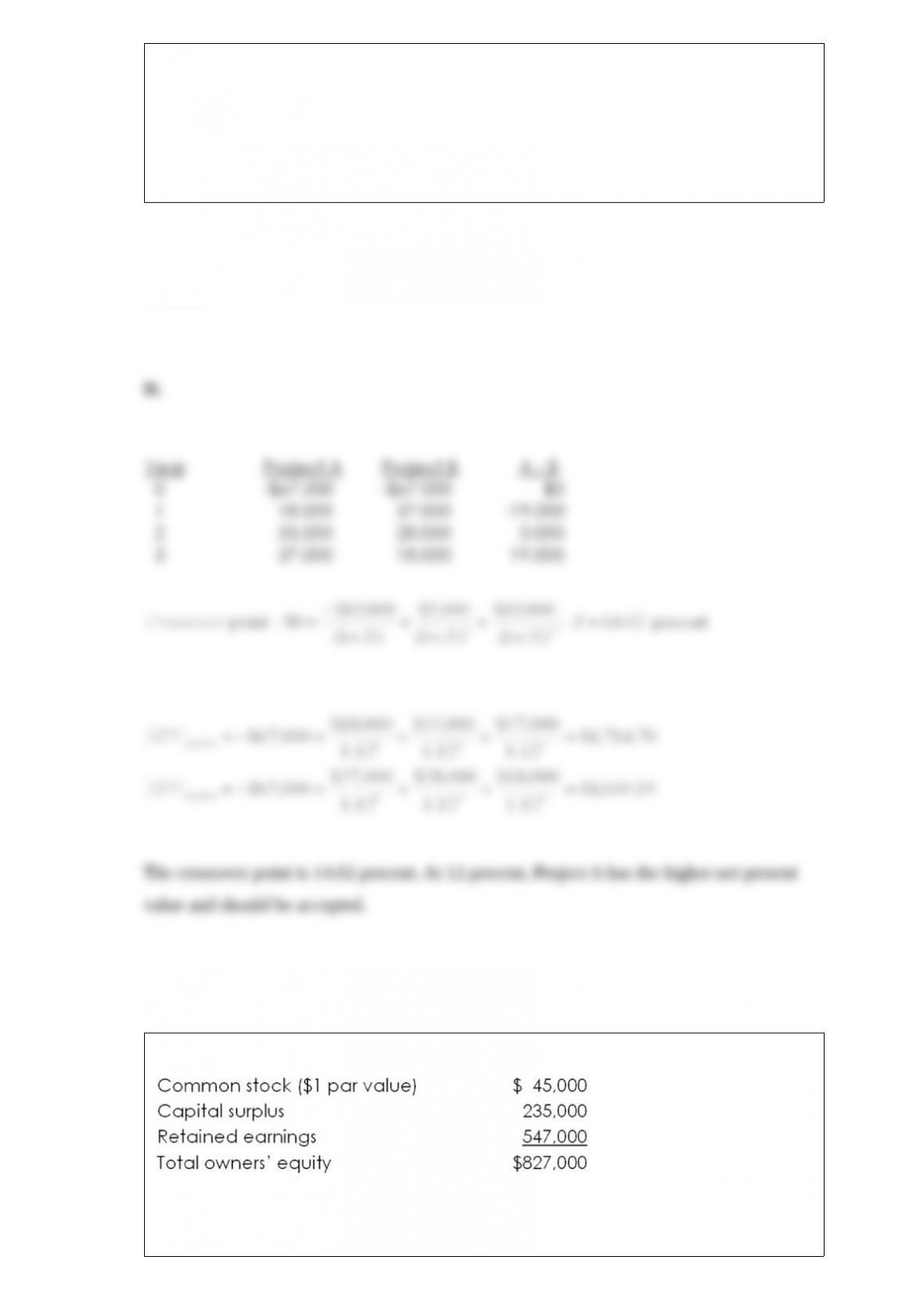
You are considering the following two mutually exclusive projects. The crossover point
is _____ and Project _____ should be accepted at a 12 percent discount rate.
A. 11.07 percent; B
B. 11.38 percent; A
C. 11.38 percent; B
D. 14.02 percent; A
E. 14.02 percent; B
Answer:
The owners’ equity accounts for Boats and More are shown here:
Assume Boats and More stock currently sells for $38 per share and a 10 percent stock
dividend is declared. What will be the new common stock account value?

A. $40,909
B. $45,000
C. $47,000
D. $48,511
E. $49,500
Answer:
A “floater” bond frequently has a:
A. flexible deferred call period.
B. fixed yield to maturity but a flexible coupon payment.
C. government guarantee.
D. fixed-dollar obligation.
E. put provision.
Answer:
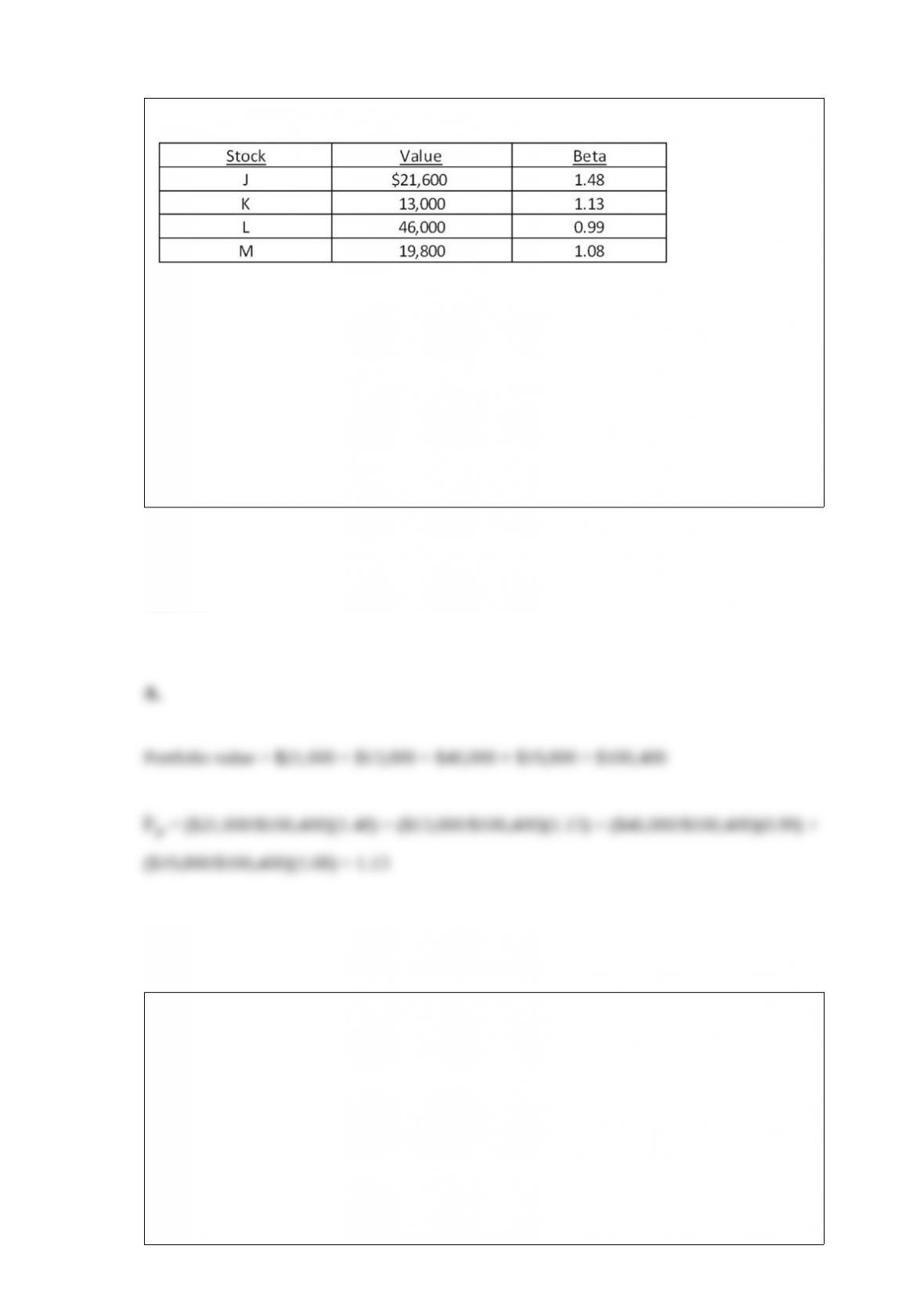
What is the beta of the following portfolio?
A. 1.13
B. 1.15
C. 1.17
D. 1.21
E. 1.23
Answer:
Dragon Trucking just paid its annual regular cash dividend of $1.25 a share, along with
a special dividend of $0.25 a share. The company follows a policy of increasing its
dividend by 3 percent annually. Which one of the following is the best estimate of the
firm’s next annual dividend payment?
A. $1.25
B. $1.29
C. $1.49

D. $1.50
E. $1.54
Answer:
Marti had an unexpected surprise when she ate her Lotsa Good cereal this morning. She
found a piece of metal mixed in her cereal. The potential claim that Marti has against
this firm is that of a(n):
A. general creditor.
B. debtholder.
C. shareholder.
D. stakeholder.
E. agent.
Answer:
Soul Foods recently liquidated its fast-food division. That unit represented 25 percent of
the firm’s overall market value. Prior to the liquidation, the firm’s stock was selling for
$40 a share, the annual dividend was steady at $1.30 per share, and there were 16,000
shares outstanding. The firm is preparing to distribute the entire liquidation proceeds to
shareholders. How much will the liquidating dividend be per share?
A. $0.24
B. $1.30
C. $6.10
D. $7.40
E. $10.00
Answer:
Which one of the following is the date on which the board of directors agrees to pay a
dividend and passes a resolution to do so?
A. Date of record
B. Ex-dividend date
C. Payment date
D. Declaration date
E. Public announcement date
Answer:

Hometown Builders is borrowing $150,000 today for five years. The loan is an
interest-only loan with an APR of 8.5 percent. Payments are to be made annually. What
is the amount of the first annual payment?
A. $12,750.00
B. $20,610.90.00
C. $30,029.18
D. $36,461.10
E. $41,300.00
Answer:
A nine-year project is expected to generate annual revenues of $114,500, variable costs
of $73,600, and fixed costs of $14,000. The annual depreciation is $3,500 and the tax
rate is 34 percent. What is the annual operating cash flow?
A. $14,301
B. $14,788
C. $15,052
D. $17,506
E. $18,944

Answer:
Which one of the following terms is used to identify the concept that exchange rates
vary to keep purchasing power constant among currencies?
A. Exchange rate equilibrium
B. Exchange rate parity
C. Universal parity
D. Market equilibrium
E. Purchasing power parity
Answer:
The exchange rate is 1.14 Swiss francs per U.S. dollar. How many U.S. dollars are
needed to purchase 2,000 Swiss francs?
A. $1,021.21
B. $1,754.39

C. $2,280.00
D. $2,850.00
E. $2,918.46
Answer:
What term is used to describe an account that a bond trustee manages for the sole
purpose of redeeming bonds early?
A. Registered account
B. Bearer account
C. Call account
D. Sinking fund
E. Premium fund
Answer:

The price of a stock at year 4 can be expressed as:
A. D0/(R + g4).
B. D0 (1 + R)5.
C. D1 (1 + R)5.
D. D4/(R – g).
E. D5/(R – g).
Answer:
A stock has a beta of 1.56 and an expected return of 17.3 percent. A risk-free asset
currently earns 5.1 percent. If a portfolio of the two assets has a beta of 1.06, what are
the portfolio weights?
A. Stock weight = 0.28; risk-free weight = 0.72
B. Stock weight = 0.032; risk-free weight = 0.68
C. Stock weight = 0.44; risk-free weight = 0.56
D. Stock weight = 0.68; risk-free weight = 0.32
E. Stock weight = 0.72; risk-free weight = 0.28
Answer:

Suppose that in 2010, a $10 silver certificate from 1898 sold for $11,200. For this to
have been true, what would the annual increase in the value of the certificate have
been?
A. 6.47 percent
B. 6.81 percent
C. 7.23 percent
D. 7.49 percent
E. 7.97 percent
Answer:
You want to buy a new sports car from Roy’s Cars for $51,800. The contract is in the
form of a 48-month annuity due at a 9.2 percent APR. What will your monthly payment
be?
A. $1,284.13
B. $1,309.29
C. $1,345.70

D. $1,352.98
E. $1,384.32
Answer:
Davidson Interiors declared a dividend to holders of record on Thursday, October 15,
that is payable on Monday, November 2. Suenette purchased 200 shares of Davidson
Interiors stock on Monday, October 12, and Jake purchased 100 shares of this stock on
the following day. Which one of the following statements is correct given this
information?
A. Both Suenette and Jake will receive this dividend.
B. Suenette will receive the dividend but Jake will not.
C. Jake will receive the dividend but Suenette will not.
D. Neither Suenette nor Jake will receive this dividend.
E. You cannot determine who will or will not receive this dividend based on the
information provided.
Answer:

A firm has a current ratio of 1.4 and a quick ratio of 0.9. Given this, you know for
certain that the firm:
A. pays cash for its inventory.
B. has more than half its current assets invested in inventory.
C. has more cash than inventory.
D. has more current liabilities than it does current assets.
E. has positive net working capital.
Answer:
Larry’s Gun Shop has sales of $189,000, a profit margin of 5.6 percent, and a capital
intensity ratio of 0.79. What is the return on assets?
A. 4.42 percent
B. 6.08 percent
C. 6.39 percent
D. 6.92 percent
E. 7.09 percent
Answer:
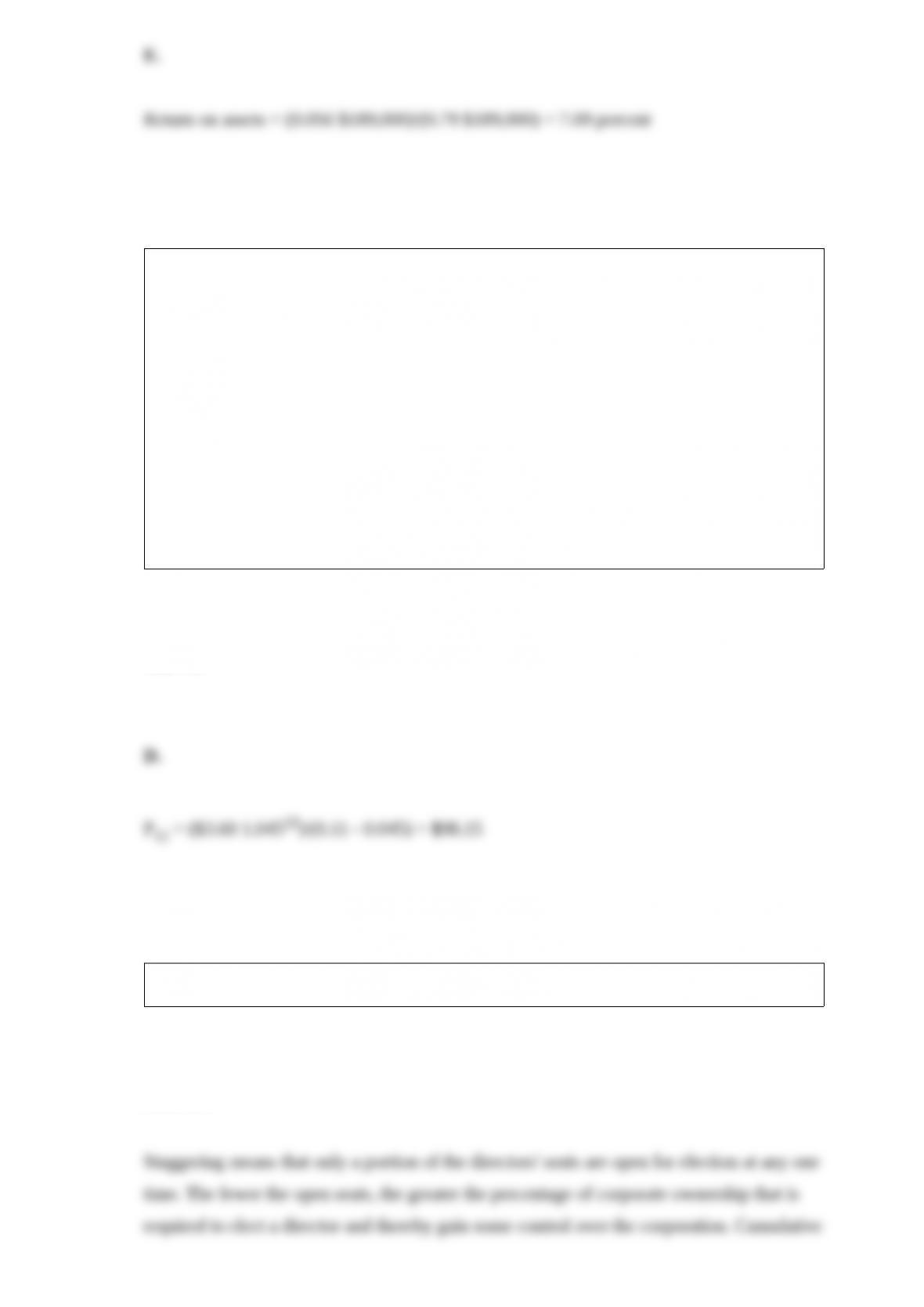
Charles Berkeley, Inc. just paid an annual dividend of $3.60 per share on its stock. The
dividends are expected to grow at a constant rate of 4.5 percent per year, indefinitely. If
investors require an 11 percent return on this stock, what will the price be in 12 years?
A. $91.71
B. $93.62
C. $95.75
D. $98.15
E. $102.57
Answer:
Explain how staggering offsets some of the benefits associated with cumulative voting.
Answer:
Over the next three years, you expect the rate of inflation to decrease, but yet remain
positive. After that, you expect inflation to increase steadily for the next several years.
Draw a term structure of interest rates graph based on this assumption and identify all
the components of that structure.
Answer:
You want to have $2.5 million saved on the day you retire. Explain how you can
minimize the amount of cash you must invest in order to achieve this goal.
Answer:
Using a security market line graph, illustrate a security that is overpriced and has a beta
of 0.89. Label all relevant points, including those that represent the overall market.
Explain why the security plots as you have illustrated it.
Answer:
Assume a fellow student made these statements during a class discussion: “Bankruptcy
costs affect a firm only if the firm files a bankruptcy petition with the court. Therefore,
the static theory of capital structure only applies to bankrupt firms.” Write a response to
your fellow student that either supports or contradicts that student’s statements.
Answer:
Explain the relationships among the reward-to-risk ratio, risk-free rate of return, market
rate of return, market risk premium, beta, and the security market line.
Answer:
Assume this is your first day on the job as the new chief financial officer of a midsize
company. Identify the three key ratios that you would compute first as you begin to try
to understand the financial status of the firm. Explain why you selected the three ratios
that you did.
Answer: