
Which of the following is NOT an advantage of a sole proprietorship?
A) Single taxation
B) Ease of setup
C) Limited liability
D) No separation of ownership and control
Assume that the corporate tax rate is 40%, the personal tax rate on income from equity
is 20% the personal rate on interest income is 36%. The effective tax advantage of a
corporate issuing debt would be closest to:
A) 10%
B) 15%
C) 25%
D) 28%
Consider the following average annual returns:
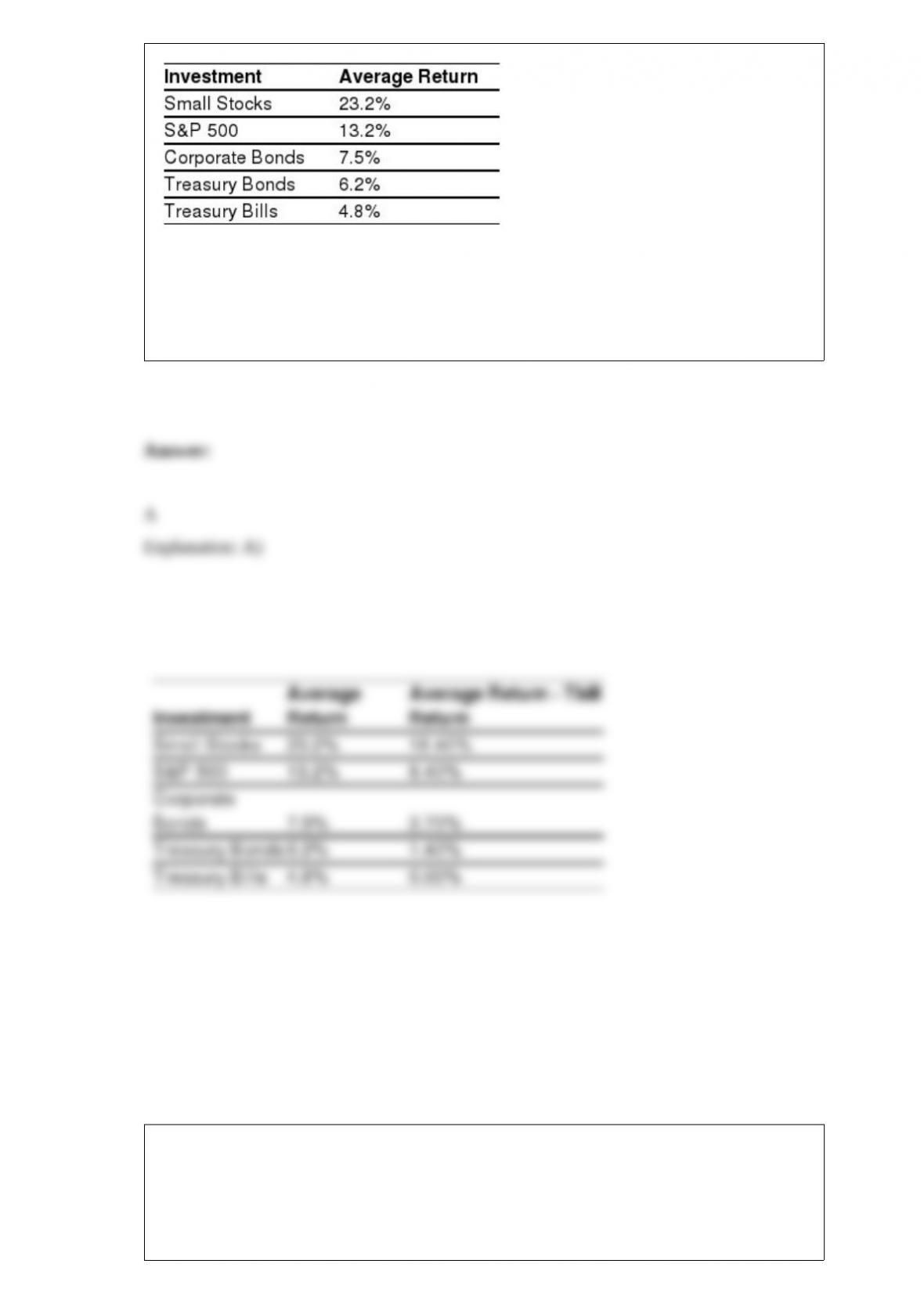
What is the excess return for Treasury Bills?
A) 0%
B) -8.4%
C) -2.7%
D) -1.4%
Which of the following types of risk doesn’t belong?
A) Market risk
B) Unique risk
C) Idiosyncratic risk
D) Unsystematic risk

Which of the following statements is FALSE?
A) The market portfolio is the efficient portfolio.
B) Many practitioners believe it is sensible to use the CAPM and the security market
line as a practical means to estimate a stock’s required return and therefore a firm’s
equity cost of capital.
C) If we plot individual securities according to their expected return and beta, the
CAPM implies that they should all fall along the CML.
D) As savvy investors attempt to trade to improve their portfolios, they raise the price
and lower the expected return of the positive alpha stocks, and they depress the price
and raise the expected return of negative alpha stocks, until the stocks are once again on
the security market line and the market portfolio is efficient.
Consider the following linear regression model:
(Ri– rf) = ai+ bi(RMkt– rf) + ei
The biin the regression
A) measures the sensitivity of the security to market risk.
B) measures the historical performance of the security relative to the expected return
predicted by the SML.
C) measures the deviation from the best fitting line and is zero on average.
D) measures the diversifiable risk in returns.
If it is managed efficiently, Luther industries will have assets with market value of $100
million, $300, million, or $500 million next year, with each outcome being equally
likely. Managers may, however, engage in wasteful empire building which will reduce
the firm’s market value by $20 million in all cases. Managers may also increase the risk
of the firm, changing the probability of each outcome to 50%, 20%, and 30%

respectively.
If its managers engage in empire building, then the expected market value of Luther’s
assets is closest to:
A) $260
B) $280 million
C) $240
D) $300 million
Monsters Incorporated (MI) in ready to launch a new product. Depending upon the
success of this product, MI will have a value of either $100 million, $150 million, or
$191 million, with each outcome being equally likely. The cash flows are unrelated to
the state of the economy (i.e. risk from the project is diversifiable) so that the project
has a beta of 0 and a cost of capital equal to the risk-free rate, which is currently 5%.
Assume that the capital markets are perfect.
Assume that in the event of default, 20% of the value of MI’s assets will be lost in
bankruptcy costs and suppose that MI has zero-coupon debt with a $125 million face
value due next year. The present value of MI’s financial distress costs is closest to:
A) $20.0 million
B) $6.6 million
C) $6.3 million
D) $19.0 million

Which of the following statements is FALSE?
A) The optimal level of debt D*, balances the costs and benefits of leverage.
B) As the debt level increases, the firm benefits from the interest tax shield (which has
present value Ï„*D).
C) If the debt level is too large firm value is reduced due to the loss of tax benefits
(when interest exceeds EBIT), financial distress costs, and the agency costs of leverage.
D) As the debt level increases, the firm faces worse incentives for management, which
increase wasteful investment and perks.
Which of the following statements is FALSE?
A) The creditors must vote to accept the Chapter 11 reorganization plan, and the
bankruptcy court must approve it. If an acceptable plan is not put forth, the court may
ultimately force a Chapter 7 liquidation of the firm.
B) In Chapter 13 liquidation, a trustee is appointed to oversee the liquidation of the
firm’s assets through an auction. The proceeds from the liquidation are used to pay the
firm’s creditors, and the firm ceases to exist.
C) When a corporation becomes financially distressed, outside professionals, such as
legal and accounting experts, consultants, appraisers, auctioneers, and others with
experience selling distressed assets, are generally hired.
D) In the case of Chapter 11 reorganization, creditors must often wait several years for
a reorganization plan to be approved and to receive payment.
Which of the following statements is FALSE?
A) Many practitioners analyze other financial characteristics of a firm, when they

forecast betas.
B) U.S. Treasuries are never subject to interest rate risk unless we select a maturity
equal to our investment horizon.
C) If a firm where to change industries, using its historical beta would be inferior to
using the beta of other firms in the new industry.
D) When using historical returns to forecast future betas, we must be mindful of
changes in the environment that might cause the future to differ from the past.
Flagstaff Enterprises expected to have free cash flow in the coming year of $8 million,
and this free cash flow is expected to grow at a rate of 3% per year thereafter. Flagstaff
has an equity cost of capital of 13%, a debt cost of capital of 7%, and it is in the 35%
corporate tax bracket.
If Flagstaff currently maintains a .5 debt to equity ratio, then the value of Flagstaff as an
all equity firm would be closest to:
A) $80 million
B) $100 million
C) $73 million
D) $115 million
Aardvark Industries is considering a project that will generate the following free cash
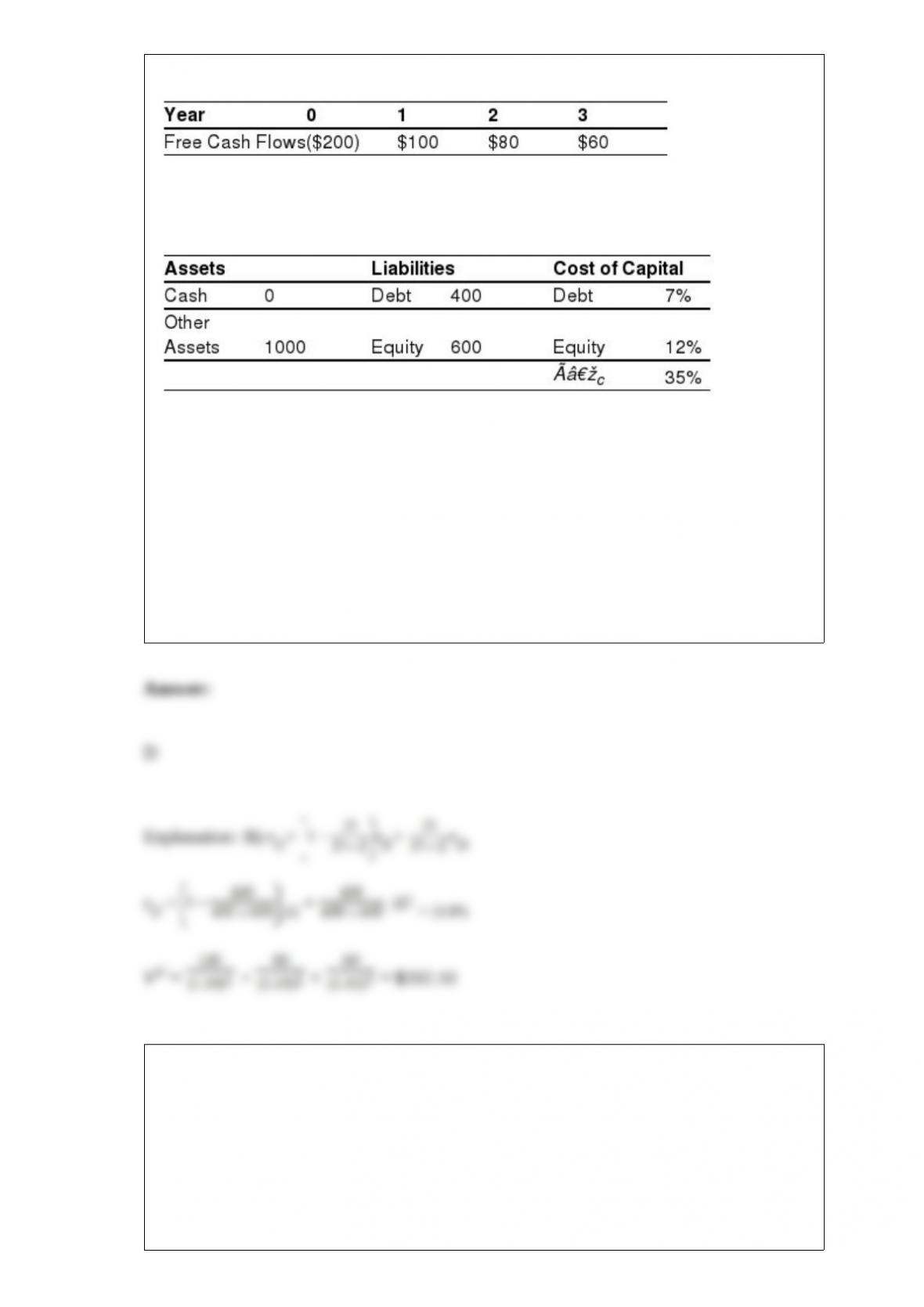
flows:
You are also provided with the following market value balance sheet and information
regarding Aardvark’s cost of capital:
The unlevered value of Aardvark’s new project is closest to:
A) $205
B) $100
C) $164
D) $202
Galt Industries is expected to generate free cash flows of $24 million per year. Galt has
permanent debt of $80 million, a corporate tax rate of 40%, and an unlevered cost of
capital of 12% and its cost of debt capital is 6%.Galt’s free cash flow to equity (FCFE)
is closest to:
A) $19.2 million
B) $20.4 million

C) $21.2 million
D) $24.0 million
Bubba Ho-Tep Company reported net income of $300 million for the most recent fiscal
year. The firm had depreciation expenses of $125 million and capital expenditures of
$150 million. Although they had no interest expense, the firm did have an increase in
net working capital of $20 million. What is Bubba Ho-Tep’s free cash flow?
A) $170 million
B) $255 million
C) $150 million
D) $5 million
Consider the following equation:
Pcum– Pex= Div ×
The term Pcum is:

A) the personal tax rate for capital gains.
B) the price per share after a dividend is paid.
C) the price per share before a dividend is paid.
D) the personal tax rate for dividend.