
If ECE’s net profit margin is 8% , then ECE’s return on equity (ROE) is:
A) 10%
B) 12%
C) 24%
D) 30%
Answer:
Which of the following statements is false?
A) Out-of-the-money calls have the highest expected returns and out-of-the-money puts
have the lowest expected returns.
B) The expression SΔ/(SΔ + B) is the ratio of the amount of money in the stock position
in the replicating portfolio to the value of the replicating portfolio (or the option price);
it is known as theleverage ratio.
C) The beta of a portfolio is just the weighted average beta of the constituent securities
that make up the portfolio.
D) The magnitude of the leverage ratio for options is usually very small, especially for
out-of-the-money options.

Answer:
Boulderado has come up with a new composite snowboard. Development will take
Boulderado four years and cost $250,000 per year, with the first of the four equal
investments payable today upon acceptance of the project. Once in production the
snowboard is expected to produce annual cash flows of $200,000 each year for 10
years. Boulderado’s discount rate is 10%.
Calculate the IRR for the snow board project and use it to determine he maximum
deviation allowable in the cost of capital estimate that leaves the investment decision
unchanged. The maximum deviation allowable is closest to:
A) 11.0%
B) 0.0%
C) 2.5%
D) 1.0%
Answer:
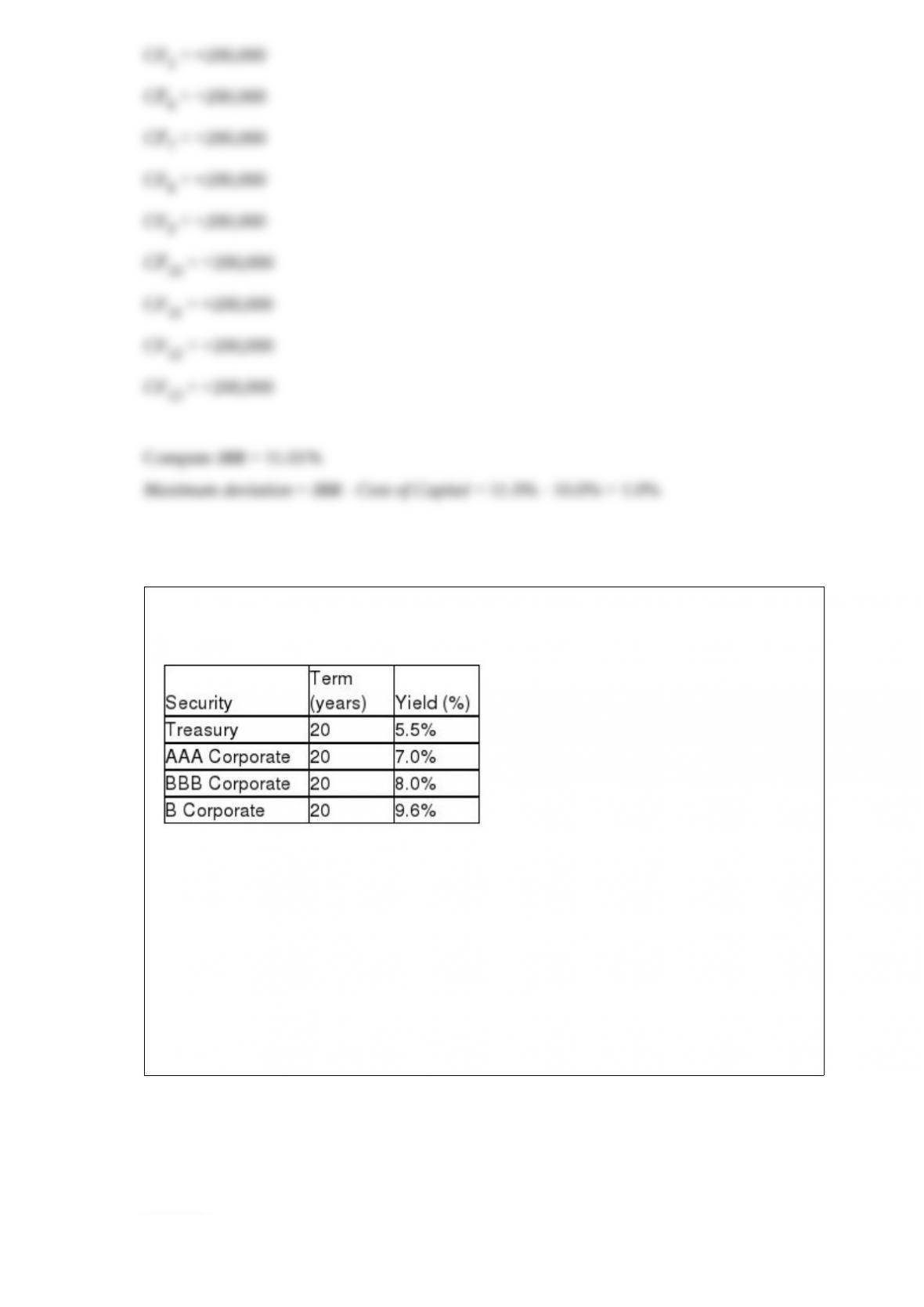
Use the following information to answer the question(s) below.
The credit spread on AAA-rated corporate bonds is:
A) 1.0%
B) 1.5%
C) 2.6%
D) 4.1%
Answer:

Which of the following statements is false?
A) With no debt, the WACC is equal to the unlevered equity cost of capital.
B) With perfect capital markets, a firm’s WACC is dependent of its capital structure and
is equal to its equity cost of capital only the firm it is unlevered.
C) As the firm borrows at the low cost of capital for debt, its equity cost of capital rises,
but the net effect is that the firm’s WACC is unchanged.
D) Although debt has a lower cost of capital than equity, leverage does not lower a
firm’s WACC.
Answer:
Use the following information to answer the question(s) below.
Taggart Transcontinental is considering adding a trucking division to expand the
coverage of its existing rail lines. The trucking division will cost $1,000,000 and is
expected to generate free cash flows of $100,000 for each of the next five years.
Taggart Transcontinental forecasts that future free cash flows after year 5 will grow at
2% per year, forever. Taggart Transcontinental’s cost of capital is 10%.
The continuation value for the trucking division in year five is closest to:
A) 1,000,000

B) 1,250,000
C) 1,275,000
D) 1,375,000
Answer:
Which of the following statements regarding the NPV decision rule is false?
A) Reject projects with a NPV of zero, as accepting them is equivalent to reducing firm
value.
B) When faced with a set of alternatives, choose the one with the highest NPV.
C) Accept those projects with a positive NPV, as accepting them is equivalent to
receiving their NPV in cash today.
D) Reject those projects with a negative NPV..
Answer:
Which of the following equations is incorrect?
A)

B)
C)
D) (Pcum – Pex)(1 – τd) = Div(1 – τg)
Answer:
Which of the following statements is false?
A) The break-even level of an input is the level for which the investment has an IRR of
zero.
B) The most difficult part of capital budgeting is deciding how to estimate the cash
flows and the cost of capital.
C) When evaluating a capital budgeting project, financial managers should make the
decision that maximizes NPV.
D) Sensitivity analysis reveals which aspects of the project are most critical when we
are actually managing the project.
Answer:

Which of the following statements is false?
A) If investors have homogeneous expectations, then each investor will identify the
same portfolio as having the highest Sharpe ratio in the economy.
B) Homogeneous expectations are when all investors have the same estimates
concerning future investments and returns.
C) There are many investors in the world, and each must have identical estimates of the
volatilities, correlations, and expected returns of the available securities.
D) The combined portfolio of risky securities of all investors must equal the efficient
portfolio.
Answer:
Use the tables for the question(s) below.
Pro Forma Income Statement for Ideko, 2005-2010
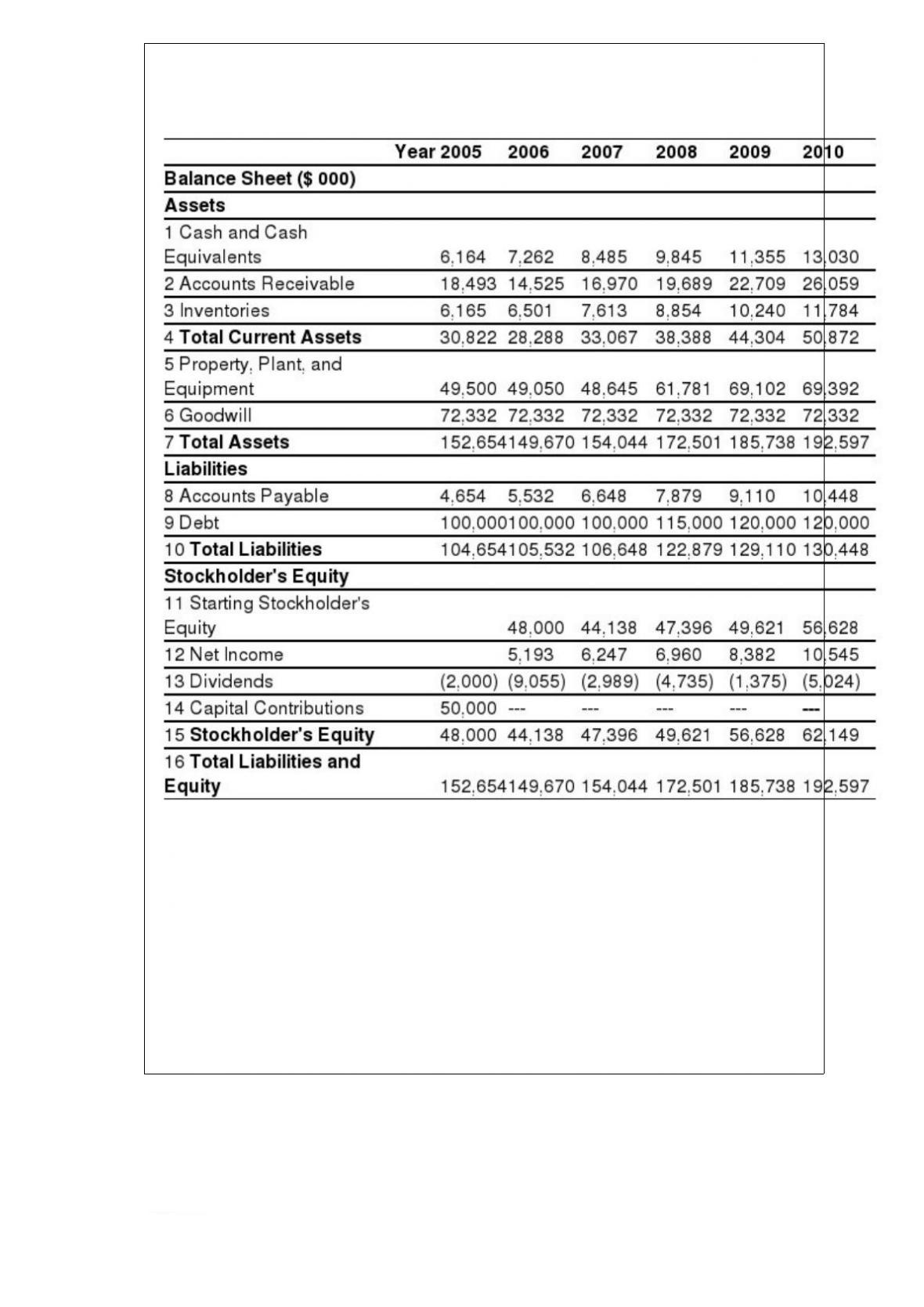
Pro Forma Balance Sheet for Ideko, 2005-2010
Assuming that Ideko has a EBITDA multiple of 8.5, then the continuation equity value
of Ideko in 2010 is closest to:
A) $181.7 million
B) $272.8 million
C) $152.8 million
D) $301.7 million
Answer:

Use the following information to answer the question(s) below.
Nielson Motors (NM) is a newly public firm with 25 million shares outstanding. You
are doing a valuation analysis of Nielson and you estimate its free cash flow in the
coming year to be $40 million. You expect the firm’s free cash flows to grow by 4% per
year in subsequent years. Because the firm has only been listed on the stock exchange
for a short time, you do not have an accurate assessment of Nielson’s equity beta.
However, you do have the following data for another firm in the same industry:
Nielson has a much lower debt-equity ratio of .5, which is expected to remain stable,
and Nielson’s debt is risk free. Nielson’s corporate tax rate is 40%, the risk-free rate is
5%, and the expected return on the market portfolio is 10%.
Nielson’s equity cost of capital is closest to:
A) 11.3%
B) 12.2%
C) 14.0%
D) 14.4%
Answer:

Which of the following statements is false?
A) The Capital Asset Pricing Model is the most important method for estimating the
cost of capital that is used in practice.
B) Because the risk that determines expected returns is unsystematic risk, which is
measured by beta, the cost of capital for an investment is the expected return available
on securities with the same beta.
C) A common assumption is that the project has the same risk as the firm.
D) To determine a project’s cost of capital we need to estimate its beta.
Answer:

Which of the following statements is false?
A) Regardless of the loan structure, the bank may include a compensating balance
requirement in the loan agreement that reduces the usable loan proceeds.
B) Another common type of fee is a loan origination fee, which a bank charges to cover
credit checks and legal fees.
C) Firms frequently use lines of credit to finance seasonal needs.
D) The commitment fee associated with a committed line of credit is designed to
decreases the effective cost of the loan to the firm.
Answer:
Which of the following statements is false?
A) Once a company goes public, it must satisfy all of the requirements of public
companies.
B) Organizations such as the Securities and Exchange Commission (SEC), the
securities exchanges (including the New York Stock Exchange and the Nasdaq), and
Congress (through the Sarbanes-Oxley Act of 2002) adopted new standards that focused
on more thorough financial disclosure, greater accountability, and more stringent
requirements for the board of directors.
C) The major advantage of undertaking an IPO is also one of the major disadvantages
of an IPO: When investors diversify their holdings, the equity holders of the corporation
become more concentrated.
D) Several high profile corporate scandals during the early part of the twenty-first
century prompted tougher regulations designed to address corporate abuses.

Answer:
Which of the following statements regarding capital leases is false?
A) Because capital leases increase the apparent leverage on the firm’s balance sheet,
firms sometimes prefer to have a lease categorized as an operating lease to keep it off
the balance sheet.
B) The firm does not report the present value of the future lease payments as a liability
on the balance sheet.
C) The asset acquired is listed on the lessee’s balance sheet, and the lessee incurs
depreciation expenses for the asset.
D) They are viewed as an acquisition for accounting purposes.
Answer:
Which of the following statements is false?
A) The standard deviation is the square root of the variance.
B) Because investors dislike only negative resolutions of uncertainty, alternative
measures that focus solely on downside risk have been developed, such as the
semi-variance and the expected tail loss.

C) While the variance and the standard deviation are the most common measures of
risk, they do not differentiate between upside and downside risk.
D) While the variance and the standard deviation both measure the variability of the
returns, the variance is easier to interpret because it is in the same units as the returns
themselves.
Answer:
The Sarbanes-Oxley Act requires all of the following except
A) that audit partners rotate every five years to limit the likelihood that auditing
relationships become too cozy over long periods of time.
B) strict limits on the amount of non-audit fees (consulting or otherwise) that an
accounting firm can earn from the same firm that it audits.
C) that senior management and the boards of public companies to be comfortable
enough with the process through which funds are allocated and controlled, and
outcomes monitored throughout the firm, to be willing to attest to their effectiveness
and validity.
D) the auditor must personally attest to the accuracy of the financial statements
presented to shareholders and to sign a statement to that effect.
Answer:

Which of the following statements is false?
A) An active takeover market is part of the system through which the threat of dismissal
is maintained.
B) When internal governance systems such as ownership, compensation, board
oversight, and shareholder activism fail, the one remaining way to remove poorly
performing managers is by mounting a hostile takeover.
C) Likely because hostile takeovers and internal governance systems are substitute
mechanisms, researchers have found that boards are less likely to fire managers for
poor performance during active takeover markets than they are during lulls in takeover
activity.
D) The effectiveness of the corporate governance structure of a firm depends on how
well protected its managers are from removal in a hostile takeover.
Answer:
Off-balance sheet transactions are required to be disclosed
A) in the management discussion and analysis.
B) in the auditor’s report.
C) in the Securities and Exchange Commission’s commentary.
D) in the statement of stockholders’ equity.
Answer:

The tendency of uninformed individuals to overestimate the precision of their
knowledge is known as
A) overconfidence bias.
B) herd behavior.
C) familiarity bias.
D) disposition bias.
Answer:
Use the following information to answer the question(s) below.
Galt Industries has no debt, total equity capitalization of $600 million, and an equity
beta of 1.2. Included in Galt’s assets is $90 million in cash and risk-free securities.
Assume the risk-free rate is 4% and the market risk premium is 6%.
Galt’s WACC is closest to:
A) 10.6%
B) 11.2%
C) 11.8%
D) 12.5%
Answer:

A tax free municipal bond pays an effective annual rate of 7.2%. If your tax rate is 30%,
then the effective annual rate that a comparable corporate bond would have to offer you
an equivalent after tax return would be closest to:
A) 5.0%
B) 7.2%
C) 9.4%
D) 10.3%
Answer:
Treasury securities that are semiannual coupon bonds with original maturities of
between 1 and 10 years are called
A) Treasury bonds.
B) Treasury bills.
C) Treasury notes.
D) TIPS.

Answer:
Which of the following statements is false?
A) If a factoring arrangement is with recourse, the factor will pay the firm the amount
due regardless of whether the factor receives payment from the firm’s customers.
B) In a factoring of accounts receivablearrangement, the firm sells receivables to the
lender (i.e., the factor), and the lender agrees to pay the firm the amount due from its
customers at the end of the firm’s payment period.
C) Businesses can also obtain short-term financing by using secured loans, which are
loans collateralized with short-term assetsmost typically the firm’s accounts receivables
or inventory.
D) Both the interest rate and the factor’s fee vary depending on such issues as the size of
the borrowing firm and the dollar volume of its receivables.
Answer:
Consider the following investment alternatives:

The lowest effective rate of return you could earn on any of these investments is closest
to:
A) 6.150%
B) 6.250%
C) 6.289%
D) 6.300%
Answer:
Use the information for the question(s) below.
Temporary Housing Services Incorporated (THSI) is considering a project that involves
setting up a temporary housing facility in an area recently damaged by a hurricane.
THSI will lease space in this facility to various agencies and groups providing relief
services to the area. THSI estimates that this project will initially cost $5 million to
setup and will generate $20 million in revenues during its first and only year in
operation (paid in one year). Operating expenses are expected to total $12 million
during this year and depreciation expense will be another $3 million. THSI will require
no working capital for this investment. THSI’s marginal tax rate is 35%.
Assume that THSI’s cost of capital for this project is 15%. The NPV of this temporary

housing project is closest to:
A) $435,000
B) -$650,000
C) $1,960,000
D) -$435,000
Answer:
A lease where the lessee can purchase the asset at the minimum of its fair market value
and a fixed price is called a
A) $1.00 out lease.
B) fixed price lease.
C) fair market value lease.
D) fair market value cap lease.
Answer:

Which of the following statements is false?
A) We can measure a firm’s sensitivity to interest rates by computing the duration of its
balance sheet.
B) Just as the interest rate sensitivity of a single cash flow increases with its maturity,
the interest rate sensitivity of a stream of cash flows increases with its duration.
C) By restructuring the balance sheet to increase its duration, we can hedge the firm’s
interest rate risk.
D) A firm’s market capitalization is determined by the difference in the market value of
its assets and its liabilities.
Answer:
Which of the following statements is false?
A) Decision nodes are nodesin which uncertainty is involved that is out of the control of
the decision maker.
B) Most investment projects allow for the possibility of reevaluating the decision to
invest at a later point in time.
C) A decision tree is a graphical representation of future decisions and uncertainty
resolution.
D) With binomial trees the uncertainty is not under the control of the decision maker.
Answer:

Which of the following statements is false?
A) After a firm decides on its credit standards, it must next establish its credit terms.
B) The decision of how much credit risk to assume plays a large role in determining
how much money a firm ties up in its payables.
C) Knowledge of the payments pattern is also useful for forecasting the firm’s working
capital requirements.
D) An aging schedulecategorizes accounts by the number of days they have been on the
firm’s books.
Answer: