
Which of the following statements about convertibles is most CORRECT?
a.The coupon interest rate on a firm’s convertibles is generally set higher than the
market yield on its otherwise similar straight debt.
b.One advantage of convertibles over warrants is that the issuer receives additional cash
money when convertibles are converted.
c.Investors are willing to accept a lower interest rate on a convertible than on otherwise
similar straight debt because convertibles are less risky than straight debt.
d.At the time it is issued, a convertible’s conversion (or exercise) price is generally set
equal to or below the underlying stock’s price.
e.For equilibrium to exist, the expected return on a convertible bond must normally be
between the expected return on the firm’s otherwise similar straight debt and the
expected return on its common stock.
Helena Furnishings wants to reduce its cash conversion cycle. Which of the following
actions should it take?
a.Increases average inventory without increasing sales.
b.Take steps to reduce the DSO.
c.Start paying its bills sooner, which would reduce the average accounts payable but not
affect sales.
d.Sell common stock to retire long-term bonds.
e.Sell an issue of long-term bonds and use the proceeds to buy back some of its
common stock.
Other things held constant, which of the following will cause an increase in net working
capital?
a.Cash is used to buy marketable securities.
b.A cash dividend is declared and paid.
c.Merchandise is sold at a profit, but the sale is on credit.
d.Long-term bonds are retired with the proceeds of a preferred stock issue.
e.Missing inventory is written off against retained earnings.
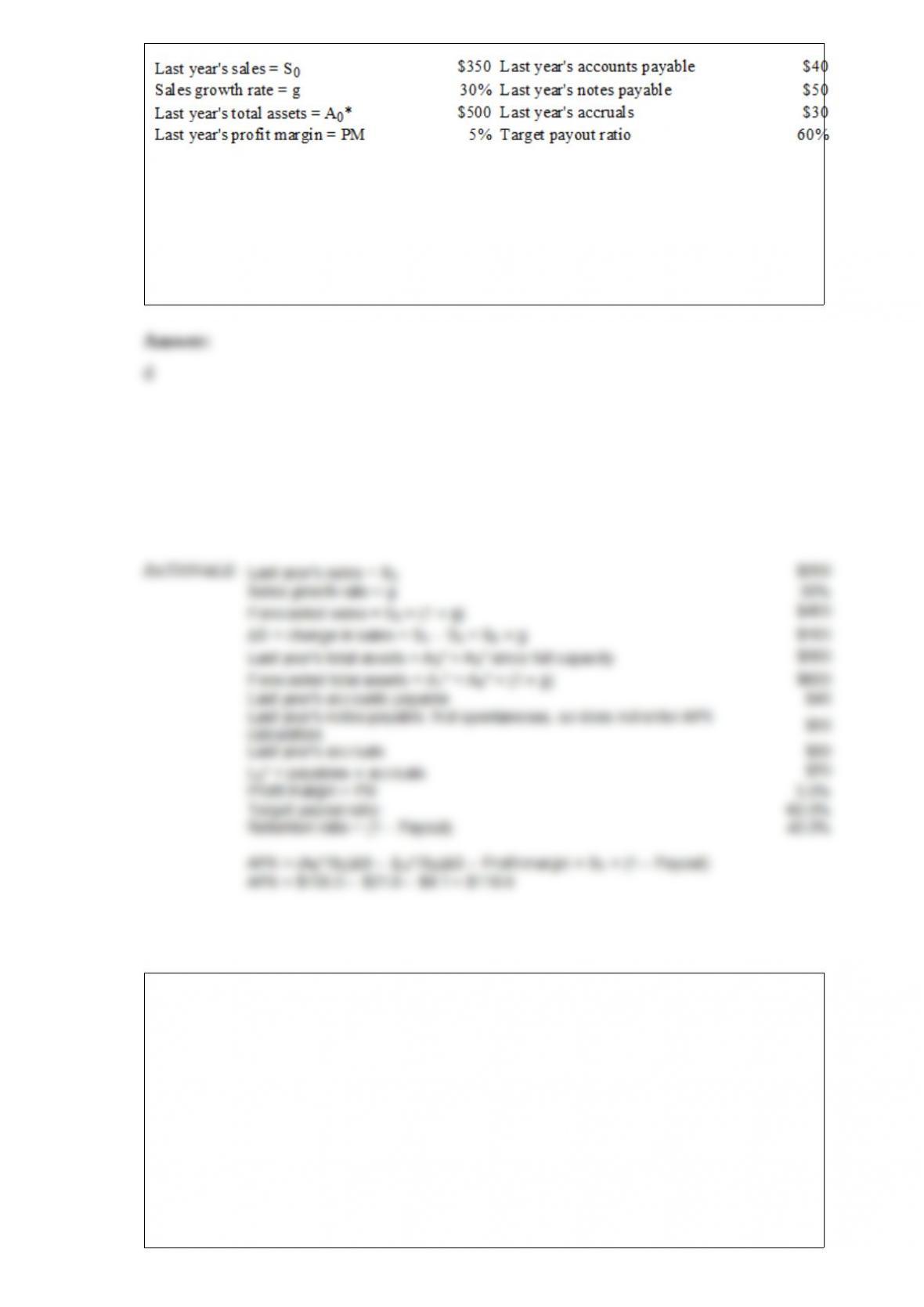
Clayton Industries is planning its operations for next year. Ronnie Clayton, the CEO,
wants you to forecast the firm’s additional funds needed (AFN). Data for use in your
forecast are shown below. Based on the AFN equation, what is the AFN for the coming
year? Dollars are in millions.
a.$102.8
b.$108.2
c.$113.9
d.$119.9
e.$125.9
Which of the following statements is CORRECT?
a.The degree of operating leverage (DOL) depends on a company’s fixed costs, variable
costs, and sales. The DOL formula assumes (1) that fixed costs are constant and (2) that
variable costs are a constant proportion of sales.
b.The degree of total leverage (DTL) is equal to the DOL plus the degree of financial
leverage (DFL).
c.Arithmetically, financial leverage and operating leverage offset one another so as to
keep the degree of total leverage constant. Therefore, the formula shows that the greater
the degree of financial leverage, the smaller the degree of operating leverage.
d.For a given change in sales, the corresponding percentage change in net income could
be more or less than the percentage change in operating income.

e.The degree of total leverage (DTL) is equal to the DFL divided by the degree of
operating leverage (DOL).
Stock A has a beta of 0.8, Stock B has a beta of 1.0, and Stock C has a beta of 1.2.
Portfolio P has equal amounts invested in each of the three stocks. Each of the stocks
has a standard deviation of 25%. The returns on the three stocks are independent of one
another (i.e., the correlation coefficients all equal zero). Assume that there is an increase
in the market risk premium, but the risk-free rate remains unchanged. Which of the
following statements is CORRECT?
a.The required return of all stocks will remain unchanged since there was no change in
their betas.
b.The required return on Stock A will increase by less than the increase in the market
risk premium, while the required return on Stock C will increase by more than the
increase in the market risk premium.
c.The required return on the average stock will remain unchanged, but the returns of
riskier stocks (such as Stock C) will increase while the returns of safer stocks (such as
Stock A) will decrease.
d.The required returns on all three stocks will increase by the amount of the increase in
the market risk premium.
e.The required return on the average stock will remain unchanged, but the returns on
riskier stocks (such as Stock C) will decrease while the returns on safer stocks (such as
Stock A) will increase.
Which of the following statements is CORRECT?
a.The slope of the security market line is equal to the market risk premium.
b.Lower beta stocks have higher required returns.
c.A stock’s beta indicates its diversifiable risk.
d.Diversifiable risk cannot be completely diversified away.
e.Two securities with the same stand-alone risk must have the same betas.
Suppose you are analyzing two firms in the same industry. Firm A has a profit margin
of 10% versus a profit margin of 8% for Firm B. Firm A’s total debt to total capital ratio
[measured as (Short-term debt + Long-term debt)/(Debt + Preferred stock + Common
equity)] is 70% versus one of 20% for Firm B. Based only on these two facts, you
cannot reach a conclusion as to which firm is better managed, because the difference in
debt, not better management, could be the cause of Firm A’s higher profit margin.
a.True
b.False
In six years’ time, you are scheduled to receive money from a trust established by your
grandparents. When the trust matures there will be $100,000 in the account. If the
account earns 9% compounded continuously, how much is in the account today?
a.$55,361.08
b.$58,274.83
c.$61,188.57
d.$64,247.99
e.$67,460.39
A lockbox plan is
a.used to protect cash, i.e., to keep it from being stolen.
b.used to identify inventory safety stocks.
c.used to slow down the collection of checks our firm writes.
d.used to speed up the collection of checks received.
e.used primarily by firms where currency is used frequently in transactions, such as fast
food restaurants, and less frequently by firms that receive payments as checks.
Which of the following statements is CORRECT?
a.The capital structure that maximizes the stock price is also the capital structure that
minimizes the cost of equity from retained earnings (rs).
b.The capital structure that maximizes the stock price is also the capital structure that
maximizes earnings per share.

c.The capital structure that maximizes the stock price is also the capital structure that
maximizes the firm’s times interest earned (TIE) ratio.
d.If a company increases its debt ratio, this will typically increase the marginal costs of
both debt and equity, but it still may reduce the company’s WACC.
e.If Congress were to pass legislation that increases the personal tax rate but decreases
the corporate tax rate, this would encourage companies to increase their debt ratios.
Assume that the risk-free rate, rRF, increases but the market risk premium, (rM – rRF),
declines with the net effect being that the overall required return on the market, rM,
remains constant. Which of the following statements is CORRECT?
a.The required return of all stocks will increase by the amount of the increase in the
risk-free rate.
b.The required return will decline for stocks that have a beta less than 1.0 but will
increase for stocks that have a beta greater than 1.0.
c.Since the overall return on the market stays constant, the required return on each
individual stock will also remain constant.
d.The required return will increase for stocks that have a beta less than 1.0 but decline
for stocks that have a beta greater than 1.0.
e.The required return of all stocks will fall by the amount of the decline in the market
risk premium.
You place $1,000 in an account that pays 7% interest compounded continuously. You
plan to hold the account exactly 3 years. Simultaneously, in another account you deposit
money that earns 8% compounded semiannually. If the accounts are to have the same
amount at the end of the 3 years, how much of an initial deposit do you need to make
now in the account that pays 8% interest compounded semiannually?
a.$ 835.94
b.$ 879.93
c.$ 926.24
d.$ 974.99
e.$1,023.74

Assume that in recent years both expected inflation and the market risk premium (rM –
rRF) have declined. Assume also that all stocks have positive betas. Which of the
following would be most likely to have occurred as a result of these changes?
a.The required returns on all stocks have fallen, but the decline has been greater for
stocks with lower betas.
b.The required returns on all stocks have fallen, but the fall has been greater for stocks
with higher betas.
c.The average required return on the market, rM, has remained constant, but the
required returns have fallen for stocks that have betas greater than 1.0.
d.Required returns have increased for stocks with betas greater than 1.0 but have
declined for stocks with betas less than 1.0.
e.The required returns on all stocks have fallen by the same amount.
Which of the following statements is CORRECT? As a firm increases the operating
leverage used to produce a given quantity of output, this
a.normally leads to an increase in its fixed assets turnover ratio.
b.normally leads to a decrease in its business risk.
c.normally leads to a decrease in the standard deviation of its expected EBIT.
d.normally leads to a decrease in the variability of its expected EPS.
e.normally leads to a reduction in its fixed assets turnover ratio.
Which of the following statements is CORRECT?
a.As a rule, the optimal capital structure is found by determining the debt-equity mix
that maximizes expected EPS.
b.The optimal capital structure simultaneously maximizes EPS and minimizes the
WACC.
c.The optimal capital structure minimizes the cost of equity, which is a necessary
condition for maximizing the stock price.
d.The optimal capital structure simultaneously minimizes the cost of debt, the cost of
equity, and the WACC.
e.The optimal capital structure simultaneously maximizes the stock price and minimizes
the WACC.
Tom Noel holds the following portfolio:
Tom plans to sell Stock A and replace it with Stock E, which has a beta of 0.75. By how
much will the portfolio beta change?
a.-0.190
b.-0.211
c.-0.234
d.-0.260
e.-0.286

Which of the following statements is CORRECT?
a.Other things held constant, the higher a firm’s days sales outstanding (DSO), the
better its credit department.
b.If a firm that sells on terms of net 30 changes its policy to 2/10, net 30, and if no
change in sales volume occurs, then the firm’s DSO will probably increase.
c.If a firm sells on terms of 2/10, net 30, and its DSO is 30 days, then the firm probably
has some past due accounts.
d.If a firm sells on terms of net 60, and if its sales are highly seasonal, with a sharp peak
in December, then its DSO as it is typically calculated (with sales per day = Sales for
past 12 months/365) would probably be lower in January than in July.
e.If a firm changed the credit terms offered to its customers from 2/10, net 30 to 2/10,
net 60, then its sales should increase, and this should lead to an increase in sales per
day, and that should lead to a decrease in the DSO.
In a portfolio of three randomly selected stocks, which of the following could NOT be
true, i.e., which statement is false?
a.The riskiness of the portfolio is less than the riskiness of each of the stocks if they
were held in isolation.
b.The riskiness of the portfolio is greater than the riskiness of one or two of the stocks.
c.The beta of the portfolio is lower than the lowest of the three betas.
d.The beta of the portfolio is higher than the highest of the three betas.
e.The beta of the portfolio is calculated as a weighted average of the individual stocks’
betas.
A company has an EBIT of $4 million, and its degree of total leverage is 2.4. The firm’s
debt consists of $20 million in bonds with a YTM of 10%. The company is considering
a new production process that will require an increase in fixed costs but a decrease in
variable costs. If adopted, the new process will result in a degree of operating leverage
of 1.4. The president wants to keep the degree of total leverage at 2.4. If EBIT remains
at $4 million, what dollar amount of bonds must be outstanding to accomplish this
(assuming the yield to maturity remains at 10%)?
a.$16,666,667
b.$17,500,000
c.$18,375,000
d.$19,293,750
e.$20,258,438