
1) An impairment loss increases both assets and net income.
2) Loan covenants are one reason lessees prefer operating lease treatment.
3) When the market rate of interest is below the nominal rate, a bond sells at stated
value.
4) Dollar-value LIFO avoids much of the detailed recordkeeping required under
standard LIFO.
5) The input cost changes that occur after the purchase of inventory items in a current
cost accounting system are recognized as unrealized holding gains.
6) Corporate distributions to shareholders are governed by state law and are consistent
from state to state.
7) In a bill and hold sale, the company recognizes revenue and the associated account
receivable, but does not ship the product to the customer until later.

8) Current GAAP for preparing the statement of cash flows using the direct method
requires cash flows from “interest paid” and “interest received” to be shown as
operating activities.
9) International financial reporting standards permit fair value disclosures for short term
trade receivables and loans as well as for long term notes receivable.
10) A lessee’s minimum lease payments includes the present value of a residual value
guarantee.
11) The weighted average cost flow assumption generates numbers that are between the
LIFO and FIFO assumptions.
12) Consolidation procedures for 100%-owned subsidiaries require simply adding
together the asset, liability, and stockholders’ equity accounts of the two companies.
13) One way to reduce conflicts of interest between lenders and borrowers is by writing
contracts that restrict the borrowers’ ability to harm lenders by taking risky actions.
14) Initial franchise fee revenue should be recognized when all material services or
conditions relating to the sale have been substantially performed by the franchisor.

15) Firms facing asset retirement obligations must report these obligations only in the
notes to their financial statements.
16) A company reported income taxes payable of $99,700, an increase in deferred tax
assets of $19,900, and a decrease in deferred tax liabilities of $9,550; therefore book
income tax expense equals $70,250.
17) The method of measuring long-lived assets at their estimated value in an input
market is the economic sacrifices approach.
18) When bonds were initially sold at a discount, interest expense increases as the
bonds reach maturity.
19) The only way a company can increase its operating profits per asset dollar is to
expand the amount of sales generated from each asset dollar.
20) Generally accepted accounting principles require that when bonds are sold at a
discount, the discount must be allocated to interest expense using the
A.cash interest method
B.effective interest method
C.bond yield method
D.cumulative interest method

21) Compensation incentives that motivate and reward executives for five years of
growth and prosperity are called
A.base salaries
B.short-term incentives
C.long-term incentives
D.executive compensation packages
22) The real accounting issue in income recognition is the
A.quantity of income recognized
B.type of income recognized
C.timing of the recognition
D.basis of income recognition
23) The amount of income taxes recognized on the income statement but not yet
payable to the government are found on the
A.balance sheet in the account Deferred Income Taxes
B.balance sheet in the account Income Taxes Payable
C.income statement in the account Income Tax Expense Current
D.income statement in the account Income Tax Expense Deferred
24) Changes in the balance sheet accounts at June 30, 2011 and 2012 for the Poker
Company are presented below:
Additional Information for 2012:
Net income was $480,000 and dividends of $400,000 were declared.
Common stock was issued for cash.
A Long-term investment was sold for $160,000.
A new Long-term investment was acquired for $360,000.
Equipment that cost $600,000 was sold for $200,000. The book value of those assets
was $150,000.
The gain on the sale of equipment for 2012 is
A.$50,000

B.$70,000
C.$100,000
D.$150,000
25)
What are the abnormal earnings for Firm A?
A.$(4,000)
B.$(6,000)
C.$4,000
D.$6,000
26) Discretionary accounting accruals are
A.cash financial statement adjustments, which accrue revenue or expenses
B.noncash financial statement adjustments, which accrue revenue or expenses
C.cash financial statement adjustments, which accrue only revenue
D.noncash financial statement adjustments, which accrue only expenses
27) Pepper, Inc. agrees to lease equipment from the Blue Corporation for 10 years at
$25,000 at the end of each year. The equipment has a fair value of $175,000 and an
estimated useful life of 10 years. The lease includes a guaranteed residual value of
$10,000. In addition to the lease payments, Pepper will pay $5,000 per year for a
maintenance agreement. Pepper can finance this lease with its bank at a 12% rate. The
lessor’s implicit lease rate, known to the lessee, is 10%. Round all calculations to the
nearest whole dollar amount.
Present value interest factors are:
At the end of Year 1, Pepper will make a payment of $30,000. Which one of the
following entries will properly record this payment?
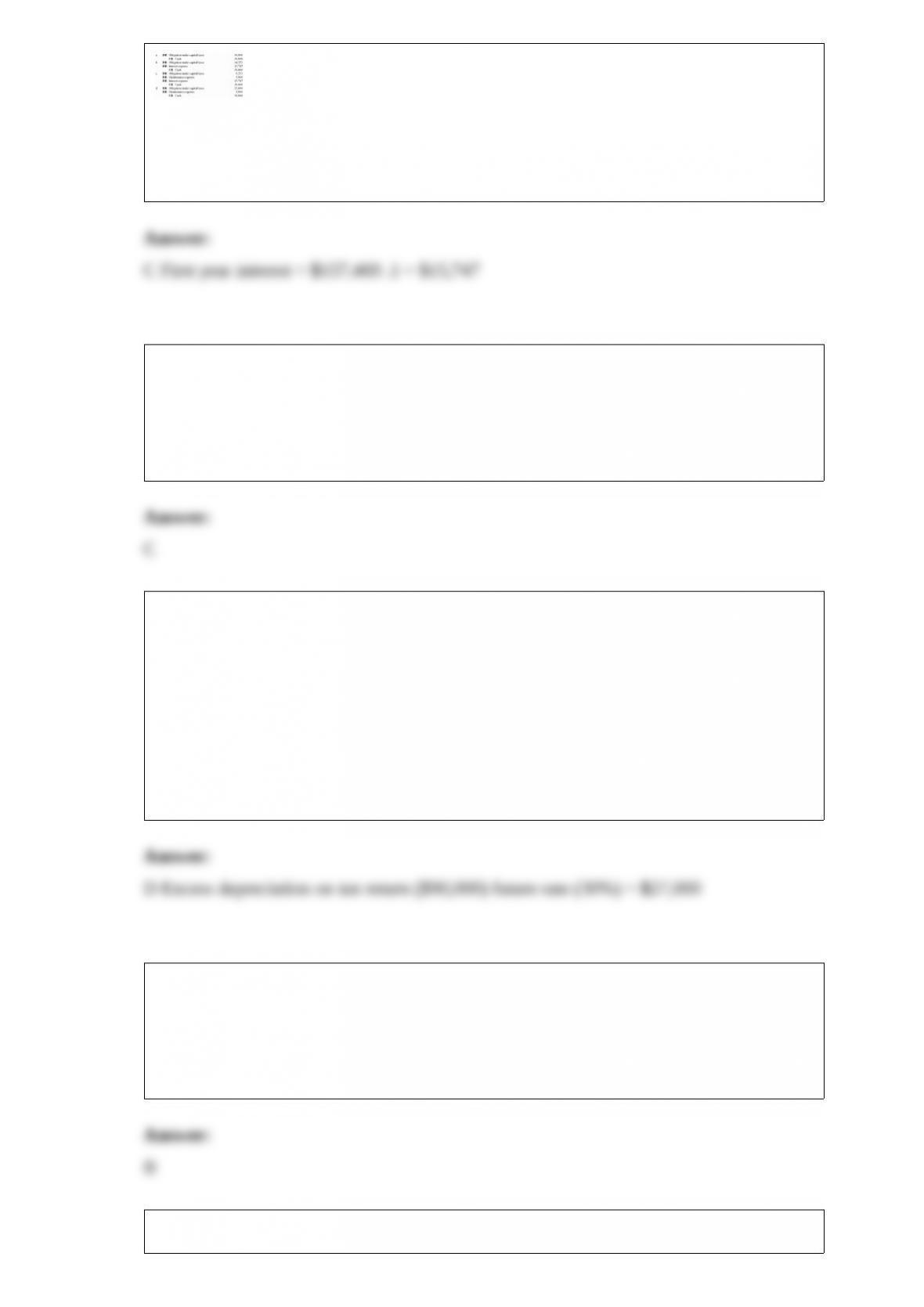
A.Option a
B.Option b
C.Option c
D.Option d
28) Notes to the financial statements typically contain all of the following except
A.a summary of significant accounting policies
B.disclosure of important subsequent events
C.management’s discussion and analysis
D.related-party transactions
29) Stone Company reported pre-tax bookincome of $700,000 for book purposes in
2012, the first year of operation. The tax depreciation exceeded its book depreciation by
$90,000. The tax rate for 2012 and all future years was 30%.
What amount of deferred income tax liability should Stone report in its December 31,
2012, balance sheet?
A.$5,000
B.$9,000
C.$20,000
D.$27,000
30) A minority active investment is accounted for by the
A.cost method
B.equity method
C.lower of cost or market method
D.speculative investment method
31) Manero Company included the following information in its annual report:

In a trend income statement for 2012, where 2010 is the base year, sales are expressed
as
A.87.2%
B.100.0%
C.114.7%
D.148.7%
32) As per GAAP, fair valuefor accounting purposesis
A.an entry price
B.an exit price
C.the market price in a forced sale
D.always easily determinable
33) A bank’s estimated bad debt expense associated with its loan receivables is the
A.loan loss provision
B.loan charge-offs
C.allowance for loans
D.accumulated loan loss
34) Which of the following is a true statement?
A.Revenues decrease owners’ equity and increase liabilities
B.Expenses increase owners’ equity and decrease liabilities
C.Revenues increase owners’ equity and expenses decrease owners’ equity
D.Revenues decrease owners’ equity and expenses increase owners’ equity
35) An adjustment to income due to an extraordinary item is regarded as
A.permanent earnings
B.transitory earnings
C.value-irrelevant earnings
D.quiet
36) Relevant financial information
A.is free from bias and error
B.is measured in a similar manner among different companies
C.can be independently verified
D.is capable of making a difference in a decision
37) The following information pertains to Grumpy Company’s defined benefit pension
plan:
What amount should Grumpy record as a prepaid pension asset on its December 31,
2011 balance sheet?
38) Reported income for FIFO firms _________ includes some realized holding gains
during periods of rising inventory costs. Which of the following terms (when inserted in
the blank) makes the previous a true statement?
A.always
B.sometimes
C.usually
D.never
39) Which of the following transactions would not create a temporary difference?
A.The cash payment to acquire a three-year insurance policy
B.The accrual of warranty expense
C.The accrual of bad debts expense
D.The cash collection of interest earned on a municipal bond
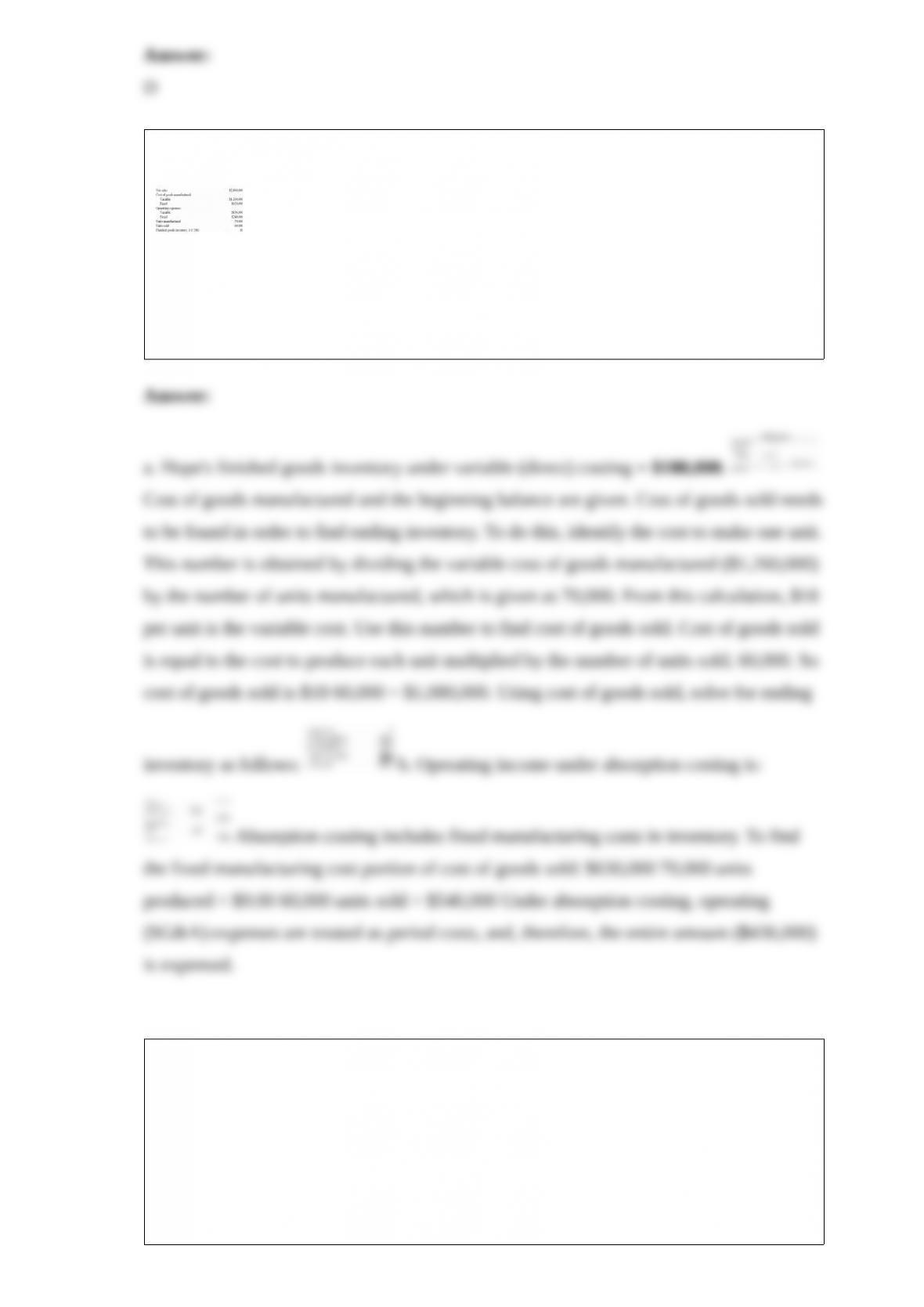
40) Information from Hope Company’s records for the year ended December 31, 2011
is available as follows:
Hope had no work-in-process inventories at either the beginning or end of 2011.
Required:
a. What would be Hope’s finished goods inventory cost under the variable (direct)
costing method at December 31, 2011?
b. What would Hope’s operating income be under the absorption costing method?
41) On December 1, 2011 a company bought a call option costing $100,000 as a
speculative investment. The call option gave the company the right to purchase 100,000
barrels of oil for $110 per barrel during April 2012 . As of December 31, 2011 the call
option had a value of $125,000. The company liquidated the call option on April 15,
2012 in exchange for $175,000. Which of the following accurately describes GAAP
accounting for this call option?
A.The realized gain applicable to the year ending December 31, 2011 is $25,000
B.The realized gain recognized on April 15, 2012 is $75,000

C.The unrealized gain recognized on April 15, 2012 is $50,000
D.The call option will be reported on the December 31, 2011 balance sheet at $125,000
and a $25,000 unrealized gain will be reported as a component of income from
continuing operations for the year ending December 31, 2011
42) Hooker Company sells $200,000 of ten-year, 8% bonds to yield 10% on January 1,
2011 . The bonds pay interest annually on December 31 . The bonds were sold at a
discount of $24,578. The amount of cash interest paid in 2011 on the bonds is
A.$14,458
B.$16,000
C.$17,542
D.$20,000
43) A company manages a large portfolio of marketable securities and sells only stocks
with substantial gains in poor income years or sells only stocks with substantial losses
in good income years. This strategy is an indication of
A.securities fraud
B.unstable portfolio management
C.income smoothing
D.violating security trading laws
44) Which of the following statements does not accurately describe the accounting for
derivatives?
A.The holding gain resulting from a fair value hedge that qualifies for hedge accounting
is recognized in net income along with the offsetting loss on the hedged item
B.The holding loss resulting from a cash flow hedge that qualifies for hedge accounting
is recognized in net income during the year of the loss
C.Management must be able to describe its hedging strategy in order to meet the GAAP
criteria to qualify for hedge accounting
D.Derivatives that fail to meet the GAAP criteria for hedge accounting are accounted
for as speculative investments
45) The Hab Company provided the following information pertaining to its defined
benefit pension plan for 2012:
The projected benefit obligation as of January 1, 2012 was $6,250,000.
The settlement/discount rate was 8%.
The service cost was $300,000.
The amortization of prior service cost was $100,000.
The expected return on plan assets was 10%.
The actual return on plan assets was $800,000.
The fair value of plan assets on January 1, 2012 was $5,000,000.
Pension payments to retirees during the year totaled $250,000.
Contributions to the pension plan totaled $200,000.
Amortization of unrecognized net actuarial losses totaled $125,000.
Required:
1> Determine the pension expense for 2012 .
2> Determine the projected benefit obligation as of December 31, 2012 .
3> Determine the fair value of plan assets as of December 31, 2012 .
4> Determine the pension liability to be reported on the December 31, 2012 balance
sheet.
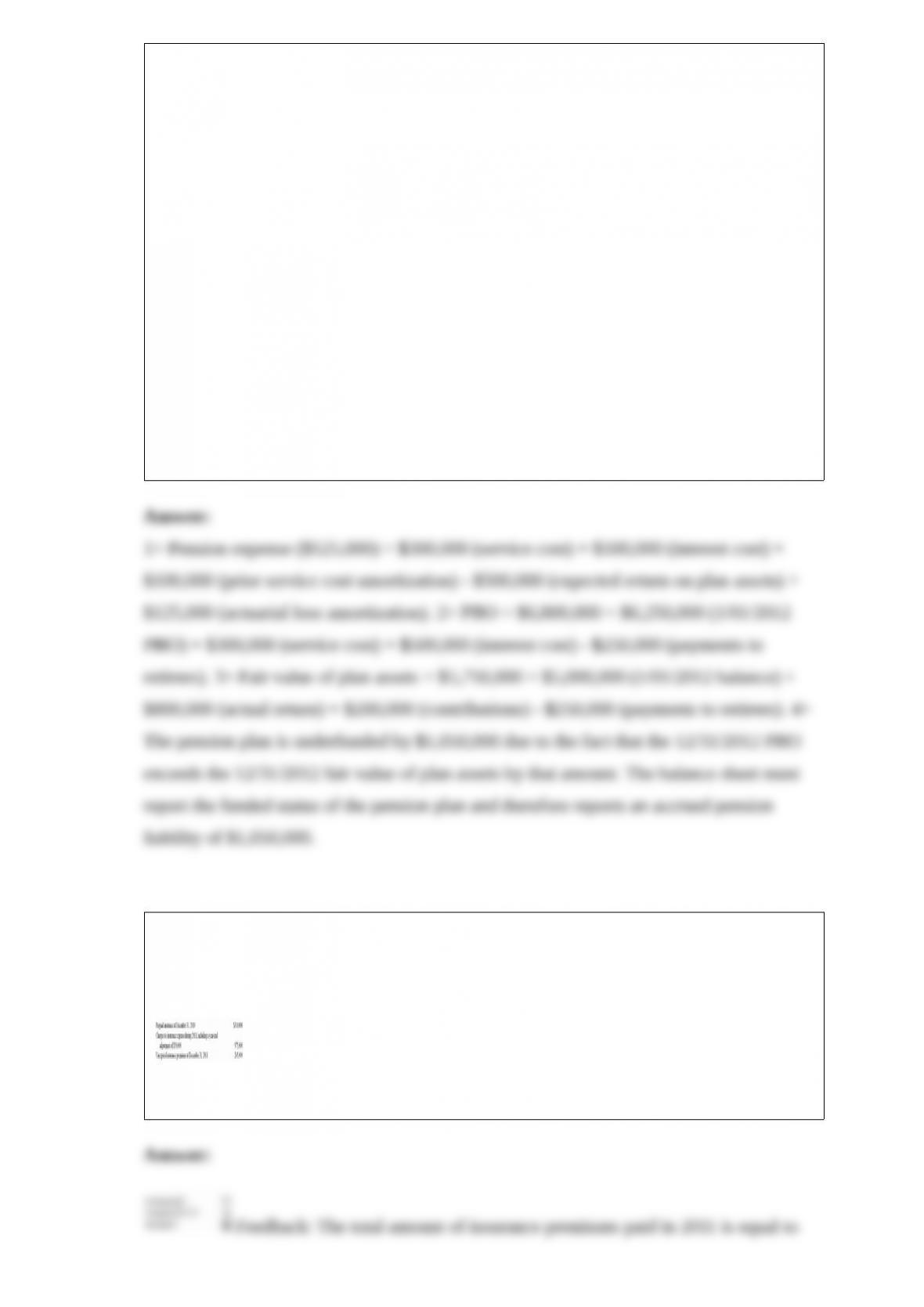
46) Under Bart Company’s accounting system, all insurance premiums paid are debited
to prepaid insurance. For interim reports, Bart makes monthly estimated charges to
insurance expense with credits to prepaid insurance. Additional information for the year
ended December 31, 2011 is as follows:
Required:
What was the total amount of insurance premiums paid by Bart during 2011?
47) Briefly define an earnings surprise and explain how one impacts the value of a
firm’s equity.
48) Describe three capital lease disclosures that are required of the lessee according to
current GAAP.
49) P/E ratios are a useful indicator and tool when performing valuation and comparing
firms. List three factors that should be considered or adjusted for when comparing P/E
ratios among different firms.

50) The Capitals Company has provided you the following information pertaining to the
year ending December 31, 2012:
Equipment costing $25,000 was acquired in exchange for common stock.
Equipment with an original cost of $57,500 and a book value of $5,000 was scrapped.
Equipment was purchased in exchange for cash.
Equipment with a book value of $39,000 was sold resulting in a $14,000 gain. The
accumulated depreciation at the time of the sale was $67,000.
Required:
1> Determine the cash paid for equipment purchases during 2012 .
2> Determine the depreciation expense for 2012 .
51) Cannon Company has the following information for the year ending December 31,
2012:
Short-term debt of $18,000 was issued for cash.
Cash paid for labor during 2012 amounted to $489,500.
During the year, Cannon experienced a pension outflow of $14,000.
Dividends of $34,000 were received.
Cannon’s cash balance at the beginning of 2012 was $975,000.
The company made an investment of $310,000 in an affiliate company.
A lease payment of $110,000 was made on November 1, 2012 .
During the year, Cannon collected $780,000 cash from customers.
Cash paid for income taxes amounted to $56,000 for all of 2012 .
During 2012, Cannon discontinued its consumer electronics division resulting in a
$12,000 net cash inflow.
Required:
Prepare Cannon Company’s statement of cash flows for the year ending December 31,
2012 using the proposal on the statement of cash flows put forth by the IASB and the
FASB.
52) The Shelast Corporation adopted a defined benefit pension plan on January 1, 2011
and has provided the following information:
The projected benefit obligation on January 1, 2011 was $2,160,500.
The 2011 service cost totaled $250,000; the 2012 service cost totaled $275,000.
Annual amortization of prior service costs is $216,050.
The settlement/discount rate is 10%.
The pension plan funding during 2011 was $200,000; the pension plan funding during
2012 was $225,000.
The actual return on plan assets was $19,000 during 2012 .
What is the projected benefit obligation balance as of December 31, 2012?
53) Financial reporting is arguably one of the most heavily regulated areas of business
activity. Provide the main reasons why accounting information is so heavily regulated.
In your answer try to address the intended consequences of such regulation.