
You’ve just found a 7 percent coupon bond on the market that sells for par value. What
is the maturity on this bond?
A. The bond must mature in 1 year.
B. The bond could have any maturity date.
C. The bond must be maturing today.
D. The bond must mature in 10 years.
E. None of these are correct.
Answer:
Alfa Life Insurance Co. is trying to sell you an investment policy that will pay you and
your heirs $10,000 per year forever. If the required return on this investment is 4.75
percent, how much will you pay for the policy?
A. $206,576.83
B. $210,526.32
C. $214,211.50
D. $217,119.02
E. $221,160.91
Answer:

A common-size balance sheet helps financial managers determine:
A. which customers are paying on a timely basis.
B. if costs are increasing faster or slower than sales.
C. if changes are occurring in a firm’s mix of assets.
D. if a firm is generating more or less sales per dollar of assets than in prior years.
E. the rate at which the firm’s dividends are changing.
Answer:
Limited liability companies are primarily designed to:
A. allow a portion of their owners to enjoy limited liability while granting the other
portion of their owners control over the entity.
B. provide the benefits of the corporate structure to foreign-based entities.
C. spin off a wholly owned subsidiary.
D. allow companies to reorganize themselves through the bankruptcy process.
E. provide limited liability while avoiding double taxation.

Answer:
Twelve years ago, you deposited $3,400 into an account. Seven years ago, you added an
additional $1,000 to this account. You earned 8 percent, compounded annually, for the
first 5 years and 5.5 percent, compounded annually, for the last 7 years. How much
money do you have in your account today?
A. $5,666.67
B. $6,717.29
C. $7,411.90
D. $8,708.15
E. $8,721.97
Answer:
Farm Equipment, Inc. announced this morning that its next annual dividend will be
decreased to $1.80 a share and that all future dividends will be decreased by an
additional 1.5 percent annually. What is the current value per share of this stock if the
required return is 16.5 percent?
A. $8

B. $10
C. $12
D. $14
E. $16
Answer:
USA Manufacturing issued 30-year, 8.5 percent semiannual bonds 6 years ago. The
bonds currently sell at 101 percent of face value. What is the firm’s aftertax cost of debt
if the tax rate is 30 percent?
A. 5.88 percent
B. 5.62 percent
C. 5.76 percent
D. 6.59 percent
E. 8.40 percent
Answer:

The Paint Ball Range, Inc. paid $30,500 in dividends and $7,600 in interest over the
past year. Sales totaled $211,800 with costs of $167,900. The depreciation expense was
$16,500. The applicable tax rate is 34 percent. What is the amount of the operating cash
flow?
A. $14,232
B. $15,306
C. $28,222
D. $37,168
E. $40,568
Answer:
For the period 1926-2011, which one of the following had the smallest risk premium?
A. Large-company stocks
B. Small-company stocks
C. Long-term corporate bonds
D. U.S. Treasury bills
E. Long-term government bonds
Answer:
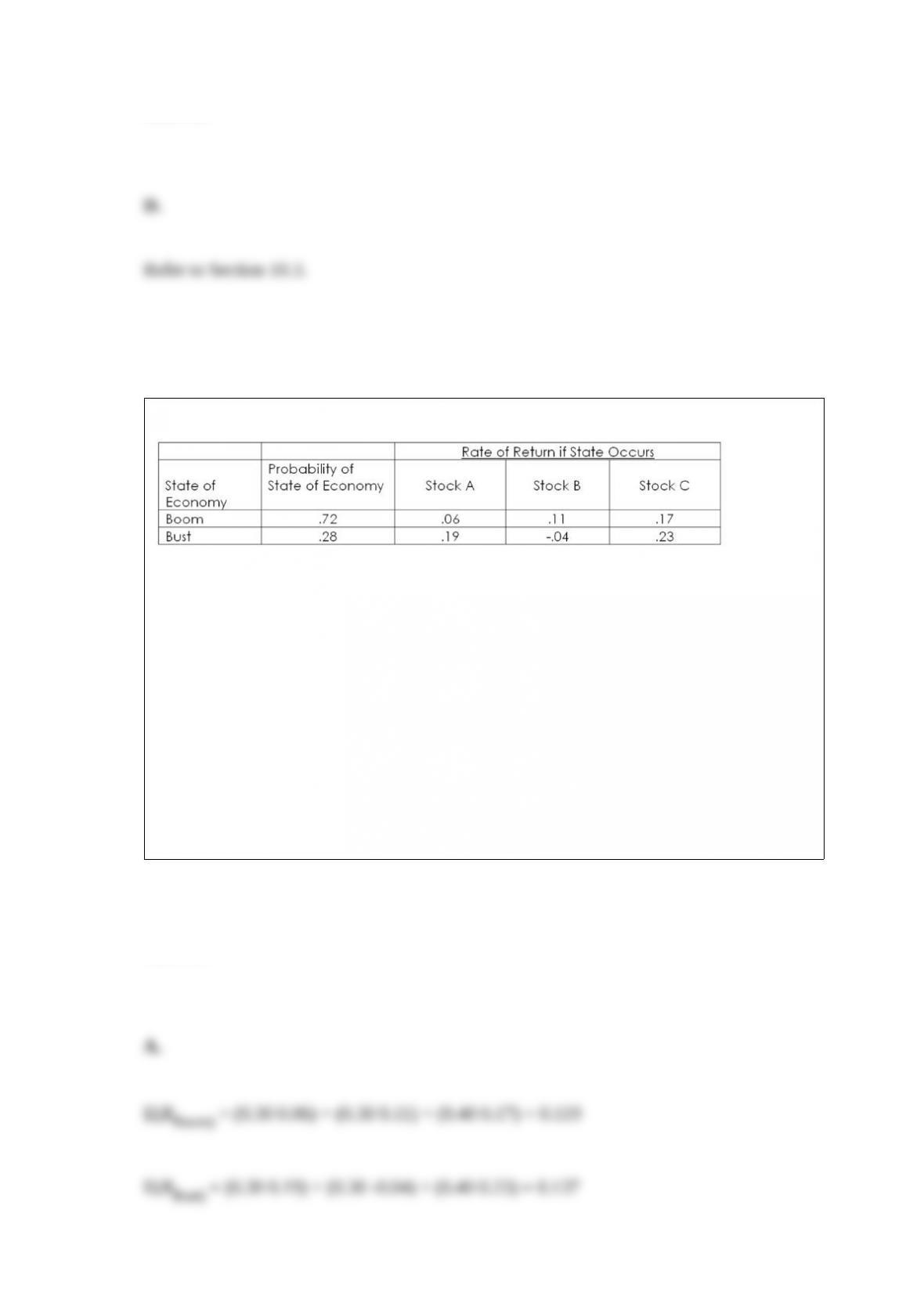
Consider the following information:
What is the variance of a portfolio invested 30 percent each in Stocks A and B and 40
percent in Stock C?
A. 0.000065
B. 0.000163
C. 0.000289
D. 0.000528
E. 0.001740
Answer:
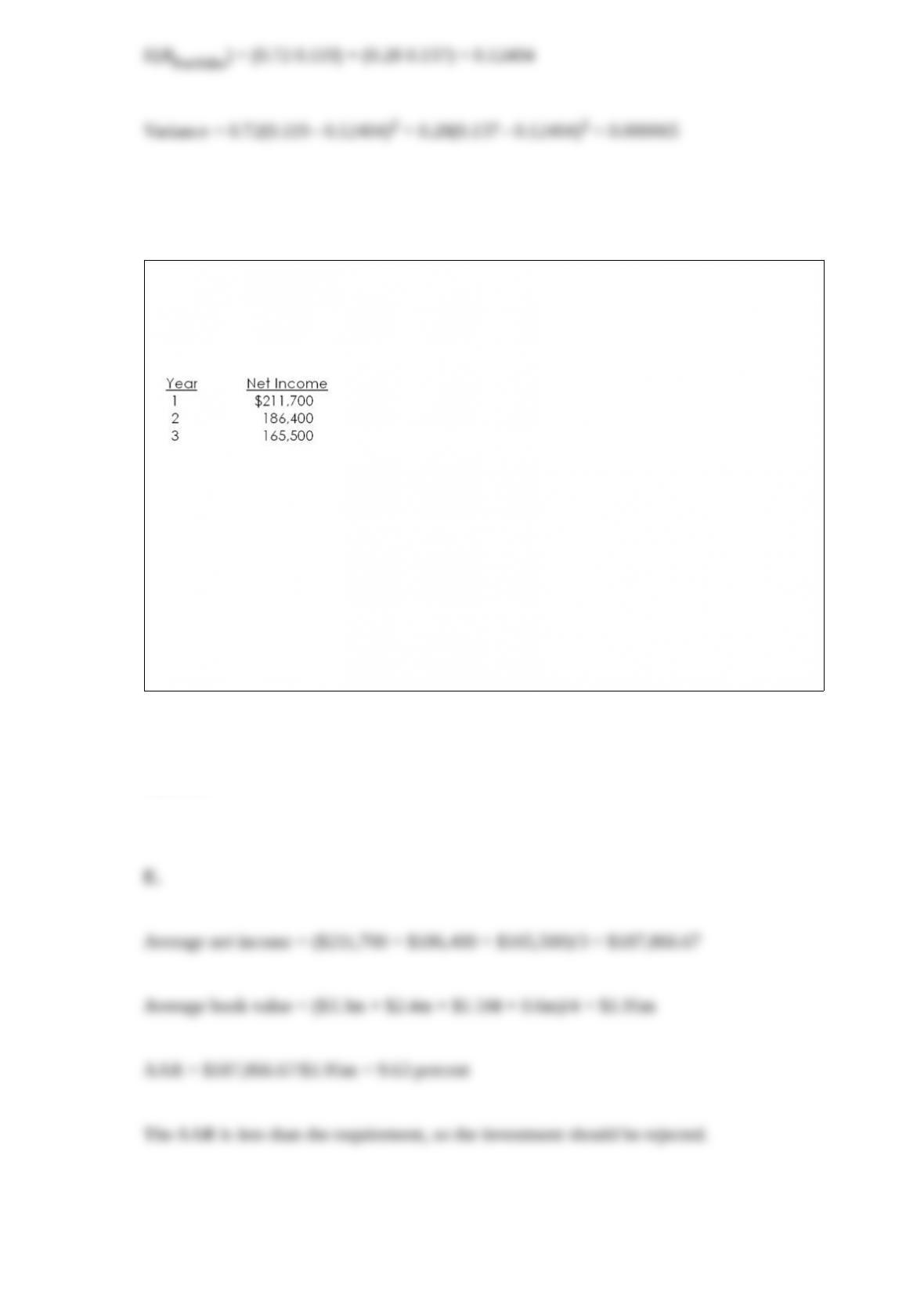
An investment has an initial cost of $3.3 million. This investment will be depreciated by
$900,000 a year over the three-year life of the project. Should this project be accepted
based on the average accounting rate of return if the required rate is 10.0 percent? Why
or why not?
A. Yes, because the AAR is 10.0 percent
B. Yes, because the AAR is less than 10.0 percent
C. Yes, because the AAR is greater than 10.0 percent
D. No, because the AAR is greater than 10.0 percent
E. No, because the AAR is less than 10.0 percent
Answer:

At the end of this month, Les will start saving $150 a month for retirement through his
company’s retirement plan. His employer will contribute an additional $0.50 for every
$1.00 that he saves. If he is employed by this firm for 30 more years and earns an
average of 10.5 percent on his retirement savings, how much will Les have in his
retirement account 30 years from now?
A. $389,406.19
B. $401,005.25
C. $540,311.67
D. $566,190.22
E. $603,289.01
Answer:
Which one of the following will tend to increase the length of the credit period?
A. Decrease in product cost
B. Decrease in consumer demand
C. Decrease in collateral value
D. Increase in credit risk
E. Increase in product standardization

Answer:
The dividend yield is defined as:
A. the current annual cash dividend divided by the current market price per share.
B. the current annual cash dividend divided by the current book value per share.
C. next year’s expected cash dividend divided by the current market price per share.
D. next year’s expected cash dividend divided by the current book value per share.
E. next year’s expected cash dividend divided by next year’s expected market price per
share.
Answer:
Last year, The Pizza Joint added $4,100 to retained earnings from sales of $93,600. The
company had costs of $74,400, dividends of $2,500, and interest paid of $1,400. The
tax rate was 34 percent. What was the amount of the depreciation expense?
A. $7,300
B. $7,500
C. $7,800

D. $8,100
E. $8,400
Answer:
The cash cycle is equal to which one of the following?
A. Inventory period minus the accounts payable period
B. Operating cycle plus the accounts payable period
C. Operating cycle minus the accounts receivable period
D. Accounts receivable period minus the accounts payable period plus the inventory
period
E. Inventory period minus the accounts receivable period minus the accounts payable
period
Answer:

Which one of the following is most apt to create a situation where an agency conflict
could arise?
A. Increasing the size of a firm’s operations
B. Downsizing a firm
C. Separating management from ownership
D. Decreasing employee turnover
E. Reducing both management and nonmanagement salaries
Answer:
Which one of the following is most closely related to the net present value profile?
A. Internal rate of return
B. Average accounting return
C. Profitability index
D. Payback
E. Discounted payback
Answer:

T.L.C. Enterprises just revised its capital structure from a debt-equity ratio of 0.30 to a
debt-equity ratio of 0.45. The firm’s shareholders who prefer the old capital structure
should:
A. sell some shares and hold the sale proceeds in cash.
B. sell all of their shares and loan out the entire sale proceeds.
C. do nothing.
D. sell some shares and loan out the sale proceeds.
E. borrow funds and purchase more shares.
Answer:
British Motor Works is reviewing its current accounts to determine how a proposed
project might affect the account balances. The firm estimates the project will initially
require $67,000 in additional current assets and $32,000 in additional current liabilities.
The firm also estimates the project will require an additional $7,000 a year in current
assets for each one of the four years of the project. How much net working capital will
the firm recoup at the end of the project assuming that all net working capital can be
recaptured?
A. -$85,000
B. $25,000
C. $63,000
D. $68,000

E. $85,000
Answer:
A firm has inventory of $11,400, accounts payable of $9,800, cash of $850, net fixed
assets of $12,150, long-term debt of $9,500, accounts receivable of $6,600, and total
equity of $11,700. What is the common-size percentage for the net fixed assets?
A. 19.60 percent
B. 26.67 percent
C. 39.19 percent
D. 42.08 percent
E. 48.75 percent
Answer:
Webster Mining is considering the purchase of a new sorting machine. The quote

consists of a quarterly payment of $29,600 for seven years at 8 percent interest. What is
the purchase price of the equipment?
A. $621,380.92
B. $629,925.66
C. $687,418.22
D. $774,311.28
E. $836,267.35
Answer:
Underwood Homes Sales has total assets of $589,900 and total debt of $318,000. What
is the equity multiplier?
A. 0.46
B. 0.54
C. 1.21
D. 1.85
E. 2.17
Answer: