1) The secondary market is where new issues of stocks and bonds are introduced.
2) Retirement funds account for about 31% Of all mutual fund assets.
3) A monoline insurance company is an insurance company which specialize in credit
insurance alone.
4) The FOMC issues directives to the trading desk at the New York Fed.
5) The existence of large numbers of banks in the United States indicates the presence
of vigorous competition.
6) Investment banks form syndicates to reduce the risk involved in selling new
securities.
7) In an emerging market economy, a country often faces severe fiscal imbalances
before a financial crisis initiates.
8) A short contract obligates the holder to sell securities in the future.
9) Intermediaries add value to the swap markets by reducing default risk.
10) Bank holding companies are regulated by the FDIC.
11) An example of direct financing is if you were to lend money to your neighbor.
12) One important advantage to a borrower who qualifies for an FHA or VA loan is the
very low interest rate on the mortgage.
13) Prices for long-term bonds are more volatile than for shorter-term bonds.
14) Discounting the future is the procedure used to find the future value of a dollar
received today.
15) Fannie Mae and Freddie Mac together either own or insure the risk on nearly
one-fourth of America’s residential mortgages.
16) The U.S. Treasury Department is the single most influential participant in the U.S.
money market.
17) Down payments are designed to reduce the likelihood of default on mortgage loans.
18) The Sarbanes-Oxley Act of 2002 provides for oversight of accounting firms but
makes no provisions for increasing the flow of information to financial markets.
19) A secured bond is backed by
A) the general creditworthiness of the borrower
B) an insurance company’s financial guarantee
C) the expected future earnings of the borrower
D) specific collateral
20) Fire and casualty insurance companies are what type of intermediary?
A) Contractual savings institution
B) Depository institutions
C) Investment intermediaries
D) None of the above
21) A balloon loan requires
A) multiple payments at odd, random intervals
B) periodic payments of principle and interest
C) a single large payment at the loan’s maturity to retire the debt
D) a steadily increasing payment (floating balloon) to retire the debt
22) The best known investment banker involved in mergers and acquisitions, credited
with inventing the junk bond market, is ________.
A) Ivan Boesky
B) Michael Milken
C) James Garner
D) Michael Douglas
23) Which of the following can be described as involving direct finance?
A) A corporation’s stock is traded in an over-the-counter market
B) People buy shares in a mutual fund
C) A pension fund manager buys commercial paper in the secondary market
D) An insurance company buys shares of common stock in the over-the-counter
markets
E) None of the above
24) When a lender refuses to make a loan, even though borrowers are willing to pay the
stated interest rate or even a higher rate, it is said to engage in ________.
A) specialized lending
B) strategic refusal
C) diversified lending
D) coercive behavior
E) none of the above
25) The impact of the 2007-2009 financial crisis was widespread, including
A) the first major bank failure in the UK in over 100 years
B) the failure of Bear Stearns, the fifth-largest U.S. investment bank
C) the bailout of Fannie Mae and Freddie Mac by the U.S. Treasury
D) all of the above
E) only B and C of the above
26) The major provisions of the Financial Institutions Reform, Recovery, and
Enforcement Act of 1989 included
A) reducing the regulatory responsibilities of the FDIC
B) establishing the Resolution Trust Corporation to manage and resolve insolvent thrifts
placed in conservatorship or receivership
C) directing the Federal Home Loan Bank Board to continue to pursue regulatory
forbearance
D) all of the above
E) only A and B of the above
27) According to the textbook authors, the Fed is
A) remarkably free of the political pressures that influence other government agencies
B) more responsive to the political pressures that influence other government agencies
C) probably somewhat constrained in its policymaking by the congressional threat to
reduce Fed independence
D) both A and C of the above
28) The Fed is an active participant in money markets mainly because of its
responsibility to
A) lower borrowing costs to encourage capital investment
B) control the money supply
C) increase the interest income of retirees holding money market instruments
D) assist the Securities and Exchange Commission in regulating the behavior of other
money market participants
29) Which of the following is an insight from behavioral finance?
A) The price of securities fully reflects all available information
B) Investor overconfidence leads to high trading volumes
C) The optimal forecast of a security’s return equals the security’s equilibrium return
D) Investment advisers cannot consistently beat the market
30) The central bank of the United States is
A) Citicorp
B) The Fed
C) Bank of America
D) The Treasury
E) none of the above
31) Which of the following are not generally rate-sensitive assets?
A) securities with a maturity of less than one year
B) variable-rate mortgages
C) fixed-rate mortgages
D) all of the above are rate-sensitive assets
E) none of the above are rate-sensitive assets
32) An investment bank is a financial institution that
A) bundles small deposits into larger loans
B) helps corporations raise funds
C) holds most of its assets in commercial paper
D) does all of the above
E) does only A and B of the above
33) Under a fixed exchange rate regime, when the domestic currency is undervalued,
the central bank must ________ the domestic currency to keep the exchange rate fixed;
as a result, it ________ international reserves.
A) purchase; gains
B) sell; gains
C) purchase; loses
D) sell; loses
34) The official reserve transactions balance is referred to as
A) the capital account
B) the current account
C) the trade balance
D) the net change in government international reserves
35) The Federal Open Market Committee consists of
A) the five senior members of the seven-member Board of Governors
B) the seven members of the Board of Governors and seven presidents of the regional
Fed banks
C) the seven members of the Board of Governors and five presidents of the regional
Fed banks
D) the twelve regional Fed bank presidents and the chairman of the Board of Governors
36) The term structure of interest rates is
A) the relationship among interest rates of different bonds with the same risk and
maturity
B) the structure of how interest rates move over time
C) the relationship among the terms to maturity of different bonds from different issuers
D) the relationship among interest rates on bonds with different maturities but similar
risk
37) Which of the following can be described as involving indirect finance?
A) A corporation takes out loans from a bank
B) People buy shares in a mutual fund
C) A corporation buys commercial paper in a secondary market
D) All of the above
E) Only A and B of the above
38) The entry of Sears, AT&T, and GM into the credit card business is an indication of
A) government’s efforts to deregulate the provision of financial services
B) the rising profitability of credit card operations
C) the reduction in costs of credit card operations since 1990
D) the sale of unprofitable operations by Bank of America and Citicorp
39) To eliminate the abuses of the state-chartered banks, the ________ created a new
banking system of federally chartered banks, supervised by the ________.
A) National Banking Act of 1863; Office of the Comptroller of the Currency
B) Federal Reserve Act of 1863; Office of the Comptroller of the Currency

C) National Banking Act of 1863; Office of Thrift Supervision
D) Federal Reserve Act of 1863; Office of Thrift Supervision
40) The share of checkable deposits in total bank liabilities has
A) expanded moderately over time
B) expanded dramatically over time
C) shrunk over time
D) remained virtually unchanged since 1960
41) Financial market activities affect
A) personal wealth
B) spending decisions by individuals and business firms
C) the economy’s location in the business cycle
D) all of the above
42) Because borrowers, once they have a loan, are more likely to invest in high-risk
investment projects, banks face the
A) adverse selection problem
B) lemon problem
C) adverse credit risk problem
D) moral hazard problem
43) Sales finance companies make loans to consumers to purchase items
A) on the Internet
B) from any retailer
C) from a particular retailer
D) for a specific use
44) The Federal Home Loan Bank Board and the FSLIC, both of which failed in their
regulatory tasks, were abolished by the
A) Competitive Equality in Banking Act of 1987
B) Financial Institutions Reform, Recovery, and Enforcement Act of 1989
C) Office of Thrift Supervision
D) Office of the Comptroller of the Currency
45) When banks offer borrowers smaller loans than they have requested, banks are said
to ________.
A) shave credit
B) discount the loan
C) raze credit
D) ration credit
46) The most important developments that have reduced banks’ cost advantages in the
past twenty years include
A) the growth of the junk bond market
B) the competition from money market mutual funds
C) the growth of securitization
D) all of the above
E) only A and B of the above
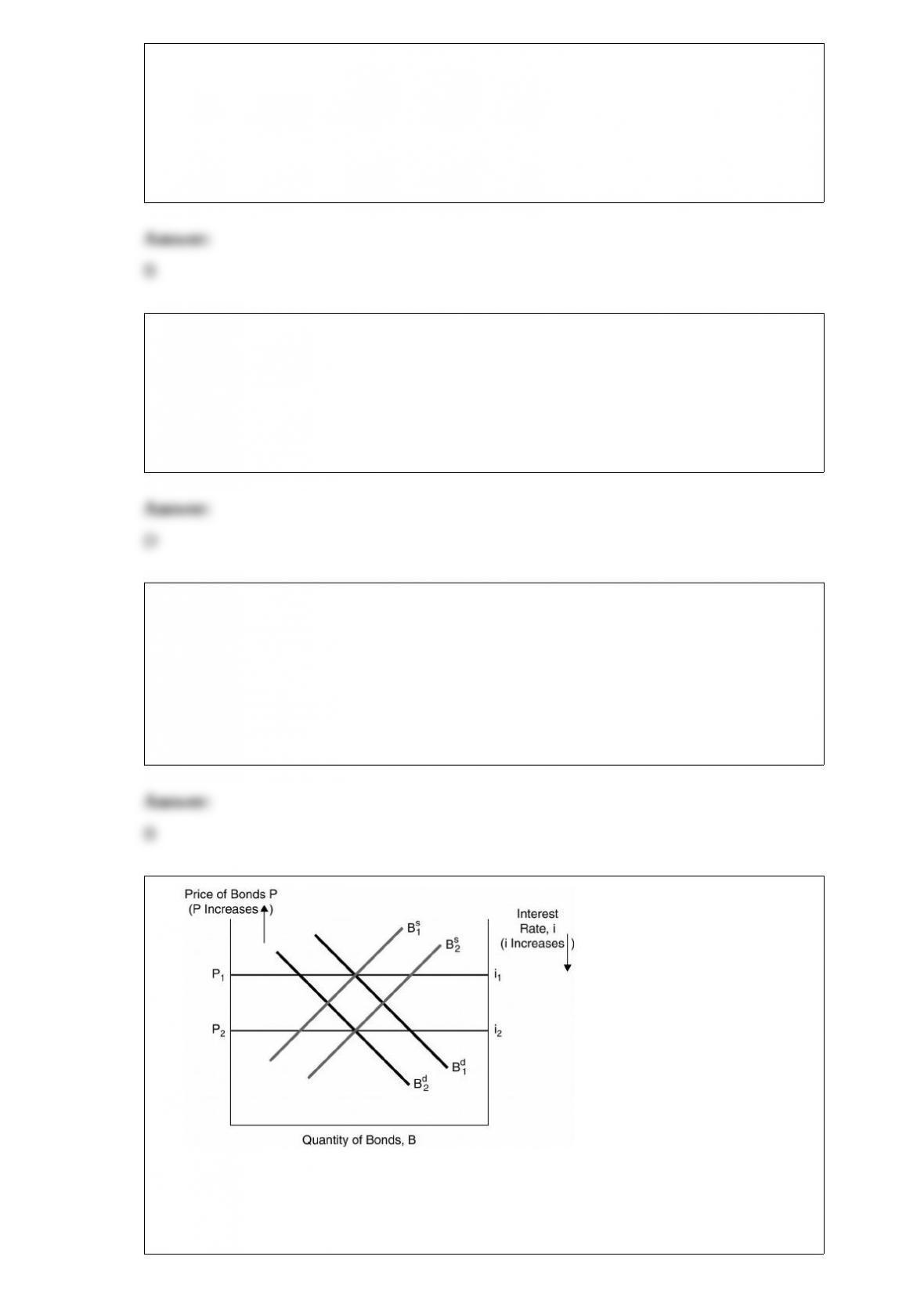
47)
Figure 4.1
In Figure 4.1, the most likely cause of a decrease in the equilibrium interest rate from i2
to i1 is
A) an increase in the expected inflation rate
B) a decrease in the expected inflation rate
C) a business cycle expansion
D) a combination of both A and C of the above
48) The concept of adverse selection helps to explain
A) which firms are more likely to obtain funds from banks and other financial
intermediaries, rather than from the securities markets
B) why indirect finance is more important than direct finance as a source of business
finance
C) why direct finance is more important than indirect finance as a source of business
finance
D) only A and B of the above
E) only A and C of the above
49) Critics of Fed independence argue
A) that it is undemocratic to have monetary policy controlled by an elite group
responsible to no one
B) that an independent Fed conducts monetary policy with a consistent inflationary bias
C) that the Fed, since it does not face a binding budget constraint, spends too much of
its earnings
D) only A and B of the above
50) When we refer to the shadow banking system, what are we talking about?
A) hedge funds, investment banks, and other nonbank financial firms that supply
liquidity
B) the “underground” banking system used for illegal activities
C) the subsidiaries of depository institutions
D) none of the above