1) emerald energy is an oil exploration and production company that trades on the
london stock market. over the past year, the stock has gone from £50 per share to £55,
but over the same period, the dollar has depreciated ten percent. calculate the investor’s
annual percentage rate of return in terms of the u.s. dollars.
a.3.5%
b.-.01%
c.0%
d.there is not enough information to compute the investor’s annual percentage rate of
return in terms of the u.s. dollars
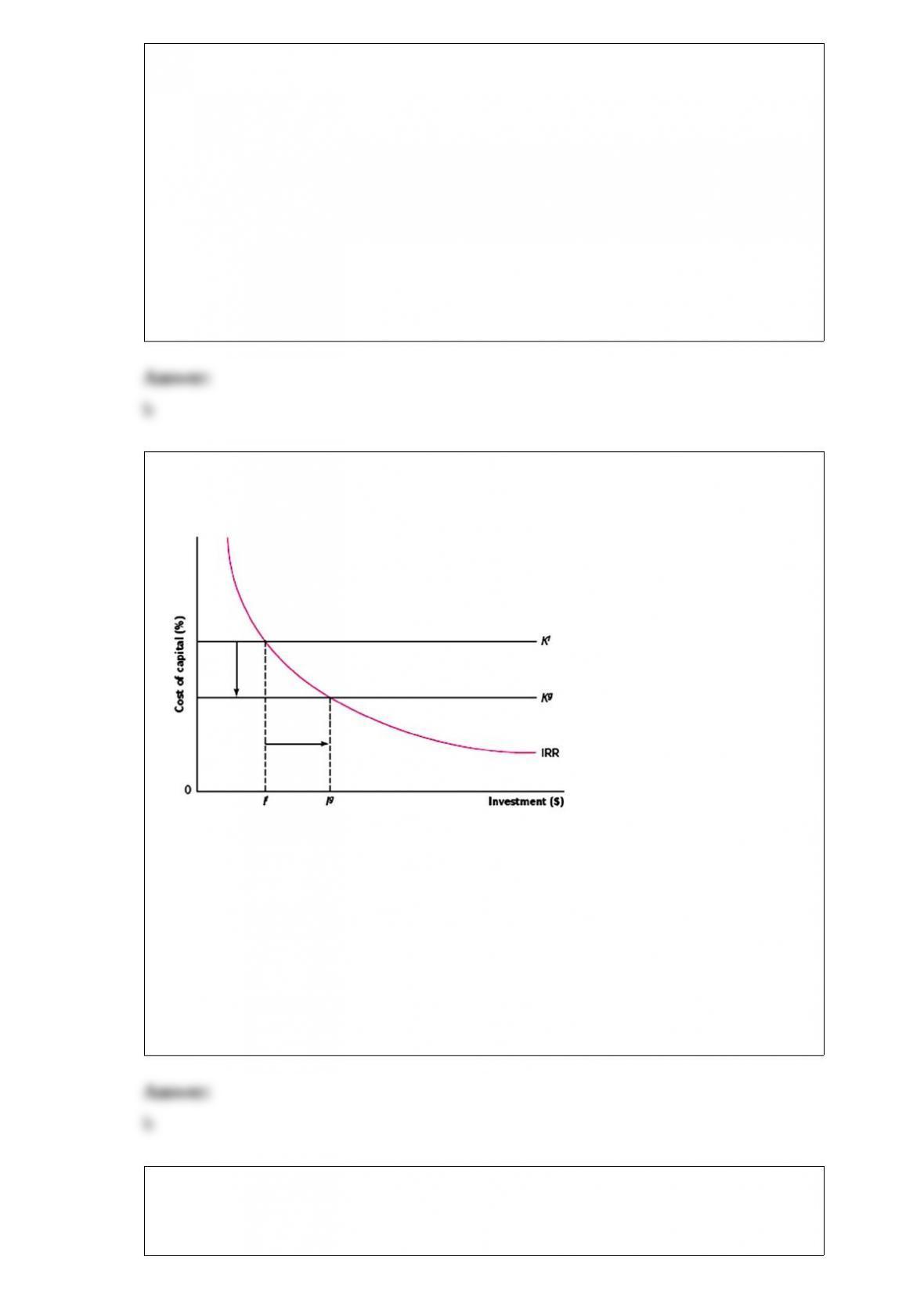
2) in the graph,
a.kl and kg represent, respectively, the cost of capital under international and local
capital structures; irr represents the internal rate of return on investment projects; il and
ig represent, respectively, the optimal investment outlays under the alternative capital
structures
b.kl and kg represent, respectively, the cost of capital under local and international
capital structures; irr represents the internal rate of return on investment projects; il and
ig represent the optimal investment outlays under the alternative capital structures
c.none of the above
3) unless investors can derive significant private benefits of control,
a.they will pay small premiums for voting shares over nonvoting shares

b.they will pay moderate premiums for voting shares over nonvoting shares
c.they will pay substantial premiums for voting shares over nonvoting shares
d.they will not pay substantial premiums for voting shares over nonvoting shares
4) if the investor hedges the exchange rate risk when investing internationally
a.the risk-return efficiency is likely to be superior
b.the expected return to the u.s. dollar investor is approximately the same whether the
investor hedges the exchange rate risk in the investment, or remains unhedged
c.to the extent that the investor establishes an effective hedge to eliminate exchange rate
uncertainty, the risk will be reduced
d.all of the above
5) recently, financial markets have become highly integrated. this development
a.allows investors to diversify their portfolios internationally
b.allows minority investors to buy and sell stocks
c.has increased the cost of capital for firms
d.answers a and c are both correct
6) if a country must make a net payment to foreigners because of a
balance-of-payments deficit, the country should
a.either increase its official reserve assets or borrow anew from foreigners
b.either run down its official reserve assets or borrow anew from foreigners
c.either run down its official reserve assets or lend more foreigners
d.none of the above

7) the recognized methods for consolidating the financial reports of an mnc are
a.short/long term method, current/future method, flexible/inflexible method, and
economic/noneconomic method
b.current/noncurrent method, monetary/nonmonetary method, short/long term method,
and current/future method
c.current/noncurrent method, monetary/nonmonetary method, temporal method, and
current rate method
d.temporal method, current rate method, flexible/inflexible method, and
economic/noneconomic method
8) suppose you are a euro-based investor who just sold microsoft shares that you had
bought six months ago. you had invested 10,000 to buy microsoft shares for $120 per
share; the exchange rate was $1.55 per euro. you sold the stock for $135 per share and
converted the dollar proceeds into euro at the exchange rate of $1.50 per euro. how
much of the return is due to the exchange rate movement?
a.3.75%
b.3.33%
c.12.50%
d.16.25%
9) today is january 1, 2009. the state of iowa has offered your firm a subsidized loan. it
will be in the amount of $10,000,000 at an interest rate of 5% and have annual
(amortizing) payments over 3 years. the first payment is due today and your taxes are
due january 1 of each year on the previous year’s income. the yield to maturity on your
firm’s existing debt is 8%. what is the apv of this subsidized loan? if you rounded in
your intermediate steps, the answer may be slightly different from what you got. choose
the closest.
a.-$3,497,224.43
b.$417,201.05
c.$840,797
d.none of the above

10) the current/noncurrent method of foreign currency translation was generally
accepted in the united states from the 1930s until 1975, when
a.fasb 2 became effective
b.fasb 4 became effective
c.fasb 6 became effective
d.fasb 8 became effective
11) systematic risk
a.is also known as non-diversifiable risk
b.is market risk
c.refers to the risk that remains even after investors fully diversify their portfolio
holdings
d.all of the above
12) a ten-year floating-rate note (frn) has coupons referenced to 3-month pound libor,
and pays coupon interest quarterly. assume that the current 3-month libor is 3 percent. if
the risk premium above libor that the issuer must pay is 1/8 percent, the next period’s
coupon rate on a £1,000 face value frn will be
a.£31.25
b.£15.625
c.£30.625
d.£7.8125
13) developing multiple production sites in a variety of countries,
a.can create an excess capacity problem
b.can lead to underutilization of domestic plants
c.can lead to domestic job losses
d.all of the above
14) consider the situation of firm a and firm b. the current exchange rate is $1.50/. firm
a is a u.s. mnc and wants to borrow 40 million for 2 years. firm b is a french mnc and
wants to borrow $60 million for 2 years. their borrowing opportunities are as shown;
both firms have aaa credit ratings.
what would be the interest rate?
15) the time from acceptance to maturity on a $6,000,000 banker’s acceptance is 360
days.
the importing bank’s acceptance commission is 2 percent and that the market rate for
360-day b/as is 3 percent.
if the exporter’s opportunity cost of capital is 11 percent, should he discount the b/a or
hold it to maturity?
16) simplify the following set of intra company cash flows for this swiss firm.
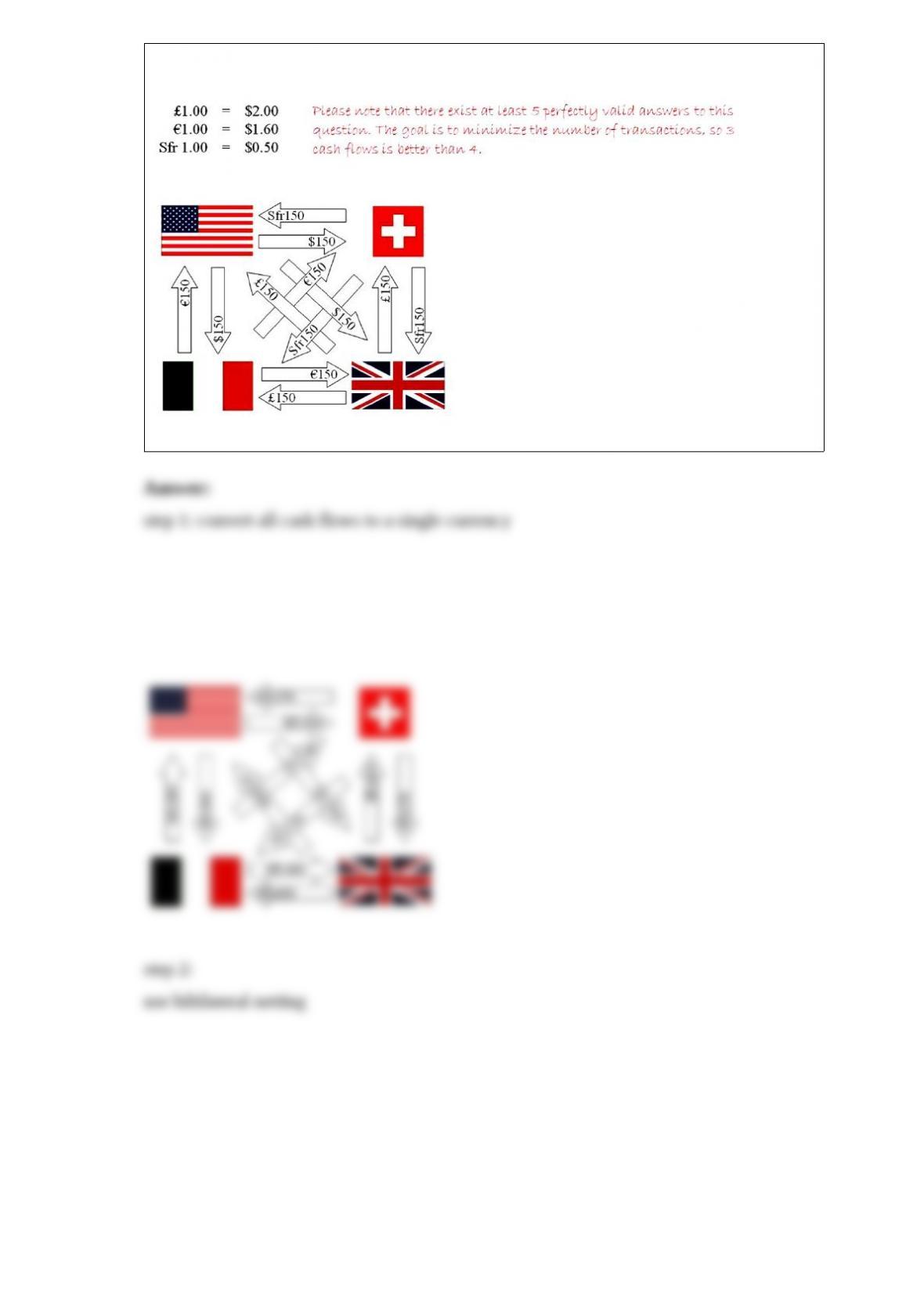
consider the following exchange rates.
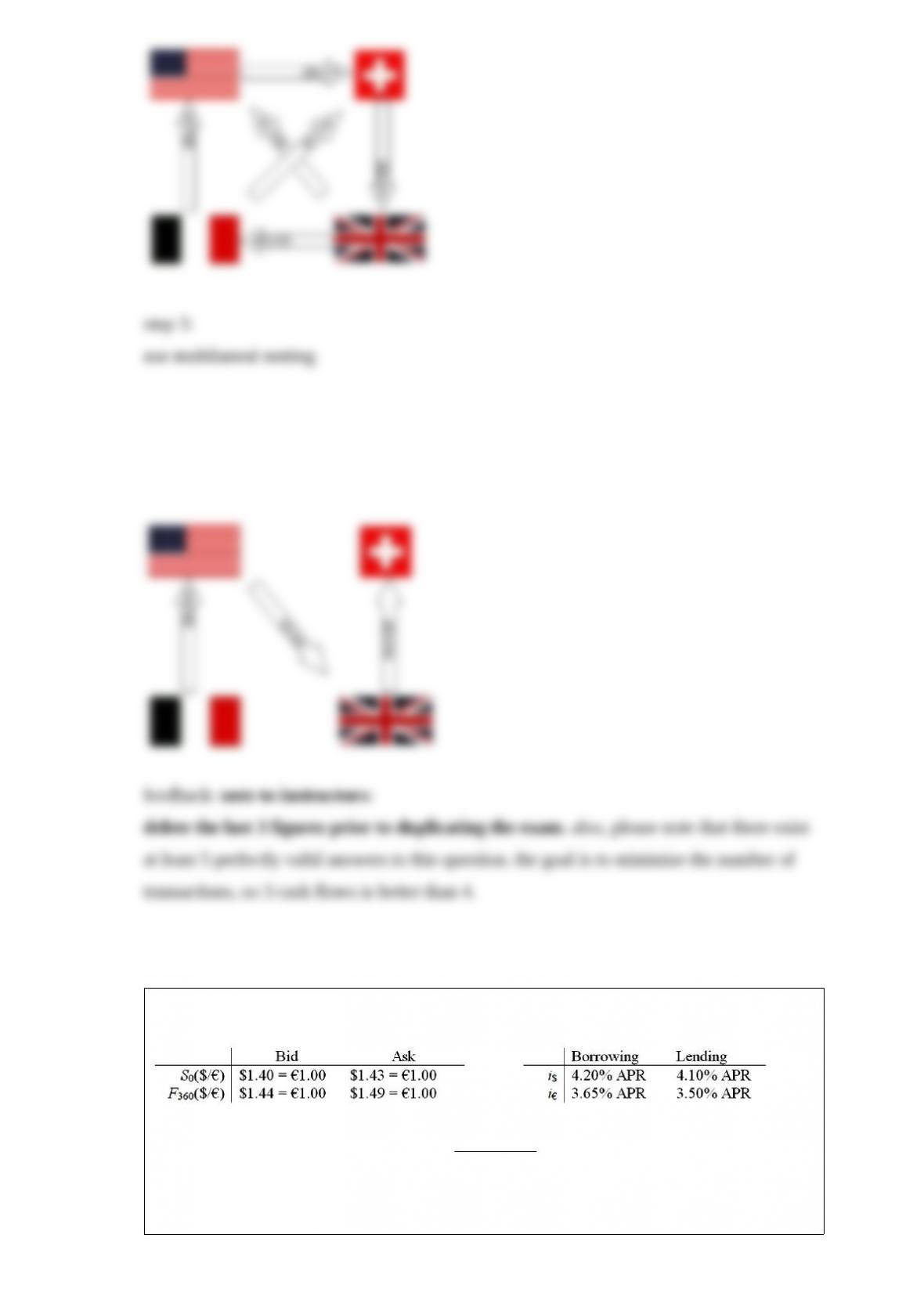
17) assume that you are a retail customer.
please note that your answers are worth zero points if they do not include currency
symbols ($, )
there is (at least) one (smallish) profitable arbitrage at these prices. what is it?
18) the time from acceptance to maturity on a $300,000 banker’s acceptance is 30 days.
the importing bank’s acceptance commission is 3 percent and that the market rate for
30-day b/as is 4 percent.
determine the amount the exporter will receive if he discounts the b/a with the
importer’s bank.
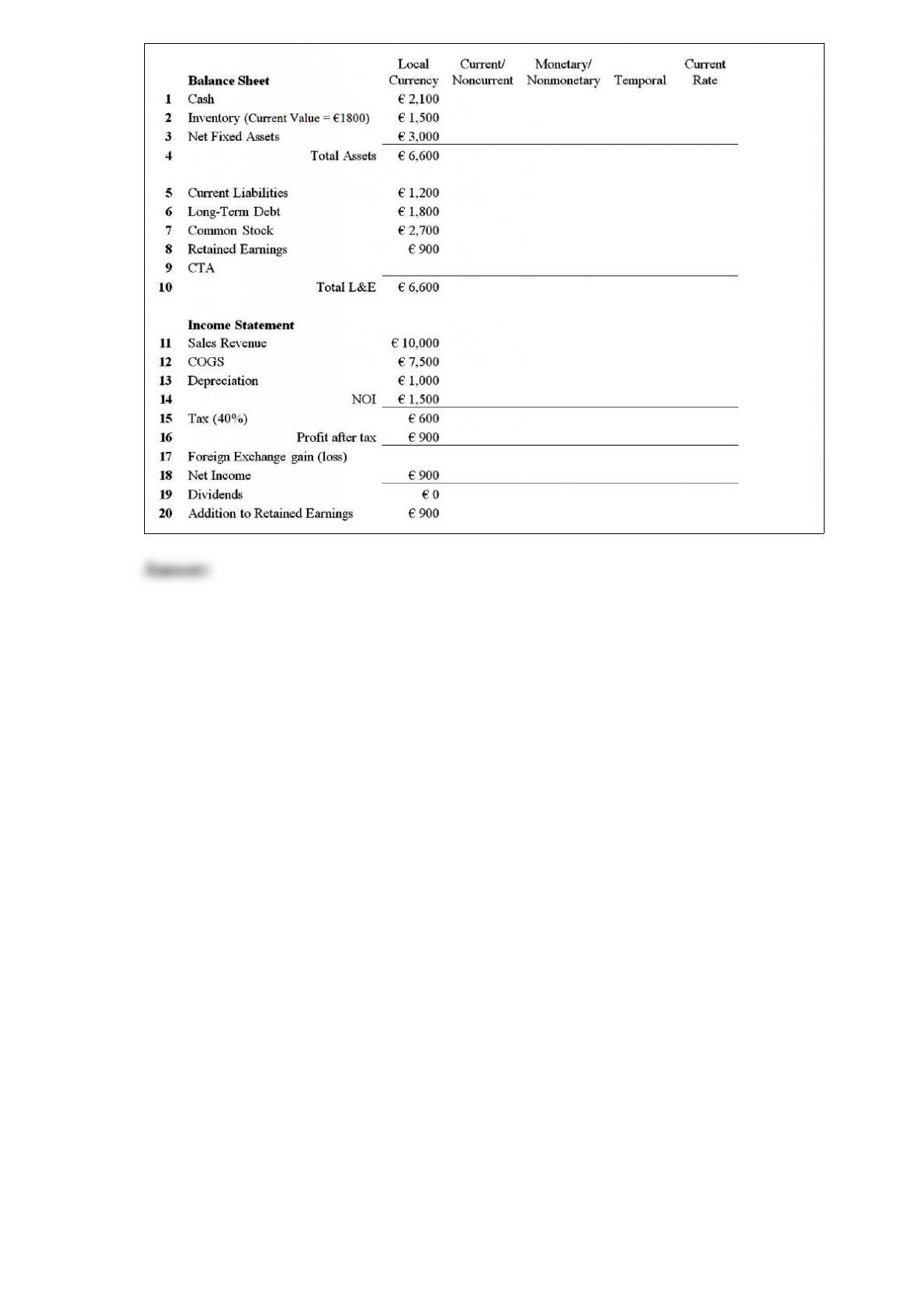
19) assume that the balance sheet and income statement of a french subsidiary, which
keeps its books in euro, is translated into u.s. dollars, the reporting currency of the u.s.
mnc.
the table presents the balance sheet and income statement in euro.
the subsidiary is at the end of its first year of operation.
the historical exchange rate is $1.60/1.00 and the most recent exchange rate is $2.00/
fill out the 20 missing entries that translate the balance sheet and income statement for
this french subsidiary using the current/noncurrent method, the monetary/nonmonetary
method, the temporal method, and the current rate method
20) the time from acceptance to maturity on a $50,000 banker’s acceptance is 180 days.
the importing bank’s acceptance commission is 2.50 percent and that the market rate for
180-day b/as is 2 percent.
if the exporter’s opportunity cost of capital is 11 percent, should he discount the b/a or
hold it to maturity?
21) the strik-it-rich gold mining company is contemplating expanding its operations. to
do so it will need to purchase land that its geologists believe is rich in gold.
strik-it-rich’s management believes that the expansion will allow it to mine and sell an
additional 2,000 troy ounces of gold per year. the expansion, including the cost of the
land, will cost $500,000. the current price of gold bullion is $425 per ounce and
one-year gold futures are trading at $450.50 = $425 (1.06). extraction costs are $375 per
ounce. the firm’s cost of capital is 10 percent.
strik-it-rich’s management is, however, concerned with the possibility that large sales of
gold reserves by russia and the united kingdom will drive the price of gold down to
$390 for the foreseeable future. on the other hand, management believes there is some
possibility that the world will soon return to a gold reserve international monetary
system. in the latter event, the price of gold would increase to at least $460 per ounce.
the course of the future price of gold bullion should become clear within a year.
strik-it-rich can postpone the expansion for a year by buying a purchase option on the
land for $25,000.
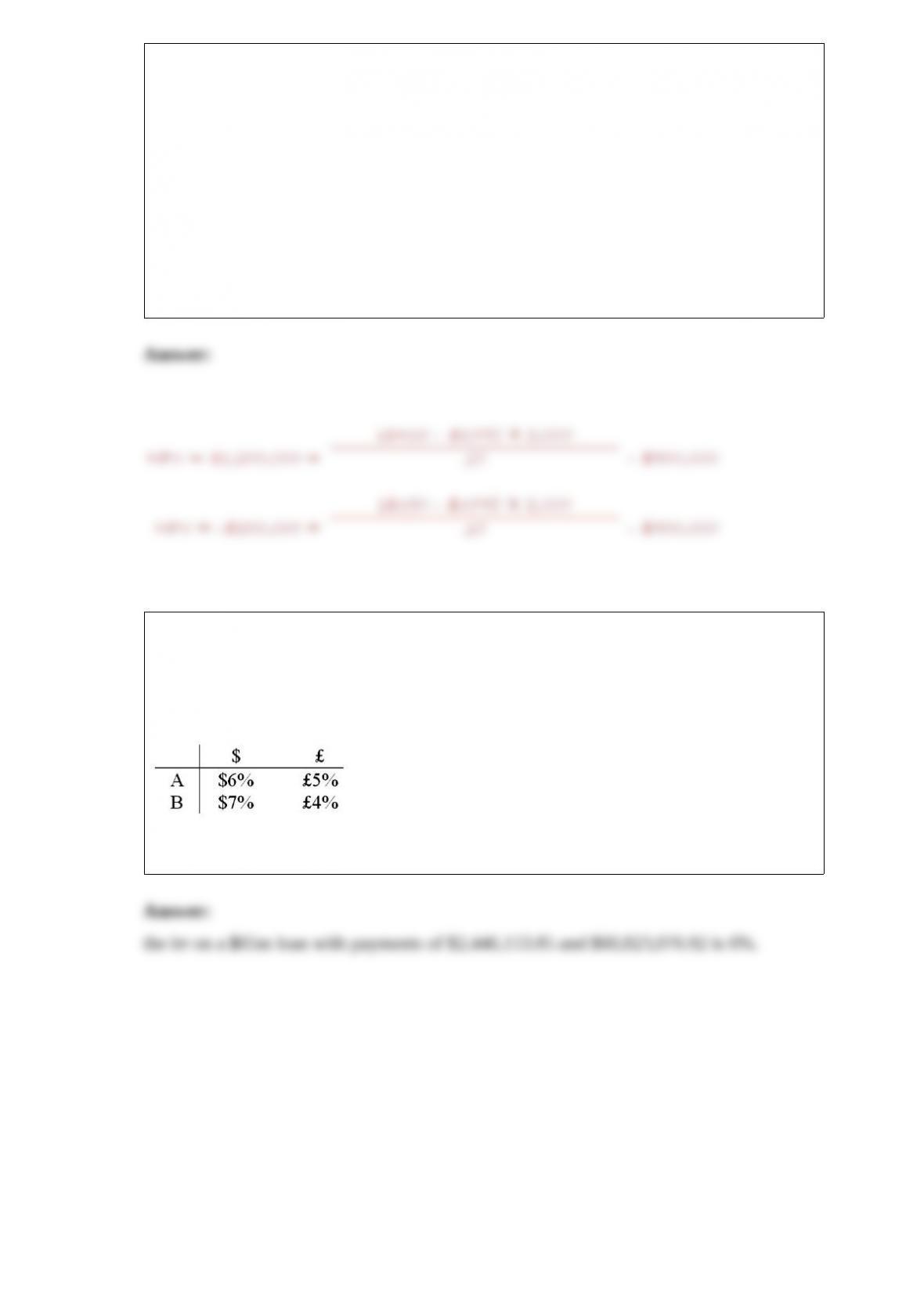
compute the npv at the two possible prices of gold.
22) consider the situation of firm a and firm b. the current exchange rate is $2.00/£ firm
a is a u.s. mnc and wants to borrow £30 million for 2 years. firm b is a british mnc and
wants to borrow $60 million for 2 years. their borrowing opportunities are as shown,
both firms have aaa credit ratings.
what would be the interest rate?