1) A company is considering two mutually exclusive projects, A and B. Project A
requires an initial investment of $100, followed by cash flows of $95, $20 and $5.
Project B requires an initial investment of $100, followed by cash flows of $0, $20 and
$130. What is the IRR of the project that is best for the company’s shareholders? The
firm’s cost of capital is 10%.
A.15.24%
B.15.96%
C.16.17%
D.15.42%
2) HiLo, Inc., doesn’t face any taxes and has $100 million in assets, currently financed
entirely with equity. Equity is worth $50 per share, and book value of equity is equal to
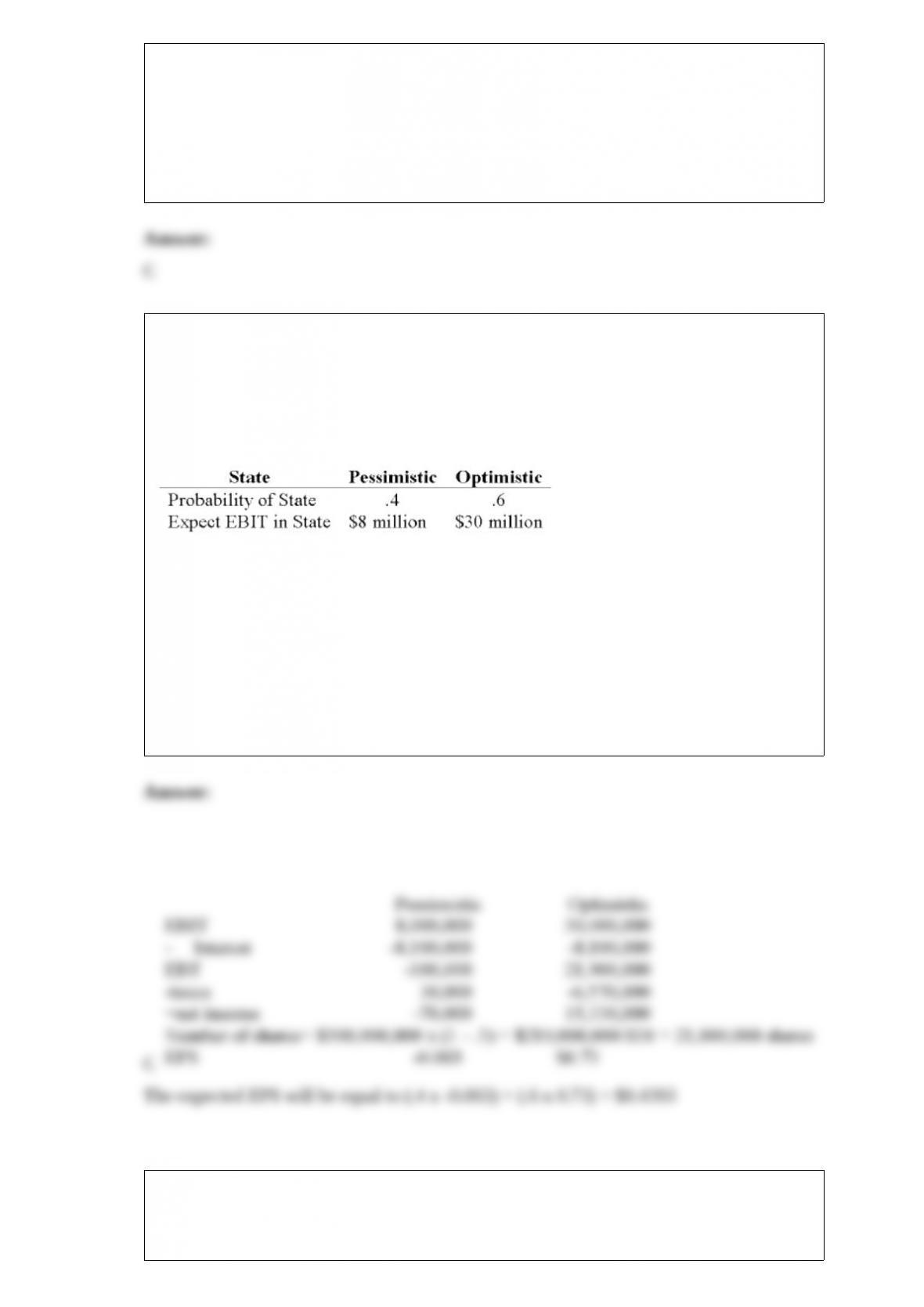
market value of equity. Also, let’s assume that the firm’s expected values for EBIT
depend upon which state of the economy occurs this year, with the possible values of
EBIT and their associated probabilities as shown below:
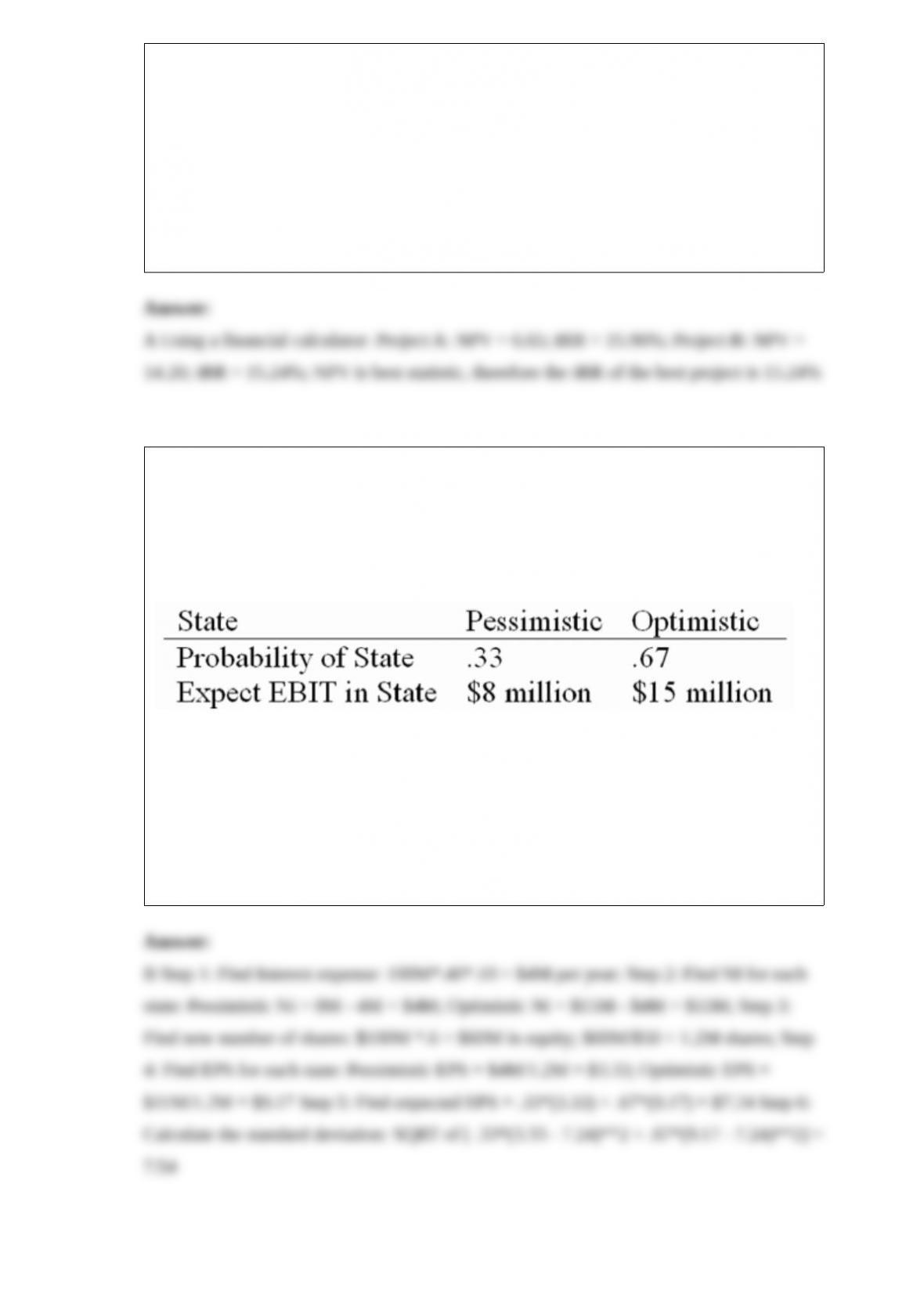
The firm is considering switching to a 40 percent debt capital structure, and has
determined that they would have to pay a 10 percent yield on perpetual debt. What will
be the standard deviation in EPS if they switch to the proposed capital structure?
A.$7.91
B.$7.54
C.$6.59
D.$6.13

3) Equipment was purchased for $50,000 plus $2,500 in freight charges. Installation
costs were $1,500 and sales tax totaled $1,000. Hiring a special consultant to provide
advice during the selection of the equipment cost $3,000. What is this asset’s
depreciable basis?
A.$55,000
B.$58,000
C.$57,000
D.$51,000
4) Solving for Rates You invested $1,000 in the stock market one year ago. Today, the
investment is valued at $1,250. What return did you earn? What return would you suffer
next year for your investment to be valued at the original $1,000?
A.+25%, -20%, respectively
B.-25%, +20%, respectively
C.125%, -25%, respectively
D.125%, -20%, respectively
5) Present Value of a Perpetuity What’s the present value, when interest rates are 10
percent, of a $75 payment made every year forever?
A.$6.75
B.$675.00
C.$750.00
D.$1,000.00
6) A 10% coupon bond has 15 years to maturity and could be called in 2 years. If the
bond is called, investors will earn 4%. The call premium is one year of coupon
payments. If coupon payments are made annually and par value is $1,000, what is the
bond’s yield to maturity?
A.6.19%
B.6.82%
C.7.65%
D.7.98%

7) Which of the following is defined as a merged firm’s advantage over smaller firms if
cuts associated with the merger lower the firm’s operating costs of production?
A.economies of scale
B.economies of scope
C.economies of synergy
D.x-efficiencies
8) Your firm needs a machine which costs $90,000, and requires $30,000 in
maintenance for each year of its 5-year life. After 5 years, this machine will be
replaced. The machine falls into the MACRS 5-year class life category. Assume a tax
rate of 35% and a discount rate of 13%. What is the depreciation tax shield for this
project in year 5?
A.$471.74
B.$1,347.84
C.$3,628.80
D.$6,739.20
9) The policy of changing the capital structure gradually over time by funding new
capital projects disproportionately with the type of capital you want to increase in the
capital structure is referred as ___________________.
A.Separation principle
B.Overinvestment problem
C.Passive capital structure management
D.Active captive structure management
10) This is the expected or “implied” rate on a short-term security that will originate at
some point in the future.
A.Current yield
B.Forward rate
C.Spot rate
D.Yield to maturity
11) Calculating Costs of Issuing Stock Amy’s Accessories, Inc., needs to raise $10
million to finance plant expansion. In discussions with its investment bank, Amy’s
learns that the bankers recommend an offer price (or gross proceeds) of $25 per share
and Amy’s will receive $23 per share. What is the underwriter’s spread on the issue?
A.$0
B.$2
C.$23
D.$25
12) A stock is expected to pay a $4.00 dividend per share. The growth rate is expected
to be 5%. If investors demand 10% on this stock, what is the expected price of the stock
10 years from now?
A.$94.68
B.$92.17
C.$130.31
D.$126.93
13) If a firm has a cash cycle of 41 days and an operating cycle of 76 days, what is its
average payment period?
A.52 days
B.29 days
C.117 days
D.35 days
14) The biggest disadvantage of the sole proprietorship is _________________.
A.Unlimited liability
B.Double taxation
C.Limited access to capital
D.Total control
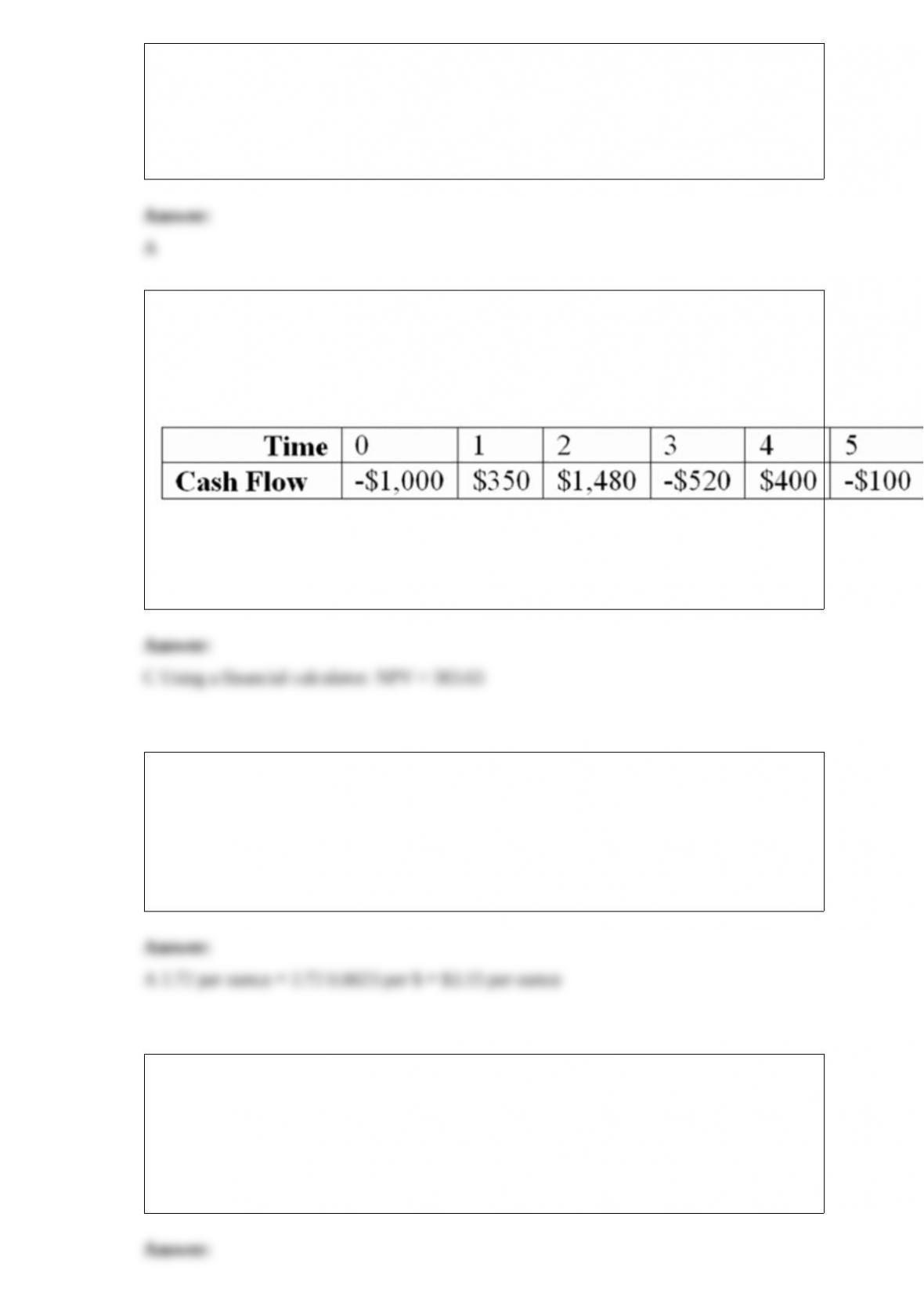
15) Compute the NPV statistic for Project U given the following cash flows and if the
appropriate cost of capital is 9 percent.
Project U
A.$201.69
B.$273.82
C.$383.63
D.$397.21
16) If the price of copper in Europe is 2.72 per ounce, what is the expected price of
copper in the United States if the spot exchange rate is $1 = 0.8623?
A.$3.15
B.$3.84
C.$4.17
D.$2.98
17) Exchange Rate Quote Convert the following direct quote to a dollar indirect quote:
1 Indian Rupee = $0.02250
A.0.02250 Rupee
B.0.9775 Rupee
C.1.0225 Rupee
D.44.44 Rupee

18) Rank the following three stocks by their total risk level, highest to lowest. Night
Ryder has an average return of 14 percent and standard deviation of 30 percent. The
average return and standard deviation of WholeMart are 12 percent and 25 percent; and
of Fruit Fly are 25 percent and 40 percent.
A.Fruit fly, Night Ryder, WholeMart
B.Night Ryder, WholeMart, Fruit Fly
C.WholeMart, Fruit Fly, Night Ryder
D.WholeMart, Night Ryder, Fruit Fly
19) Calculation of Average Costs with Economies of Scope Jewelry Designs is
considering a merger with Beads Supply Stores. Jewelry’s total operating costs of
producing services are $300,000 for sales volume of $2 million. Beads’ total operating
costs of producing services are $125,000 for a sales volume (JP) of $2.25 million. For a
sales volume of $4.25 million, calculate the reduction in production costs the merged
firms need to experience such that the total average cost (TAC) for the merged firms is
equal to 8%.
A.decrease of $340,000
B.decrease of $85,000
C.decrease of $40,000
D.decrease of $25,000
20) Calculating Costs of Issuing Stock Beach Stuff, Inc., needs to raise $10 million in
new capital funding from a seasoned equity offering. In discussions with its investment
bank, Beach Stuff learns that the bankers recommend a gross price of $20.00 per share
and they will charge an underwriter’s spread of $1.75 of the gross price. In addition,
Beach Stuff must pay $1.5 million in legal and other administrative expenses for the

seasoned stock offering. What is the number of shares of stock that Beach Stuff will
need to sell to raise the $10 million?
A.630,137
B.575,000
C.500,000
D.547,946
21) Risks inherent in making investments in foreign countries include _____________.
A.The value of their investment changes as the exchange rates change
B.Cash flows to be received in the future may be worth less when actually received if
the foreign exchange rate fluctuates dramatically
C.Political risks due to an unstable government
D.All of these
22) Calculating Costs of Issuing Debt Tennis Games, Inc., with the help of its
investment bank recently issued $25 million of new debt. The offer price (and face
value) on the debt was $1,000 per bond and the underwriter’s spread was 8 percent of
the gross proceeds. What is the amount of capital funding Tennis Games, Inc., raised
through this debt offering?
A.$1,000
B.$2 million
C.$23 million
D.$25 million
23) You have been asked by the president of your company to evaluate the proposed
acquisition of a new special-purpose truck for $50,000. The truck falls into the MACRS
three-year class, and it will be sold after three years for $5,000. Use of the truck will
require an increase in NWC (spare parts inventory) of $2,000. The truck will have no
effect on revenues, but it is expected to save the firm $25,000 per year in before-tax
operating costs, mainly labor. The firm’s marginal tax rate is 40 percent. What will the
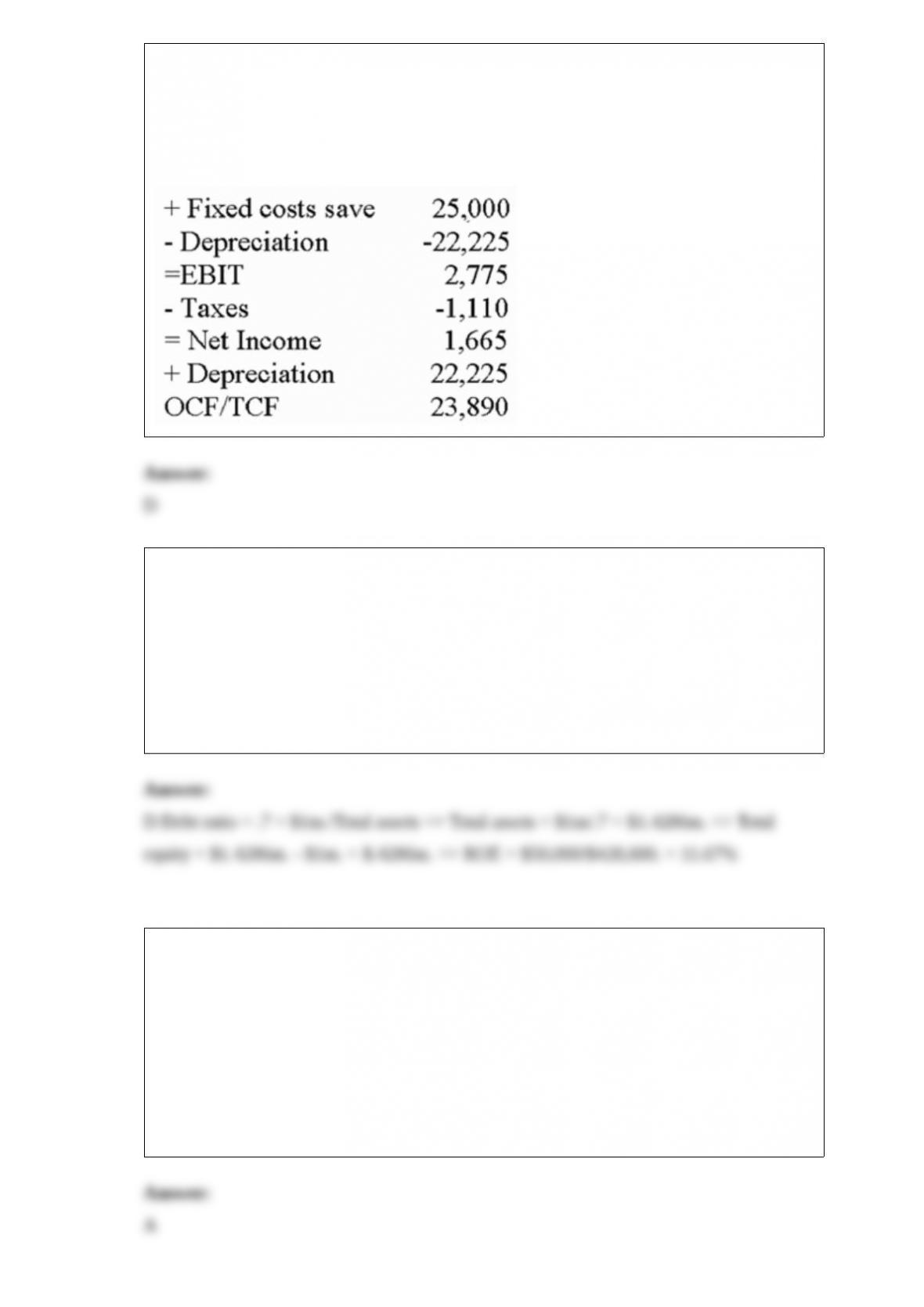
operating cash flow for this project be during year 2?
A.$21,890
B.$22,225
C.$22,690
D.$23,890
24) Profitability and Asset Management Ratios You are thinking of investing in Ski
Sports, Inc. You have only the following information on the firm at year-end 2011: net
income = $50,000, total debt = $1 million, and debt ratio = 70%. What is Ski’s ROE for
2011?
A.2.94%
B.3.49%
C.7.14%
D.11.67%
25) Which of the following is incorrect?
A.Most firms would want to sell additional shares of common stock if they feel their
stock is undervalued
B.Most firms would not want to repurchase shares of common stock if they feel their
stock is overvalued
C.It is important for financial managers to understand market efficiency because it
helps them understand how their stock prices will react to different types of decisions
and news announcements
D.None of these statements are incorrect
26) Whenever a set of stock prices go unnaturally high and subsequently crash down,
the market experiences what we call a(n) ___________________.
A.Financial meltdown
B.Irrational behavior
C.Stock market bubble
D.None of these
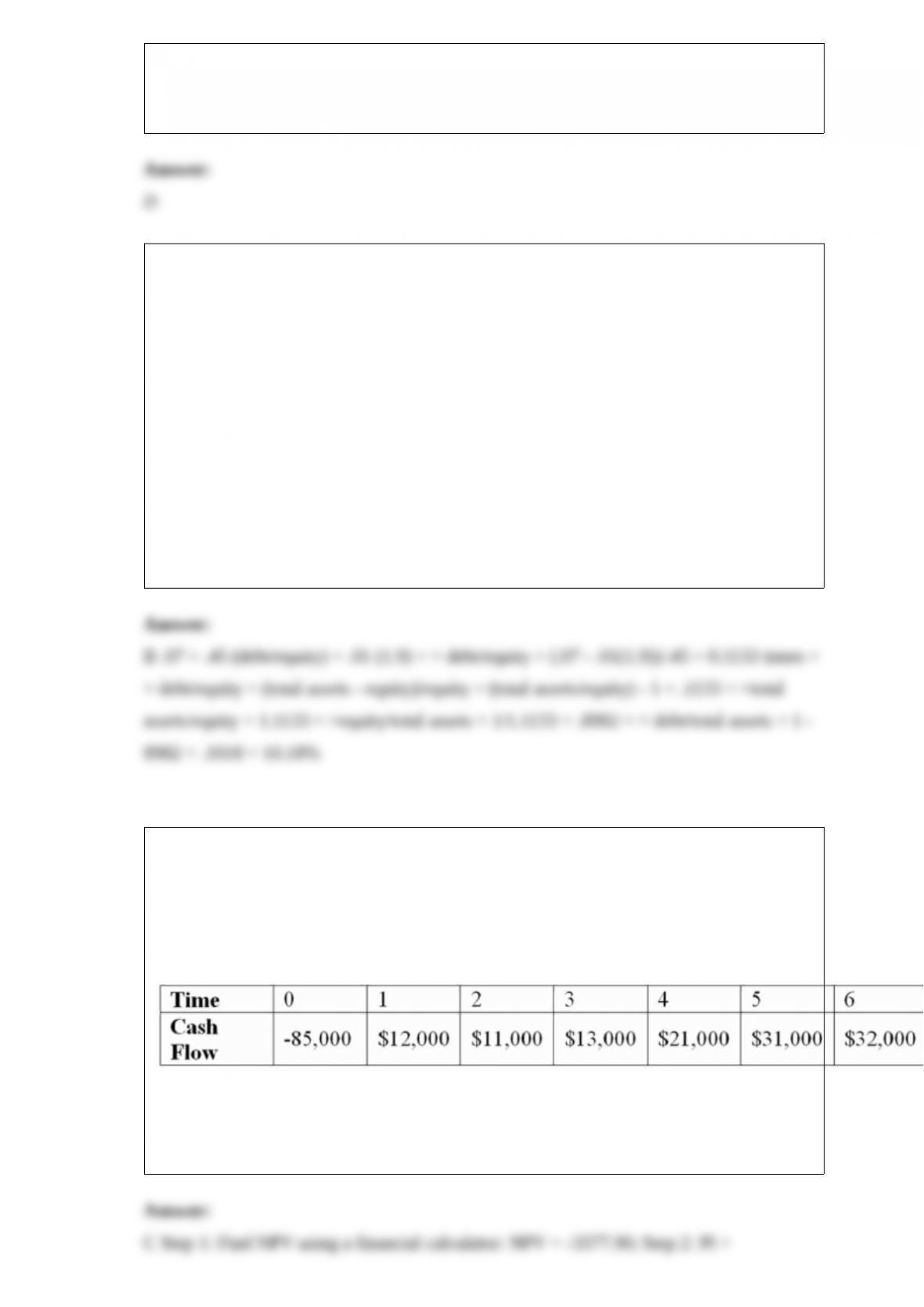
27) Your company faces a 30% tax rate and has $300 million in assets, currently
financed entirely with equity. Equity is worth $10 per share, and book value of equity is
equal to market value of equity. Also, let’s assume that the firm’s expected values for
EBIT depend upon which state of the economy occurs this year, with the possible
values of EBIT and their associated probabilities as shown below:
The firm is considering switching to a 30-percent debt capital structure, and has
determined that they would have to pay a 9 percent yield on perpetual debt in either
event. What will be the level of expected EPS if they switch to the proposed capital
structure?
A.$0.30
B.$0.365
C.$0.44
D.$0.73
28) Which of the following tools is suitable for choosing between mutually exclusive
projects?
A.Profitability Index
B.IRR
C.MIRR
D.NPV
29) Calculating the Probability of Bankruptcy A linear probability model you have
developed finds there are two factors influencing the past bankruptcy behavior of firms:
the debt-to-equity ratio and the sales-to-total assets ratio. Based on past bankruptcy
experience, the linear probability model is estimated as:
PDi = .45 (debt/equity) + .01 (sales/total assets)
A firm you are thinking of lending to has a sales-to-assets ratio of 1.9 and its expected
probability of default, or bankruptcy, is estimated to be 7 percent. Calculate the firm’s
debt ratio.
A.11.33%
B.10.18%
C.89.82%
D.7.00%
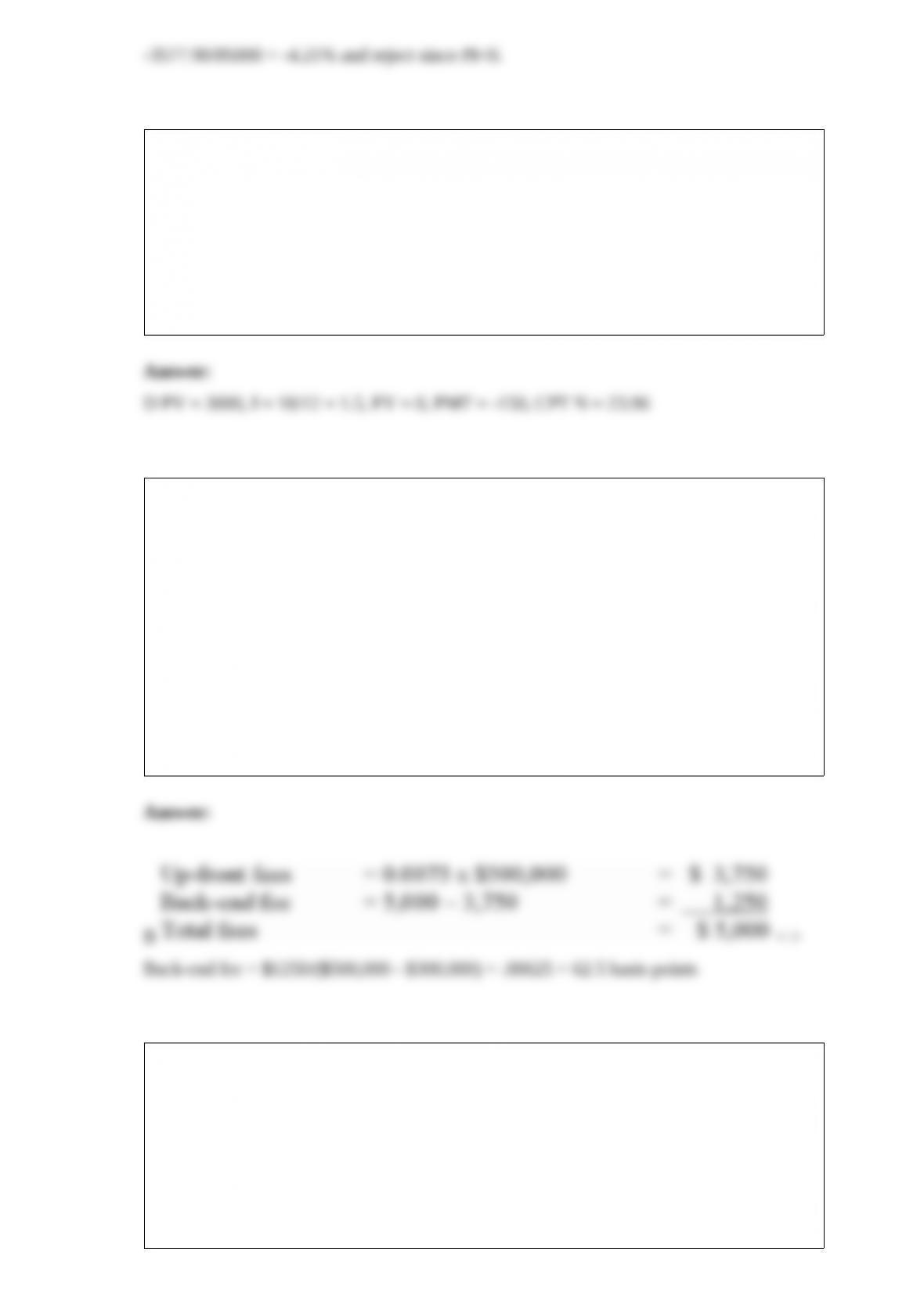
30) Suppose your firm is considering investing in a project with the cash flows shown
below, that the required rate of return on projects of this risk class is 10 percent, and
that the maximum allowable payback and discounted payback statistics for the project
are 3.5 and 4.5 years, respectively. Use the PI decision to evaluate this project; should it
be accepted or rejected?
A.PI = 6.94%; reject the project
B.PI = -7.52%; reject the project
C.PI = -4.21%; reject the project
D.PI = 5.33%; accept the project
31) Number of Annuity Payments Joey realizes that he has charged too much on his
credit card and has racked up $3,000 in debt. If he can pay $150 each month and the
card charges 18 percent APR (compounded monthly), how long will it take him to pay
off the debt?
A.13.03 months
B.14.68 months
C.20.00 months
D.23.96 months
32) Calculating Fees on a Loan Commitment During the last year you have had a loan
commitment from your bank to fund inventory purchases for your small business. The
total line available was $500,000, of which you took down $300,000. It is now the end
of the loan commitment period and your bank is asking you to pay the back-end fees.
You have misplaced the paperwork that listed the terms of the commitment, but you
know you paid total fees (this does not include any interest paid to borrow the
$300,000) of $5,000 on this loan commitment. You remember that the up-front fee was
75 basis points. What is the back-end fee on this loan commitment?
A.6 basis points
B.62.5 basis points
C.75 basis points
D.2.5 basis points
33) You are evaluating a product for your company. You estimate the sales price of
product to be $375 per unit and sales volume to be 500 units in year 1; 1,000 units in
year 2; and 200 units in year 3 . The project has a 3-year life. Variable costs amount to
$200 per unit and fixed costs are $100,000 per year. The project requires an initial
investment of $175,000 in assets which will be depreciated straight-line to zero over the
3-year project life. The actual market value of these assets at the end of year 3 is
expected to be $20,000. NWC requirements at the beginning of each year will be
approximately 25% of the projected sales during the coming year. The tax rate is 34%
and the required return on the project is 10%. What will the year 2 free cash flow for
this project be?
A.$8,933
B.$22,458
C.$69,333
D.$144,333
34) What is the trade-off between using too much financial leverage and not using
enough leverage? Who is likely to complain the most in each case?
35) Describe the difference between the internal growth rate and the sustainable growth
rate.
36) Yields of a Bond A 4.75 percent coupon municipal bond has 20 years left to
maturity and has a price quote of 98.9. The bond can be called in 5 years. The call
premium is one year of coupon payments. Compute and discuss the bond’s current
yield, yield to maturity, taxable equivalent yield (for an investor in the 35 percent
marginal tax bracket), and yield to call. (Assume interest payments are paid
semi-annually and a par value of $5,000.)
37) Explain why, in a world with both corporate taxes and the chance of bankruptcy, a
small firm with volatile EBIT is unlikely to have much debt?
38) Explain when it is appropriate to use the nave, average, and seasonality- and
trend-adjusted approaches to forecasting sales.
39) What would prompt a firm like GE to start paying out a much higher percentage of
its earnings as dividends?
40) How does compounding help build wealth (or increase debt) over time?