
Liquidity
a. measures the ability of the firm to pay financial obligations as they become due.
b. can be measured in terms of working capital.
c. can be assessed by the current ratio.
d. All of the above.
For each of the types of payroll taxes and other payroll-related items listed, indicate
whether it is paid by the employee through a paycheck withholding, by the employer, or
both.(Choices may be used more than once.)
a. Employee
b. Employer
c. Both
10/ Medicare taxes
11/ Unemployment taxes
12/ Social security taxes
13/ State income taxes
14/ Fringe benefits
15/ State unemployment taxes
16/ Federal income taxes
17/ Federal unemployment taxes
18/ Gross pay
A company issued 5-year bonds with a par value of $5,000,000 and a 7% annual stated
rate of interest on January 2, 2013. The issue price of the bond issue was $4,431,850
which reflected a 10% effective interest rate. Interest payments are made annually. Any
premiums or discounts should be amortized using the effective interest rate method.
Required:
A) Record the issuance of the bonds.
B) Record interest expense at December 31, 2013.
C) Record the interest paid to the bondholders on January 2, 2014.
D) Record interest expense at December 31, 2014.
Which of the following statements is nottrue? The information in the statement of cash
flows helps investors, creditors and others
a. assess a company’s ability to produce future cash inflows.
b. judge a company’s ability to meet it obligations and pay dividends.
c. estimate the company’s needs for external financing.
d. show the inflows and outflow of net income on the accrual basis.
Refer to Rags to Riches. Which of the following would result from a horizontal analysis
of the company’s income statement?
a. Net sales in 2015 increased to 140.74% of the 2014 amount.
b. Gross profit is 57.9% of net sales for 2015.
c. Accounts receivable is 13.3% of total assets in 2015.
d. The accounts receivable turnover ratio is 7.76 in 2015.
Rags to Riches
Selected data from the financial statements are provided below:
2015 2014
Accounts Receivable $ 120,000 $ 76,000
Inventory 24,000 32,000
Total Assets 900,000 760,000
Net Sales 760,000 540,000
Cost of Goods Sold 320,000 420,000
Refer to Rags to Riches. Which of the following would result from a horizontal analysis
of the company’s balance sheet?
a. Accounts receivable increased $22,000 or 57.9% during 2015.
b. Accounts receivable is five times larger than inventory in 2015.
c. Accounts receivable is 13.3% of total assets in 2015.
d. The accounts receivable turnover ratio is 7.76 in 2015.
Blackbeard’s Restaurant began operations on January 1, 2011, with a total investment of
$100,000 by its stockholders. The restaurant had a net loss its first year of business of
$15,000. During 2012 and 2013, the business was profitable with net incomes of
$25,000 and $50,000, respectively. The company paid $5,000 per year in dividends to
its shareholders in 2012 and 2013.
A) In good form, prepare a statement of retained earnings for the year ended December
31, 2012.
B) How much is total retained earnings on December 31, 2013?
C) Explain the link between the statement of retained earnings and the balance sheet.
Lakeside Properties, Inc. had 50,000 shares of 5%, $20 par preferred stock and 400,000
shares of $8 par common stock issued and outstanding at the beginning of 2015.
Indicate the effect each of the following items has directly on retained earnings by
writing the amount in the space provided. Use a plus sign (+) in front of the amount to
indicate increases in retained earnings, and use parentheses ( ) around the amount to
indicate decreases in retained earnings. If the transaction results in no direct change in
retained earnings, place N/A in the space.
A) Issued a 2-for-1 preferred stock split when the market price of the preferred stock
was $44 per share.
B) Earned net income in the amount of $650,000 for 2015.
C) Declared and paid the annual stated cash dividend to its preferred stockholders.
D) Declared and paid a 10% common stock dividend when the market price of the
common stock was $11 per share.
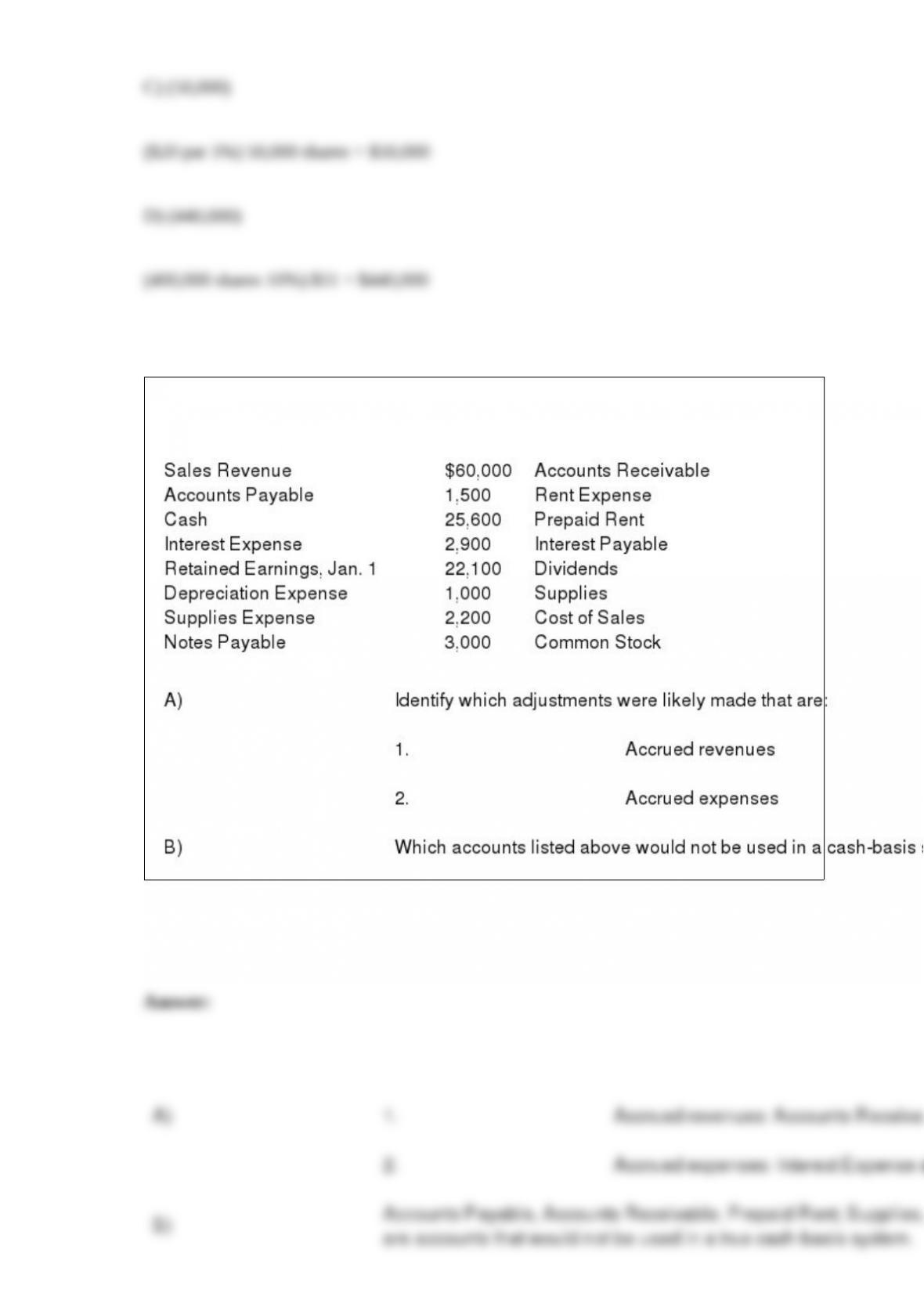
Given below are the accounts from the ledger AFTER adjustments have been posted at
December 31, 2014.

A-One Construction
The following data are from the company’s records for 2013:
Accounts Receivable–January 1, 2013 $455,000
Credit sales during 2013 900,000
Collections from credit customers during 2013 825,000
Customer accounts written off as uncollected during 2013 15,000
Allowance for Doubtful Accounts
(After write-off of uncollected accounts) 2,100
Estimated uncollected accounts based on an aging analysis 29,200
Refer to A-One Construction. What is the balance of Accounts Receivable at December
31, 2013?
a. $545,000
b. $440,000
c. $515,000
d. $530,000

The Allowance for Doubtful Accounts represents:
a. Bad debt losses incurred in the current period
b. The amount of uncollected accounts written off to date
c. The difference between total sales made on credit and the amount collected from
those credit sales
d. The difference between the recorded value of accounts receivable and the net
realizable value of accounts receivable
All of the following accounts have normal debit balances except
a. accounts receivable.
b. dividends.
c. supplies expense.
d. service revenue.
What is the impact on the accounting equation of recording the accrual of interest
expense?
a. Both assets and liabilities decrease.
b. Both assets and stockholders’ equity decrease.
c. Liabilities decrease and stockholders’ equity increases.
d. Liabilities increase and stockholders’ equity decreases.
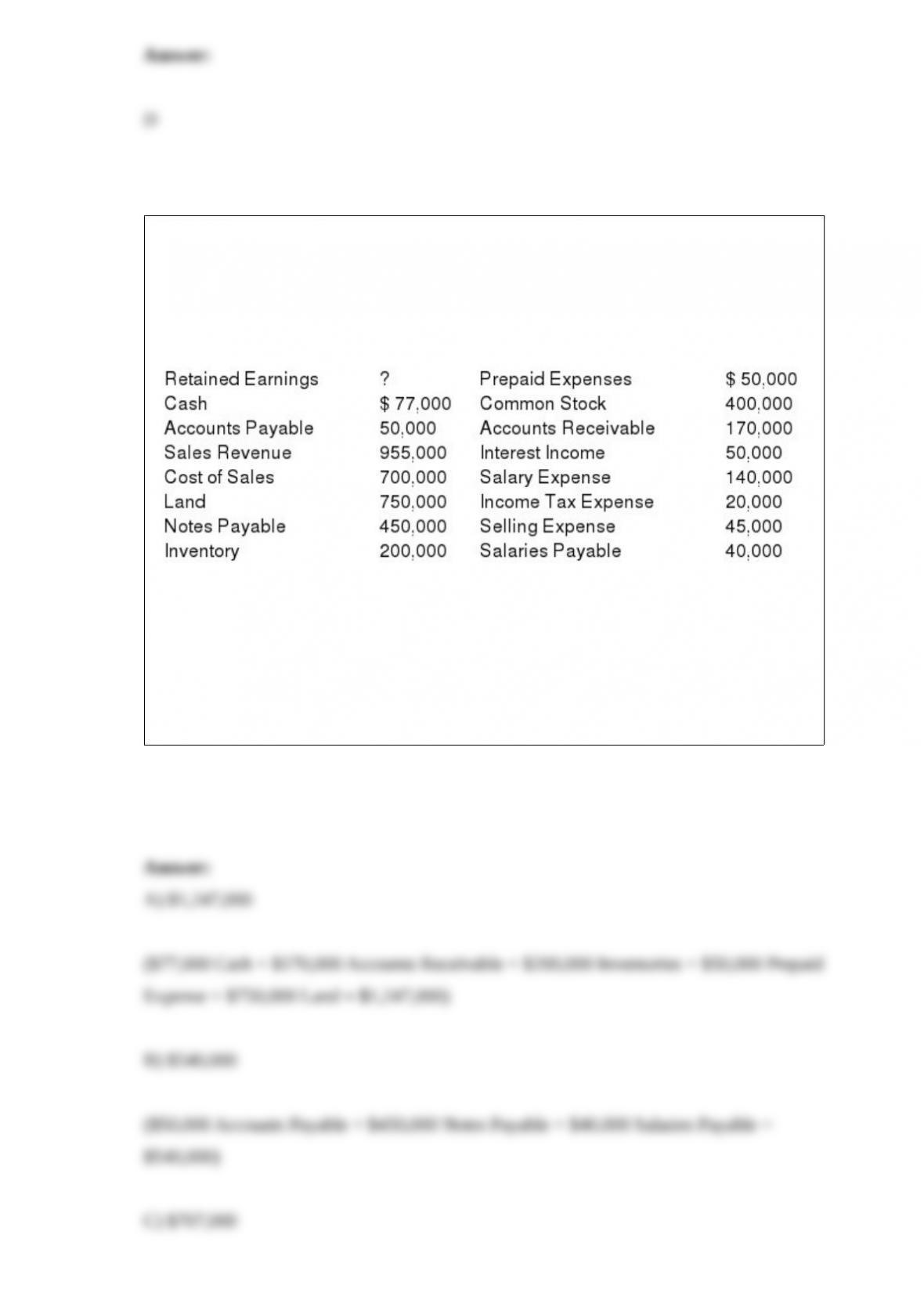
Ben & Terry’s Ice Cream
The accountant prepared the following list from the company’s accounting records for
the year ended December 31, 2013:
Determine the following amounts for Ben & Terry’s Ice Cream.
A) Total Assets at the end of 2013.
B) Total Liabilities at the end of 2013.
C) Total Equity at the end of 2013.
Match these terms with their definitions.
a. Callable bonds f. Mortgage bonds
b. Capital lease g. Notes payable
c. Convertible bonds h. Operating lease
d. Debenture bonds i. Secured bonds
e. Junk bonds
Refer to the information provided for Lemke Corp. How much is ending inventory on
April 30th?
a. $265.45
b. $312.00
c. $318.55
d. $324.00
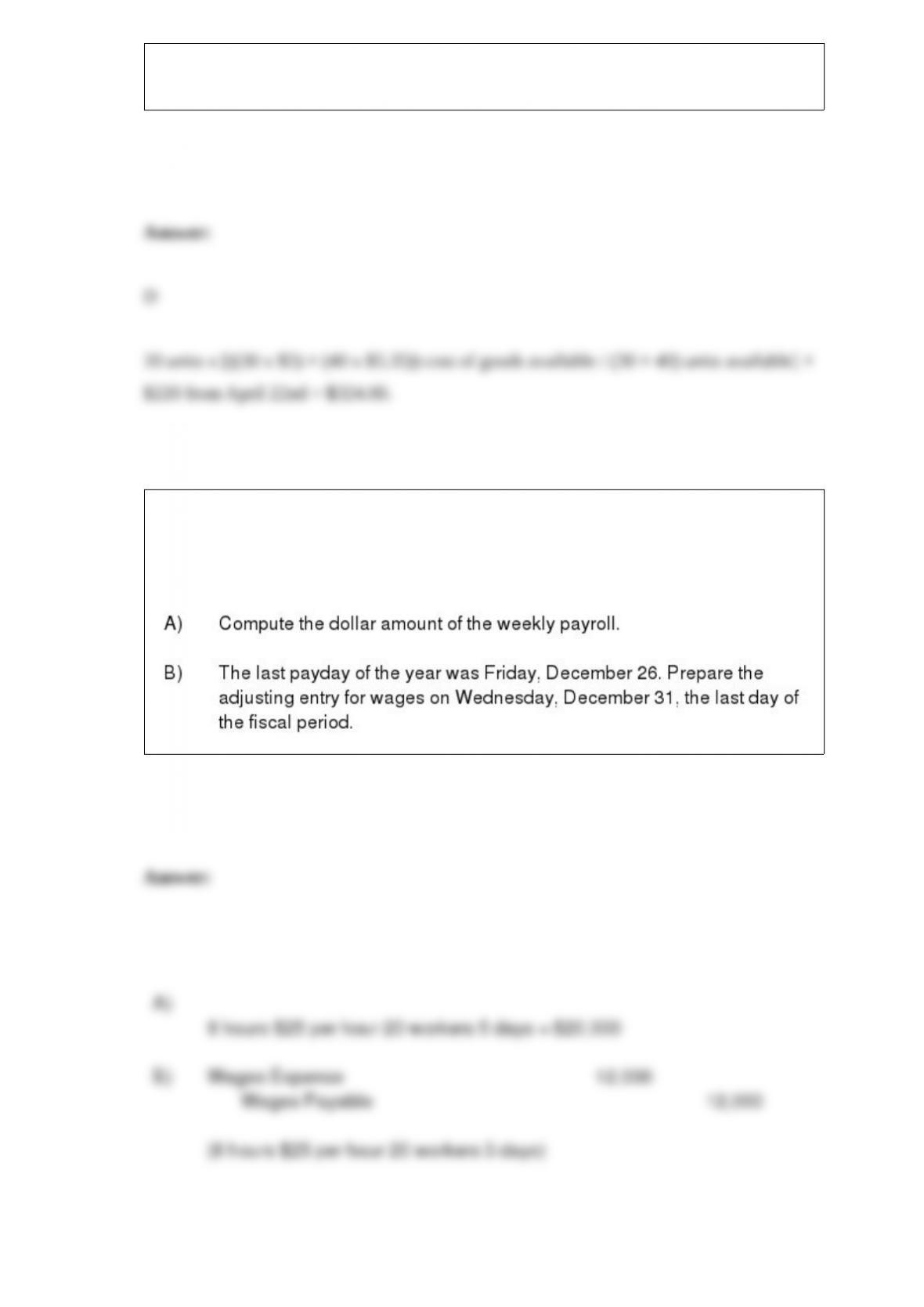
Chicago Works employs 20 workers. Each employee is paid wages of $25 per hour and
works an 8-hour workday, Monday through Friday. Employee wages are paid every
Friday for the workweek just ending.
A question frequently asked by investors is, “How much debt does this company have?”
Which financial statement answers this question?
a. single step income statement
b. cash flow statement
c. multiple-step income statement
d. classified balance sheet
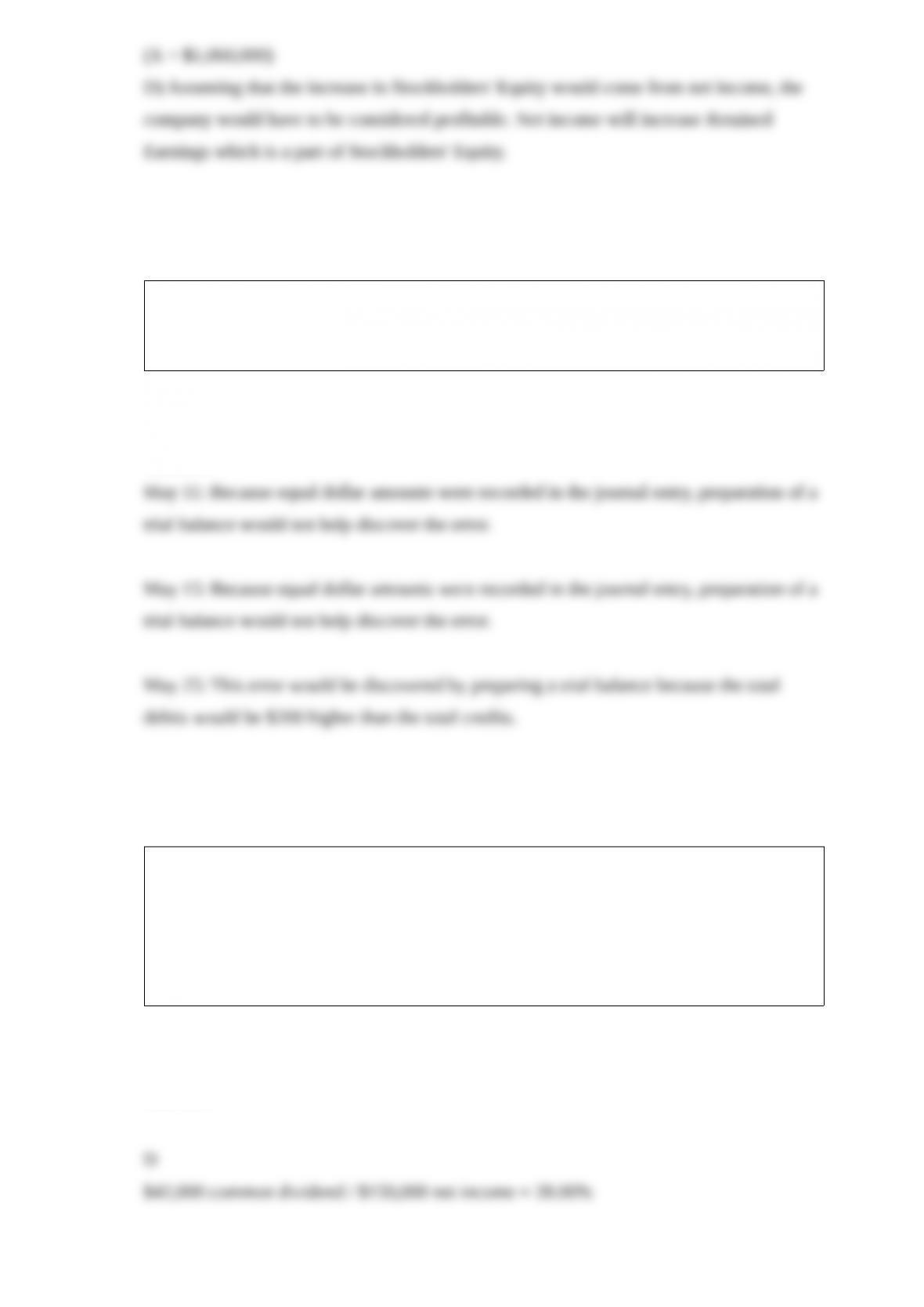
The following balance sheet information is provided:
A) What is the amount of Stockholders’ Equity at January 1, 2013?
B) What is the amount of Liabilities at December 31, 2013?
C) Assume that the company paid dividends of $620,000 during the year. How much
net income did it earn during the year?
D) Assume that the company paid no dividends during the year. Without looking at the
income statement, how can you tell if the company is profitable or not?
Refer to Holiday Marina. Assume that the incorrect journal entries have been posted to
the general ledger. For each incorrect journal entry, explain why the error would or
would not be discovered by preparing a trial balance.
Refer to Labor Finders, Inc. The company’s 2015 dividend payout ratio is reported as
a. 2.67%.
b. 2.80%.
c. 26.67%.
d. 28.00%.

When using the indirect method to determine operating cash flows, how is the decrease
in accounts payable shown on the Statement of Cash Flows?
a. operating activity
b. investing activity
c. financing activity
d. noncash investing and financing activity
e. not reported on the statement of cash flows
Hunsinger Enterprises purchases many small pieces of office furniture, such as trash
cans, that cost less than $100 each. The company accounts for these items as expenses
when acquired rather than reporting them as property, plant, and equipment on its
balance sheet. The company’s accountant states that no accounting principle has been
violated. Justification for expensing these furniture items is based on cost vs. benefit
considerations as well as the accounting constraint of
a. conservatism.
b. materiality.
c. neutrality.
d. verifiability.
A company issued 10-year, 9%, $1,000,000 bonds paying interest on an annual basis, at
a premium. Which one of the following statements is true?
a. The annual interest expense on the bonds will be greater than the amount of interest

payments to bondholders each year.
b. The annual interest expense on the bonds will be less than the amount of interest
payments to bondholders each year.
c. The issue price will be less than $1,000,000.
d. The cash paid to bondholders will be based on the market rate of interest.
You have determined that a company uses straight line depreciation. However, the
depreciation expense is different than you expected it to be. What could be the reason
for this difference?
a. different residual values
b. same residual values
c. same useful lives
d. Cannot be determined.
Which of the following would describe a callable bond?
a. Borrower has the right to pay off the bonds prior to due date.
b. Borrower has the right to issue more bonds prior to due date of existing bonds.
c. Borrower has the right to call off the interest payments on the bonds.
d. Investor has the right to call off the interest payments on the bonds.

How are purchase returns and purchase discounts recorded by a company using the
periodic inventory system?
a. as a reduction to the Purchases account
b. in contra-accounts to the Purchases account
c. as operating expenses
d. as miscellaneous expenses
If the stated interest rate is 12% per year, but it is compounded semiannually, then the
adjusted rate used for present or future value calculations will be
a. 12% per year.
b. 3% per quarter.
c. 6% per 6-month period.
d. 1% per 6-month period.
Refer to Lanthier’s Heating & Air. What is the maximum amount that can be reported
on the balance sheet for common stock and preferred stock, respectively, if all of the
stock is issued?
Common Stock Preferred Stock
a. $20,000 $ 2,400
b. $20,000 $40,000
c. $10,000 $40,000
d. $10,000 $ 2,400
Refer to HVAC Service. The journal entry to record the purchase of office equipment
and supplies will include a credit to
a. furniture & supplies.
b. cash.
c. accounts payable.
d. delivery expense.
Which set of items below are current assets?
a. Accounts Receivable, Net Income, Inventory, and Dividends
b. Cash, Accounts Receivable, Capital Stock, and Sales
c. Net Income, Cash, Office Supplies, and Inventory
d. Cash, Accounts Receivable, Inventory, and Office Supplies
An ____________________ revenue must be recorded when revenue is earned in
advance of receiving cash.
An amount recorded as an increase in the company’s cash account at the end of the
period, but which has notyet been reflected on the bank statement is called a(n)
____________________.
A T-account for Cash cannot contain any credits.

Liquidity refers to a company’s ability to pay its current obligations when they come
due.
The corporation’s retained earnings is computed by adding the beginning balance and
net income, then subtracting the current year ____________________.
If the bank debits its customer’s checking account, then the customer’s cash balance
increases.
The residual claim entitles a common stockholder to a proportionate share of a
liquidating payout before preferred stockholders are paid.
Knox Jewelers issued $1,000,000 of 8% interest bearing debt at the beginning of the
year. The company reported net income before interest and taxes of $2,000,000 for the
current year. Assuming a 40% tax rate, what is the company’s net income for the year?
As a general rule, all users of financial statements seek answers to the same questions.
Ward Company had beginning inventory of $40,000 on January 1, 2013. During 2013,
the company purchased $660,000 of goods from a supplier. On December 31, 2013, the
cost of unsold inventory was $50,000. Compute Ward Company’s cost of goods
available for sale and cost of goods sold for 2013.
A construction company purchased a piece of equipment with a price of $100,000 on
March 1, 2013. The amounts are related to the equipment purchase. Match the items
and explain how each item should be accounted for. (Choices may be used more than

once.)
a. This item should be included as part of the cost of the equipment.
b. This item should be considered a revenue expenditure.
10, The cash purchase was made on March 8 with terms of 2/10, net 30.
11, $3,000 freight costs were paid to ship the equipment from the manufacturer,
12, A state agency required that a pollution-control device be installed on the
equipment at a cost of $5,000.
13, During the installation, the equipment was damaged and repair costs of $2,000
were incurred.
14, It was necessary for an architect to redesign the work space to accommodate the
new equipment. A fee of $6,000 was paid.
15, The company purchased a three-year liability insurance policy to cover possible
damage caused by the new equipment at a cost of $6,000.
16, The company financed the equipment purchase with a bank loan. Interest of
$3,000 was paid on the loan during 2013.
Collections of accounts receivable are considered to be cash equivalents.
Differentiate a cumulative dividend preference from a participating dividend
preference. Describe the circumstances under which these preferences would be
utilized.
The following information is available at January 1, 2015:
Common Stock, $10 par, 1,000,000 shares authorized, 50,000 shares issued $500,000
Treasury Stock, 1,000 common shares at cost 80,000
Record the purchase of the treasury stock on November 30, 2013 and the January 10,
2014 sale of 500 shares of treasury stock for $70 per share.
Presented below is a partially-completed income statement for Waddy Corp. for 2013.
Determine the missing amounts for each letter.
Net sales $ A
Cost of goods sold:
Beginning inventory B
Net purchases 140,000
Cost of goods available for sale 160,000
Ending inventory C
Cost of goods sold 125,000
Gross profit 75,000
Selling, general & administrative expenses D
Operating income 10,000
Agrefeld, Inc. has a return on assets of 12% and a return on common equity of 15%.
What causes the difference in these two returns?
The dividends account has a normal debit balance.

The indirect method of reporting cash flows from operating activities involves
reconciling net income and cash flows from operations.