1) a theory based on the relationship of domestic spending for domestic goods relative
to domestic output is known as the elasticities approach.
2) if u.s dollar depreciates against foreign currency, the u.s. exports will become
relatively more expensive to foreigners and the trade deficit will get worsen.
3) under the monetary approach to exchange rate, a rise in domestic money supply will
cause a depreciation of domestic currency.
4) the goal of an arbitrage transaction between two currencies is to profit on difference
in exchange rates in different markets by taking some risks of exchange rate
movements.
5) the internal and external equilibrium occurs when the is curve crosses the lm curve
above the bp curve.
6) table 3-1:
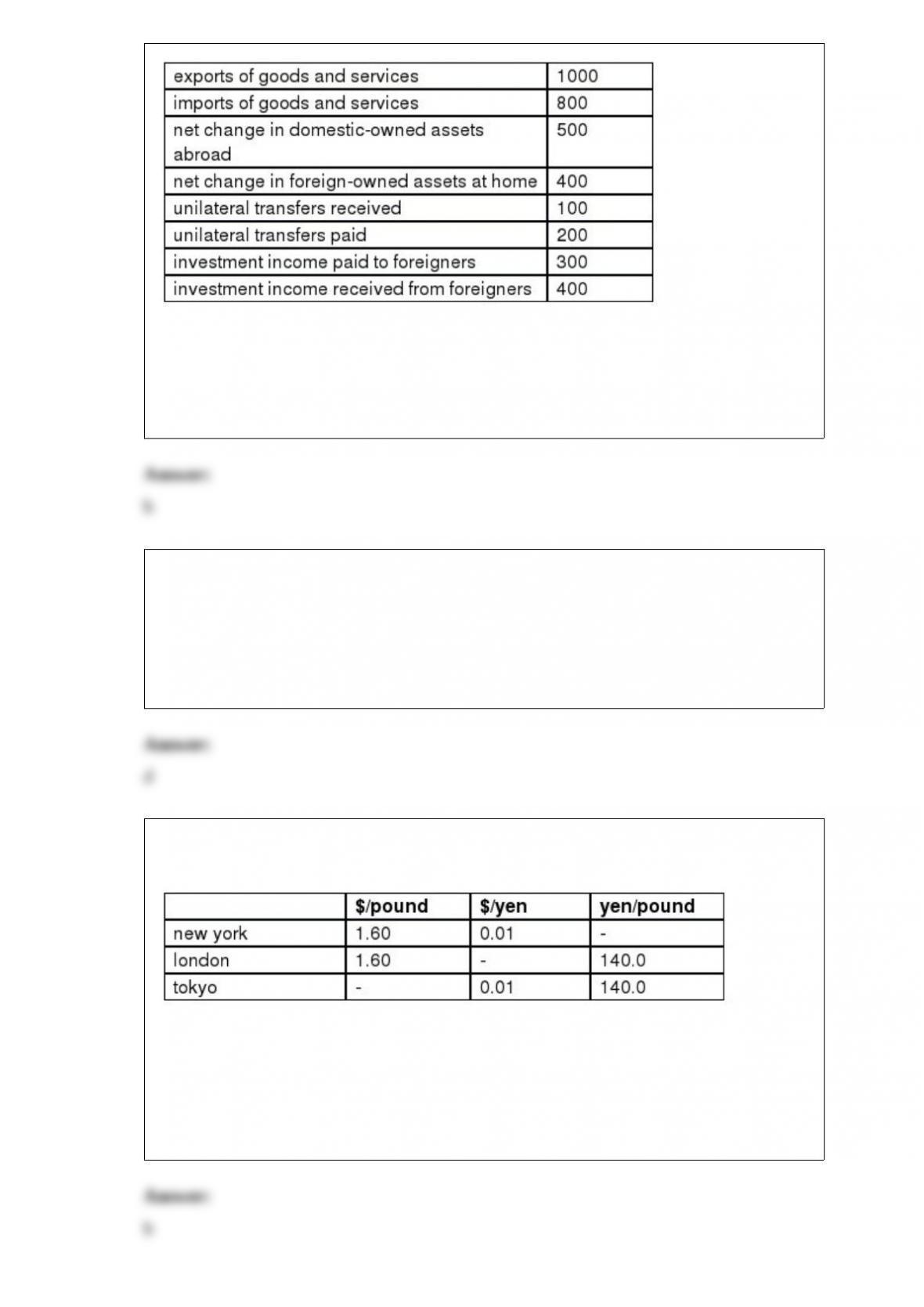
refer to table 3-1. the balance on the capital account is:
a.+ 900
b.+100
c. 0
d. 100
7) the offsetting of international reserve flows by central banks that wish to follow an
independent monetary policy is known as:
a.printing money
b.balancing the official settlements
c.the monetary approach
d.sterilization
8) assume that the following exchange rates exist for the u.s. dollar, japanese yen and
the british pound.
if you are an arbitrageur that starts with $1,000 in new york, you will end up with the
arbitrage profit of:
a.$0
b.$142.86
c.$446.43
d.$875.00

9) the big mac index is used as:
a.a way to set exchange rates in different currencies
b.a way to set interest rates in different regions
c.a record of different ingredients in hamburgers in different regions
d.a measure of different prices in different countries
10) in capital budgeting, a multinational firm often:
a.forecasts exchange rates
b.ignores capital seizures risks
c.provides a bill of lading
d.transfers profits to one foreign subsidiary
11) suppose that the one-year u.s. interest rate is 8% and the equivalent one-year u.k.
interest rate is 10%. according to the covered interest rate parity, there is a ________ on
the u.s dollar.
a.2% forward discount
b.2% forward premium
c.18% forward discount
d.18% forward premium
12) a currency is at a ________ when its interest rate is ________ than the interest rate
in the other country.
a.forward flat, lower
b.forward discount, lower
c.forward discount, higher
d.forward premium, higher
13) the potential effect of exchange rate fluctuations on future cash flows of the direct
foreign investment is expressed as _____ exposure.
a.translation
b.transaction
c.conversion
d.economic

14) people in the bahamas use both bahamian dollars and u.s. dollars to pay for goods
and services. suppose that the fed increases money supply, causing higher inflation rate
in the u.s. if the exchange rate were allowed to float, the u.s. dollar will ________
against the bahamian dollar and bahamians will substitute toward more __________
holding.
a.appreciate; bahamian dollars
b.appreciate; u.s. dollars
c.depreciate; bahamian dollars
d.depreciate; u.s. dollars
15) if the spot exchange rate goes from 0.80 euro per dollar to 0.60 euro per dollar, the
dollar has ___________ against the euro by _________ percent.
a.appreciated; 25.0
b.appreciated; 33.3
c.depreciated; -25.0
d.depreciated; -33.3
16) which of the following reasons explain why interest rate parity may not hold
perfectly?
i.controls on financial capital flows
ii.offshore risk accounting rules
iii.different tax rates for interest and foreign exchange rate earnings
iv.time zone fluctuations
a.i only
b.i and iii
c.i, ii, and iii
d.i, iii, and iv
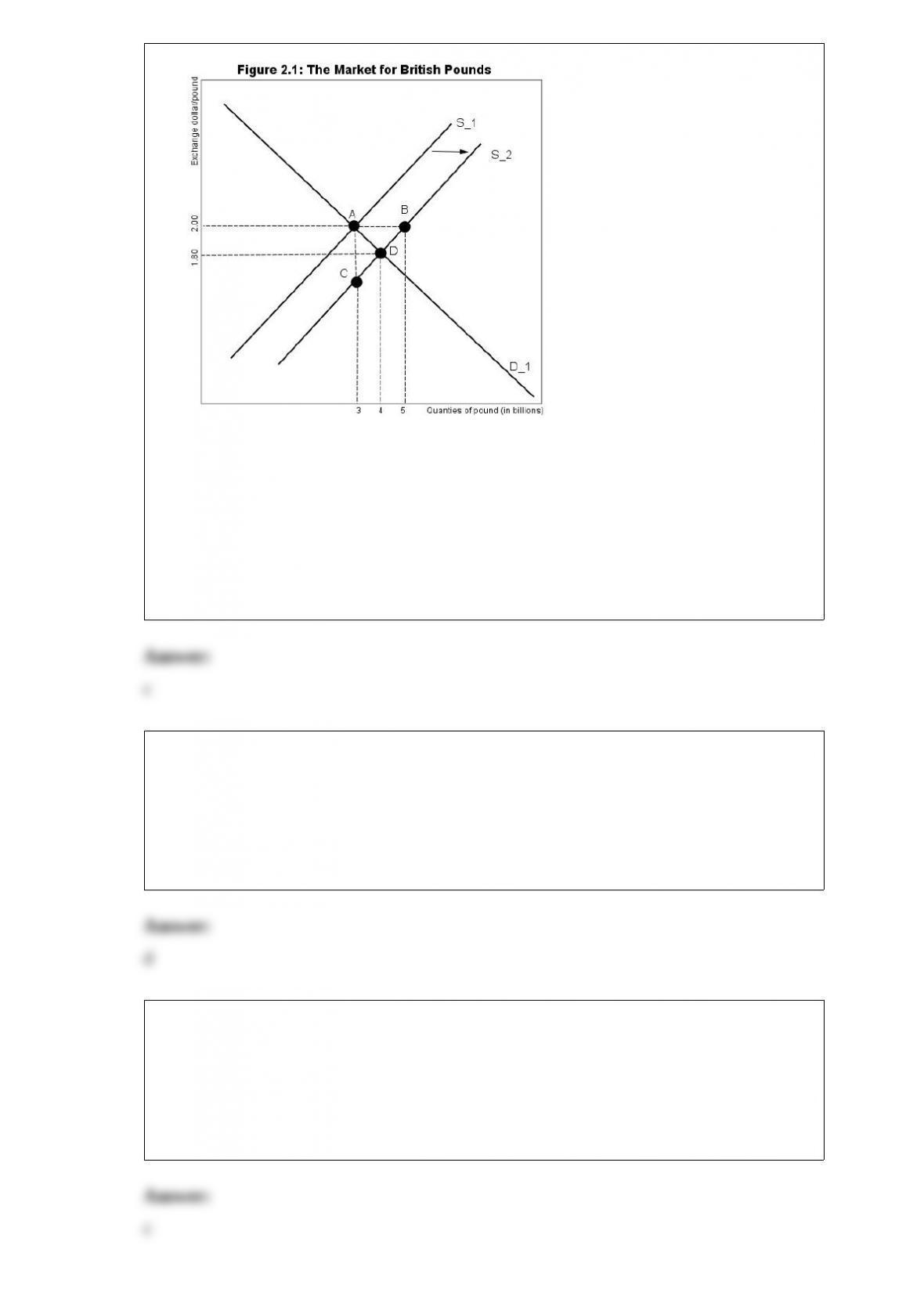
17)
referring to figure 2.1, the pound per dollar exchange rate starts at 2.00. assume that an
increase in the taste for u.s. imports by u.k. residents leads to a shift in the supply of
pounds. how many pounds will the bank of england need to purchase to restore the
exchange of 2.00?
a.0.2 billion
b.1 billion
c.2 billion
d.4 billion
18) security a and security b have a correlation coefficient of 0. if security as return is
expected to increase by 10 percent,
a.security bs return should also increase by 10 percent
b.security bs return should decrease by 10 percent
c.security bs return should be zero
d.security bs return is impossible to determine from the above information
19) if the u.s. and the u.k. have identical term structures of interest rates, we would
expect:
a.the pound to appreciate against the dollar
b.the pound to depreciate against the dollar
c.no change in the exchange rate between two currencies
d.there is not enough information to forecast the direction of the exchange rate
20) under the flexible exchange rate regime, which of the following variables in the
monetary approach becomes zero and is dropped out of the equation?
a.percentage change in domestic credit
b.percentage change in spot exchange rate
c.percentage change in foreign reserves
d.percentage change in money demand
21) when the exchange rate for the mexican peso changes from 8 pesos to the dollar to
10 pesos to the dollar, then
a.the peso has appreciated against the dollar by 20%
b.the peso has appreciated against the dollar by 20%
c.the peso has appreciated against the dollar by 25%
d.the peso has depreciated against the dollar by 25%
22) when the demand is ________, an increase in price will decrease the total revenue.
a.elastic
b.inelastic
c.contracted
d.expanded
23) suppose sumitomo bank quotes the ¥/$ exchange rate as 110.30.50 and nomura
bank quotes 110.50.70. in this case,
a.there is no arbitrage opportunity
b.you can make money by buying dollars at sumitomo bank and selling dollars at
nomura
c.you can make money by buying dollars at nomura bank and selling dollars at
sumitomo
d.you can make money by buying dollars at sumitomo bank and selling yens at nomura
bank
24) table 6-2: spot and forward exchange rates on may 5, 2012
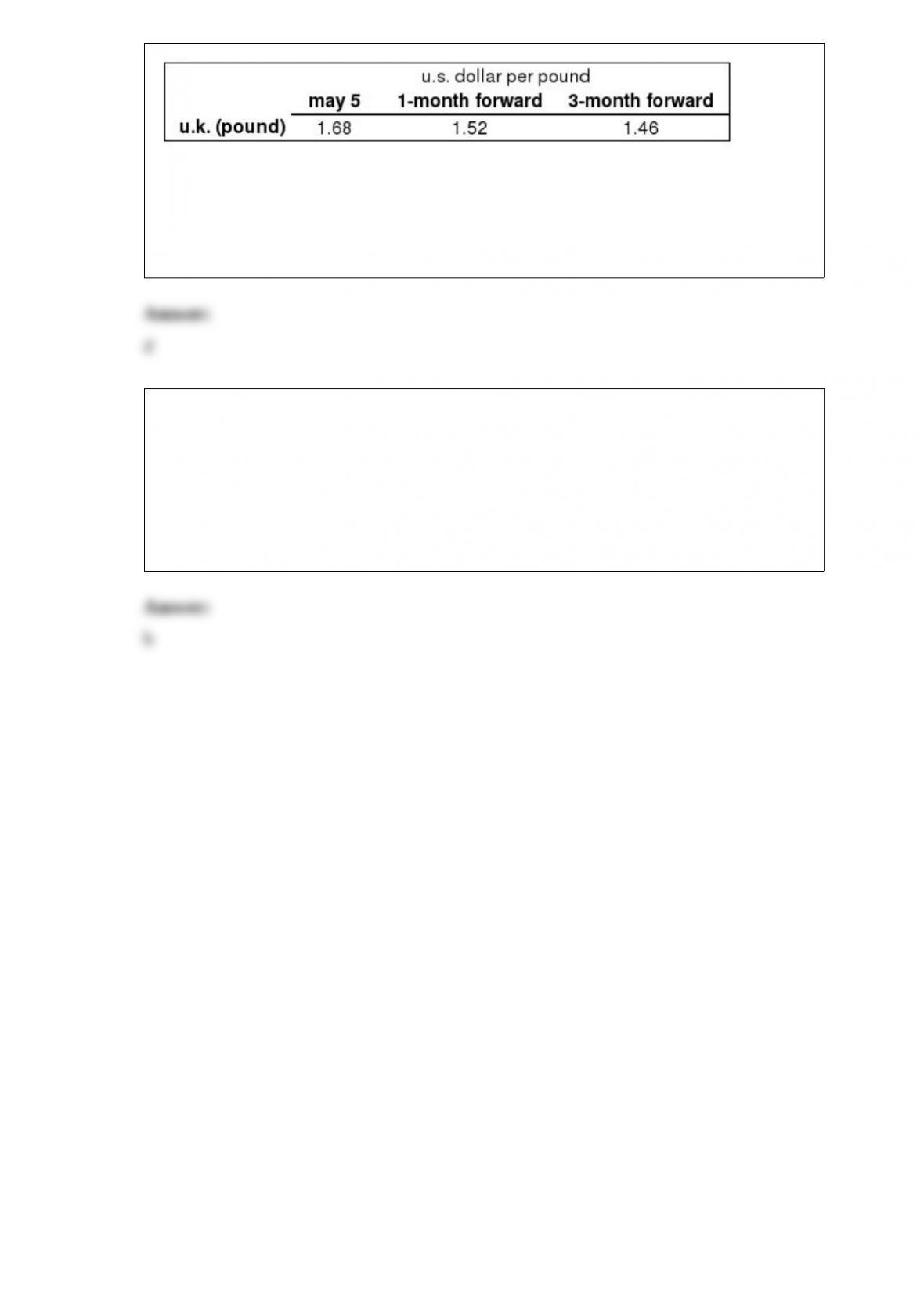
refer to table 6-2. on may 5, 2012, the 1-month forward pound was selling at a:
a.9.52% premium per annum against the dollar
b.114.24% premium per annum against the dollar
c.9.52% discount per annum against the dollar
d.114.24% discount per annum against the dollar
25) according to the monetary approach, when a monetary disequilibrium exists, either
____________ or _____________ has to adjust depending on the type of exchange rate
system.
a.the balance of payments; domestic production
b.the balance of payments; exchange rate value
c.domestic production; exchange rate value
d.domestic production; foreign inflation rate