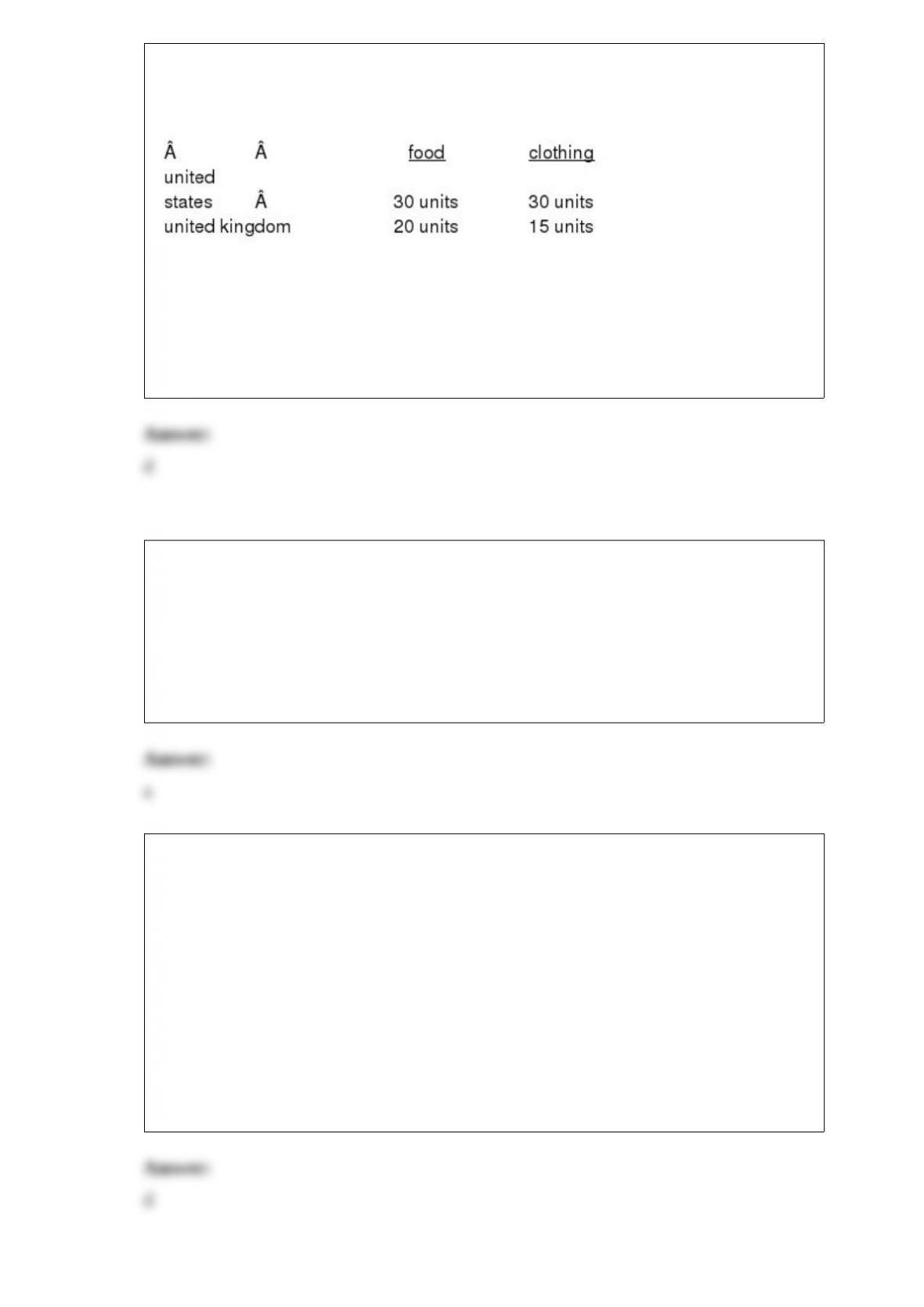
1) you are given the following classical-type table showing the output of 10 days labor
in the production of each of the two commodities in each of the two countries. assume
that the u.k. workers wage is £30 per day and that the fixed exchange rate is $2 = £1.
if trade is taking place between the two countries, what is the upper limit to the u.s.
workers wage per day?
a. $30
b. $40
c. $90
d. $120
2) two of the convergence criteria pertaining to initial membership in the emu were that
a countrys ratio of government debt to gdp must be __________ and that a countrys
ratio of government budget deficit to gdp must __________.
a. 60 percent or less; 3 percent or less
b. 60 percent or less; 60 percent or less
c. 3 percent or less; also be 3 percent or less
d. 3 percent or less; 60 percent or less
3) if two countries with increasing opportunity costs have identical ppfs but different
tastes,
a. the countries will have identical relative commodity prices under autarky, and
therefore there is no incentive to trade
b. the countries will have different relative commodity prices under autarky, but there
will still be no incentive for them to trade
c. the countries will have different relative commodity prices under autarky, and each
country can gain by exporting the good for which its consumers have the higher relative
preference
d. the countries will have different relative commodity prices under autarky, and each
country can gain by exporting the good for which its consumers have the lower relative
preference
4) if population growth is taking place,
a. one can no longer meaningfully compare community indifference curves to evaluate
the impact of growth and trade
b. the growth in population must be accompanied by increased capital stock or changes
in technology if social welfare is to increase (if increasing returns to scale are not
present)
c. the production-possibilities frontier will shift out relatively more for the labor-
intensive good than for the capital-intensive good
d. all of the above
5) suppose that the nominal tariff rate on final good x is 7 percent and that the weighted
average of the nominal tariff rates on the inputs used in producing good x is 10 percent.
in this situation, the effective rate of protection (erp) for final good industry x
a. will be greater than 10 percent
b. will be less than 10 percent but must be greater than 7 percent
c. will be less than 7 percent but must be greater than 0 percent
d. can be negative
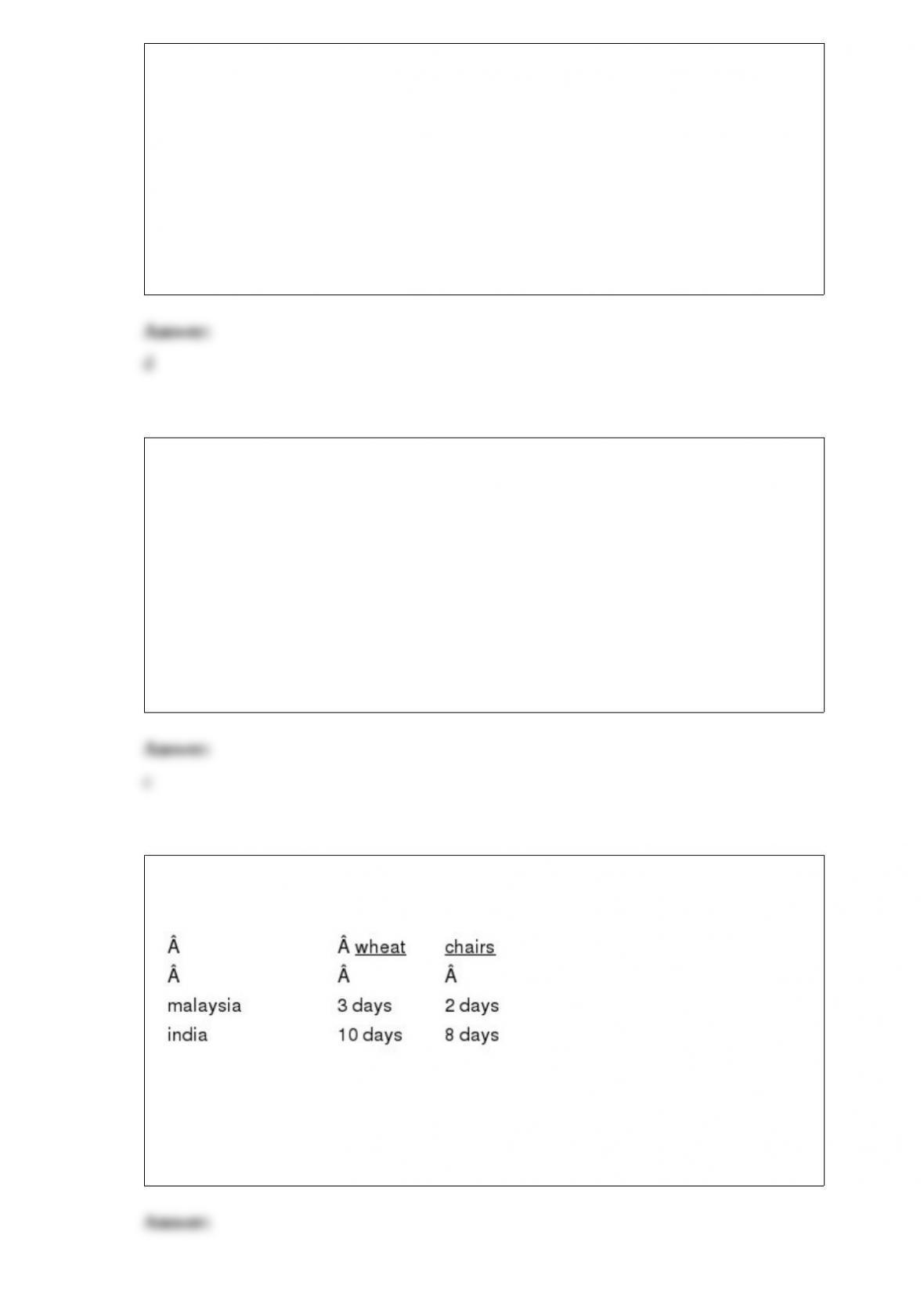
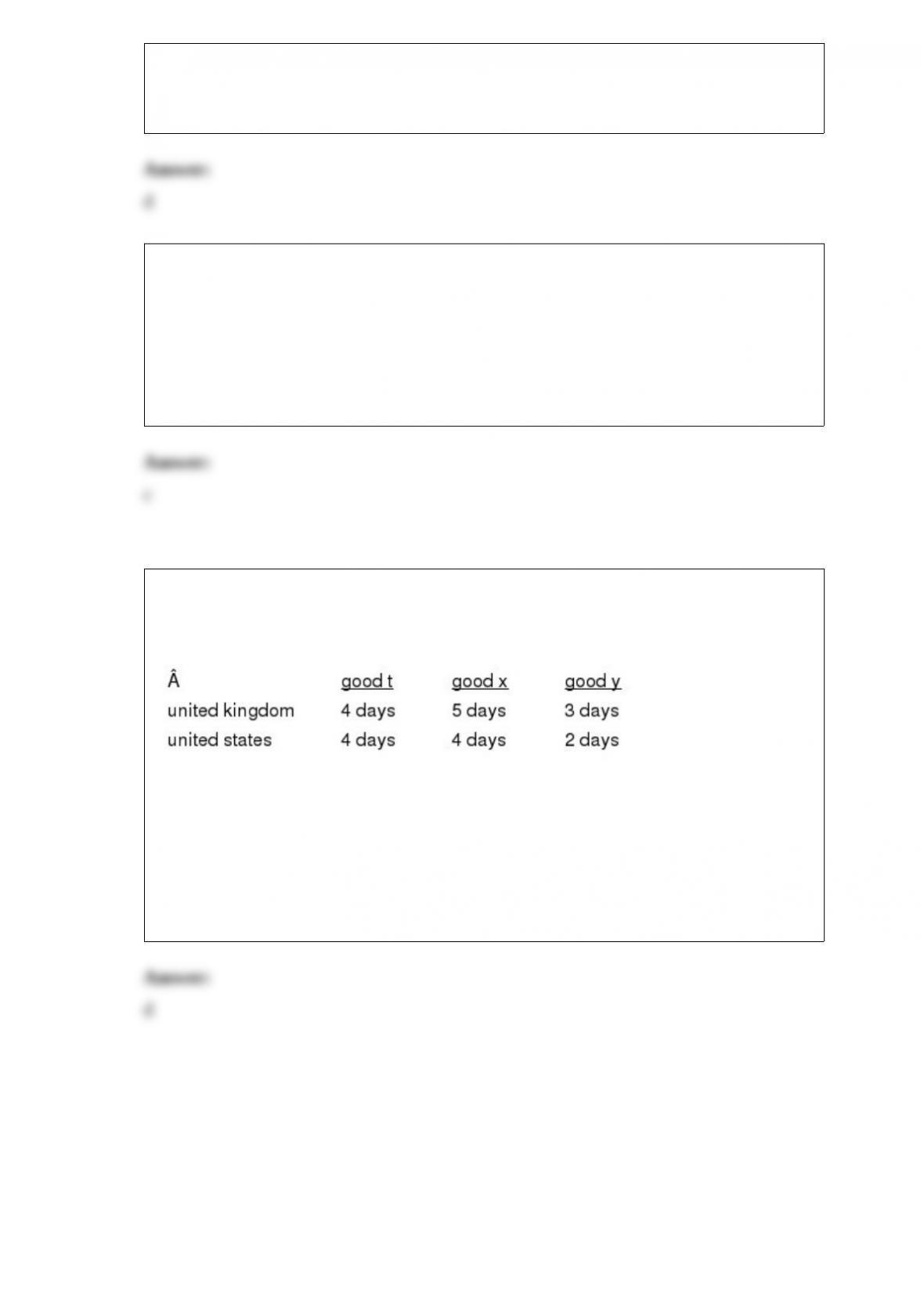
6) given the following classical-type table shows the number of days of labor input
required to obtain one unit of output of each of the three commodities in each of the two
countries:
suppose that the wage rate in the united kingdom is £30 per day, the wage rate in the
united states is $40 per day, and the exchange rate is £1 = $1. in this situation, the
united kingdom will
a. export good t and import goods x and y
b. export good y and import goods t and x
c. export goods t and x and import good y
d. export goods x and y and import good t
7) a 1974 empirical study (by steven rosefielde) found that the leontief statistic for the
soviet union in its trade with western industrialized nations was 1.44, and its leontief
statistic for its trade with developing countries was 0.43. if the soviet union was trading
in accordance with the heckscher-ohlin theorem, these results suggest that the soviet
union was relatively __________ compared to its western trading partners and
__________ compared to developing countries.
a. capital abundant; was relatively labor abundant
b. capital abundant; also was relatively capital abundant
c. labor abundant; also was relatively labor abundant
d. labor abundant; was relatively capital abundant
8) in considering trade creation and trade diversion in the formation of a customs union
between countries and whether the customs union enhances welfare in a home country
joining the union, two general conclusions that seem valid are that the customs union is
less likely to enhance welfare, other things equal, (i) if the union contains a
__________ number of countries and (ii) if costs of production in the partner countries
in the case of trade diversion differ __________ from costs of production in the outside
world (the non-member countries).
a. large rather than a small; greatly
b. large rather than small; only slightly
c. small rather than a large; greatly
d. small rather than a large; only slightly
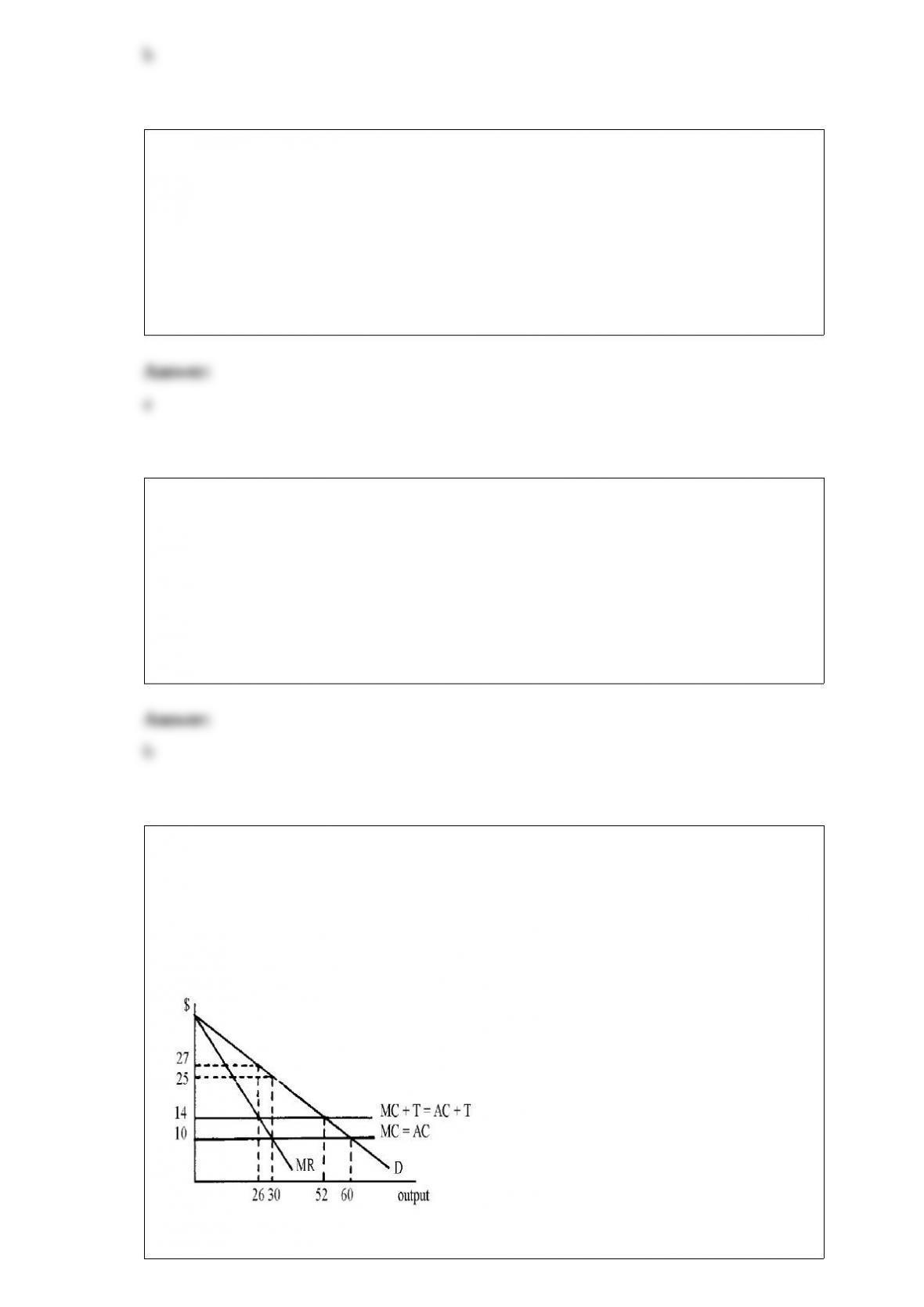
9) given the following ricardo-type table showing the amount of labor input needed to
get one unit of output in each industry in each country:
a. terms of trade of 1 wheat:1.25 chairs is not a feasible equilibrium terms of trade
b. terms of trade of 1 wheat:1.5 chairs would give all the gains from trade to india
c. malaysia has an absolute advantage in both goods and a comparative advantage in
wheat
d. india has an absolute advantage in both goods and a comparative advantage in wheat
10) in the monetary approach to the balance of payments and the exchange rate, if there
is an excess demand for money, the result is a balance-of-payments __________ in a
fixed exchange rate situation and __________ of the countrys currency in a flexible
exchange rate situation.
a. surplus; an appreciation
b. surplus; a depreciation
c. deficit; an appreciation
d. deficit; a depreciation
11) in the monetary approach to the balance of payments, under flexible exchange rates,
an increase in the proportion of income that people in country a wish to hold as money
would, other things equal, lead to an __________ in country a’s balance of payments
and therefore to __________ of a’s currency in the foreign exchange markets.
a. incipient surplus; a depreciation
b. incipient surplus; an appreciation
c. incipient deficit; a depreciation
d. incipient deficit; an appreciation
12) the following diagram shows the demand and marginal revenue curves facing a
foreign monopoly supplier of a good to the home country, as well as the firms
horizontal marginal cost curve when there is no tariff by the home country (mc) and the
marginal cost curve when a specific tariff is imposed by the home country (mc + t).
(assume that average cost (ac) equals marginal cost.) in this situation, the price to home
country consumers after the tariff has been imposed is __________.
a. $10
b. $14
c. $25
d. 27
13) in considering the demand for money in the monetary approach to the balance of
payments, it can be said that the money demand would increase if home real income
__________ and if the home interest rate __________.
a. decreases; also decreases
b. decreases; increases
c. increases; decreases
d. increases; also increases
14) given the following classical-type table shows the number of days of labor input
required to obtain one unit of output of each of the three commodities in each of the two
countries:
if the u.s. wage rate is $40 per day and the exchange rate is £1 = $1, what is the upper
limit to the wage rate in the united kingdom that is consistent with two-way trade
between the countries?
a. £262/3 per day
b. £30 per day
c. £32 per day
d. £40 per day