
1) an investor is considering purchasing a treasury bond with a 16-year maturity, a 6%
coupon and a 7% required rate of return. the bond pays interest semiannually.
a) what is the bond’s modified duration?
b) if annual promised yields decrease 30 basis points immediately after the purchase,
what is the predicted price change in dollars based on the bond’s duration?
2) in the post-depression era the largest number of bank failures occurred in which time
period?
a.1955-1965
b.1965-1975
c.1975-1985
d.1985-1995
e.1995-2005
3) the federal reserve system is charged with
a.regulating securities exchanges
b.conducting monetary policy
c.providing payment and other services to a variety of institutions
d.setting bank prime rates
e.both b and c
4) measured by the amount outstanding, the largest type of derivative market in the
world is the
a.futures market
b.forward market
c.swap market
d.options market
e.credit forward market
5) you own 500 shares of common stock in a firm that has 2 million shares outstanding.
the firm announces a plan to sell an additional 500,000 shares through a rights offering.
a) how many rights to purchase new shares will you receive?
b) suppose that the market price per share is $30, but each right allows you to purchase
a share of stock for $27. what should be the value of one right?
c) if you sold your rights, how much money should you make?
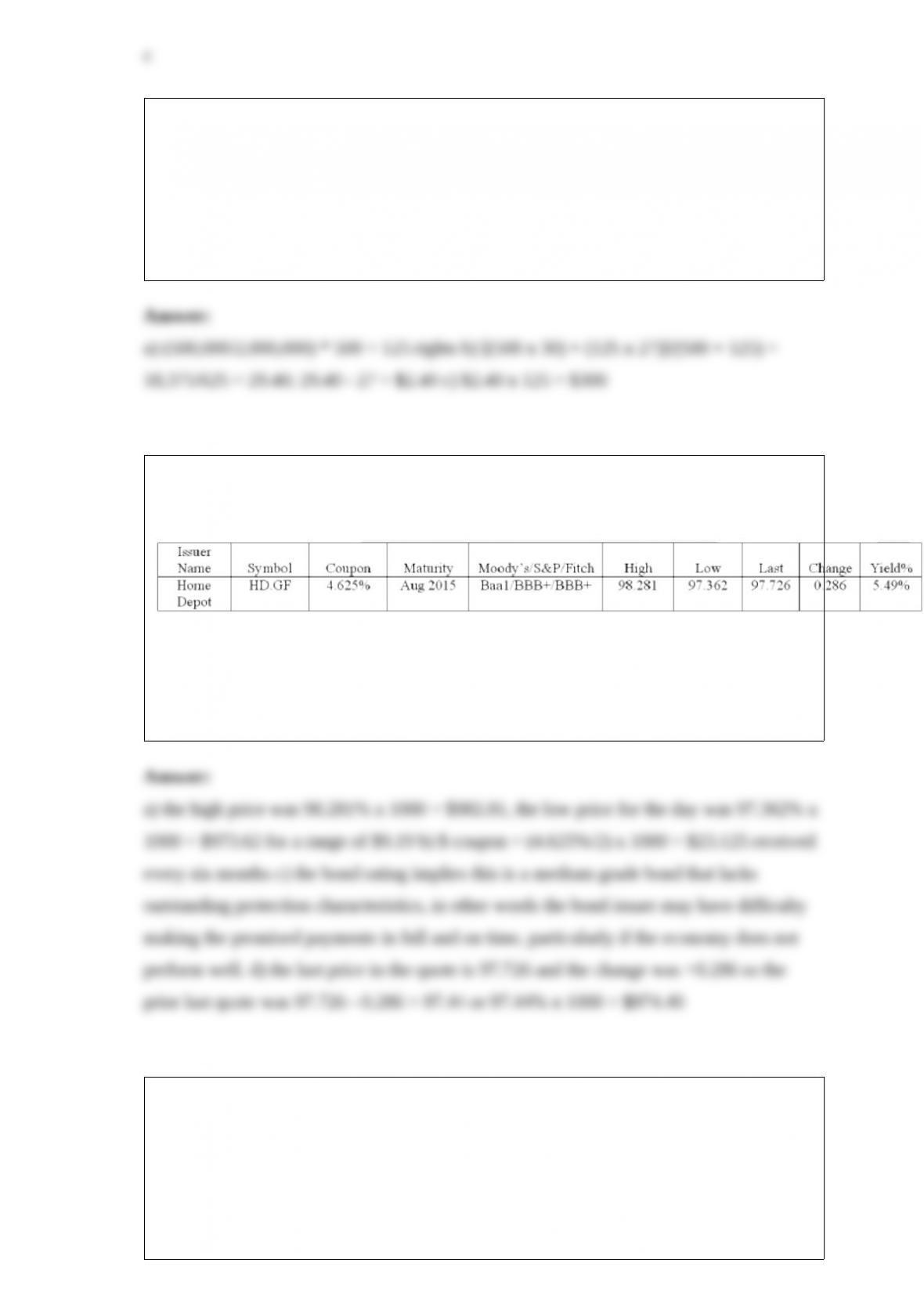
6) you find the following quote for a corporate bond ($1,000 par, pays interest
semiannually):
a) what was the range of the price for the given day?
b) how many dollars would you receive from each coupon payment?
c) approximately what risk level is implied by the bond rating?
d) what would have been the last price on the day before?
7) if the fed is targeting interest rates and money demand increases, an appropriate
policy response would be to
a.increase reserve requirements
b.increase the discount rate
c.buy u.s. treasury securities from government bond dealers
d.increase government spending
e.none of the above

8) the ________________ measures the net flows of imports and exports of goods,
services, income payments, and unilateral transfers.
a.current account
b.capital account
c.change in official reserves
d.statistical discrepancy
e.basic balance account
9) in year one, a bank facing reinvestment risk earns 11% on its assets and pays 10% on
its liabilities. in year two, the bank had a negative profit spread of 100 basis points.
which of the following is true? in year two,
a.rates rose 100 basis points
b.rates rose 200 basis points
c.rates fell 100 basis points
d.rates fell 200 basis points
e.none of the above
10) the primary regulator of insurance firms is the
a.naic
b.mccarran-ferguson commission
c.fdic
d.state insurance regulator
e.sec
11) the schedule showing how monthly mortgage payments are split into principle and
interest is called a(n)
a.securitization schedule
b.balloon payment schedule
c.graduated payment schedule
d.amortization schedule
e.growing equity schedule
12) you have $10,000 to invest and you are considering investing in a fund. the fund
charges a front-end load of 5.75% and an annual expense fee of 1.25% of the average
asset value over the year. you believe the fund’s gross rate of return will be 11% per
year. if you make the investment, what should your investment be worth in one year?
a.$10,135.48
b.$10,337.46
c.$10,461.75
d.$10,556.23
e.$10,578.92
13) in concept, the raroc measure indicates a loan is acceptable if the raroc is greater
than the
a.borrower’s roe
b.lender’s roa
c.borrower’s roa
d.lender’s roe
e.nco rate