1) Suppose your firm is considering investing in a project with the cash flows shown
below, that the required rate of return on projects of this risk class is 8 percent, and that
the maximum allowable payback and discounted payback statistic for the project are 3
and 3.5 years, respectively.
Use the IRR decision rule to evaluate this project; should it be accepted or rejected?
A.-4.95%, reject
B.4.95%, accept
C.-23.18%, reject
D.23.18%, accept
2) __________________ refers to a firm that is still allowed to continue to operate
while the creditors’ claims are settled using a collective procedure.
A.Chapter 7 bankruptcy
B.Chapter 11 bankruptcy
C.Technical insolvency
D.Prepackaged bankruptcy
3) Number of Annuity Payments Phoebe realizes that she has charged too much on her
credit card and has racked up $7,000 in debt. If she can pay $200 each month and the
card charges 17 percent APR (compounded monthly), how long will it take her to pay
off the debt?
A.28.63 months
B.35.00 months
C.47.71 months
D.48.68 months
4) The Sarbanes-Oxley Act requires public companies to ensure that these individuals
have considerable experience applying generally accepted accounting principles
(GAAP) for financial statements.

A.External auditors
B.Internal auditors
C.Chief Financial Officers
D.Corporate boards’ audit committees
5) Which of the following statements is correct?
A.An IPO is an example of a primary market transaction
B.Money markets are subject to wider price fluctuations and are therefore more risky
than capital market instruments
C.A direct transfer of funds is more efficient than utilizing financial institutions
D.The market segmentation theory argues that the different investors have different risk
preferences which determine the shape of the yield curve
6) When your investment compounds, your money will grow in a(n) __________
fashion.
A.linear
B.exponential
C.static
D.implied
7) You have approached your local bank for a start-up loan commitment for $175,000
needed to open a computer repair store. You have requested that the term of the loan be
one-year. Your bank has offered you the following terms: size of loan commitment =
$175,000, term = 1 year, up-front fee = 75 basis points, back-end fee = 80 basis points.
If you take down 75 percent of the total loan commitment, calculate the total fees you
have paid on this loan commitment.
A.$2,712.50
B.$1,312.50
C.$1,550.00
D.$1,662.50

8) Which of the following is correct regarding the coefficient of variation?
A.It measures the amount of standard deviation for each one percent of covariance
B.It measures the amount of return achieved for each one percent of risk taken
C.It measures the amount of risk taken for each one percent of return achieved
D.None of these statements are correct
9) JUJU’s dividend next year is expected to be $5.50. It is trading at $45 and is expected
to grow at 4% per year. What is JUJU’s dividend yield and capital gain?
A.2.5%; 6%
B.12.22%; 4%
C.4%; 12.22%
D.6%; 2.5%
10) Which of the following statements is correct with respect to Section 179
deductions?
A.It was designed to help small businesses
B.It allows the firm to expense the asset immediately in the year of purchase
C.Most businesses can expense up to $108,000 of property placed in service during
each year
D.All of these are correct statements
11) Moving Cash Flows What is the value in year 3 of a $250 cash flow made in year
15 when interest rates are 12 percent?
A.$45.67
B.$64.17
C.$177.95
D.$220.00
12) Which of the following statements is incorrect?
A.While linear probability models divide firms into high or low bankruptcy risk classes,

logit models and linear discriminant models produce a value for the expected
probability of bankruptcy
B.The logit model overcomes a weakness of the linear probability model by restricting
the estimated range of bankruptcy probabilities to lie between 0 and 1
C.All three credit scoring models use past data, such as financial ratios, as inputs to
explain repayment experiences on old debt
D.All of these statements are correct
13) Debt Management Ratios Paige’s Purses, Inc. reported a debt to equity ratio of 2.4
times at the end of 2011 . If the firm’s total assets at year-end are $27 million, how
much of their assets is financed with equity?
A.$7.94m
B.$11.25m
C.$19.06 m
D.$64.8m
14) When interest rates are lower, borrowers can
A.get loans more easily
B.cannot get loans as easily
C.borrow more money
D.afford higher payments
15) U Suppose your firm is considering investing in a project with the cash flows
shown below, that the required rate of return on projects of this risk class is 8 percent,
and that the maximum allowable payback and discounted payback statistic for the
project are 3 and 3.5 years, respectively.
se the MIRR decision rule to evaluate this project; should it be accepted or rejected?
A.-10.60%, reject

B.10.60%, accept
C.-15.33%, reject
D.15.33%, accept
16) Many companies grow very fast at first, but slower future growth can be expected.
Such companies are called
A.Fortune 500 companies
B.Blue Chip companies
C.Variable Growth Rate firms
D.Constant Growth Rate firms
17) You are considering an investment in Fields and Struthers, Inc. and want to evaluate
the firm’s free cash flow. From the income statement, you see that Fields and Struthers
earned an EBIT of $52 million, paid taxes of $10 million, and its depreciation expense
was $5 million. Fields and Struthers’ gross fixed assets increased by $38 million from
2010 to 2011 . The firm’s current assets increased by $20 million and spontaneous
current liabilities increased by $12 million. Calculate Fields and Struthers’ operating
cash flow (OCF), investment in operating capital (IOC) and free cash flow (FCF) for
2011.
A.OCF = $42,000,000; IOC = $37,000,000; FCF = $5,000,000
B.OCF = $47,000,000; IOC = $37,000,000; FCF = $10,000,000
C.OCF = $42,000,000; IOC = $46,000,000; FCF = -$4,000,000
D.OCF = $47,000,000; IOC = $46,000,000; FCF = $1,000,000
18) PAW Industries has 5 million shares of common stock outstanding with a market
price of $8.00 per share. The company also has outstanding preferred stock with a
market value of $10 million, and 100,000 bonds outstanding, each with face value
$1,000 and selling at 96% of par value. The cost of equity is 19%, the cost of preferred

is 15%, and the cost of debt is 9%. If PAW’s tax rate is 34%, what is the WACC?
A.10.14%
B.10.38%
C.12.51%
D.14.33%
19) Which of the following is a reason municipal bonds offer lower rates of interest
income for their investors?
A.They are able to avoid interest rate risk
B.They are able to avoid reinvestment rate risk
C.They are able to offer reduced credit risk as they are backed by the federal
government
D.They are tax exemptat least at the federal level
20) Lemmon Inc. lists fixed assets of $100 on its balance sheet. The firm’s fixed assets
have recently been appraised at $140. The firm’s balance sheet also lists current assets
at $15. Current assets were appraised at $16.5. Current liabilities book and market
values stand at $12 and the firm’s long-term debt is $40. Calculate the market value of
the firm’s stockholders’ equity.
A.$156.5
B.$112.50
C.$104.50
D.$144.50
21) Which of the following will increase the additional funds needed from external
sources?
A.The firm’s profit margin increases
B.The firm’s dividend payout ratio decreases
C.The firm’s debt ratio decreases

D.The firm becomes more capital intensive
22) Unbiased Expectations Theory Suppose we observe the three-year Treasury security
rate (1R3) to be 6 percent, the expected one-year rate next year E(2r1) to be 3 percent,
and the expected one-year rate the following year E(3r1) to be 5 percent. If the unbiased
expectations theory of the term structure of interest rates holds, what is the one-year
Treasury security rate, 1R1?
A.3.00%
B.10.13%
C.14.00%
D.19.88%
23) These individuals help firms access capital markets and advise managers about how
to interact with those capital markets.
A.Auditors
B.Investment analysts
C.Investment bankers
D.Credit analysts
24) Brady inherited 1000 shares of LNM, Inc. The stock is selling in the market for
$177 per share and the company is contemplating a 2-for-6 stock split. Given this
information, which of the following statements is correct?
A.Brady will have 3000 shares and stock’s price will be near $531
B.Brady will have 3000 shares and stock’s price will be near $59
C.Brady will have 333.33 shares and stock’s price will be near $531
D.Brady will have 333.33 shares and stock’s price will be near $59

25) Suppose your firm is considering investing in a project with the cash flows shown
below, that the required rate of return on projects of this risk class is 12 percent, and
that the maximum allowable payback and discounted payback statistic for the project
are 2 and 2.5 years, respectively.
Use the MIRR decision rule to evaluate this project; should it be accepted or rejected?
A.12.00%, reject
B.31.21%, accept
C.54.22%, accept
D.80.67%, accept
26) This measures the number of dollars of sales produced per dollar of fixed assets.
A.fixed asset to working capital ratio
B.fixed asset turnover ratio
C.fixed asset management ratio
D.sales to working capital ratio
27) Under what conditions can a rate-based statistic yield a different accept/reject
decision than NPV?
A.Independent projects that are evaluated at a high cost of capital
B.Mutually exclusive projects that are evaluated at a low cost of capital
C.Any projects that exhibit differences in scale or timing
D.Mutually exclusive projects that exhibit differences in scale or timing
28) A stock is expected to pay a $1.00 dividend per share. The growth rate is expected
to be 4%. If investors demand 10% on this stock, what is the expected price of the stock

10 years from now?
A.$24.68
B.$22.17
C.$25.00
D.$26.93
29) Jane has been saving $450 in her retirement account each month for the last 20
years and plans to continue contributing $450 each month for the next 20 years. Her
account has been earning a 9% annual interest rate and she expects to earn the same rate
for the next 20 years. Her twin brother, Hal, has not saved anything for the last 20
years. Due to sibling rivalry, he wants to have as much as Jane is expected to have at
the end of 20 years. If Hal expects to earn the same annual interest rate as Jane, how
much must Hal save each month to achieve his goal?
A.$1,791.34
B.$2,109.28
C.$2,872.91
D.$3,154.12
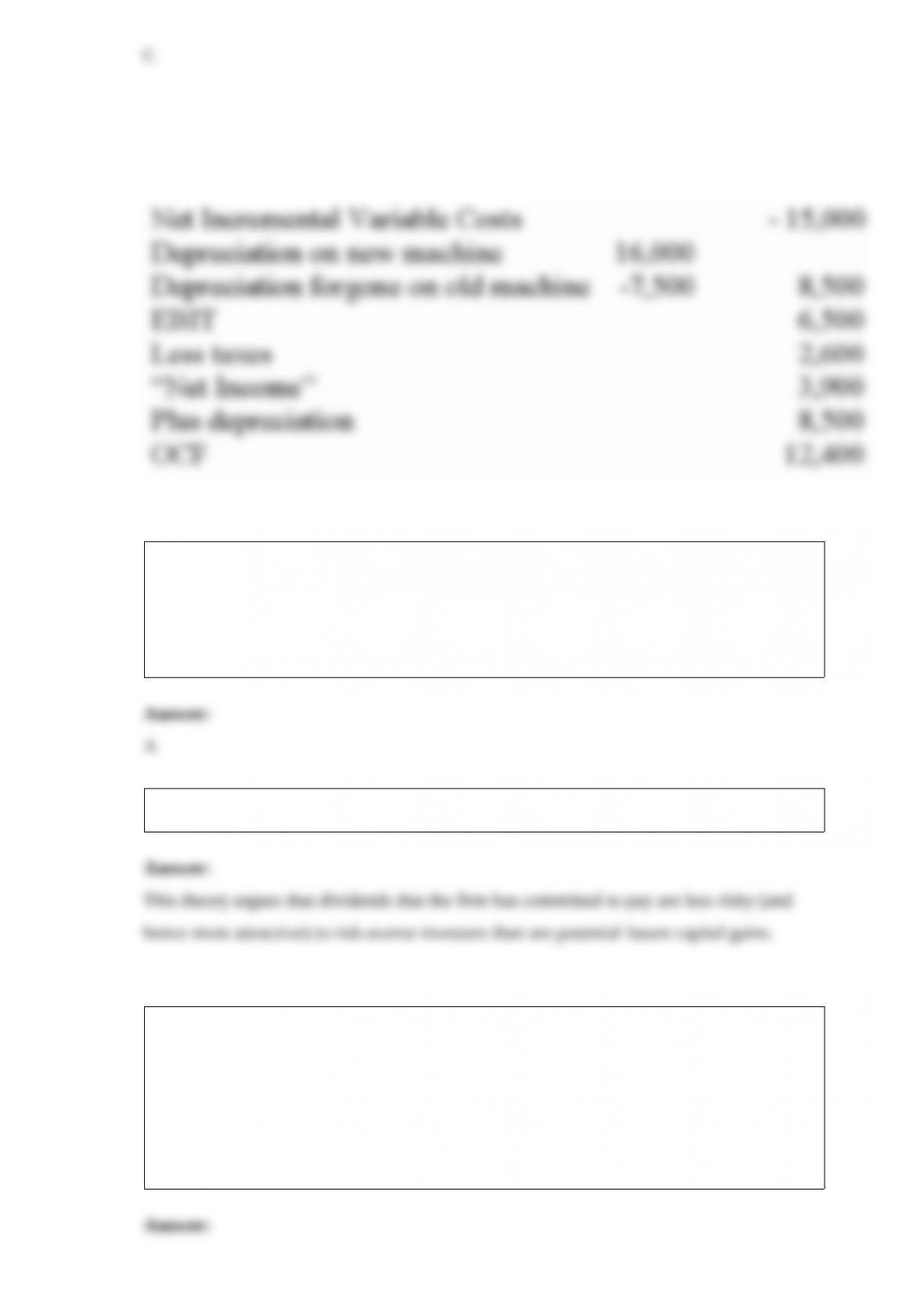
30) Your company is considering the purchase of a new machine. The original cost of
the old machine was $75,000; it is now 5 years old, and it has a current market value of
$35,000. The old machine is being depreciated over a 10-year life toward a zero
estimated salvage value on a straight-line basis, resulting in a current book value of
$37,500 and an annual depreciation expense of $7,500. The old machine can be used
for 6 more years but has no market value after its depreciable life is over. Management
is contemplating the purchase of a new machine whose cost is $80,000 and whose
estimated salvage value is zero. Expected before-tax cash savings from the new
machine are $15,000 a year over its full MACRS depreciable life. Depreciation is
computed using MACRS over a 5-year life, and the cost of capital is 15 percent.
Assume a 40 percent tax rate. What will the year 1 operating cash flow for this project
be?
A.$3,900
B.$4,480
C.$12,400
D.$16,600
31) The agency relationship in corporate finance refers to _______________________.
A.when the shareholders hire a manager to run their company
B.when the corporate hires an advertising agency to market their new product/service
C.when the board of directors are elected to staggered terms
D.when the board of directors oversee the CEO
32) Explain Gordon and Lintner’s Bird-in-the-hand theory.
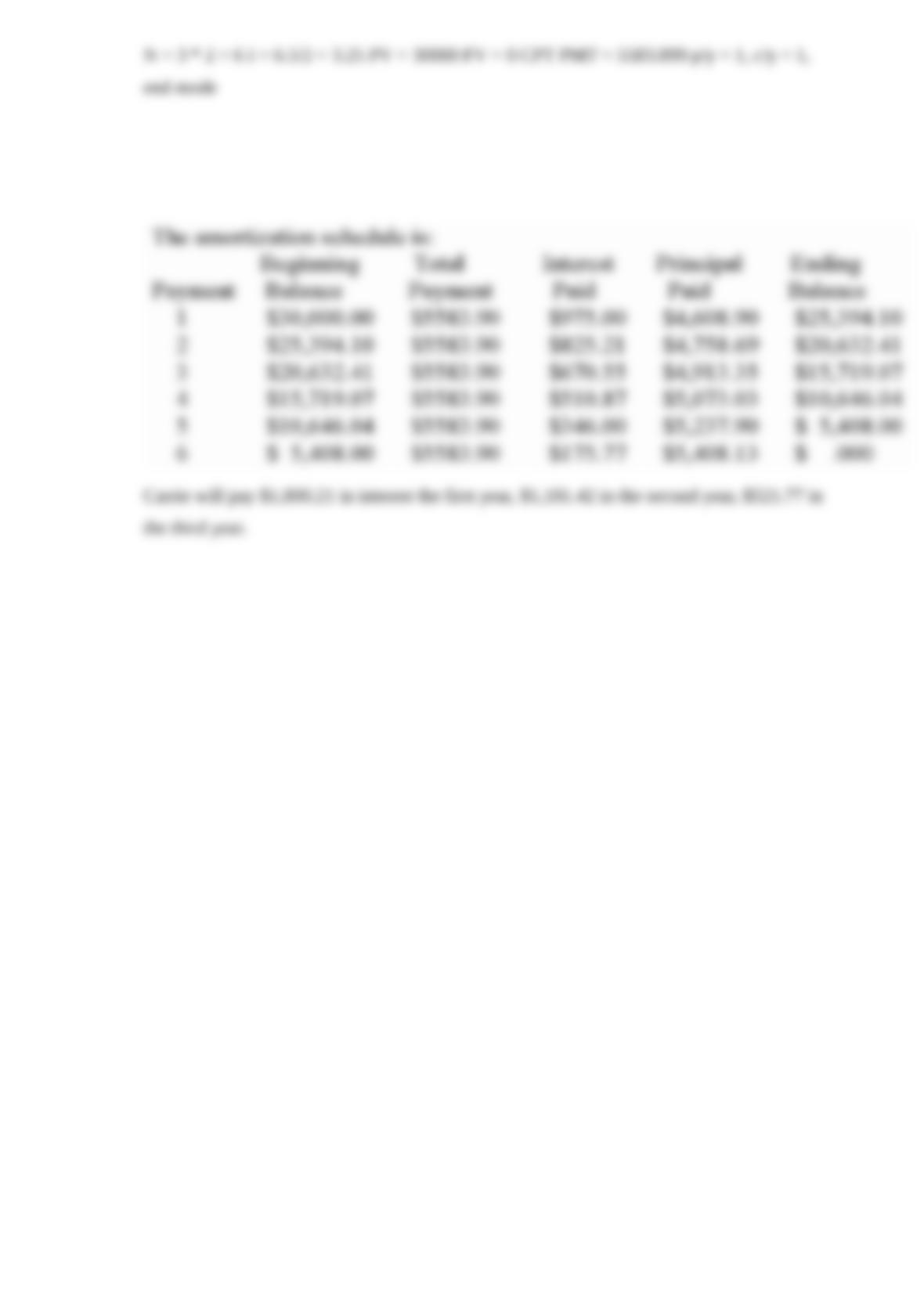
33) Annuity Payments and Amortization Schedule Consider Carrie asks Miranda to
help with her 20% down payment on her apartment. Miranda is willing to loan Carrie
$30,000, but she is requiring 6.5% interest and semi-annual payments over three years
to repay the loan. Carrie wants to deduct the loan’s interest from her taxes, and Miranda
must show the interest income on her taxes, so they need to know how much interest is
included each year in the payments. Compute the semi-annual payments and create an
amortization schedule to determine the interest paid each year.