
1) The portfolio beta is simply the sum of the betas of the individual stocks in the
portfolio.
2) Exchange-rate risk arises from the fact that the spot exchange rate on a future date is
unknown today.
3) A seasoned equity offering is the sale of additional shares by a company whose
shares are already publicly traded.
4) Common-sized balance sheets show each account as a percentage of total sales to
help analysts in comparing companies of difference sizes.
5) The future value of a 10-year ordinary annuity is twice as much as the future value of
an otherwise identical 5-year annuity.
6) The interest earned on U.S. Treasury bills is subject to state and local income taxes.
7) If a firm’s production process requires high operating leverage (use of fixed costs),
then the firm should finance its assets with debt, so that the cost of capital will be
reduced and financing costs will remain fixed.

8) Generally accepted accounting principles (GAAP) require finance statements
prepared on a cash basis because these statements are most useful for investors and
managers.
9) Arbitrage is the process of buying in one market and selling in another market in
order to make a riskless profit.
10) Leveraged b (los) are used by existing corporate bondholders to increase the rate of
return earned on their bonds.
11) Investors will be indifferent between two investments if both investments have the
same expected return.
12) Diversifying among different kinds of assets is called asset allocation.
13) Financial ratios are useful for evaluating performance but should not be used for
making financial projections.
14) Interest payments on debt are not included in a project’s incremental cash flows, but
are instead accounted for in the project’s discount rate.

15) One advantage of organized stock exchanges is increased stock price volatility
resulting from the efficient exchange of pricing information.
16) If the interest rate is positive, a six-year ordinary annuity of $500 per year must
have a present value over $3,000.
17) A corporation needing cash sells securities to investors in the secondary market.
18) Given taxes and bankruptcy costs exist, as financial increases, the weighted average
cost of capital first decreases and then increases.
19) Crandal Dockworks is undergoing a major expansion. The expansion will be
financed by issuing new 15-year, $1,000 par, 9% annual coupon bonds. The market
price of the bonds is $1,070 each. Five Rivers flotation expense on the new bonds will
be $50 per bond. Crandal’s marginal tax rate is 35%. What is the yield to maturity on
the newly-issued bonds?
A) 6.95%
B) 7.99%
C) 8.17%
D) 9.82%
20) An example of a secondary market transaction involving a capital market security is
A) a new issue of a security with a very short maturity
B) a new issue of a security with a very long maturity

C) the transfer of a previously-issued security with a very short maturity
D) the transfer of a previously-issued security with a very long maturity
21) Assume that you have $100,000 invested in a stock that is returning 14%, $150,000
invested in a stock that is returning 18%, and $200,000 invested in a stock that is
returning 15%. What is the expected return of your portfolio?
A) 13.25%
B) 14.97%
C) 15.67%
D) 15.78%
22) Bart’s Moving Company bonds have a 11% coupon rate. Interest is paid
semiannually. The bonds have a par value of $1,000 and will mature 8 years from now.
Compute the value of Bart’s Moving Company bonds if investors’ required rate of
return is 9.5%.
A) $1,197.27
B) $1,133.05
C) $1,098.99
D) $1,082.75
23) Southland Tours has net income of $2 million this year. The book value of
Southland Tours common equity is $8 million dollars. The company’s dividend payout
ratio is 60% and is expected to remain this way. What is Southland Tours’ internal
growth rate?
A) 6%
B) 9%
C) 10%
D) 15%
24) A project that requires an initial investment of $340,000 is expected to have an
after-tax cash flow of $70,000 per year for the first two years, $90,000 per year for the
next two years, and $150,000 for the fifth year? Assume the required return for this
project is 10%.

a.What is the NPV of the project%?
b.What is the IRR of the project?
c.What is the MIRR of the project?
d.What is the PI of the project?
e.What decision would you make regarding this project if the required rate of return is
10%?
f.What is the equivalent annual annuity using a 10% required rate of return?
25) Initial OutlayCash Flow in Period
1234
$4,000,000$1,546,170$1,546,170$1,546,170$1,546,170
The Internal Rate of Return (to nearest whole percent) is
A) 10%
B) 18%
C) 20%
D) 24%
26) Potential applications of the break-even model include
A) replacement for time-adjusted capital budgeting techniques
B) pricing policy
C) optimizing the cash-marketable securities position of a firm
D) all of the above
27) Table 4-2
Drummond Company
Balance Sheet
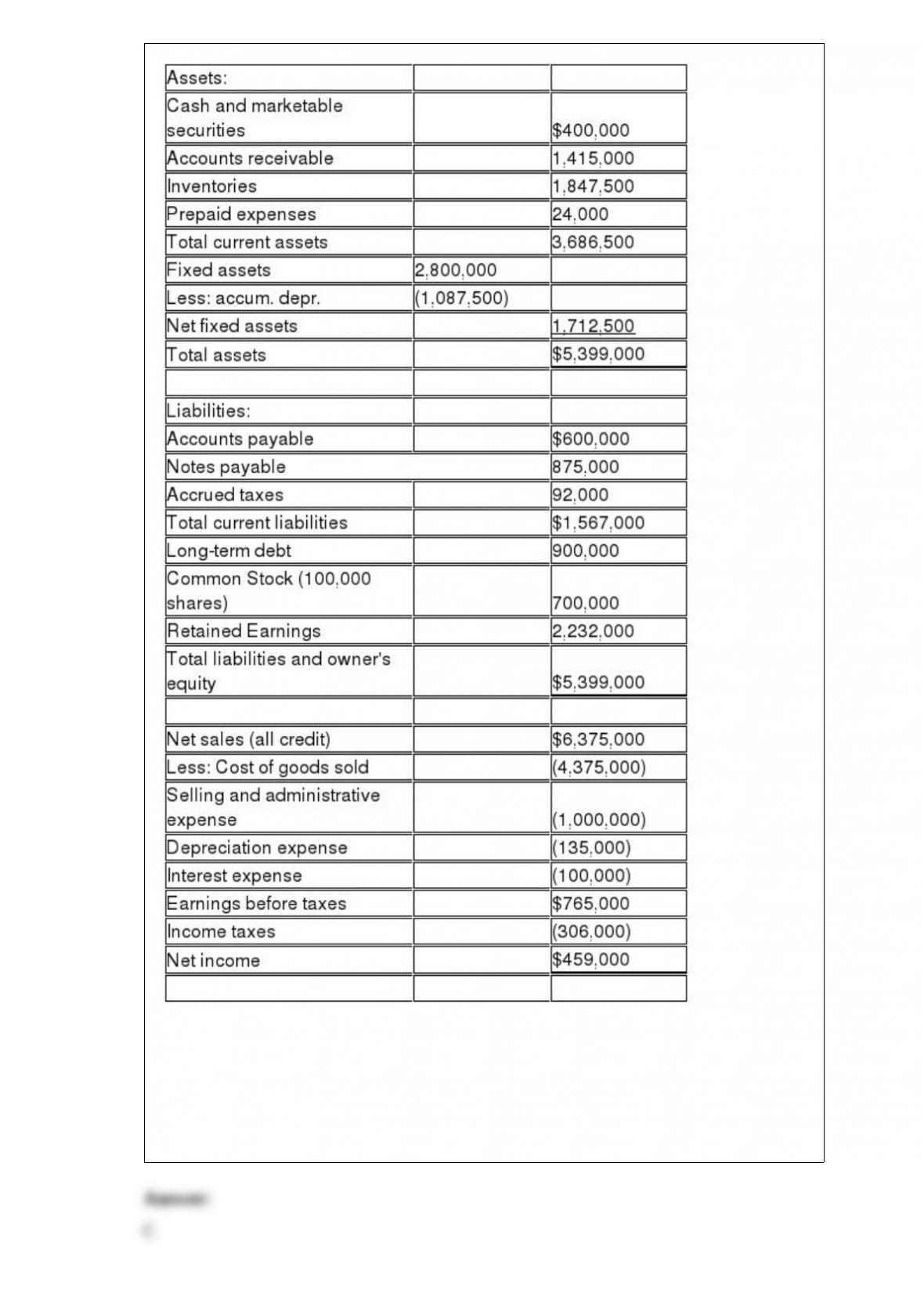
Based on the information in Table 4-2, the debt ratio is
A) 28.12%
B) 34.74%
C) 45.69%
D) 42.03%

28) Of the following EOQ model assumptions, the most limiting is
A) uniform demand
B) constant unit price
C) constant ordering costs
D) independent orders
29) Which of the following accounts does NOT belong on the asset side of a balance
sheet?
A) accounts receivable
B) accumulated depreciation
C) cash
D) accruals
30) Advantages of using simulation include
A) adjustment for risk in the resulting distribution of net present values
B) a range of possible outcomes presented
C) is good only for single period investments since discounting is not possible
D) graphically displays all possible outcomes of the investment
31) Which of the following accounts belongs in the equity section of a balance sheet?
A) retained earnings
B) cash
C) long-term debt
D) dividends
32) California Retailing Inc. has sales of $4,000,000; the firm’s cost of goods sold is
$2,500,000; and its total operating expenses are $600,000. The firm’s interest expense is
$250,000, and the corporate tax rate is 40%. The firm paid dividends to preferred
stockholders of $40,000, and the firm distributed $60,000 in dividend payments to
common stockholders. What is California Retailing’s “Addition to Retained Earnings”?
A) $650,000
B) $390,000
C) $330,000

D) $290,000
33) LPD Logistics, Inc.’s projected sales for the first six months of 2010 are given
below.
Jan.$300,000April$350,000
Feb.$350,000May$500,000
Mar.$475,000June$400,000
20% of sales are collected in the month of the sale, 75% are collected in the month
following the sale, and 5% are written off as uncollectible. Cost of goods sold is 80% of
sales. Purchases are made the month prior to the sales and are paid during the month the
purchases are made (i.e. goods sold in March are bought and paid for in February).
Total other cash expenses are $35,000/month. The company’s cash balance as of
February 1, 2010 will be $30,000. Excess cash will be used to retire short-term
borrowing (if any). LPD has no short term borrowing as of February 28, 2010. Assume
that the interest rate on short-term borrowing is 1% per month. The company must have
a minimum cash balance of $20,000 at the beginning of each month. What is LPD’s
projected total disbursements for April?
A) $422,918
B) $435,686
C) $398,833
D) $375,655
34) A wildcat oil driller has enough capital to invest in only one project, that is, to drill
one well in an East Texas oil field. A major oil company is drilling 100 wells in the
same field. The probability of successfully striking oil is 10% for any well drilled in this
field. Which of the following statements is MOST correct concerning the risk involved
in these capital budgeting projects?
A) The risk for the wildcat driller is the same as the risk for the major oil company
since they are both drilling in the same oil field
B) The appropriate risk for the wildcat driller is systematic risk
C) The appropriate risk for the major oil company is contribution-to-firm risk, if all
shareholders of the firm are well diversified
D) The best measure of risk for the wildcat oil driller is project standing alone risk
35) Brown Inc. needs to borrow $250,000 for the next 6 months. The company has a
line of credit with a bank that allows the company to borrow funds with an 8% interest
rate subject to a 20% of loan compensating balance. Currently, Brown Inc. has no funds

on deposit with the bank and will need the loan to cover the compensating balance as
well as their other financing needs. How much will Brown Inc. need to borrow?
A) $270,000
B) $300,000
C) $312,500
D) $347,222
36) All of the following are potential disadvantages of short-term debt EXCEPT
A) short-term debt must be paid back more quickly than long-term debt
B) uncertainty of interest costs because short-term debt must be replaced often
C) a greater risk of illiquidity than long-term debt
D) short-term debt generally has a higher interest cost than long-term debt
37) Money market instruments include
A) common stock
B) preferred stock
C) T-bonds
D) T-bills
38) An analyst is evaluating two companies, A and B. Company A has a debt ratio of
50% and Company B has a debt ratio of 25%. In his report, the analyst is concerned
about Company B’s debt level, but not about Company A’s debt level. Which of the
following would best explain this position?
A) Company B has much higher operating income than Company A
B) Company A has a lower times interest earned ratio and thus the analyst is not
worried about the amount of debt
C) Company B has a higher operating return on assets than Company A, but Company
A has a higher return on equity than Company B
D) Company B has more total assets than Company A
39) The balance sheet for the Long Drive Golf Company on September 30, 2010 is
presented below:
Long Drive Golf Company Balance Sheet
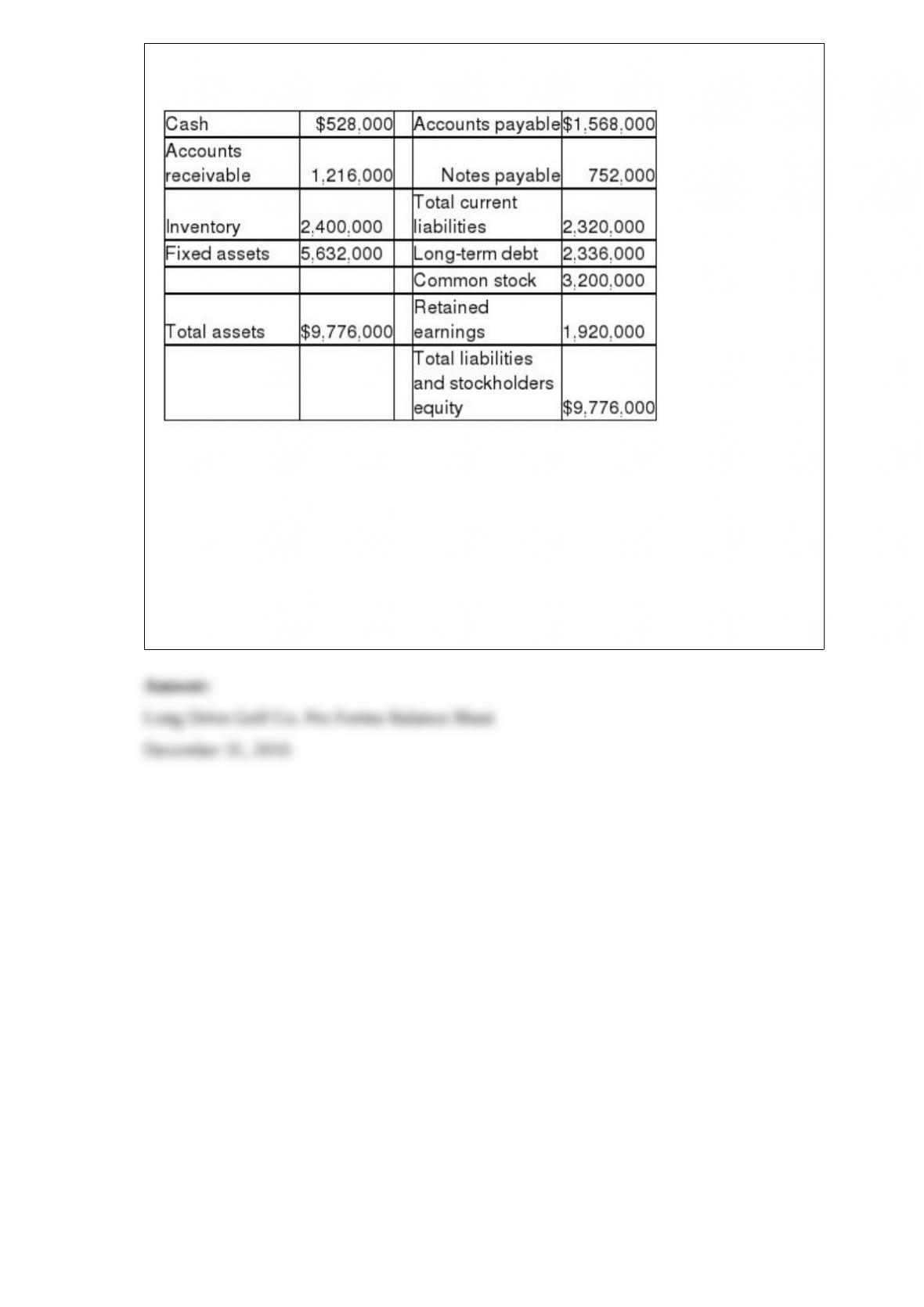
September 30, 2010
The treasurer of the firm wants to issue $1,200,000 in long-term bonds to be used as
follows:
1>$240,000 to reduce accounts payable
2>$192,000 to retire notes payable
3>$128,000 to increase cash on hand
4>$640,000 to increase inventories
a.Assuming that the loan is obtained, construct a pro forma balance sheet for December
31, 2010, for Long Drive Golf Company that reflects the use of the funds provided.
b.Was the liquidity of Long Drive Golf Company improved by the loan?
40) All of the following are found in the cash budget EXCEPT
A) a net change in cash for the period
B) accounts receivable
C) cash disbursements
D) new financing needed
41) Finance theory suggests that the current market value of a bond is based upon
which of the following?
A) the future value of interest paid on a bond
B) the sum total of principal and interest paid on a bond
C) the sum of the present value of the bond’s interest payments and the present value of
the principal
D) the present value of a bond’s par value plus the future value of the bond’s present
value

42) Marley Financial plans to sell $50,000,000 of 120-day commercial paper, on which
it expects to pay discounted interest at a rate of 5% per year. Dealer fees are expected to
be $30,000. The effective cost of credit to Marley Financial is
A) 5.27%
B) 5.64%
C) 6.22%
D) 7.53%
43) The optimal capital structure is the funds mix that will
A) minimize the use of debt
B) achieve an equal proportion of debt, preferred stock, and common equity
C) minimize the firm’s composite cost of capital
D) maximize total leverage
44) One method of accounting for systematic risk for a project involves identifying a
publicly traded firm that is engaged in the same business as that project and using its
required rate of return to evaluate the project. This method is referred to as
A) the accounting beta method
B) scenario analysis
C) the pure play method
D) sensitivity analysis
45) In which of the following cases will the agency problem between shareholders and
managers be the greatest?
A) 100% of the common stock is owned by the founder of the company who decided to
retire and hired a manager to run his business for him
B) The Johnson family owns 50% of the common stock of the company. The other 50%
is owned by 5 mutual funds
C) The common stock of the company is owned by many diverse shareholders, with no
shareholder owning more than 1% of the outstanding stock
D) All top managers in the company own significant amounts of stock and stock
options

46) Plato Industries’ projected sales for the first six months of 2012 are given below:
Jan.$250,000April$300,000
Feb.$340,000May$350,000
Mar.$280,000June$380,000
20% of sales are collected in cash at time of sale, 50% are collected in the month
following the sale, and the remaining 30% are collected in the second month following
the sale. Cost of goods sold is 85% of sales. Purchases are made in the month prior to
the sales, and payments for purchases are made in the month of the sale. Total other
cash expenses are $70,000/month. The company’s cash balance as of February 28, 2012
will be $10,000. Excess cash will be used to retire short-term borrowing (if any). Plato
has no short term borrowing as of February 28, 2012. Ignore any interest on short-term
borrowing. The company must have a minimum cash balance of $40,000 at the
beginning of each month. Plato’s projected EBIT for March 2012?
A) $42,000
B) $23,000
C) ($28,000)
D) ($60,000)
47) Waterfront Solutions, Inc. paid a dividend of $5.00 per share on its common stock
yesterday. Dividends are expected to grow at a constant rate of 4% for the next two
years, at which point the stock is expected to sell for $56.00. If investors require a rate
of return on Waterfront’s common stock of 18%, what should the stock sell for today?
A) $50.22
B) $48.51
C) $44.76
D) $40.22
48) Insurance companies invest in the “long-end” of the securities market by purchasing
securities with longer maturities. In which of the following instruments would an
insurance company be least likely to invest most of its assets?
A) corporate stocks
B) corporate bonds
C) mortgages
D) commercial paper

49) Which of the following is NOT an advantage of trade credit?
A) The amount of extended credit expands and contracts with the needs of the firm
B) The cost of forgoing the discount is less than the prime rate
C) Generally no formal agreements are involved in the extension of trade credit
D) Trade credit is very flexible