
Which one of the following terms applies to the costs incurred by a firm that is trying to
avoid filing for bankruptcy?
A. Indirect bankruptcy costs
B. Direct bankruptcy costs
C. Static theory cost
D. Optimal capital structure cost
E. Reorganization costs
Answer:
Mark is analyzing a proposed project to determine how changes in the variable costs
per unit would affect the project’s net present value. What type of analysis is Mark
conducting?
A. Sensitivity analysis
B. Erosion planning
C. Scenario analysis
D. Benefit-cost analysis
E. Opportunity cost analysis
Answer:

Changes in interest rates affect bond prices. Which one of the following compensates
bond investors for this risk?
A. Taxability risk premium
B. Default risk premium
C. Interest rate risk premium
D. Real rate of return
E. Bond premium
Answer:
Which one of the following is the hypothesis that securities markets are efficient?
A. Geometric market hypothesis
B. Standard deviation hypothesis
C. Efficient markets hypothesis
D. Capital market hypothesis
E. Financial markets hypothesis
Answer:
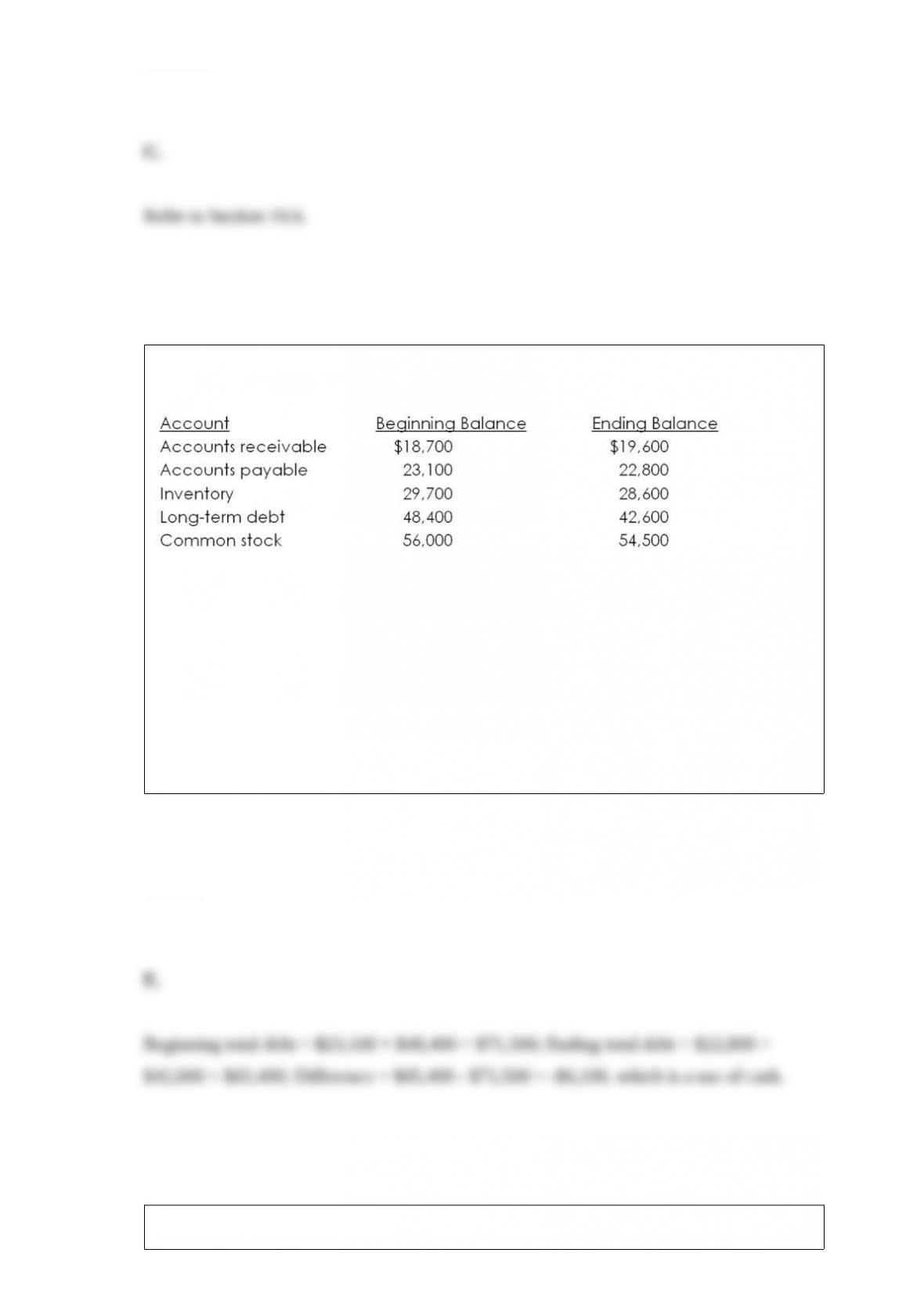
A firm has the following account balances. Which one of the following statements is
correct concerning those balances?
A. Accounts receivable is a $900 source of cash.
B. Common stock is a $1,500 source of cash.
C. Net working capital, excluding cash, is a $1,500 use of cash.
D. Long-term debt is a $5,800 source of cash.
E. Total debt is a $6,100 use of cash.
Answer:
You just won $50,000 and deposited your winnings into an account that pays 5.5

percent interest, compounded annually. How long will you have to wait until your
winnings are worth $100,000?
A. 11.24 years
B. 12.00 years
C. 12.29 years
D. 12.67 years
E. 12.95 years
Answer:
Use the following tax table to answer this question:
The Holiday Inn earned $177,284 in taxable income for the year. How much tax does
the company owe on this income?
A. $46,311.02
B. $48,490.76
C. $52,390.76
D. $59,998.81
E. $65,240.76
Answer:
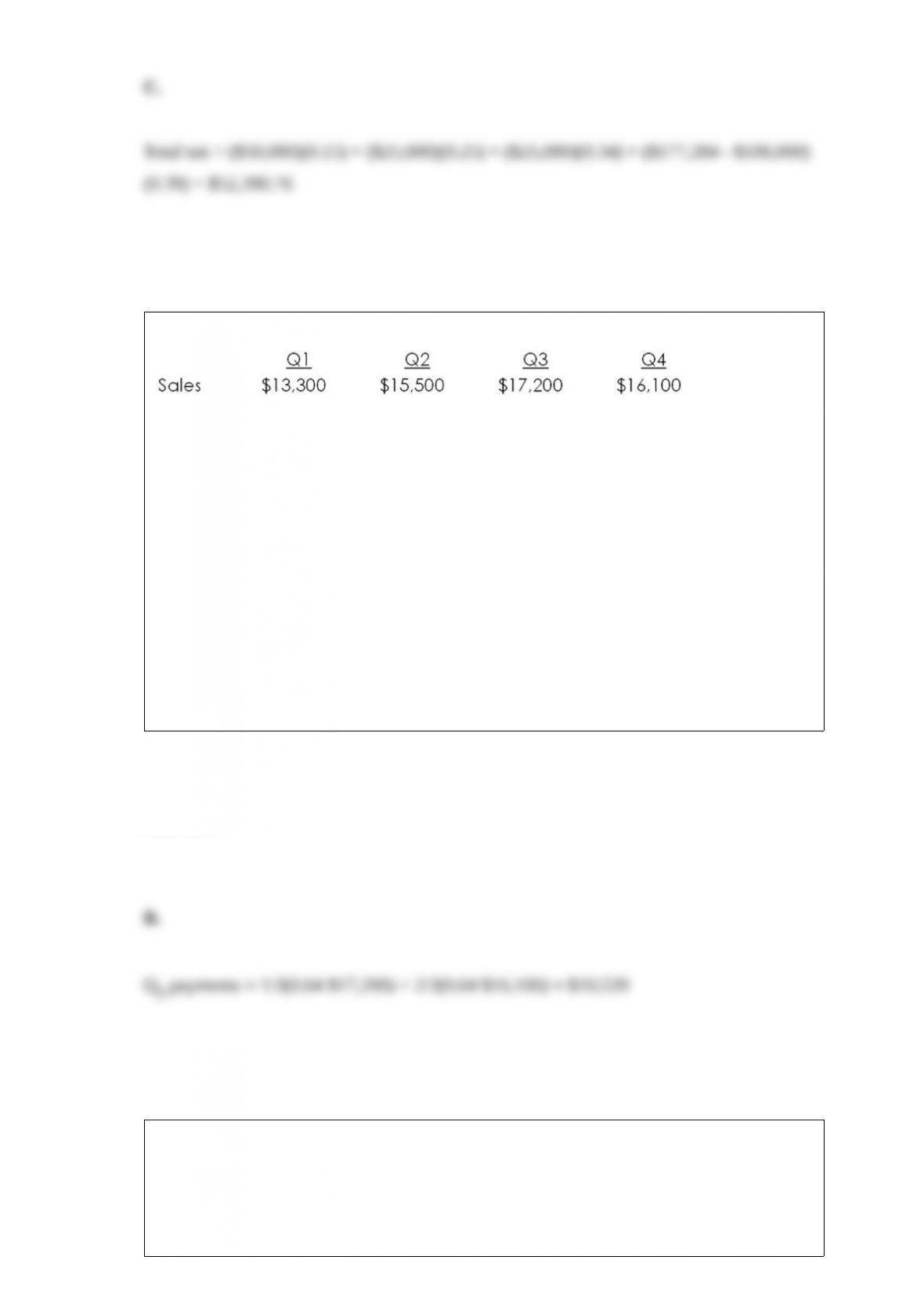
Joseph Schmidt and Co. has the following estimated sales.
Purchases are equal to 64 percent of the following quarter’s sales. What is the cash
outlay for accounts payable for quarter 3 if the firm has a 30-day accounts payable
period? Assume each month has 30 days.
A. $9,938
B. $10,539
C. $3,488
D. $6,977
E. $7,503
Answer:
You are considering an investment for which you require a 14 percent rate of return.
The investment costs $61,900 and will produce cash inflows of $26,000 for three years.
Should you accept this project based on its internal rate of return? Why or why not?
A. Yes, because the IRR is 12.51 percent

B. Yes, because the IRR is 13.65 percent
C. Yes, because the IRR is 13.67 percent
D. No, because the IRR is 12.51 percent
E. No, because the IRR is 13.65 percent
Answer:
Lawler’s is considering a new project. The company has a debt-equity ratio of 0.72. The
company’s cost of equity is 15.1 percent, and the aftertax cost of debt is 7.2 percent.
The firm feels that the project is riskier than the company as a whole and that it should
use an adjustment factor of +3 percent. What is the WACC it should use for the project?
A. 12.53 percent
B. 12.98 percent
C. 14.79 percent
D. 15.14 percent
E. 15.68 percent
Answer:

The owner of a trading license who trades on the floor of the NYSE for his or her
personal account is called a(n):
A. DMM.
B. independent broker.
C. floor trader.
D. stand-alone agent.
E. dealer.
Answer:
Over the period of 1926-2011:
A. the risk premium on large-company stocks was greater than the risk premium on
small- company stocks.
B. U.S. Treasury bills had a risk premium that was just slightly over 2 percent.
C. the risk premium on long-term government bonds was zero percent.
D. the risk premium on stocks exceeded the risk premium on bonds.
E. U. S. Treasury bills had a negative risk premium.

Answer:
A new financial services company just opened in your town. To attract customers, it is
offering a “9-11” loan special. The company will lend $9 today in exchange for a
payment of $11 one year from today. What is the APR on this loan?
A. 20.00 percent
B. 20.76 percent
C. 21.84 percent
D. 22.22 percent
E. 23.08 percent
Answer:
Which one of the following situations is most apt to create an agency conflict?
A. Compensating a manager based on his or her division’s net income
B. Giving all employees a bonus if a certain level of efficiency is maintained

C. Hiring an independent consultant to study the operating efficiency of the firm
D. Rejecting a profitable project to protect employee jobs
E. Selling an underproducing segment of the firm
Answer:
You own a portfolio that has $1,900 invested in Stock A and $2,700 invested in Stock
B. If the expected returns on these stocks are 9 percent and 15 percent, respectively,
what is the expected return on the portfolio?
A. 10.57 percent
B. 11.14 percent
C. 11.96 percent
D. 12.52 percent
E. 13.07 percent
Answer:

Will and Bill both enjoy sunshine, water, and surfboards. Thus, the two friends decided
to create a business together renting surfboards, paddle boats, and inflatable devices in
California. Will and Bill will equally share in the decision making and in the profits or
losses. Which type of business did they create if they both have full personal liability
for the firm’s debts?
A. Sole proprietorship
B. Limited partnership
C. Corporation
D. Joint stock company
E. General partnership
Answer: