1) Higher interest rates tend to increase the growth of an economy and increase the
demand for an MNC’s products.
2) Although MNCs may need to convert currencies occasionally, they do not face any
exchange rate risk, as exchange rates are stable over time.
3) If the Fed decides to weaken the dollar utilizing unsterilized intervention, it should
be aware that this action may backfire because it will increase money supply and thus
increase inflation.
4) Since yield curves are identical across countries, MNCs rarely consider them when
deciding on the maturity of bonds denominated in a foreign currency.
5) A speculator in futures contracts expecting the value of a foreign currency to
depreciate would likely sell futures contracts.
6) An international acquisition may be preferable to the establishment of a new
subsidiary because the firm can immediately expand its international business and
benefit from existing customer relationships.
7) U.S. firms can attempt to hedge their translation exposure of their European
subsidiaries with a forward purchase of euros.

8) In an open account transaction, the exporter ships the goods to the importer but
retains title to the goods until they have been sold.
9) The supply curve for a currency is downward sloping since U.S. corporations would
be encouraged to purchase more foreign goods when the foreign currency is worth less.
10) An irrevocable L/C obligates the issuing bank to honor all drawings presented in
conformity with the terms of the L/C.
11) The establishment of the euro allows for more consistent economic conditions
across countries but eliminates the power of any individual European country to solve
local economic problems with its own unique monetary policy.
12) The J curve effect is the initial worsening of the U.S. trade balance due to a
weakening dollar because of established trade relationships that are not easily changed;
as the dollar weakens, the dollar value of imports initially rises before the U.S. trade
balance is improved.
13) Assume the Fed desires to strengthen the dollar. If it buys dollars and
simultaneously buys Treasury securities, this is an example of sterilized intervention.
14) Margin is used in the forward market to mitigate default risk.
15) If the international Fisher effect (IFE) holds, the local investors are expected to earn
the same return from investing internationally as they would from investing in their
local markets.
16) For locational arbitrage to be possible, one bank’s ask rate must be higher than
another bank’s bid rate for a currency.
17) A regression analysis of the Australian dollar value on the inflation differential
between the U.S. and Australia produced a coefficient of .8. Thus, for every 1%
increase in the inflation differential, the Australian dollar is expected to depreciate by .
8%.
18) The valuation of an MNC is reduced if the required return on its investments in
foreign countries is reduced.
19) Hewitt Bank quotes a value for the Japanese yen () of $0.007, and a value for the
Canadian Dollar (C$) of $0.821. The cross exchange rate quoted by the bank for the
Canadian dollar is 118.00. You have $5,000 to conduct triangular arbitrage. How much
will you end up with if you conduct triangular arbitrage?
a.$6,053.27
b.$5,030.45
c.$6,090.13
d.Triangular arbitrage is not possible in this case

20) When you own ____, there is no obligation on your part; however, when you own
____, there is an obligation on your part.
a.call options; put options
b.futures contracts; call options
c.forward contracts; futures contracts
d.put options; forward contracts
21) Which of the following is not true regarding futures contracts?
a.Unlike forward contracts, they are generally traded on an exchange
b.Futures contracts are standardized with respect to delivery date and size of the
contract
c.There is an active over-the-counter market for currency futures contracts
d.Currency futures can be used by speculators who attempt to profit from exchange rate
movements
22) ____ is (are) a limitation of hedging translation exposure.
a.Inaccurate earnings forecasts
b.Inadequate forward contracts for some currencies
c.Accounting distortions
d.Increased transaction exposure
e.All of the above
23) The least risky method by which firms conduct international business is:
a.Franchising
b.The acquisitions of existing operations
c.International Trade
d.The establishment of new subsidiaries
e.Licensing
24) If speculators expect the spot rate of the Canadian dollar in 30 days to be ____ than
the 30-day forward rate on Canadian dollars, they will ____ Canadian dollars forward
and put ____ pressure on the Canadian dollar forward rate.
a.lower; sell; upward

b.lower; sell; downward
c.higher; sell; upward
d.higher; sell; downward
25) Which of the following is true?
a.Some countries may prohibit netting
b.Some countries may prohibit forms of leading and lagging
c.A and B
d.None of the above
26) If you have a position where you might be obligated to buy Euros, you are:
a.a call writer
b.a put writer
c.a put buyer
d.a futures seller
27) Which of the following is an example of triangular arbitrage initiation?
a.Buying a currency at one bank’s ask and selling at another bank’s bid, which is higher
than the former bank’s ask
b.Buying Singapore dollars from a bank (quoted at $0.55) that has quoted the South
African rand (ZAR)/Singapore dollar (S$) exchange rate at ZAR2.50 when the spot rate
for the South African rand is $0.20
c.Buying Singapore dollars from a bank (quoted at $0.55) that has quoted the South
African rand/Singapore dollar exchange rate at ZAR3.00 when the spot rate for the
South African rand is $0.20
d.Converting funds to a foreign currency and investing the funds overseas
28) According to the text, MNCs can:
a.use only debt financing in foreign countries to support foreign subsidiaries
b.use only equity financing in foreign countries to support foreign subsidiaries
c.use only parent financing in foreign countries to support foreign subsidiaries
d.none of the above
29) Subsidiary A of Mega Corporation has net inflows in Australian dollars of
A$1,000,000, while Subsidiary B has net outflows in Australian dollars of A$1,500,000.
The expected exchange rate of the Australian dollar is $.55. What is the net inflow or
outflow as measured in U.S. dollars?
a.$500,000 outflow
b.$500,000 inflow
c.$275,000 inflow
d.$275,000 outflow
30) Which of the following are true about the Southeast Asian currency crisis?
a.It was preceded by several years of large capital inflows to Asia
b.It was preceded by a five-year recession in Asia
c.Asian interest rates declined during the crisis
d.Asian exchange rates were pegged to the Japanese yen to resolve the crisis
31) A high home inflation rate relative to other countries would ____ the home
country’s current account balance, other things equal. A high growth in the home
income level relative to other countries would ____ the home country’s current account
balance, other things equal.
a.increase; increase
b.increase; decrease
c.decrease; decrease
d.decrease; increase
32) If a U.S. firm’s expenses are more susceptible to exchange rate movements than
revenue, the firm will ____ if the dollar ____.
a.benefit; weakens
b.be unaffected; weakens
c.be unaffected; strengthens
d.benefit; strengthens

33) A weak dollar is normally expected to cause:
a.high unemployment and high inflation in the U.S
b.high unemployment and low inflation in the U.S
c.low unemployment and low inflation in the U.S
d.low unemployment and high inflation in the U.S
34) To exploit monopolistic advantages, an MNC should:
a.acquire a competitor that has controlled its local market
b.establish a subsidiary or acquire a competitor in a new market
c.establish a subsidiary in a market where tougher trade restrictions will adversely
affect the firm’s export volume
d.establish subsidiaries in markets where competitors are unable to produce the
identical product
35) Which of the following theories suggests that the percentage difference between the
forward rate and the spot rate depends on the interest rate differential between two
countries?
a.purchasing power parity (PPP)
b.triangular arbitrage
c.international Fisher effect (IFE)
d.interest rate parity (IRP)
36) The checklist approach:
a.requires several inspections of the country being evaluated
b.requires the use of discriminant analysis to assess country risk
c.requires ratings and weights to be assigned to all factors relevant in assessing country
risk
d.involves the collection of independent opinions on country risk
37) A forward rate for a currency is said to exhibit a discount if

a.the forward rate exceeds the existing spot rate
b.the forward rate is less than the existing spot rate
c.the forward rate exceeds the expected future spot rate
d.the forward rate is less than the expected future spot rate
e.none of the above
38) The demand for U.S. exports tends to increase when:
a.economic growth in foreign countries decreases
b.the currencies of foreign countries strengthen against the dollar
c.U.S. inflation rises
d.none of the above
39) A U.S. firm plans to borrow Swiss francs today for a one-year period. The Swiss
interest rate is 9%. It uses today’s spot rate as a forecast for the franc’s spot rate in one
year. The U.S. one-year interest rate is 10%. The expected effective financing rate on
Swiss francs is:
a.equal to the U.S. interest rate
b.less than the U.S. interest rate, but more than the Swiss interest rate
c.equal to the Swiss interest rate
d.less than the Swiss interest rate
e.more than the U.S. interest rate
40) Economic exposure can affect:
a.MNCs only
b.purely domestic firms only
c.A and B
d.none of the above
41) Which of the following is not a limitation of fundamental forecasting?
a.uncertain timing of impact
b.forecasts are needed for factors that have a lagged impact
c.omission of other relevant factors from the model
d.possible change in sensitivity of the forecasted variable to each factor over time
e.none of the above
42) Assume that Mill Corporation, a U.S.-based MNC, has applied the following
regression model to estimate the sensitivity of its cash flows to exchange rate
movements:
PCFt = a0 + a1et + mt
where the term on the left-hand side is the percentage change in inflation-adjusted cash
flows measured in the firm’s home currency over period t, and et is the percentage
change in the exchange rate of the currency over period t. The regression model
estimates a coefficient of a1 of 2. This indicates that:
a.if the foreign currency appreciates by 1%, Mill’s cash flows will decline by 2%
b.if the foreign currency appreciates by 1%, Mill’s cash flows will decline by .2%
c.if the foreign currency depreciates by 1%, Mill’s cash flows will increase by 2%
d.if the foreign currency depreciates by 1%, Mill’s cash flows will decline by 2%
e.none of the above
43) International trade:
a.is a relatively conservative approach to foreign market penetration
b.entails minimal risk
c.does not require large amount of investment
d.all of the above
44) Johnson, Inc., a U.S.-based MNC, will need 10 million Thai baht on August 1. It is
now May 1. Johnson has negotiated a non-deliverable forward contract with its bank.
The reference rate is the baht’s closing exchange rate (in $) quoted by Thailand’s central
bank in 90 days. The baht’s spot rate today is $.02. If the rate quoted by Thailand’s
central bank on August 1 is $.022, Johnson will ____ $____.
a.pay; 20,000
b.be paid; 20,000
c.pay; 2,000
d.be paid; 2,000
e.none of the above
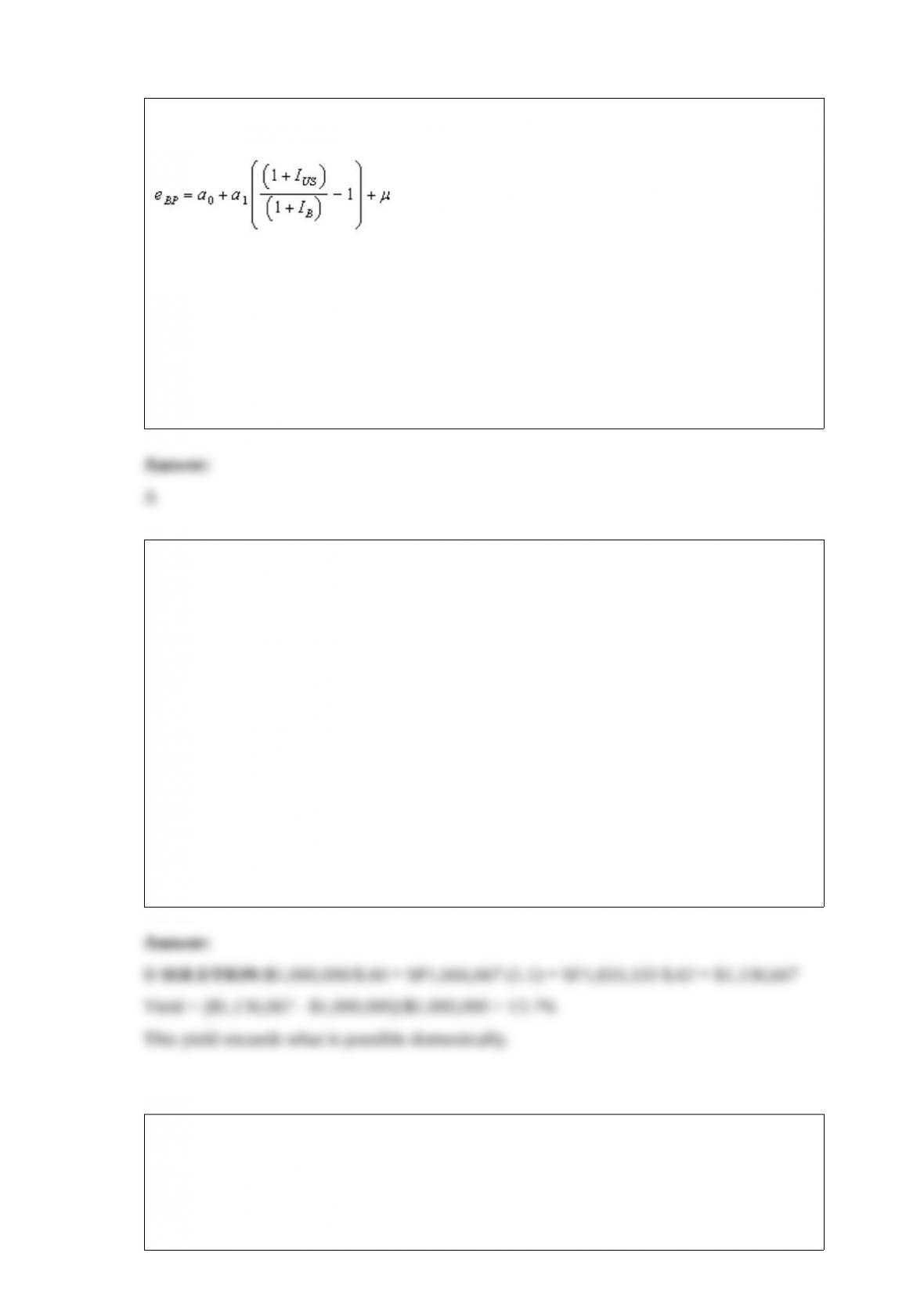
45) The following regression analysis was conducted for the inflation rate information
and exchange rate of the British pound:
Regression results indicate that a0 = 0 and a1 = 1. Therefore:
a.purchasing power parity holds
b.purchasing power parity overestimated the exchange rate change during the period
under examination
c.purchasing power parity underestimated the exchange rate change during the period
under examination
d.purchasing power parity will overestimate the exchange rate change of the British
pound in the future
46) Assume the following information:
U.S. investors have $1,000,000 to invest:
1-year deposit rate offered by U.S. banks=12%
1-year deposit rate offered on Swiss francs=10%
1-year forward rate of Swiss francs=$.62
Spot rate of Swiss franc=$.60
Given this information:
a.interest rate parity exists and covered interest arbitrage by U.S. investors results in the
same yield as investing domestically
b.interest rate parity doesn’t exist and covered interest arbitrage by U.S. investors results
in a yield above what is possible domestically
c.interest rate parity exists and covered interest arbitrage by U.S. investors results in a
yield above what is possible domestically
d.interest rate parity doesn’t exist and covered interest arbitrage by U.S. investors results
in a yield below what is possible domestically
47) Which of the following does not constitute a form of direct foreign investment?
a.Franchising
b.International trade
c.Joint ventures
d.Acquisitions of existing operations

e.Establishment of new foreign subsidiaries