
Technological advances allow a firm’s earnings to grow over time because they increase
the productivity of:
a. labor.
b. capital.
c. both labor and capital.
In debt restructuring, all debt claimants must agree on the reassignment of debt claims,
but one or more claimants has an incentive to wait for a better deal. This is known as
the ______ problem.
a. holdout
b. instigation
c. concession
d. compromise
The expected returns on the debt and equity of a levered firm are rE=15% and rD=7%,
and the current market value of the debt and equity are E=66 and D=44, respectively.
What is the firm’s weighted average cost of capital (WACC)?
a. 7.8%
b. 9.8%

c. 11.8%
d. 13.8%
FORMULA: WACC=rD(D/V)+rLE(E/V)
Suppose a firm’s initial parameter values are: V=500, X=300, T=3, rf=2%,
=750, and =333.33. Compute the current values of the firm’s debt and
levered equity, D and EL, respectively.
FORMULAS: = ; EL= ;
Compute the promised yield to maturity and expected return to maturity on a
default-risky 3-year pure-discount corporate bond that has a current price of $543. With
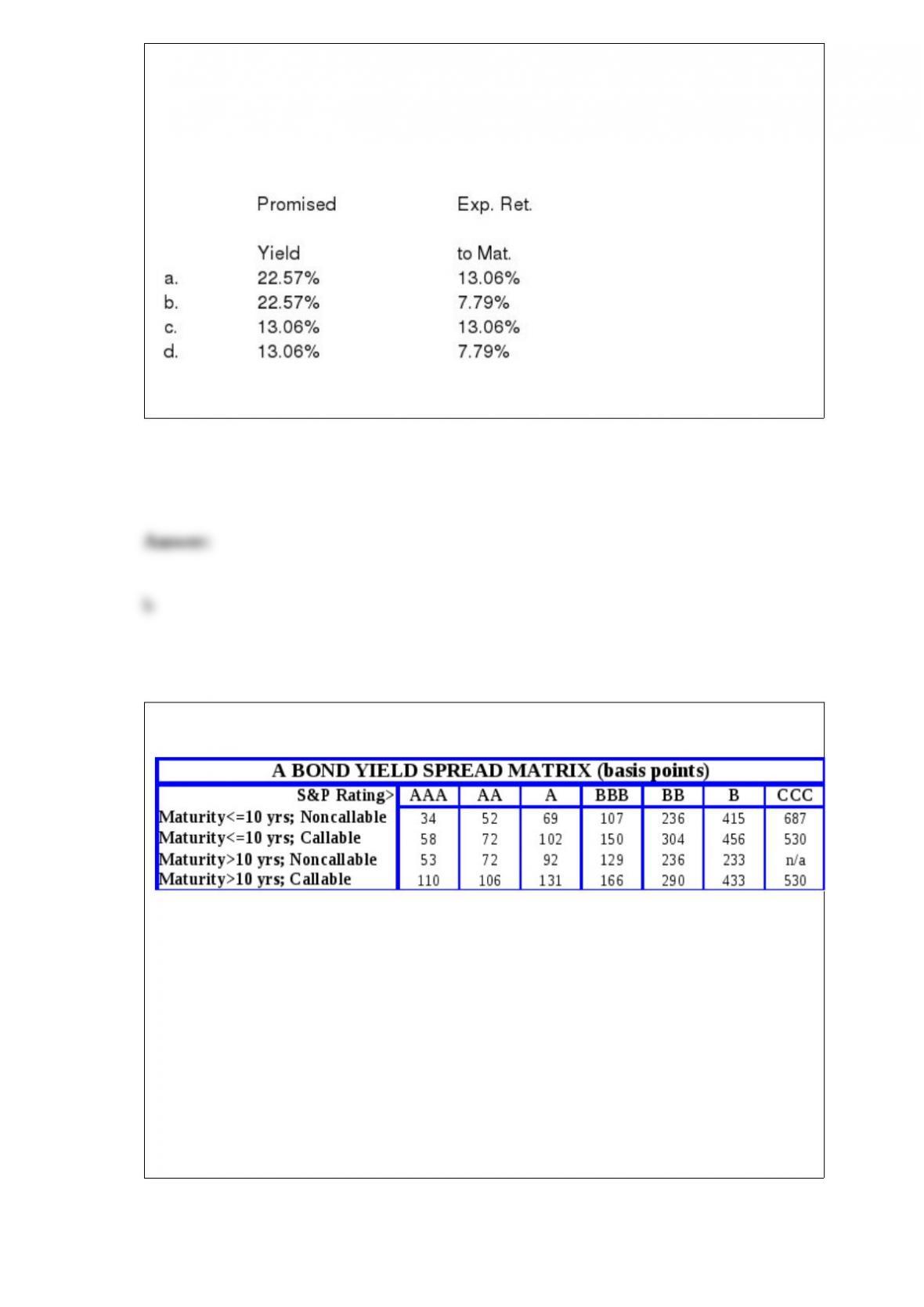
a probability of 0.6, the issuer will repay the principal of $1,000 at maturity. However,
the probability is 0.4 that the issuer will default, in which case bondholders will receive
only $200 per bond.
Promised Exp. Ret.
FORMULAS: y = [X/P]1/T“1; rD= [E(PAY)/P]1/T“1, where E(PAY)= p[X] + (1-p)[X”]
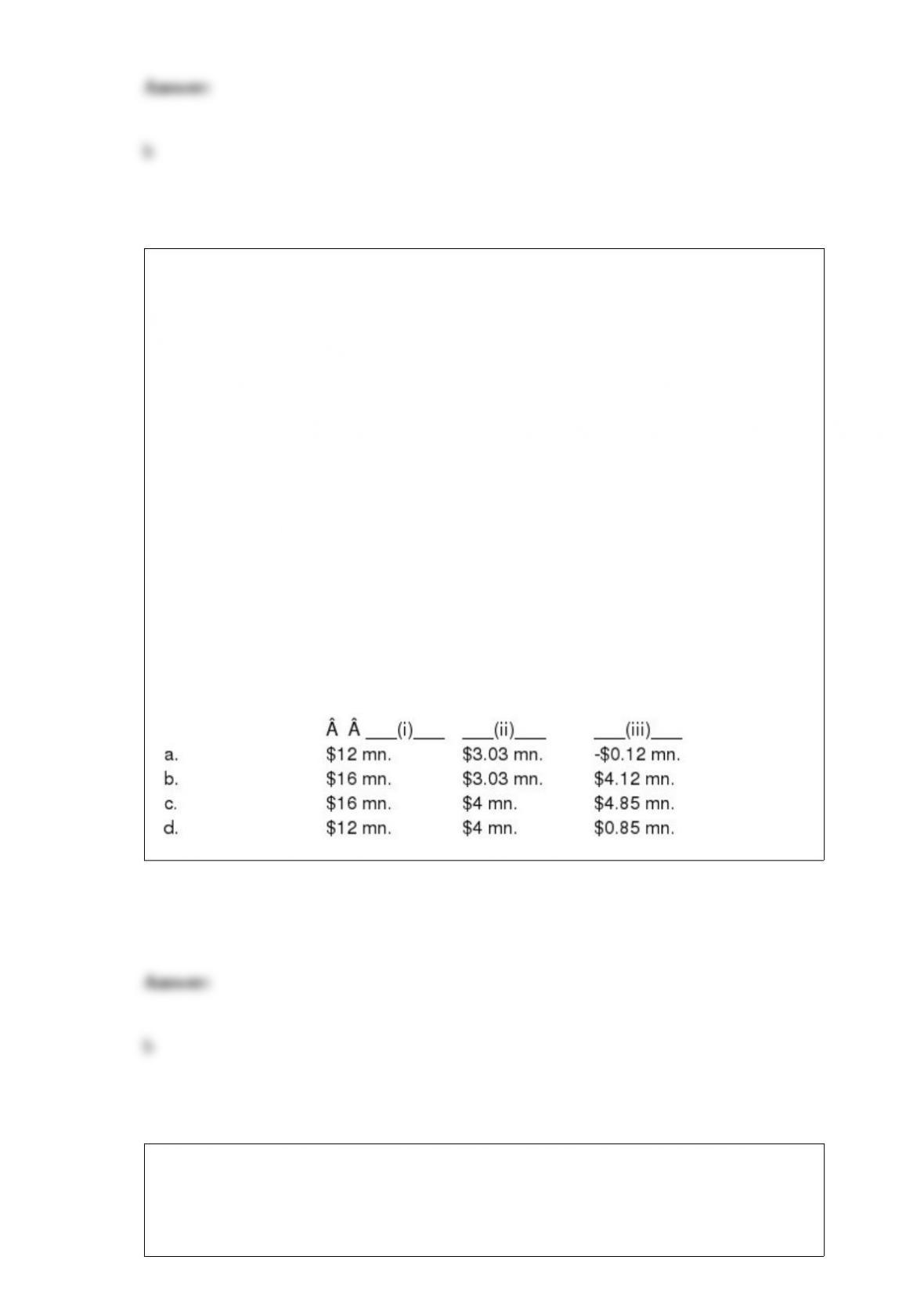
The next two problems require the bond yield spread matrix given below:
Using the bond yield spread matrix above, calculate the fair yield on a 20-year callable
corporate bond that is rated “BBB” by S&P, given also that the yield on 20-year
Treasuries is 5.55%.
a. 1.66%
b. 7.21%
c. 6.54%
d. 8.89%
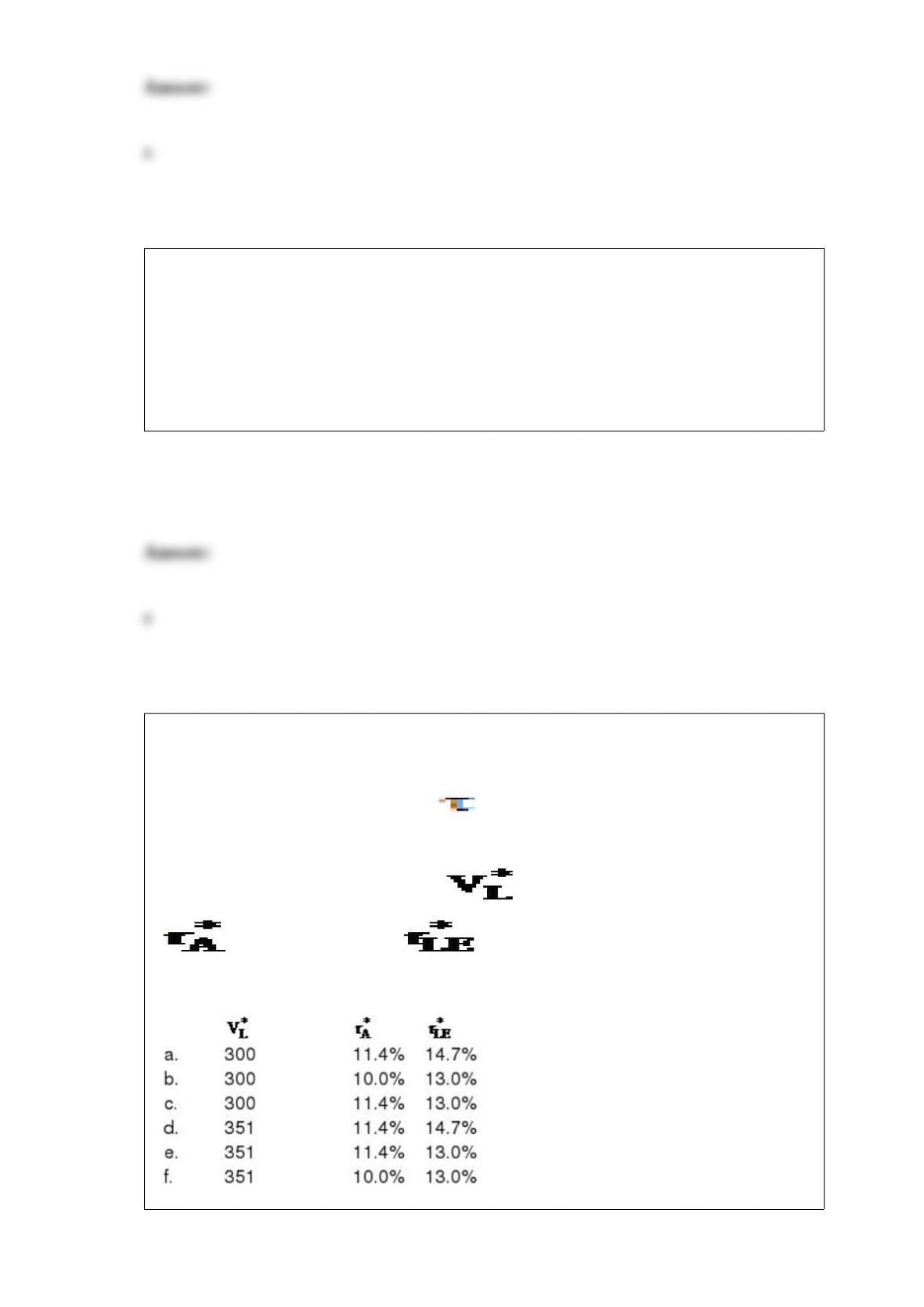
Nutrition, Inc., a vitamin supplement manufacturer, is financed entirely with equity that
is currently privately owned by its managers. The firm is expected to generate earnings
of $5 million per year into perpetuity, and all earnings are paid out in dividends. The
owner-managers receive no additional compensation. For all of the owner-managers,
their shares of the firm’s equity account for the bulk of their personal wealth. As a
result, in determining their personal valuation of the firm they apply a high discount
rate of 33% to their future expected dividends, and thus they value the firm at $15.15
mn. (=$5 mn./0.33).
The management team has recently consulted with an investment-banking firm about
selling all of the firm’s equity publicly; that is, about going public with the firm’s
shares. Assuming that the current management will continue to operate the firm, the
investment banker estimates that the market will value the firm’s equity by applying a
25% discount rate to expected future dividends. However, expected dividends to public
shareholders will be only $4 mn., because managers will now be paid a total of $1 mn.
per year in salaries. Ignoring taxes and transaction costs: the market value of the firm’s
public shares is ___(i)___; the present value of management’s salaries (discounted at
33% into perpetuity) is ___(ii)___ ; and therefore the management team’s wealth gain
(or loss) from going public is ___(iii)___.
In a _______ merger, two firms that heretofore have been competitors in the same line
of business combine.
a. conglomerate

b. vertical
c. diagonal
d. horizontal
As Akerlof argues, sellers who have a lemon, of course, know they have lemon but are
not willing to tell the truth about the condition of their auto and, for the short selling
period involved, can put their auto in a satisfactory condition that approximates the
normal condition of the auto that are not lemons. In subsequent literature, this problem
called the __________ problem.
a. informational asymmetry
b. agency
c. moral hazard
d. certification
Contract devices explicitly designed to thwart a hostile takeover attempt are called
poison pills or shark repellents. Examples include all of the following EXCEPT:
a. a shareholder rights plan that can be issued as dividends at management’s discretion.
b. an event-triggered put provision in one of the firm’s debt contracts.

c. a provision in the firm’s charter that gives incumbent management their positions for
life.
A legitimate means of averting an unintended transfer of wealth to creditors in a merger
is to:
a. decrease leverage.
b. reduce the volatility of operating profits.
c. offer a guarantee to the separate firms’ creditors.
d. increase leverage.
The _________ hypothesis is stated as follows:Among long-term assets, the firm
should finance long-term tangible assets, such as PP&E, with long-term debt, while
other long-term assets, such as investments and intangibles, must be financed with
equity.
a. tangible asset
b. debt-equity
c. collateral
d. Fisher

According to which hypothesis below, the market generally reacts favorably to an asset
sale because such sales promote efficiency by allocating assets to better uses.
a. the financing hypothesis of asset sales
b. the efficient deployment hypothesis
c. the information hypothesis
d. the fire-sales hypothesis
In Chapter 11, the court has two mechanisms to implement an optimal bankruptcy
outcome:
a. the right to extinguish any claim, and the use of a restricted auction.
b. the right to extinguish any claim, and restrictions on bargaining between claimants.
c. restrictions on bargaining between claimants, and the threat of fines.
d. restrictions on bargaining between claimants, and the use of a restricted auction.

If a gold producer wishes to employ a non-contingent hedge, it should use a(n)
___(i)___ contract, while if it wishes to employ a contingent hedge (i.e., to hedge only
down-side risk), it should use a(n) ___(ii)___ contract.
The _________ gives the bond issuer an option to redeem a specified fraction of the
bond issue within a specified period at a predetermined price, but only by using funds
from a subsequent equity offering.
a. subsequent events provision
b. clawback provision
c. contingency provision
d. conversion provision
The next two problems require the bond yield spread matrix given below:
Using the bond yield spread matrix above, calculate the fair yield on a 5-year
noncallable corporate bond that is rated “B” by S&P, given also that the yield on 5-year

Treasuries is 4.44%.
a. 4.15%
b. 6.15%
c. 8.59%
d. 10.59%
Akerlof also discusses the problem of _______ in the health insurance market. Health
insurers attempt to estimate, for each individual insurance applicant, the probability that
they will file an insurance claim, and price insurance premiums accordingly. However,
this is an imperfect process, so the insurer must offer a common premium to a specified
group of individuals that reflects the average health of the individuals in the group,
even though the individuals in the group differ in terms of their health and thus the
probability of a claim. Each individual knows their own health better than the insurer,
so those members of the group who are less healthy (and thus more likely to file a
claim) will be more likely to purchase insurance policy, and thus the premium set by the
insurer to reflect the average health of the entire group will be inadequate to
compensate the insurer for the ex post sub-group of individuals that actually purchase a
policy.
a. adverse selection
b. certification
c. moral hazard
d. informational asymmetry
A typical ______ involves a campaign among competing groups for the right to cast
shareholders’ votes on their behalf in elections for a focal firm’s board directors.
a. proxy contest
b. shareholder-initiated proposal
c. initiation procedure
d. takeover contest
The value of Jones Company as an unlevered firm is VU=300. However, Jones
Company has perpetual debt outstanding with a value of D=150. The rate on the firm’s
debt is rD=7%. The firm’s tax rate is C=34%. The firm’s expected annual
after-tax cash flow to shareholders and bondholders combined is ATCF=$40, into
perpetuity. Compute the firm’s value, , tax- adjusted cost of capital,
, and cost of equity, .

FORMULAS: = VU+ cD; = ATCF/ ;
= rD+
According to the ______ hypothesis, in an acquisition or a takeover the bidder’s
management overvalues the target because they overestimate their ability to create
value once they wrest control of the target’s assets.
a. humidor
b. hubris
c. humungous ego
d. haughty headquarters
Myers (2000) recognizes three imperfect solutions to the basic contracting problem
between diffuse shareholders and management. Which of the following is NOT one of
these solutions?
a. dividends
b. monitoring
c. incentive compensation
d. contingent shareholder intervention
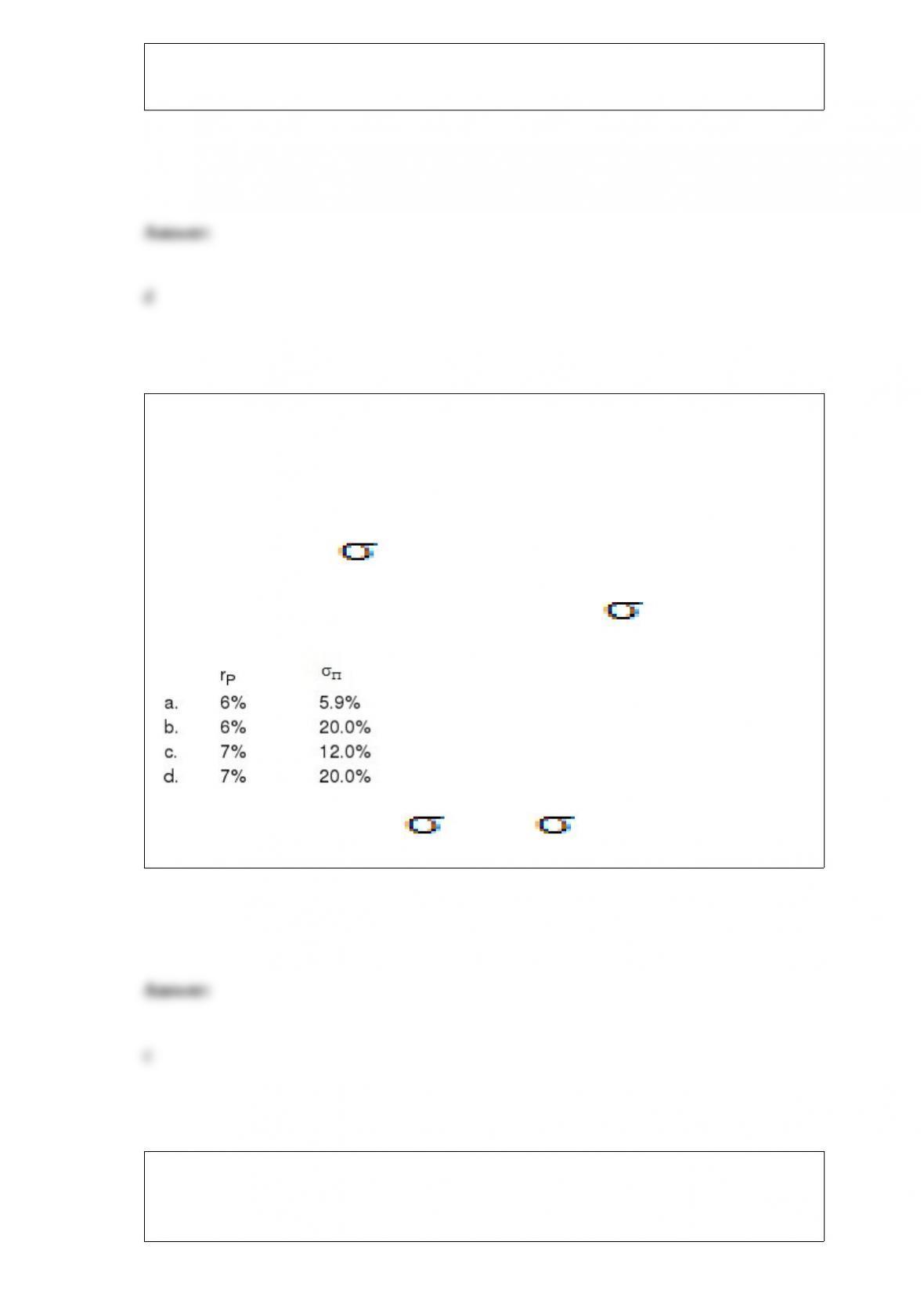
For your retirement fund, you have decided to place 40% of your contributions into a
riskfree asset that pays 4% interest per annum, and the remaining 60% of your
contributions will be placed in an available stock mutual fund that approximates the
holdings of the mythical market portfolio. You expect this fund to provide an average
return of rP=9%, but will expose you to risk, measured in terms of an estimated
standard deviation of P=20%. What is your estimate of the expected return
and standard deviation of your complete portfolio, rCand C, respectively?
FORMULAS: rc= wfrf+ wprp; c= wp p= .6(20%)=12%
Under the Securities Exchange Act of 1934, Congress created the Securities and
Exchange Commission (the “SEC”). The SEC’s mission is to administer federal
securities laws and issue rules and regulations to provide protection for investors and to

ensure that the securities markets are fair and honest. This is accomplished primarily
by:
a. creating a national system of securities brokers and dealers.
b. requiring public firms to disclose accurate and timely information to the investing
public.
c. creating a system of arbitration boards to provide judgments on investors’ complaints.
d. regulating the trading procedures in U.S. securities markets.
The probability of a callable bond being called, and thus the yield premium that
investors demand for the risk of a call, is directly related to:
a. the volatility of the bond’s yield.
b. the deferment period.
c. the call price.
Gompers (1996) argued that smaller, younger VCs often bring their firms public earlier
in order to establish a reputation and therefore attract additional capital in the future. He
refers to such self-serving behavior on the part of a VC as
a. grandstanding.

b. boasting.
c. reputation building.
d. repugnant.
Which of the following assumptions of an ideal (or perfect) capital market most closely
relates to the assumed symmetryof information set shared by all firms and all investors?
a. Capital Markets are frictionless
b. Homogeneous expectations
c. Atomistic competition
d. The firm has a fixed investment program
e. Once chosen, the firm’s financing is fixed
VCs generally take the form of a
a. limited partnership.
b. corporation.
c. proprietorship.
d. joint venture.
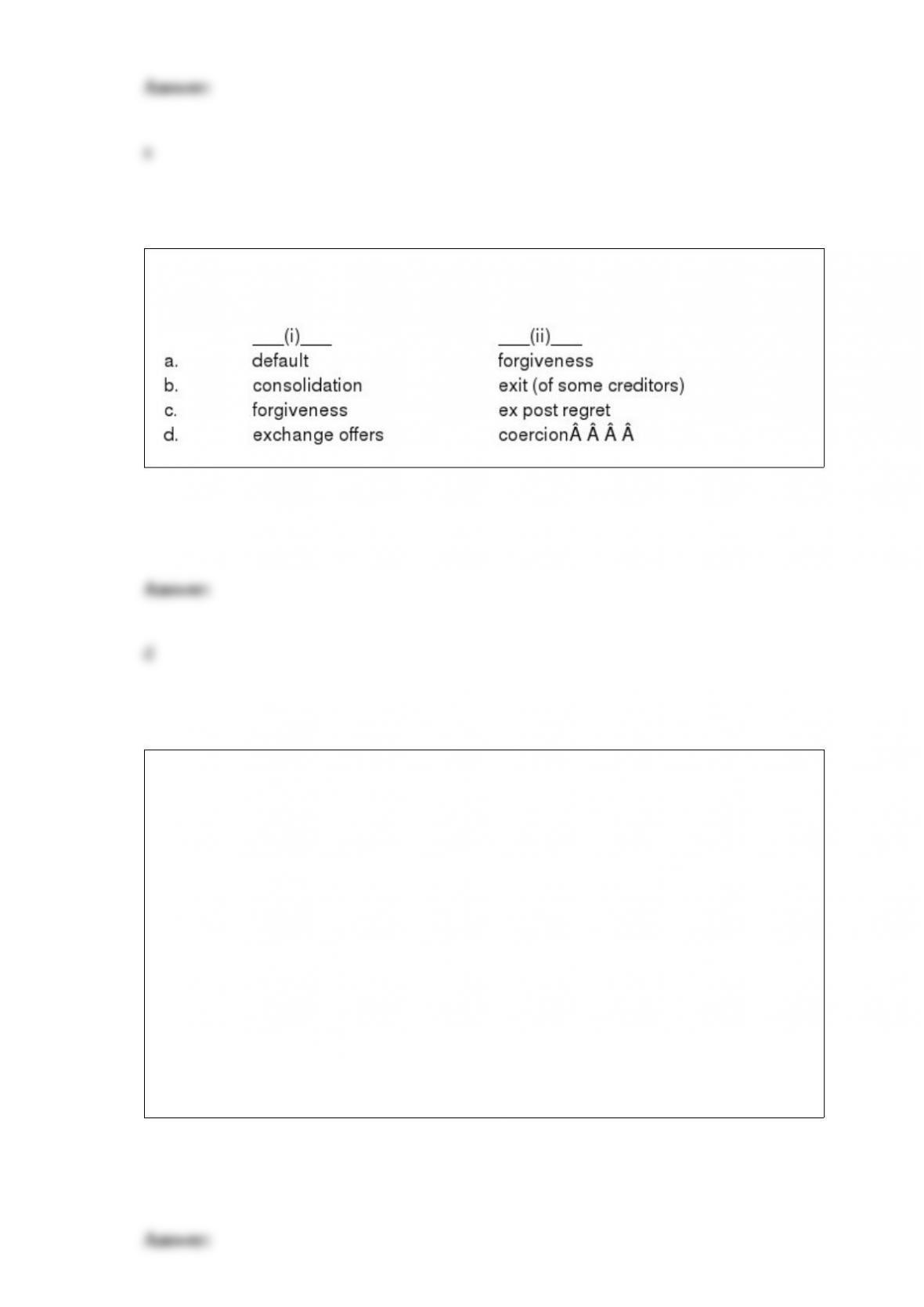
Debt restructuring is generally accomplished via a combination of ___(i)___ and
___(ii)___.
Which of the following is NOT generally considered a cost of going public?
a. Agency Costs of Managerial Discretion: Separating ownership and control leads to
such costs, though they can be mitigated with monitoring, incentive contracting, etc.
b. Information Asymmetry: Disclosure requirements may compromise the firm’s
strategic position in the industry.
c. Taxes: Public firms face higher federal and state tax rates than private firms.
d. Performance Pressures: Management will face pressure for performance from
investors, the financial press, equity research analysts, and bond rating agencies.
e. Distractions: Management is often distracted by time-consuming investor-relations
tasks, such as press releases, personal visits from or to major shareholders, etc.